


The pothole was there for weeks. Neighbors had complained, someone had even snapped a photo. Then one rainy evening your front tire dropped into it, the car swerved, and the next thing you remember is the sound of a guardrail.
Now the questions start. Who was supposed to fix that road? Can anyone actually be held accountable? And why does every answer seem to begin with the words “it depends”?
Road maintenance accident liability is one of the most confusing areas of injury law because the responsible party might be a city, a state agency, a private contractor, a utility company or even a property owner.
Each one plays by different rules, and some of those rules come with deadlines measured in weeks rather than years.
Who Is Liable for a Road Maintenance Accident?
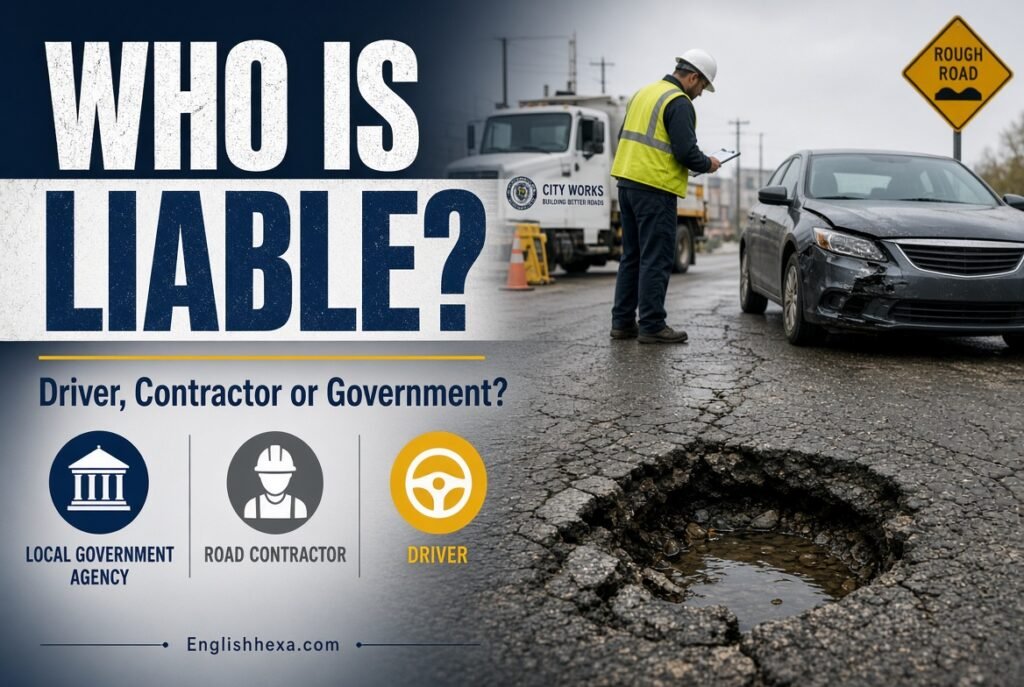
Liability usually falls on the entity that owned or controlled the road and failed to repair or warn about a known hazard. That may be a government agency, a private contractor performing road work or a private property owner.
Claims against government agencies follow special rules, including short notice-of-claim deadlines and proof that the agency knew or should have known about the defect.
Key Takeaways
- The responsible party depends on who owns, maintains or controls the road.
- Government claims often require written notice within a short window.
- Most claims turn on whether the defendant had notice of the hazard.
- Private contractors can be sued under ordinary negligence rules.
- Evidence disappears fast because hazards are repaired quickly.
- Both the driver’s own conduct and the defect can affect recovery.
What Is Road Maintenance Accident Liability?
Road maintenance accident liability is the legal responsibility a person or organization has when poor road upkeep contributes to a crash, injury or property damage. It rests on a basic idea: if you control a road, you must keep it reasonably safe or warn people about danger.
When that duty is breached and someone is harmed, the injured person may have a claim for compensation.
The Core Legal Idea
Most cases are built on negligence. The injured person must show that a duty existed, that it was breached, that the breach caused the accident and that damages resulted.
How Road Maintenance Cases Differ from Ordinary Car Crashes
In a typical crash, one driver blames another. In a road maintenance case, the claim targets the entity responsible for the condition of the road itself.
That brings in government immunity rules, notice requirements and often several possible defendants.
| Feature | Ordinary Car Crash | Road Maintenance Case |
|---|---|---|
| Typical defendant | Another driver | Government agency, contractor or property owner |
| Key issue | Driver conduct | Road condition and notice |
| Special deadlines | Standard limitation period | Often a short notice-of-claim deadline |
| Main evidence | Police report, witnesses | Maintenance records, complaints, photos of the defect |
| Immunity issues | Rare | Common for government defendants |
Who Is Responsible for Maintaining Roads?
The first step in any road maintenance accident liability case is finding out who owned or maintained the road at the exact spot of the crash. That is not always obvious.
Federal Roads
Federal agencies manage roads on federal land, such as national parks and military bases. Claims against the United States are generally handled under the Federal Tort Claims Act, which requires an administrative claim before any lawsuit.
State Roads and Highways
State departments of transportation maintain interstates, state highways and many major routes. Claims typically follow the state’s tort claims act.
County Roads
Counties and county road commissions look after rural roads and many suburban routes. Their liability usually follows state rules for local government.
City and Municipal Streets
Cities maintain local streets, sidewalks and sometimes traffic signals. They often have their own claim procedures and notice requirements.
Private Roads, Parking Lots and Driveways
Private owners, homeowners associations and businesses maintain private roads and lots. Ordinary premises liability and negligence rules usually apply.
Contractors and Subcontractors
Companies hired to repair, resurface or work on roads can be liable for their own negligence. That includes poor work zone setup and failure to restore the road safely.
Utility Companies
Utilities that dig into roads can be responsible for trenches, plates and poorly restored surfaces.
Responsibility Quick Reference
| Road Type | Usually Maintained By | Typical Rules |
|---|---|---|
| Interstate | State transportation department | State tort claims rules |
| State highway | State transportation department | State tort claims rules |
| County road | County or road commission | Local government immunity rules |
| City street | Municipality | Municipal claim and notice rules |
| Federal land road | Federal agency | Federal Tort Claims Act |
| Private road or lot | Owner or association | Premises liability |
| Work zone | Contractor and agency | Negligence and contract rules |
How to Find Out Who Maintains a Road
Check the road’s official classification on state or county map portals. A call to the local public works office or transportation department can confirm responsibility.
Ask in writing if possible, so you have a record of the answer.
Legal Theories Behind Road Maintenance Accident Claims

Several legal theories can support a claim. Which one applies depends on the facts and the defendant.
Negligence
The defendant failed to use reasonable care in maintaining or repairing the road. Examples include ignoring known potholes or leaving debris in the lane.
Dangerous Condition of Public Property
Many states allow claims when a public road is in a dangerous condition and the agency had notice. The condition must create a substantial risk to people using the road with reasonable care.
Premises Liability
When a private owner controls the road or lot, premises liability rules apply. The owner must keep the property reasonably safe or warn visitors of hidden hazards.
Negligence Per Se
When a defendant violates a safety statute or regulation designed to prevent the harm that occurred, the violation can establish negligence. Work zone safety rules are one example.
Public Nuisance
An ongoing, unreasonable hazard on a public way may be treated as a nuisance in some jurisdictions.
Product and Design Claims
In rare cases, a road design defect or defective guardrail can support claims against designers or manufacturers.
Elements You Must Prove in a Road Maintenance Claim
A successful claim has to establish several elements. Missing even one can end the case.
1. Duty of Care
The defendant owed a duty to maintain or warn about the road. This is often straightforward for the entity that owns or controls it.
2. Breach of Duty
The defendant failed to act as a reasonably careful owner or contractor would. That might mean not inspecting, not repairing or not placing warnings.
3. Notice of the Hazard
Many claims depend on proof that the defendant knew or should have known about the defect. This is often the hardest element, especially against government agencies.
4. Causation
The defect must have actually caused the accident. If the crash would have happened anyway, the claim fails.
5. Damages
The injured person must show real harm, such as injuries, medical bills, vehicle damage or lost income.
Elements Summary Table
| Element | What You Need to Show | Example Evidence |
|---|---|---|
| Duty | Defendant controlled the road | Ownership records, maintenance contracts |
| Breach | Failure to repair or warn | Inspection logs, repair history |
| Notice | Knowledge of the hazard | Complaints, prior accidents, work orders |
| Causation | Defect caused the crash | Photos, accident reconstruction |
| Damages | Losses from the crash | Medical bills, repair estimates, pay records |
The Notice Requirement: Why “They Knew” Matters
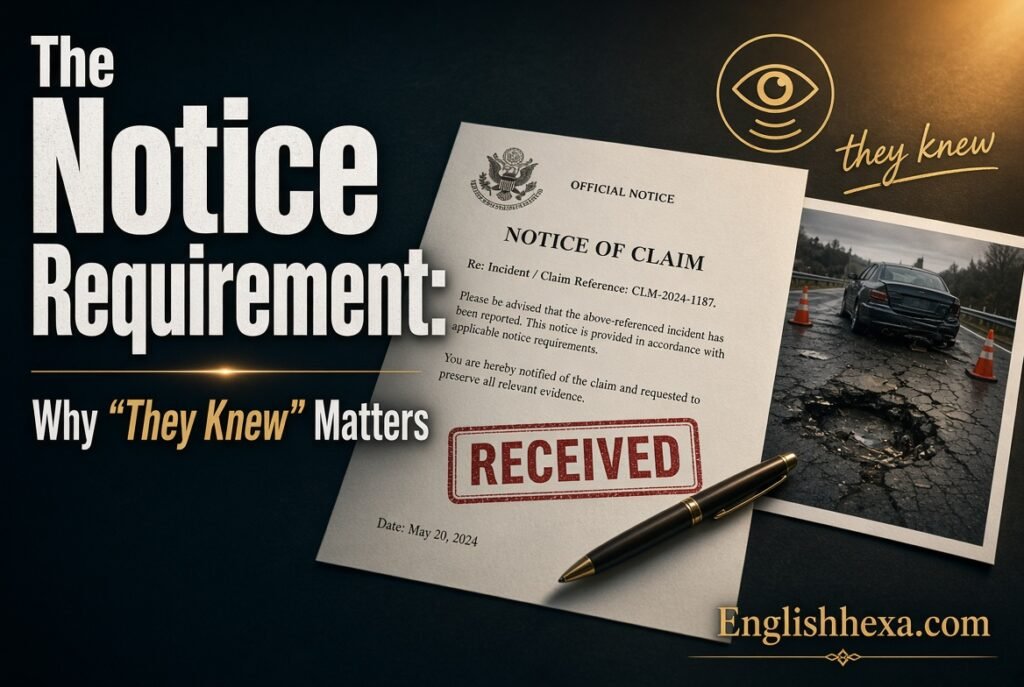
Notice is the hinge of most road maintenance accident liability cases. A defendant is rarely liable for a hazard it could not have known about.
There are two common types of notice.
Actual Notice
The defendant actually knew about the hazard. Evidence can include complaints, work orders, emails, 311 reports or earlier accident reports.
Constructive Notice
The hazard existed long enough that a reasonable inspection would have found it. A deep, visible pothole that has been there for weeks is a typical example.
Prior Written Notice
Some jurisdictions go further and require that the government received written notice of the specific defect before it can be sued. New York City is often cited as an example, where claims commonly fail without proof of prior written notice.
Michigan’s Approach as an Example
Under Michigan’s governmental tort liability act, immunity is waived for roads that are not reasonably safe because of lack of repair, but the agency must have had actual or constructive notice of the defect before the accident.
How to Show Notice
- Prior citizen complaints or 311 tickets
- Maintenance and repair records
- Inspection schedules and logs
- Earlier accidents at the same spot
- Photos showing how long a defect existed
- Statements from neighbors or workers
Sovereign Immunity and Its Exceptions
Sovereign immunity is the legal doctrine that says the government cannot be sued without its consent. Because most roads are public, it matters in almost every claim.
What Sovereign Immunity Means
Without a waiver, you cannot sue a government agency. Fortunately, every state and the federal government have passed laws that waive immunity in limited ways.
The Highway Maintenance Exception
Many states waive immunity for failure to maintain public roads. These exceptions often apply only to the traveled part of the road and not to shoulders or adjacent areas.
State Tort Claims Acts
These laws set the terms for suing state and local government. They typically define what claims are allowed, which procedures apply and sometimes cap damages.
For example, South Carolina’s Tort Claims Act requires notice within a set period, and punitive damages are generally unavailable against government defendants.
The Federal Tort Claims Act
The FTCA allows claims against the United States for negligence by federal employees. You must first file an administrative claim with the responsible agency before filing suit.
Discretionary Function Immunity
Governments are often protected when they make policy decisions, such as deciding how to allocate road budgets. They are generally not protected for simple failures to carry out routine maintenance.
Design Immunity
Some states protect governments from liability for approved road designs. Maintenance failures typically remain actionable, while design choices may be shielded.
Maintenance vs Design Defects
| Type | Meaning | Typical Liability Outlook |
|---|---|---|
| Maintenance defect | Failure to repair or keep road safe | Often actionable with notice |
| Design defect | Flaw in road plan or layout | Often protected by design immunity |
| Policy decision | Budget or planning choice | Often protected by discretionary immunity |
| Operational failure | Failure to follow routine procedures | Often actionable |
Notice-of-Claim Deadlines: A Critical Trap
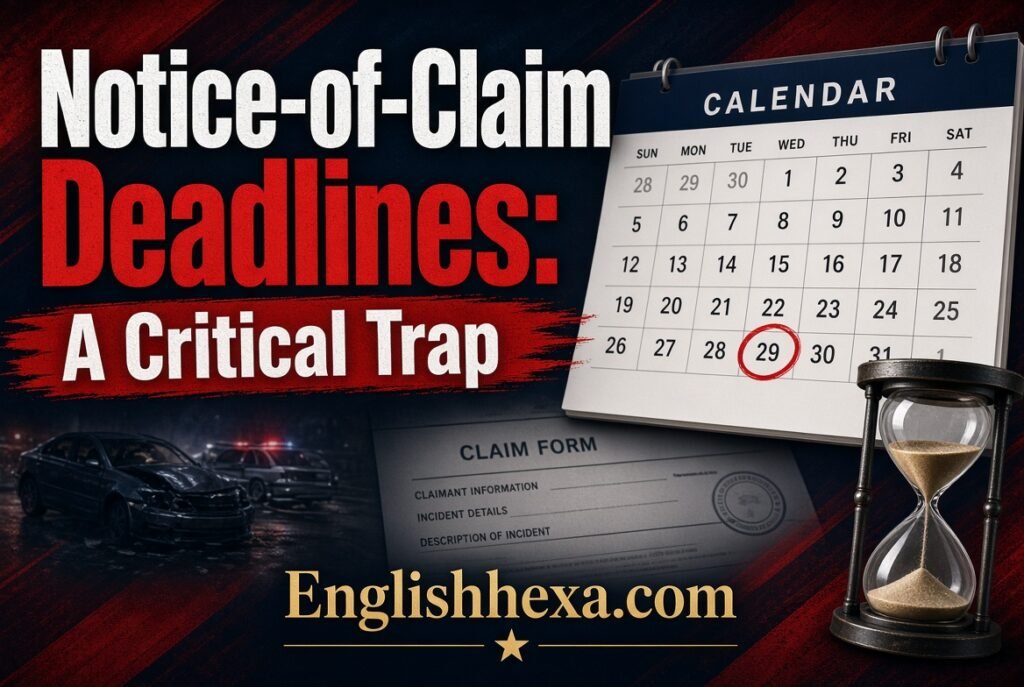
Claims against government entities often require a formal notice within a short time. Missing the deadline can end the claim even if the road was clearly defective.
The deadlines below are examples drawn from published legal guidance. They vary by state, agency and type of claim, so confirm the current rules for your location.
| Jurisdiction (Example) | Example Notice Rule |
|---|---|
| New York City | A notice of claim is commonly required within 90 days |
| South Carolina | Notice commonly required within 180 days under the Tort Claims Act |
| California | Government tort claim commonly required within six months |
| Florida | Written notice required before suit under sovereign immunity rules |
| Federal (FTCA) | Administrative claim required before suit; strict filing limits apply |
What a Notice of Claim Usually Includes
- Date, time and exact location of the accident
- A description of the defect and how it caused harm
- Names of injured people and any witnesses
- A description of injuries and damages
- Sometimes an estimate of the amount claimed
Statutes of Limitations
Ordinary negligence claims often have a limitation period of two or three years, depending on the state. For example, private contractors in New York generally face a three-year negligence limitation period.
Do not assume the ordinary deadline applies to a government claim. The notice period can be much shorter.
EOF wc -w road-maintenance-accident-liability.md### Contractor Liability in Road Work Zones
Road work creates its own risks. When a contractor is hired to repair or build a road, that company can be liable for hazards it creates.
Unlike government agencies, private contractors generally do not enjoy sovereign immunity. Ordinary negligence rules and standard limitation periods typically apply.
Common Work Zone Hazards
- Missing, hidden or confusing signs
- Poorly placed barriers and cones
- Abrupt lane shifts without warning
- Uneven pavement where lanes meet
- Open trenches or unsecured steel plates
- Loose gravel and debris
- Poor lighting at night
- Inadequate flagging
Safety Standards for Work Zones
Federal and state guidelines, including the Manual on Uniform Traffic Control Devices, set expectations for signs, markings and traffic control. A contractor that ignores these standards may be found negligent.
Who Else May Be Responsible
| Party | Possible Basis for Liability |
|---|---|
| General contractor | Overall site safety and traffic control |
| Subcontractor | Negligent work on a specific task |
| Government agency | Failure to supervise or approve safe traffic control |
| Traffic control company | Improper signs or setup |
| Utility company | Poorly restored trenches or covers |
| Engineering firm | Faulty design or inspection |
Contracts and Indemnity
Contracts between agencies and contractors may shift responsibility for road maintenance. Indemnity clauses can require a contractor to cover the agency’s losses, which affects who ultimately pays.
Common Road Hazards That Lead to Accidents
Road maintenance accident liability claims arise from many kinds of hazards. Some are more clearly actionable than others.
Potholes
Deep or sharp-edged potholes can damage tires and wheels and cause loss of control. They are the classic example of a maintenance defect.
Shoulder Drop-Offs
A sharp drop between the pavement and the shoulder can make it hard to steer back onto the road. Motorcyclists and cyclists are especially vulnerable.
Uneven Pavement and Rutting
Ruts, sunken sections and abrupt height changes can destabilize vehicles. Utility cuts that settle are a common source.
Debris and Loose Gravel
Gravel left after paving or debris not cleared from the lane can cause skids. Responsibility depends on who left it and how long it remained.
Standing Water and Poor Drainage
Clogged drains and poorly graded roads can create hydroplaning hazards. Claims often turn on whether the agency knew about recurring flooding.
Ice and Snow
Agencies are often given discretion in how they handle winter weather. Claims are harder unless the agency created a new hazard or ignored a known problem.
Missing or Damaged Signs
Fallen stop signs, missing curve warnings and obscured speed limit signs can contribute to crashes. Timely repair is part of road maintenance.
Faded Lane Markings
Worn markings reduce visibility, especially at night and in rain. Failure to repaint over long periods can be a maintenance issue.
Malfunctioning Traffic Signals
Signals stuck on one color or dark at an intersection can cause serious collisions. Responsibility depends on who maintains the signal.
Damaged Guardrails and Barriers
A missing or damaged guardrail can turn a minor run-off into a severe crash. Maintenance records are important here.
Hazard Summary Table
| Hazard | Typical Responsible Party | Key Question |
|---|---|---|
| Pothole | Agency or road owner | How long was it there? |
| Shoulder drop-off | Agency | Was the shoulder maintained? |
| Debris | Agency or contractor | Who created or ignored it? |
| Drainage problem | Agency | Was it a known recurring issue? |
| Missing sign | Agency or contractor | When was it last inspected? |
| Signal malfunction | Agency or utility | Who maintains the signal? |
| Work zone hazard | Contractor and agency | Did setup follow standards? |
| Private lot hazard | Owner | Did the owner know and fail to act? |
Weather, Driver Behavior and Comparative Fault

A road defect does not automatically mean the road owner pays everything. Defendants often argue that the driver also contributed to the crash.
Comparative Negligence
Most states reduce compensation by the injured person’s share of fault. Some bar recovery entirely if the injured person is mostly or fully at fault.
Common Defense Arguments
- The driver was speeding or distracted.
- The hazard was open and obvious.
- Weather conditions caused the crash.
- The agency did not have time to repair the defect.
- The driver failed to maintain the vehicle.
How to Counter These Arguments
Strong evidence helps. Photos, witness statements, dashcam footage and records of earlier complaints can show that the defect, not the driver, caused the crash.
Damages: What Compensation May Cover
If a claim succeeds, damages aim to cover real losses. The categories depend on the injuries and the law in your state.
| Damage Type | Examples |
|---|---|
| Medical expenses | Emergency care, surgery, therapy, medication |
| Property damage | Vehicle repair or replacement, wheel and tire damage |
| Lost income | Missed work, reduced earning capacity |
| Pain and suffering | Physical pain and emotional distress |
| Future care | Long-term treatment or rehabilitation |
| Loss of enjoyment | Inability to do activities you used to do |
| Wrongful death | Funeral costs and loss of support, available to eligible family members |
Limits on Damages Against Government
Some states cap damages or bar punitive damages against government defendants. Limits vary widely, which is another reason to check local law.
What to Do After an Accident Caused by a Road Defect
The first hours matter. Hazards are often repaired quickly, and the evidence can disappear before anyone thinks to document it.
- Get to safety and call 911. Check for injuries and move out of traffic if you can do so safely.
- Seek medical care. Some injuries appear hours or days later, and records link injuries to the crash.
- Document the hazard. Take photos and video of the defect from several angles, with a coin or tape measure for scale.
- Record the exact location. Note street names, mile markers, GPS coordinates and landmarks.
- Photograph the scene and vehicles. Capture skid marks, debris, signs and road conditions.
- Collect witness information. Get names and phone numbers of anyone who saw the crash or the hazard.
- Request a police report. Ask the officer to note the road condition.
- Preserve the vehicle and damaged parts. Do not discard torn tires or bent wheels.
- Report the hazard. Notify the responsible agency through its hotline, website or 311 so the report is on record.
- Meet the claim deadline. Find out the notice period and act quickly.
Evidence Checklist
- Photos and video of the defect
- Measurements of depth, width or drop height
- Weather and lighting conditions
- Police and incident reports
- Medical records and bills
- Repair estimates and receipts
- Witness statements
- Dashcam footage
- Requests for maintenance and inspection records
Public Records Requests
You can often request maintenance logs, complaint histories and inspection schedules from public agencies. Those records can establish notice.
Insurance and Road Maintenance Accidents
Insurance often plays a role even when a government entity may be responsible. Claim timelines can be long, so you may need coverage to move forward.
Your Own Insurance
Collision coverage can pay for vehicle damage regardless of fault, subject to your deductible. Medical payments or personal injury protection may cover injuries.
Uninsured and Underinsured Coverage
In some cases, uninsured motorist coverage can apply when no insured driver is at fault. Policy terms vary.
Subrogation
If your insurer pays and a government agency or contractor is at fault, the insurer may seek reimbursement. Tell your insurer about the hazard promptly.
Contractor and Agency Insurance
Contractors usually carry liability insurance. Government entities may self-insure or use risk pools, and claims go through formal procedures.
How to File a Claim Against a Government Agency
Each agency has its own process. Follow the instructions exactly, since technical mistakes can derail a valid claim.
- Identify the responsible agency. Confirm who maintains the road at the accident location.
- Find the claim form and rules. Check the agency or state website for forms and deadlines.
- Prepare the notice. Include date, location, description, injuries and damages.
- Send it correctly. Use the delivery method required, often certified mail or in-person delivery.
- Keep proof of delivery. Save receipts, tracking numbers and copies.
- Wait for a response. Agencies often have a set period to accept or deny.
- Consider next steps. If denied, a lawsuit may be possible within a limited window.
Why Road Maintenance Claims Are Denied
Many claims fail for predictable reasons. Knowing them helps you avoid mistakes.
- The notice deadline was missed.
- The agency lacked actual or constructive notice.
- The defect was on the shoulder or outside the covered area.
- The agency had immunity for the decision at issue.
- Evidence of the defect was lost.
- The driver was found mostly at fault.
- The road was privately owned and the wrong party was named.
- The injury or damage was not clearly caused by the defect.
Special Situations
Some cases raise extra issues. Knowing the differences helps you ask the right questions.
Motorcyclists and Cyclists
Small hazards that a car can absorb can throw a two-wheeled rider off balance. Shoulder drop-offs, gravel and uneven seams are frequent causes.
Pedestrians
Cracked, raised or missing sidewalk sections can cause falls. Sidewalk responsibility sometimes belongs to the adjacent property owner rather than the city.
Commercial Drivers and Trucking
Commercial vehicles can be affected by lane widths, weight-restricted bridges and poorly marked work zones. Federal and state rules may add complexity.
Rideshare and Delivery Drivers
Insurance coverage may depend on whether the driver was on a trip. Report the road hazard and the accident promptly to all insurers involved.
Tourists and Out-of-State Drivers
You may be bound by the law of the state where the crash happened, including its notice deadlines. Do not assume your home state’s rules apply.
How Agencies Can Reduce Road Maintenance Liability
Road owners and contractors can reduce risk and protect the public through consistent practices. Good habits also help in court.
Routine Inspection and Records
Documented inspections show that the agency acted reasonably. Missing records can suggest neglect.
Prompt Repair of Known Hazards
Prioritizing high-risk defects such as deep potholes and missing signs reduces crashes and claims.
Complaint Systems
Tracking citizen reports and responding within a set time helps prevent repeat problems.
Proper Work Zone Management
Following traffic control standards, using trained flaggers and inspecting setups regularly lower the risk for contractors.
Temporary Warnings
When repair cannot happen immediately, warning signs, cones and barricades protect drivers and show reasonable care.
Maintenance Best Practices Table
| Practice | Benefit |
|---|---|
| Scheduled inspections | Finds defects early |
| Written logs | Shows reasonable care |
| Rapid response to complaints | Reduces notice-based liability |
| Standardized traffic control | Prevents work zone crashes |
| Contractor oversight | Ensures quality and compliance |
| Public reporting tools | Increases hazard detection |
How to Report a Dangerous Road Condition
Reporting hazards protects other drivers and creates a record that can help later. It takes only a few minutes.
- Call the local public works or transportation department.
- Use the agency’s website or mobile app.
- Dial 311 where available.
- Provide the exact location and a photo if possible.
- Save the confirmation number or email.
- Follow up if the hazard remains.
Working with an Attorney
Road maintenance claims can be complex because of immunity rules and short deadlines. Many injury attorneys offer free consultations, and some work on contingency, meaning they are paid only if you recover.
When to Consider Legal Help
- You were seriously injured or a loved one died.
- The defendant is a government agency or contractor.
- Several parties may share responsibility.
- The agency or insurer denied your claim.
- You are unsure about notice deadlines.
Questions to Ask a Lawyer
- Have you handled road defect or government liability cases?
- What notice deadlines apply to my case?
- Who are the likely defendants?
- What evidence should I preserve?
- What are the costs and fee arrangements?
What to Bring to a Consultation
Bring your photos, police report, medical records, insurance information and any communications with the agency. The more complete your file, the more useful the meeting will be.
Common Mistakes to Avoid
Small errors can damage a claim. These are the ones that come up again and again.
Waiting Too Long
Hazards are repaired and deadlines pass quickly. Start documenting and researching immediately.
Assuming Ordinary Deadlines Apply
Government claims often have much shorter notice periods. Confirm the rule for your jurisdiction.
Not Documenting the Defect
Without photos and measurements, it is hard to prove what the road looked like. Capture the scene before repairs happen.
Giving Recorded Statements Without Advice
Insurance adjusters may ask for statements. Consider speaking with an attorney first, especially in serious cases.
Naming the Wrong Defendant
Suing the city when the state owns the road wastes time and may bar the claim. Confirm ownership early.
Posting on Social Media
Public posts can be used against you. Avoid discussing the accident or your injuries online.
Also Read
- Food Manufacturing ERP Software: The Complete Buyer’s Guide for US Producers 2026
- Photography Business Visibility: How to Get Found, Trusted, and Booked in the US 2026
- Product Demo Video: How to Create One That Turns Viewers Into Customers 2026
- Digital Infusing Aggr8Tech Guide and Key Insights
- GFXRobotection AI Software by GFXMaker: A Complete Guide to Features, Uses & How It Works
Frequently Asked Questions (FAQs)
Who is liable for a road maintenance accident?
Liability usually rests with the entity that owned or controlled the road and failed to repair or warn about a known hazard. That may be a government agency, a contractor or a private owner.
Can I sue the city for a pothole accident?
Often yes, but special rules apply. Many states allow claims for poorly maintained roads, though you must usually give timely notice and show the city knew or should have known about the pothole.
What is sovereign immunity in road accident cases?
It is the doctrine that protects the government from lawsuits without its consent. States and the federal government have waived it in limited ways, including for some road maintenance failures.
What does notice of the defect mean?
Notice means the defendant knew, or reasonably should have known, about the hazard before the crash. It can be actual, such as a complaint, or constructive, such as a defect that existed for a long time.
What is prior written notice?
Some jurisdictions require proof that the government received written notice of the specific defect before it can be sued. Without it, claims can fail even if the road was dangerous.
How long do I have to file a claim against the government?
It varies widely. Examples include 90 days in New York City, 180 days in South Carolina and six months in California, so confirm the rule for your location immediately.
Is the deadline the same as the normal statute of limitations?
No. The notice-of-claim deadline is often much shorter than the ordinary limitation period, which is commonly two or three years.
Can I sue a road construction contractor?
Yes. Private contractors generally lack sovereign immunity and can be sued under ordinary negligence rules if their work created a hazard.
Who is responsible for work zone accidents?
Possible defendants include the general contractor, subcontractors, the traffic control company and the agency that approved the plan. The facts decide who is at fault.
Can a utility company be liable for road damage?
Yes. Utilities that dig into roads can be responsible for trenches, plates and poor restoration that cause crashes.
What if the road is private?
Private owners and associations are generally subject to premises liability rules. They must keep the property reasonably safe or warn visitors of hidden hazards.
Does the shoulder count as part of the road?
Not always. Some states limit claims to the traveled portion of the road, so a defect on the shoulder may be treated differently.
What evidence should I collect after a road defect crash?
Collect photos and video of the defect, measurements, location details, witness information, the police report, medical records and repair estimates. Request maintenance records as soon as possible.
Should I report the road hazard?
Yes. Reporting it to the agency creates a record and helps protect others. Save the confirmation number.
Can I recover damages for vehicle damage only?
Possibly. Property damage claims exist, though thresholds, procedures and immunity rules vary. Your collision coverage may also help.
What damages can I recover in a road maintenance claim?
Damages may include medical expenses, property damage, lost income, pain and suffering and future care. Limits and caps depend on state law.
Are there caps on damages against the government?
In some states, yes. Many also bar punitive damages against government defendants.
What if I was partly at fault for the crash?
Most states reduce recovery by your share of fault. Some bar recovery if you are mostly or entirely at fault.
Is the government liable for ice and snow?
Often it has more protection for winter weather decisions. Claims are harder unless the agency created a new hazard or ignored a known problem.
Can motorcyclists and cyclists bring road defect claims?
Yes. Small hazards like gravel, shoulder drop-offs and uneven pavement are especially dangerous for two-wheeled riders and can support claims.
What is the difference between a design defect and a maintenance defect?
A design defect is a flaw in the road’s plan or layout and may be protected by design immunity. A maintenance defect is a failure to keep the road safe and is often actionable with notice.
Do I need a lawyer for a road maintenance accident claim?
Not always, but serious injuries, government defendants and short deadlines make legal advice valuable. Many attorneys offer free consultations.
Why was my road defect claim denied?
Common reasons include a missed deadline, lack of notice, immunity, lost evidence, the wrong defendant or the driver’s own fault.
Can I request maintenance records from the government?
Often yes through public records requests. Logs, complaint histories and inspection schedules can help establish notice.
Conclusion:
Road maintenance accident liability depends on a few core questions. Who controlled the road, did that party know about the hazard and did the defect actually cause the crash?
Government claims add notice rules and deadlines that can be as short as a few months, so speed matters. Document the scene, preserve evidence, report the hazard and confirm the claim procedure for your state right away.
Every case turns on its own facts and local law, so consider speaking with a licensed attorney in your state before making decisions. This article is general information, not legal advice.

Dilawar Mughal is an SEO expert with 8 years of hands-on experience helping websites grow their organic traffic, rankings, and revenue. He specializes in content-driven SEO, local SEO, and Pinterest SEO, and builds practical, results-focused strategies for businesses and publishers.
