


Soccer classes for kids work best when parents choose by age, goal, time, cost, and location, not by the loudest advertisement. A weekly skills class, a league season, and a club team look similar from the outside, yet they demand very different schedules and budgets. Parents who understand that difference first avoid the most common mistake, which is buying a competitive product for a beginner child.
Soccer classes for kids also vary sharply by place, because programs are run by cities, schools, nonprofits, franchises, and clubs in different ways. A price in one town does not predict a price in another town, and a season date in one state does not apply nationwide. Local checking matters as much as national advice, especially for registration windows, age cutoffs, and field locations.
Soccer classes for kids should feel fun, safe, and age appropriate before they feel competitive, especially for toddlers and preschoolers. Young children learn through movement, songs, games, and short activities, not through long lectures about tactics or positions. Older children need more structure, yet they still need touches on the ball, clear coaching, and a positive sideline culture.
Soccer classes for kids can build confidence, coordination, teamwork, fitness, and friendships when the level matches the child. The wrong level can do the opposite, creating boredom for a strong player or anxiety for a beginner. Choosing well is therefore a parenting decision, not only a sports decision, and it deserves a simple checklist.
What a Class, League, Club, Camp, and Clinic Actually Mean
Class, League, Club, Camp, and Clinic Defined
A weekly class focuses on skills and play, usually once per week, without a fixed team or a league table. Children rotate through stations, play small games, and learn dribbling, passing, stopping, and shooting in short bursts. Classes suit beginners, shy children, and families who want low commitment and a clear trial option.

A league season adds a team, a coach, practices, and games, usually over 6 to 10 weeks, with a set schedule. Children wear a uniform, play other local teams, and learn team roles through real matches, even in recreational leagues. Leagues suit children who want regular games and friendships without tryouts or long travel.
A club team adds tryouts, selection, more practices, and travel, often across a full season or a full year. Clubs suit motivated players who want higher competition, stronger coaching, and more training time, and they suit families who can accept higher cost and travel. Clubs do not suit every beginner, even a talented beginner who simply loves playing.
A camp packs several days of soccer into a school break or summer week, with morning sessions, games, and skill work. Camps suit skill bursts, holiday coverage, and trying soccer without a season commitment, yet they do not replace weekly practice for steady development. A clinic is shorter still, often one day or a few sessions focused on one skill area.
A futsal program uses a smaller, low bounce ball on a hard court, with 5-a-side games and many touches in tight spaces. Futsal suits winter play, quick footwork, and close control, and it complements outdoor soccer rather than replacing it fully. Parents should check whether a futsal class is indoor, what shoes are required, and whether it counts toward league play.
Who Benefits Most From Each Format
Beginners benefit most from a non competitive class or recreational league, because pressure stays low and touches stay high. Children who have never played need time to learn the ball, the field, and the group before they face selection or standings. A fun first experience protects long term interest far better than an early win.
Children who love games benefit most from a league season, because weekly matches give purpose to practice and a team identity. A league also teaches spacing, passing, and sportsmanship through real play, not only through drills. Parents should still check playing time rules, since a league where a child sits often teaches little.
Motivated players benefit most from a club or academy pathway, once they ask for more training and can handle more practices and travel. A club should be a child led step, not a parent led push, and it should be reviewed each season. Children can also return to recreational play without shame if club pressure grows too high.
Families with tight schedules benefit most from a one day practice plus game model, offered by some community leagues. That model puts practice and game on the same day, often on a weekend, and reduces weeknight driving. Parents should check total time, including arrival, warm up, and post game time, not only the listed game length.
The One Sentence Decision
Choose by age first, goal second, time third, cost fourth, and location fifth, in that order, and the rest becomes easier. Age decides format and ball size, goal decides competitive level, time decides how many sessions fit a week, and cost decides which programs stay realistic. Location then decides which nearby options actually run on days that work.
A parent who starts with brand or price alone often chooses a program that fits neither the child nor the family calendar. A famous program with a bad time slot will fail faster than a modest program with a good coach and a workable schedule. Fit beats fame, and a trial class reveals fit better than any brochure.
| Format | Typical time | Tryout | Travel | Best for |
|---|---|---|---|---|
| Weekly class | 1 session per week, 30 to 50 minutes | No | Local only | Beginners, toddlers, preschoolers, shy children |
| Recreational league | 1 practice plus 1 game per week, or 1 combined day | No | Local | First team experience, friendships, low pressure games |
| Competitive club | 2 to 4 practices plus games, tournaments possible | Often yes | Local to regional | Motivated players seeking higher competition |
| Camp or clinic | Daily sessions for days or weeks | Usually no | Local | Skill bursts, school breaks, trying soccer |
| Futsal class | 1 session per week, indoor court | Usually no | Local | Footwork, winter play, tight space skills |
Which Program Fits Your Child by Age
Ages 18 Months to 2 Years
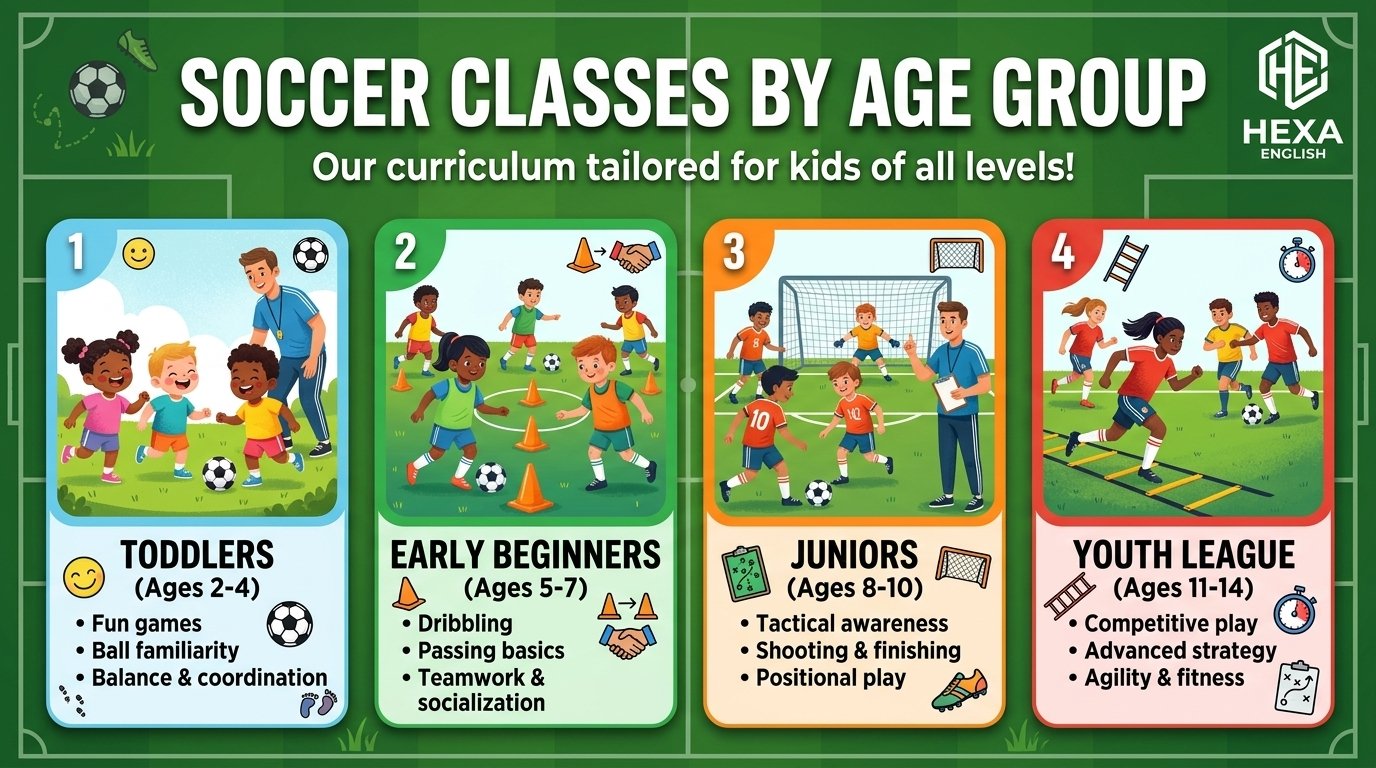
Toddlers need movement, ball familiarity, and parent support, not tactics, positions, or scores. Classes at this age usually last 30 minutes, use songs, stories, and simple games, and invite a parent onto the field. A parent on the field helps a toddler feel safe, follow simple cues, and enjoy movement without fear.
Toddlers also need short activities and frequent changes, because attention spans are short and energy comes in bursts. Good coaches rotate stations, use colorful cones and small goals, and celebrate effort rather than correct every kick. Parents should expect joyful chaos, not tidy drills, and should judge success by smiles and movement.
Parents should check class size, parent role, and indoor surface before booking a toddler class. Small groups help coaches notice each child, while a clear parent role avoids confusion on the first day. Indoor turf or a soft gym floor suits toddlers, while outdoor grass suits older children who can handle uneven ground.
Ages 3 to 4 Years
Preschoolers need simple skills through play, with dribbling, stopping, kicking, and gentle passing introduced as games. Classes may be parent and me or drop off, depending on the program and the child, and both models can work well. A drop off class suits a confident preschooler, while parent and me suits a child who still needs a trusted adult nearby.
Preschool sessions usually last 30 to 45 minutes, with warm up, skill stations, and a small sided game at the end. Coaches should use clear, short instructions, visual cues, and praise for listening, sharing, and trying, not only for scoring. Children at this age learn social skills as much as soccer skills, including turn taking and group play.
Parents should ask whether scores are kept in preschool games, since non competitive games suit this age better than league tables. A program that keeps preschool scores can create pressure that young children do not need, even if adults mean well. Fun, movement, and friendship should outrank winning at ages 3 and 4.
Ages 5 to 6 Years
Kindergarten children can handle skills plus small sided games, with dribbling, passing, shooting, and basic positioning introduced slowly. Sessions often last 40 to 50 minutes, with more structure than preschool classes yet still plenty of play. Children begin to understand teamwork, spacing, and simple game rules without adult tactics.
Kindergarten leagues often use 4v4 small sided games, which give each child more touches and more chances to score. More touches matter because young players learn by doing, not by watching older children dominate a large field. Parents should prefer small fields and small teams over full size fields for this age group.
Kindergarten children also need clear routines and kind coaching, since school and soccer both demand new social rules. A good coach explains the plan, uses names, and gives every child a role, even in a short game. Parents should watch how a coach handles mistakes, since that response shapes a child’s confidence.
Ages 7 to 8 Years
Early elementary children can handle positioning, passing patterns, and team play, while still needing high energy games and praise. Sessions often last 50 to 60 minutes, with drills, small sided games, and league matches that teach spacing and decision making. Children begin to choose favorite positions, yet they should still rotate roles for balanced development.
Early elementary leagues often use 4v4 games for younger players and 7v7 games as they grow, depending on the league and region. That progression keeps fields and teams age appropriate, rather than jumping too fast to large formats. Parents should check game format, practice count, and playing time rules before registering for a season.
Early elementary children also need honest feedback without harsh criticism, since confidence grows through effort and correction in equal measure. Coaches should correct technique briefly, then let children try again, rather than stopping play for long lectures. Parents can help by praising effort, teamwork, and improvement after games.
Ages 9 to 12 Years
Older elementary and middle school children can handle first touch, decision making, team shape, and stronger competition, when they want it. Recreational leagues remain a strong choice at this age, with weekly practice and games plus a social team. Skills training suits players who want extra coaching without full club commitment or travel.
Older children may face a first club decision at ages 9 to 12, yet that decision should follow the child’s interest, not a fear of falling behind. A child who loves soccer and wants more training may thrive in a club, while a child who loves soccer socially may thrive in recreational play. Both paths can lead to high school soccer later, with different costs and pressures.
Parents should watch for specialization pressure at this age, since year round soccer can crowd out other sports, rest, and school. Multi sport play supports overall athletic development, reduces overuse risk, and keeps soccer fresh for many children. A balanced calendar usually beats a packed calendar for long term enjoyment.
Ages 13 Years and Older
Teenagers face club, school, and academy pathways, with different rules about school team eligibility, travel, and college recruiting. This guide covers teenagers only briefly, because most readers searching for kids classes need younger age guidance first. Parents of teenagers should check league rules, school rules, and club rules together before committing.
Teenage programs often require 3 to 4 practices per week, plus games and showcases, with higher costs and travel. That load suits motivated teenagers, yet it can strain school, sleep, and family time if chosen without a clear goal. A teenager should help decide, since motivation matters more at this stage than parental enthusiasm alone.
| Age group | Usual format | Session length | Game format example | Parent role |
|---|---|---|---|---|
| 18 months to 2 years | Parent and me class | About 30 minutes | Play games, no league table | Parent on field |
| 3 to 4 years | Parent and me or drop off class | 30 to 45 minutes | Small games, non competitive | Parent on field or watching |
| 5 to 6 years | Skills class or recreational league | 40 to 50 minutes | 4v4 small sided | Parent watching |
| 7 to 8 years | League plus skills training | 50 to 60 minutes | 4v4, then 7v7 by league | Parent watching |
| 9 to 12 years | Recreational league or club | 60 to 90 minutes | 7v7, 9v9, then 11v11 | Parent watching, team support |
| 13 years and older | Club, school, academy | 90 minutes or more | 11v11 | Parent support, player led |
Class Versus League Versus Club Versus Camp
Weekly Class Strengths and Limits
Weekly classes give low pressure skill learning, with no team standings and no tryout stress for beginners. Children can join mid season in many programs, try a free trial where available, and leave without a long season commitment. Classes suit families who want to test interest before buying a uniform and a season.
Weekly classes limit game experience, since children may play only short games at the end of a session. A child who loves matches may soon want a league, where team games happen weekly and friendships deepen. Parents should treat a class as a first step, not as a final destination for every child.
Recreational League Strengths and Limits
Recreational leagues give team identity, weekly games, and community, with open registration and balanced teams in many nonprofit leagues. The national recreational organization AYSO promotes philosophies including everyone plays, balanced teams, open registration, positive coaching, good sportsmanship, and player development. Those principles suit beginners and social players who want fun plus structure.
Recreational leagues limit training time and coach consistency, since many coaches are volunteers with varying experience. Parents should check coach training, practice plans, and playing time rules, rather than assuming every volunteer coach teaches the same way. A strong league director and clear parent communication often matter more than a famous league name.
Competitive Club Strengths and Limits
Competitive clubs give more practices, stronger coaching, and higher level games, with selection that groups similar ability together. Clubs suit players who want challenge, can handle feedback, and enjoy travel and tournaments as part of soccer. Clubs also create friendships with teammates who share a serious interest in the game.

Competitive clubs limit family time and budget, with higher fees, travel, tournaments, and fundraising in many cases. Clubs can also create pressure, reduced playing time for some players, and burnout if a child joins too early. Parents should ask about playing time, roster size, and total annual cost before a tryout, not after selection.
Camp and Clinic Strengths and Limits
Camps give intensive skill bursts during school breaks, with daily games and coaching that can spark rapid improvement. Camps suit children who want to try soccer, improve one skill area, or stay active during summer. Camps also help parents cover school holidays with a structured, physical activity.
Camps limit steady development, since a week of camp cannot replace weekly practice across a season. Parents should view camp as a supplement, not as a substitute for a class or league season. A camp with a very large group or a very long day may also tire young children quickly.
| Factor | Weekly class | Recreational league | Competitive club | Camp or clinic |
|---|---|---|---|---|
| Tryout | No | Usually no | Often yes | Usually no |
| Practices per week | 1 | 1, sometimes combined with game | 2 to 4 | Daily for a short period |
| Games | Short games in class | Weekly league games | League plus tournaments | Daily games in camp |
| Travel | Local | Local | Local to regional | Local |
| Cost level | Lower | Lower to medium | Higher | Medium per week |
| Pressure level | Low | Low to medium | Medium to high | Low to medium |
| Best first step | Yes for beginners | Yes for team lovers | No for most beginners | Yes for trying soccer |
How Much Do Soccer Classes for Kids Cost
What Fees Usually Cover
Program fees usually cover coaching, field rental, insurance, and administration, with uniforms sometimes included and sometimes charged separately. Some programs include a shirt in the fee, while others charge for a full uniform kit with jersey, shorts, and socks. Parents should ask for a written fee breakdown before registering, since a low headline fee can hide uniform and tournament costs.
Program fees usually do not cover cleats, shin guards, balls, travel, or snacks, unless a program states otherwise in writing. Families should budget for gear, transport, and time, not only for the registration fee itself. A program that supplies balls and cones still expects parents to supply shoes, guards, and a water bottle.
Cost Ranges With a Local Warning
Cost ranges below use competitor guide estimates and location examples only, never a verified national price survey. Guide estimates from a youth soccer structure guide list recreational programs at about $100 to $500 per year, competitive travel at about $1,500 to $4,000 per year, and elite national programs at about $4,000 to $8,000 per year. Those ranges help parents compare levels, yet they do not predict a price in a specific city.
Location examples from 2026 research show how town and season change price for similar young child programs. A New Jersey youth sports provider listed Soccer Squirts sessions at $134 to $135 for a 5 week block in November to December 2026, with $149 in Bedford Hills, New York, and $170 for a Parent and Me block in Montclair, New Jersey. Those figures are examples only, tied to town, age, and season, and they must not be quoted as national prices.
A Tucson partner program listed an 8 week Soccer Shots season at $200, with longer Premier sessions at $220, plus a $25 yearly fee including a shirt. A community league venue in Westerville, Ohio listed a 6 week Spring 2027 season at $153 for ages 3 to 4 and $159 for ages 5 to 12, if paid by January 15, 2027. A monthly toddler program in Milford, Ohio listed $77 per month for ages 2 to 5, showing how monthly pricing differs from season pricing.
Parents should therefore compare total cost per season, including uniform, gear, travel, and any yearly fee, rather than comparing only a headline weekly price. A monthly program that runs year round can cost more than a short season, even when the monthly figure looks small. Total cost, not headline cost, decides affordability for most families.
Hidden Costs to Check
Hidden costs include uniform kits, tournament fees, travel fuel, parking, and fundraising, especially in club programs. Some clubs charge separately for coaching, fields, referees, league fees, and tournaments, so parents should request a full annual estimate. Recreational leagues usually have fewer hidden costs, yet they may still ask families to bring snacks, buy a practice ball, or contribute to a team party.
Families should also check refund, transfer, and makeup policies before paying, since illness, moves, and schedule changes happen often. Some programs prorate a season when a child joins late, while others charge a full season fee regardless of start date. A clear makeup policy matters more than a discount for families with unpredictable schedules.
Scholarships, Aid, and Sibling Discounts
Scholarships and financial aid exist in some nonprofit leagues, city programs, and clubs, yet availability varies sharply by place and program. Parents should ask directly about aid, payment plans, and sibling discounts, rather than assuming a program has none. City parks programs and nonprofit leagues often offer lower fees or aid, while franchise programs may offer sibling discounts or prorated seasons instead.
Parents should also check school, daycare, and community center programs, which sometimes cost less than standalone academies. A school enrichment class or a parks class can offer a strong first experience without club prices. Low cost does not mean low quality, especially when the coach is patient, the group is small, and the curriculum is age appropriate.
| Program type | Guide estimate per year | What to verify locally |
|---|---|---|
| Weekly toddler or preschool class | Monthly or season fee, varies by city | Session length, parent role, makeup policy, yearly fee |
| Recreational league | About $100 to $500 per year as a guide estimate | Uniform included, practice count, game count, volunteer coach training |
| Competitive travel club | About $1,500 to $4,000 per year as a guide estimate | Tryout, roster size, playing time, travel, tournament fees |
| Elite national program | About $4,000 to $8,000 per year as a guide estimate | Showcase travel, school team rules, total annual cost |
| Camp | Per week fee, varies by hours and location | Hours, coach ratio, lunch, gear, refund policy |
What Happens in a Kids Soccer Class
A Typical Session by Age
A toddler session starts with free movement and songs, then moves to simple ball games, obstacle courses, and a closing cheer. Coaches use stories and imagination, such as dribbling around cones as if they were trees, to keep young children engaged. Parents on the field help toddlers follow cues, share balls, and stay safe near other children.
A preschool session starts with a warm up game, then moves to skill stations for dribbling, stopping, and kicking, then ends with a small game. Stations keep children moving, reduce waiting in line, and let coaches correct gently in small groups. A closing routine helps children learn transitions, listening, and goodbyes, which matter as much as soccer skills.
An elementary session starts with a warm up and ball touches, then moves to passing, shooting, and small sided games with simple tactics. Coaches may teach spacing, support runs, and defensive positioning through games, not through long whiteboard talks. A cool down and a brief team talk help children reflect, praise teammates, and plan the next practice.
How Much Game Time Matters
Game time matters because children learn soccer by playing soccer, not by standing in a line waiting for a turn. Small sided games give each child more touches, more decisions, and more chances to score, especially for ages 5 to 8. Parents should ask how much of a session is game play versus waiting, since a class with long lines teaches patience more than soccer.
Coaches should also rotate positions and roles, so every child tries dribbling, passing, defending, and shooting across a season. Early position labels can limit development, especially for a child labeled only as a defender or only as a goalkeeper. Rotation builds a complete player and keeps soccer fun for children who have not yet found a favorite role.
How Coaches Handle Shy Children and Big Feelings
Good coaches handle shy children with patience, choice, and gentle inclusion, rather than forcing a child into the center of attention. A shy child might start by watching, then join a station, then join a game, with praise at each step. Parents should tell coaches about shyness, sensory needs, or anxiety before the first class, so coaches can plan support.
Good coaches handle big feelings with calm routines and clear expectations, such as a water break, a quiet corner, or a simple job like collecting cones. Young children cry, get frustrated, and lose focus, and those moments do not mean soccer has failed. A coach who stays calm, kind, and consistent teaches emotional skills alongside soccer skills.
Parent on Field Versus Parent Watching
Parents stay on the field for youngest toddler classes, where safety, comfort, and guidance require an adult nearby. Parents watch from the sideline or a viewing area for preschool and older classes, where independence and coach authority matter more. Programs should state the parent role clearly before the first session, so families arrive prepared.
Parents watching should support positive sideline behavior, with praise for effort, teamwork, and improvement, not coaching from the sideline. Sideline coaching can confuse children, contradict the coach, and increase pressure during games. A simple rule helps: parents cheer, coaches coach, referees referee, and children play.
| Session part | Toddler class | Preschool class | Elementary class |
|---|---|---|---|
| Warm up | Songs and free movement | Tag game and ball touches | Ball touches and passing warm up |
| Skill work | Simple kicking and stopping games | Stations for dribbling, stopping, kicking | Passing, shooting, first touch drills |
| Game | Small play games, no score | Small sided game, often non competitive | Small sided or league game, with score by league rules |
| Cool down | Closing song and cheer | Closing routine and praise | Cool down, team talk, next practice preview |
How to Find Soccer Classes Near You
Search Terms That Actually Work
Search terms that work include city plus age plus program type, such as a city name with toddler soccer, preschool soccer, recreational soccer, or youth soccer league. A broad search for soccer classes for kids alone often returns national guides, franchise pages, and unrelated towns, which wastes time. Adding a city, a school district, or a neighborhood narrows results to programs a family can actually attend.
Search terms should also include trial, season, and registration words, such as free trial soccer class, fall soccer registration, spring soccer league, and indoor soccer winter. Those terms surface booking pages and season pages faster than generic program descriptions. Parents should save useful pages and note season dates, since registration windows close early in many leagues.
Parks, Schools, YMCA, and League Finders
City parks and recreation departments often run low cost recreational leagues with local fields, volunteer coaches, and simple registration. School enrichment programs and daycare programs sometimes host franchise classes during school hours or after school, which suits working families. Community centers and YMCA youth sports programs offer another local route, with age groups, seasons, and financial aid in some locations.
National recreational league finders help parents locate a local region or chapter, yet the local page still controls prices, dates, and formats. Parents should use a national finder to find a region, then read the local region page for age chart, game format, and registration details. A national page alone does not guarantee a local program exists in a specific town.
Trial Class Workflow
A trial class workflow starts with booking, arrival, observation, and debrief, in that order, and it reveals more than any website. Parents should book a free trial where available, arrive 10 to 15 minutes early, and bring water, suitable shoes, and a change of clothes. Early arrival lets a child meet the coach, see the field, and settle before the session starts.
During the trial, parents should watch coach tone, group size, waiting time, and child reaction, not only skill outcomes. A good trial shows a coach who knows names, explains briefly, praises effort, and keeps children moving. A poor trial shows long lines, unclear instructions, harsh corrections, or a child who looks lost for most of the session.
After the trial, parents should ask the child what felt fun, what felt hard, and what they want to try next, without leading the answer. A child who says fun and wants to return has given the most important signal, even if skills looked messy. A child who felt scared, bored, or pressured deserves a different program, a different age group, or a break before trying again.
1. Define age and goal. Write down the child’s age, experience, goal, and weekly availability before searching, so choices stay focused.
2. Search locally first. Use city plus age plus program type, then check parks, schools, YMCA, and league finder results for real local options.
3. Compare three options. Compare format, session length, coach ratio, cost, makeup policy, and safety policy across three programs, not thirty.
4. Book a trial where available. Book a free trial or a single session first, and arrive early with water and suitable shoes for the surface.
5. Observe the session. Watch coach tone, group size, waiting time, game time, and how the coach handles mistakes and shy children.
6. Debrief with your child. Ask what felt fun and what felt hard, and let the child’s answer weigh more than a brochure or a ranking.
7. Check safety before paying. Ask about background checks, concussion protocol, heading rules, heat and lightning policy, and first aid coverage.
8. Register and calendar the season. Register before the deadline, note practice and game days, and set reminders for uniform, gear, and weather updates.
How to Choose: A Parent Decision Checklist
Goal First
Goal first means asking whether the child wants fun, fitness, friends, skills, or competition, in the child’s own words where possible. A child who wants friends and fun needs a recreational league or a class, while a child who wants challenge and training needs a skills program or a club. Parents should revisit the goal each season, since goals change as children grow and interests shift.
Goal first also means avoiding adult goals disguised as child goals, such as college recruiting for a 5 year old or elite status for a beginner. Early pressure can turn a joyful activity into a chore, even when a child has talent. Talent needs time, play, and rest to grow, not a full time schedule at age 6.
Time and Travel Reality
Time reality means counting practice, game, travel, arrival, and post game time, not only the listed session length. A 60 minute practice with 30 minutes of driving each way takes 2 hours from a family evening, and that cost matters. Weekend games, tournaments, and school nights all compete with homework, sleep, and other activities.
Travel reality means checking field locations, traffic, and carpool options before registering for a club or a regional league. Local leagues suit families with limited driving time, while clubs suit families who can accept regional travel. A program that requires constant long drives will strain even a motivated family over a full season.
Coach Check
Coach check means asking about training, experience, ratio, communication, and background checks, in a polite and direct way. A good program should explain coach training, whether coaches are paid or volunteer, and how many children each coach supervises. A coach ratio under 12 to 1 suits young children, while a beginner camp guide suggests 8 to 1 or better for beginners, as guide advice rather than a universal rule.
Coach communication matters because parents need clear schedules, weather updates, and feedback without chasing information. A program with a clear app, email list, or team manager usually runs more smoothly than a program with vague updates. Parents should also note how a coach talks to children, since tone shapes confidence more than any drill.
Safety Check
Safety check means asking about background checks, concussion protocol, heading rules, heat policy, lightning policy, and first aid before paying. A program should state who is background checked, what training coaches complete, and what happens if a child hits their head. Parents should also check field conditions, goal anchoring, and supervision at drop off and pick up.
Safety check also means checking medical information handling, such as asthma, allergies, and emergency contacts, with the coach or program director. Parents should provide an action plan for asthma or allergies where relevant, and confirm who holds medication and who can act in an emergency. Clear medical communication protects children and coaches alike.
Culture Check
Culture check means watching playing time, balanced teams, sideline behavior, and coach language during a trial or a game. A positive culture gives every child meaningful playing time, rotates positions, and praises effort and teamwork. A negative culture benches weaker players, yells at referees, and treats young games like professional matches.
Culture check also means checking parent expectations, since a league that promises fun yet tolerates aggressive sidelines sends a mixed message. Parents can help by modeling calm support, thanking coaches and referees, and avoiding sideline coaching. Children notice adult behavior more than adult advice about sportsmanship.
| Red flag | What to ask | Better alternative |
|---|---|---|
| No background check policy stated | Who is background checked, and what training do coaches complete | Program with a written coach safety policy |
| Very large group, long lines | What is the coach ratio, and how much game time do children get | Small group class or small sided league |
| Scores and standings for preschoolers | Are preschool games non competitive, and how are scores handled | Non competitive play based program |
| No makeup or refund policy | What happens if we miss a session, move, or get ill | Program with makeup sessions or prorated fees |
| Heading drills for young children | What heading rules apply for this age group and league | Program following current league heading rules |
| Guaranteed team place or scholarship promise | What does selection actually guarantee, in writing | Program with clear tryout and selection wording |
| No weather or cancellation plan | How are rain, heat, and lightning decisions communicated | Program with a written weather policy |
Gear Guide: Ball Size, Shoes, and What to Wear
Ball Size by Age
Ball size matters because a ball that is too large or heavy makes kicking harder, slows learning, and can teach poor technique. Young children need a smaller, lighter ball that they can control with the inside of the foot, not only with a toe poke. Older children need a larger ball that matches league play and prepares them for full size soccer.
Ball size guides from youth soccer sources list size 1 for ages 3 and under, size 2 for ages 3 to 5, size 3 for ages 5 to 8, size 4 for ages 8 to 12, and size 5 for ages 12 and older. Those age bands overlap, because children grow at different rates and leagues set their own match ball rules. Parents should check the league match ball first, then buy a practice ball in the same size where possible.
Ball weight and circumference also vary slightly by manufacturer and source, so parents should check the product label rather than relying on memory. Size 3 balls commonly measure 23 to 24 inches around, size 4 balls measure 25 to 26 inches, and size 5 balls measure 27 to 28 inches. A ball that feels hard, overinflated, or oversized for a child should be replaced with a softer, age appropriate option.
| Ball size | Circumference | Common age guide | Best use |
|---|---|---|---|
| Size 1 | 18 to 20 inches | 3 years and under, plus skills training for older players | First touch, juggling, close control |
| Size 2 | 20 to 22 inches | Ages 3 to 5 | Early learning, basic kicking and control |
| Size 3 | 23 to 24 inches | Ages 5 to 8 | Youth games, training, small sided play |
| Size 4 | 25 to 26 inches | Ages 8 to 12 | Youth league matches, stronger kicking |
| Size 5 | 27 to 28 inches | Ages 12 and older | Official matches, high school and adult play |
Cleats Versus Turf Shoes Versus Sneakers
Shoes matter because surface, safety, and comfort change with grass, turf, indoor court, and gym floor. Cleats suit natural grass fields, with studs that grip soil and help children change direction without slipping. Turf shoes suit artificial turf, with small rubber studs that grip without catching, while sneakers suit indoor courts and gym floors.
Parents should check the program shoe rule before buying, since many indoor programs forbid outdoor cleats on indoor turf or gym floors. A toddler class may require sneakers only, while an outdoor league may require cleats and shin guards for games. Buying the wrong shoe wastes money and can delay a child’s first session.
Shoe fit matters as much as shoe type, since tight or loose shoes cause blisters, trips, and discomfort during running. Parents should choose shoes with room for growth yet snug enough to stay on during quick turns, and should test shoes with soccer socks. A child who complains about shoes every session needs a fit check, not more practice.
Shin Guards, Uniform, and Water
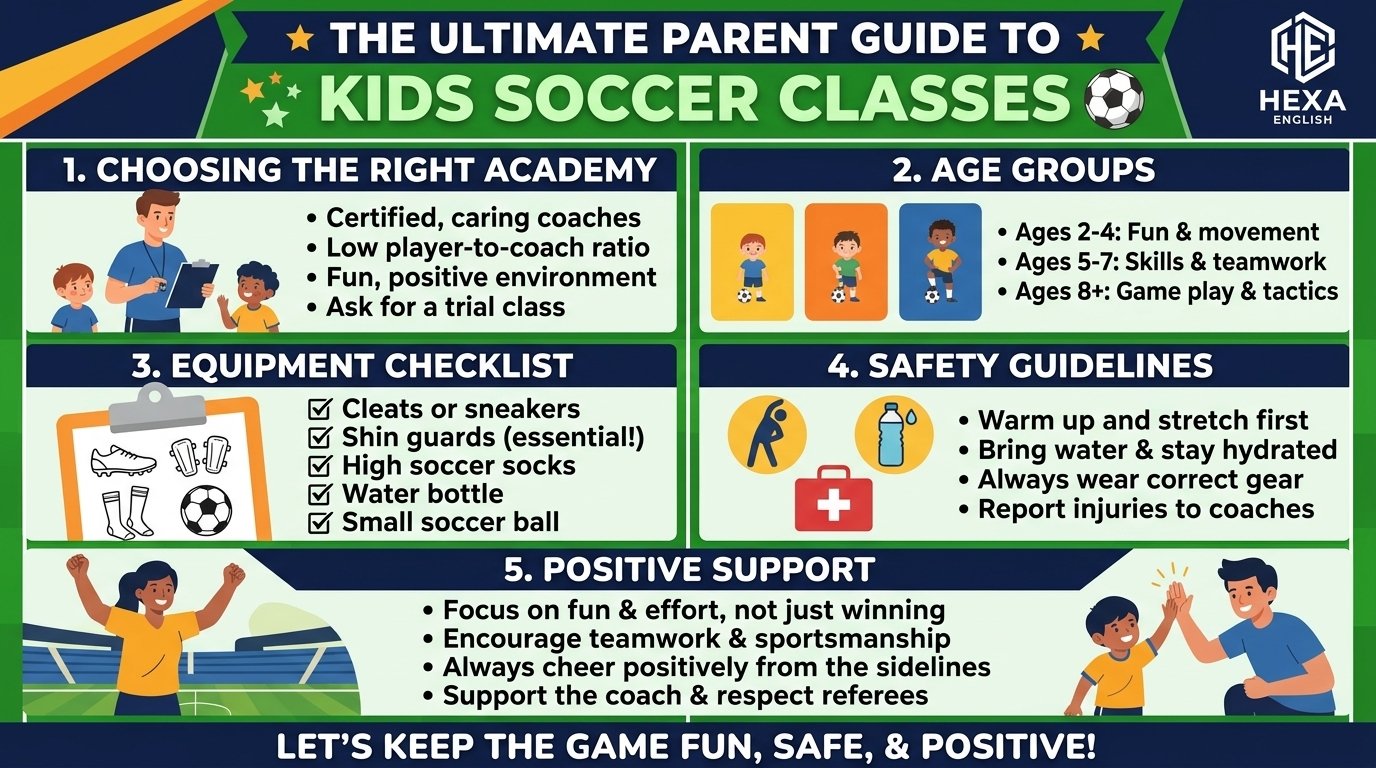
Shin guards protect the front of the lower leg from kicks and collisions, and most leagues require them for games. Guards should cover from just below the knee to just above the ankle, fit snugly under socks, and stay in place during running. Parents should check league rules for guard type, since some leagues require hard shell guards while others accept softer guards for young children.
Uniforms usually include a jersey, shorts, and socks, with some programs including a shirt in the fee and others charging separately. Parents should label uniforms, wash them after games, and keep a spare pair of socks for muddy or wet days. A water bottle, a snack for after play, and weather layers complete the basic kit for most classes.
Weather layers matter because children cool down quickly after active play, especially on windy or rainy days. A light jacket, a hat for sun, and sunscreen for outdoor sessions help children stay comfortable and safe. Parents should check the program weather policy and dress children in layers that can be removed during play.
| Gear item | What to choose | Check before buying |
|---|---|---|
| Ball | Age size from the table above | League match ball size and practice ball size |
| Shoes | Cleats for grass, turf shoes for turf, sneakers for indoor | Program shoe rule for the specific field |
| Shin guards | Snug guards from knee to ankle, under socks | League guard requirement for games |
| Uniform | Jersey, shorts, socks, labelled with name | Whether uniform is included in the fee |
| Water bottle | Reusable bottle, filled before class | Water refill point at the field or center |
| Weather layers | Light jacket, hat, sunscreen for outdoor play | Weather and cancellation policy |
Safety, Health, and Inclusion
Heading Rules by Age Group
Heading rules protect young brains by limiting or banning heading at ages when technique and neck strength are still developing. The US Soccer Federation concussion initiative states that players in U11 programs and younger shall not engage in heading in practices or games. Players in U12 and U13 programs face limited heading practice, with a maximum of 30 minutes per week and 15 to 20 headers per player per week under that initiative.
A later US Youth Soccer policy reported in 2026 guidance uses different wording for some ages, including no deliberate heading for players age 10 and under, and a weekly header limit for players age 11 and 12 across practices and skill sessions. That difference shows why parents must check their sanctioning body and league rule, not rely on one summary alone. A league may also set a stricter rule than the national minimum, and the stricter local rule controls for that league.
Coaches should teach safe heading technique only at ages where heading is allowed, with correct timing, body shape, and ball size. Young children should practice ball control with feet, chest, and thighs instead, without heading drills disguised as fun games. Parents who see heading drills for U11 children should ask the program director about the league rule in writing.
Concussion: General Information Only
Concussion information here is general information only, not medical advice, and families should seek medical care promptly for any suspected head injury. A child who hits their head, shows confusion, headache, dizziness, vomiting, or unusual behavior should be removed from play and assessed by a clinician. Return to play should follow a clinician’s guidance and the league’s return to play protocol, not a parent’s guess or a coach’s pressure.
Parents should ask programs about concussion training, removal from play rules, and communication plans before the season starts. A strong program trains coaches to recognize possible concussion signs, removes a child from play for assessment, and informs parents promptly. A program that pressures an injured child to keep playing fails a basic safety test, regardless of its coaching quality.
Heat, Hydration, Lightning, and Field Conditions
Heat safety matters because children heat up faster and cool down slower than adults during intense play, especially in humid weather. Programs should schedule water breaks, shade breaks, and reduced intensity on hot days, and should cancel or move sessions when heat risk is high. Parents should send water, dress children in light layers, and teach children to drink before feeling thirsty.
Lightning safety matters because outdoor fields offer no safe shelter during thunderstorms, and play should stop when lightning is near. Programs should state a lightning distance and wait time rule, and parents should follow the program’s cancellation notice rather than driving to a field during a storm. Field conditions also matter, since muddy, uneven, or poorly anchored goals create trip and injury risks.
Background Checks and Coach Training
Background checks and training protect children by screening adults and teaching safe coaching practices, yet policies vary by program type. National youth soccer organizations use SafeSport training for covered adults in the US Olympic and Paralympic movement, while the national recreational organization uses Safe Haven training for its volunteers. Parents should ask which training applies to their specific program, rather than assuming one label covers every league.
Background checks should cover coaches, assistant coaches, and regular volunteers who work directly with children, according to the program’s written policy. Parents should also check supervision at drop off and pick up, visitor rules, and how a program handles a safeguarding concern. A program that answers those questions clearly earns more trust than a program that avoids them.
Kids With Disabilities and Adaptive Programs
Kids with disabilities can play soccer through adaptive programs, inclusive leagues, and supported mainstream teams, depending on needs and local options. The national recreational organization offers an EPIC program, which stands for Everyone Plays in Our Community, for players whose physical or mental disabilities make mainstream team play difficult. EPIC programs focus on participation, fun, and development in a supportive setting, with a minimum age that varies by region.
Parents of children with disabilities should ask about coach training, support ratios, field access, communication aids, and medical plans before registering. A program that welcomes a planning conversation, offers a trial, and adapts stations or rules shows inclusion in practice, not only in words. Parents should also check whether a child needs a support adult, a buddy, or modified equipment for safe participation.
Children with asthma, allergies, or other medical needs should have a clear plan shared with the coach before the first session. Parents should provide emergency contacts, medication locations, and action steps in writing, and confirm who can act if a coach is absent. A program that keeps medical information private yet accessible to the responsible coach balances safety and dignity well.
Skills by Age: What to Expect Without Pressure
Ages 2 to 4: Movement First
Ages 2 to 4 should focus on movement, coordination, and ball familiarity, with kicking, stopping, and chasing games that feel like play. Children learn balance by running, hopping, and changing direction, and they learn foot eye coordination by touching a ball often. Parents should celebrate attempts, not correct technique at length, since confidence grows faster than precision at this age.
Ages 2 to 4 should not face tactics, positions, or standings, since those concepts exceed developmental readiness and create confusion. A child who dribbles in the wrong direction has still practiced dribbling, balance, and joy, which are the real goals. Coaches who keep activities short, visual, and playful serve this age group best.
Ages 5 to 6: Simple Skills Plus Games
Ages 5 to 6 should focus on dribbling with control, stopping the ball, simple passing, and shooting in small games. Children begin to use the inside of the foot, look up briefly, and share the ball with teammates, even if passing remains inconsistent. Coaches should use stations, races, and small goals to keep energy high and learning active.
Ages 5 to 6 should also learn listening, turn taking, and sportsmanship through team games and clear routines. A child who waits for a turn, cheers for a teammate, and accepts a loss with support has learned skills that last beyond soccer. Parents should praise those behaviors as warmly as goals scored.
Ages 7 to 8: Passing, Spacing, and Teamwork
Ages 7 to 8 should focus on passing accuracy, spacing, movement off the ball, and basic defending in small sided games. Children begin to understand that passing can beat a defender, that space helps teammates, and that defending needs position as well as effort. Coaches should teach those ideas through games, with brief pauses for questions and corrections.
Ages 7 to 8 should also learn decision making under mild pressure, such as choosing when to dribble, pass, or shoot. That skill grows through many small game repetitions, not through long lectures about systems. Parents should avoid shouting tactical instructions from the sideline, since that pressure slows decision learning.
Ages 9 to 12: First Touch and Team Shape
Ages 9 to 12 should focus on first touch, receiving under pressure, passing range, shooting technique, and team shape in larger small sided games. Children begin to scan before receiving, move into space, and support teammates with runs and angles. Coaches should add fitness through games, rather than through long laps that bore young players.
Ages 9 to 12 should also learn resilience, leadership, and responsibility, through captain roles, team jobs, and honest feedback. A child who leads a warm up, helps a new teammate, or accepts a referee decision with grace has grown as a person and a player. Parents should support that growth by praising effort, preparation, and teamwork after games.
Recreational Versus Competitive: When to Move, When to Stay
Signs Your Child Is Ready for More Challenge
Readiness signs include a child who asks for more practice, enjoys competition, handles feedback well, and wants to train with stronger players. A child who practices at home without prompting, watches games with interest, and recovers quickly from losses may enjoy a club step. Readiness also includes family readiness, since more practices and travel affect the whole household.
Readiness does not mean a child must win every recreational game or score the most goals to qualify for a club. Coaches look for effort, coachability, movement, and game understanding, not only goals, when assessing a player. Parents should ask a current coach for an honest assessment before a tryout, rather than relying on goals alone.
Signs Your Child Needs Less Pressure
Less pressure signs include a child who dreads practice, cries before games, loses sleep, or says soccer no longer feels fun. Those signs can reflect too much training, too much travel, harsh coaching, or a level that exceeds current skill. A step back to recreational play, a skills class, or a break often restores joy faster than pushing through pressure.
Less pressure does not mean a child has failed at soccer, since interests, friendships, and development change across childhood. A child who steps back may return stronger later, try another sport, or enjoy soccer socially for years. Parents should treat a step back as a smart adjustment, not as a loss of talent or effort.
Tryouts: What They Are and Are Not
Tryouts are selection sessions where coaches watch players in drills and small games, then form teams by ability and roster need. Tryouts do not measure a child’s worth, future potential, or love for soccer, and a single tryout can miss form, nerves, or growth. Parents should prepare children by explaining that tryouts test fit for one team, not talent for life.
Tryouts should be fair, transparent, and kind, with clear criteria, feedback where possible, and a respectful result process. Parents should ask how teams are formed, how playing time works, and what happens if a child is not selected. A program that offers a recreational alternative after a club tryout shows care for every child, not only for selected players.
Multi Sport Balance and Burnout Signs
Multi sport balance supports overall athletic development, injury prevention, and long term enjoyment, especially before high school. Children who play different sports learn varied movements, meet different friends, and avoid overuse from one repetitive motion. Soccer skills transfer well to other sports, and other sports transfer well back to soccer.
Burnout signs include loss of interest, fatigue, frequent complaints, anxiety before play, and declining performance without a clear injury cause. Burnout can grow from year round play, excessive travel, harsh coaching, or adult pressure to specialize early. Parents should respond with rest, conversation, and a lighter schedule, rather than with more training or guilt.
How to Talk About Quitting or Switching
Quitting conversations should start with listening, not persuading, since a child’s reason may be coaching, friendships, pressure, schedule, or simply a new interest. Parents should ask open questions, validate feelings, and separate a bad week from a bad season before deciding. A short break, a different team, or a different format can solve a problem that quitting alone cannot.
Switching programs should be handled respectfully and promptly, with notice to the current coach and league where rules require it. Parents should check transfer, refund, and registration rules before switching, since some leagues restrict mid season moves. A respectful exit preserves friendships and future options, even when a program was not the right fit.
Season Calendar and Registration Deadlines
Fall, Winter, Spring, and Summer
Fall seasons usually run late summer through autumn, with registration in spring or early summer for many recreational leagues. Spring seasons usually run late winter through spring, with registration in autumn or winter for many programs. Winter indoor sessions fill the gap for families who want year round play without outdoor weather disruption.

Summer offers camps, clinics, and short leagues, with registration in spring and high demand for popular weeks. Parents should calendar registration windows early, since waitlists form quickly for toddler classes and popular league age groups. A missed window can mean a season on a waitlist, even when a child is eager to play.
Mid Season Joining and Makeup Policies
Mid season joining depends on program type, roster space, and league rules, with some classes prorating fees and some leagues closing rosters. Weekly classes often allow rolling enrollment, while league teams may close once games begin to protect team balance. Parents should ask about prorated fees, uniform timing, and practice integration before joining mid season.
Makeup policies vary sharply, with some programs offering makeup sessions, credits, or open play for missed classes, and others offering no makeup at all. Weather cancellations may be rescheduled, refunded, or simply lost, depending on program policy and field availability. Parents should read the makeup and weather policy before paying, since those details affect real value.
| Season | Typical registration window | Typical play window | Parent action |
|---|---|---|---|
| Fall | Spring to early summer | Late summer to autumn | Register early, check age cutoff and field location |
| Winter indoor | Autumn | Winter months | Check indoor shoe rule and facility location |
| Spring | Autumn to winter | Late winter to spring | Register early, check practice nights and game days |
| Summer camp | Spring | Summer school break | Book popular weeks early, check hours and lunch |
Mistakes to Avoid
1. Choosing a club for a beginner. A beginner needs skills, fun, and touches, not tryouts, travel, and standings in the first season. Start with a class or recreational league, then review club options when the child asks for more challenge.
2. Copying a price from another town. A price from another town reflects local fields, coaches, and season length, not a national standard. Compare total local cost, including uniform and travel, before judging whether a program is expensive or cheap.
3. Ignoring coach ratio and waiting time. A large group with long lines teaches waiting more than soccer, especially for young children. Ask about ratio and game time, and observe a trial session before committing to a season.
4. Buying the wrong ball or shoes. A ball that is too large and shoes for the wrong surface create frustration and discomfort from the first session. Check league ball size and program shoe rules, then buy gear that fits the child and the field.
5. Skipping the safety questions. A program without a clear background check, concussion, heading, heat, and lightning policy should not receive a child’s registration first. Ask those questions in writing, and choose a program that answers them clearly.
6. Forcing a shy child into a large game. A shy child needs gradual inclusion, choice, and praise, not immediate center stage pressure. Tell the coach about shyness, try a smaller class, and let confidence grow through small successes.
7. Treating preschool games like adult matches. Preschool soccer needs play, movement, and friendship, not standings, tactics, or sideline coaching. Keep scores out of toddler and preschool play, and praise effort, sharing, and trying.
8. Overloading the calendar. A calendar with soccer every night plus other activities leaves no time for rest, homework, or free play. Count total weekly hours, including travel, and protect at least one free evening and one free weekend day where possible.
9. Staying silent about medical needs. A coach cannot help with asthma, allergies, or support needs that were never shared in writing. Provide emergency contacts, medication locations, and action steps before the first session, and confirm who holds that information.
10. Judging a program by one bad week. A single rainy session, a lost game, or a tired child does not prove a program is wrong for a season. Look for patterns across several sessions, talk to the coach, and decide based on safety, fun, and learning over time.
Expert Tips
1. Watch the first 10 minutes. The first 10 minutes reveal coach tone, organization, and child energy better than any brochure. Look for names, clear instructions, movement, and smiles, rather than long lines and lectures.
2. Count touches, not goals. A good young child session gives many touches, passes, and shots to every child, not only to the strongest player. Small sided games and stations create touches, while large games with few players involved do not.
3. Ask about playing time in writing. Playing time rules vary by league, age, and team, and verbal promises can fade during a season. Ask how playing time works, how rotations work, and what happens if a child misses practice.
4. Use a trial debrief script. After a trial, ask what felt fun, hard, and worth trying again, without leading the child toward a yes. A child’s honest answer beats a parent’s hope for a particular program every time.
5. Keep a season notebook. Note practice days, game days, uniform needs, weather notices, and coach messages in one place for the season. A simple notebook reduces missed sessions, forgotten gear, and confusion about schedule changes.
6. Practice at home in short bursts. Short home sessions of 10 to 15 minutes with dribbling, passing against a wall, and juggling build skills without pressure. Keep home practice playful, praise effort, and stop before frustration grows.
7. Rotate positions early. Early rotation builds complete players and flexible thinkers, while early labeling limits growth and fun. Encourage children to try defense, midfield, attack, and goalkeeping across a season where safe and appropriate.
8. Protect rest and sleep. Rest, sleep, and free play support recovery, learning, and enjoyment as much as extra training does. A tired child learns less, enjoys less, and risks injury more than a rested child with fewer sessions.
9. Build a positive sideline habit. Cheer effort, teamwork, and improvement, thank coaches and referees, and avoid tactical shouting during games. Children play freer when adults stay calm, kind, and consistent on the sideline.
10. Review the fit each season. Age, interest, school load, and friendships change each season, so revisit goal, time, cost, and level before re-registering. A program that fit last year may not fit this year, and that change is normal.
Quick Decision Quiz
Question 1: My child is 3 years old and has never played. Where should we start?
Start with a parent and me or preschool play class, with songs, games, and short activities. A league with standings and long practices would overwhelm most 3 year olds, while a playful class builds movement and confidence first.
Question 2: My child is 6 years old and loves games. Class or league?
Choose a recreational league or a skills class plus small sided games, depending on schedule and local options. A league gives weekly team games and friendships, while a class gives more skill repetitions without a full season commitment.
Question 3: My child is 10 years old and has never played. Is it too late?
No, it is not too late, yet the right entry matters more than speed. Choose a beginner friendly recreational league or skills class, with age appropriate grouping and a coach who welcomes late starters without tryout pressure.
Question 4: My child wants more training, but we cannot travel far. What fits?
Choose a local skills class plus a recreational league, rather than a distant club with regional travel. Extra local training can challenge a motivated child without the time and cost burden of long travel each week.
Question 5: My child is shy and worries about new groups. What helps?
Choose a small group class with a patient coach, and tell the coach about shyness before the first session. A trial class, a friend in the same group, and gradual inclusion often help shy children settle faster than a large team trial.
Question 6: How do I know if a program is safe enough?
Check background checks, concussion protocol, heading rules, heat and lightning policy, and first aid coverage in writing before paying. A program that answers those questions clearly, with a named contact, passes a basic safety test that every family should apply.
Question 7: Should my child specialize in soccer now?
Most young children benefit from varied sports and free play, rather than year round specialization before high school. Multi sport play supports overall athletic development, reduces overuse risk, and keeps soccer enjoyable for longer.
Question 8: What if my child wants to quit mid season?
Listen first, check whether the issue is coaching, friendships, pressure, schedule, or a new interest, and talk to the coach if appropriate. A short break, a different format, or a respectful season finish may solve the problem better than an immediate quit or a forced finish.
FAQs
What age should kids start soccer classes?
Children can start play based soccer classes at 18 months to 2 years, with parent support and short movement games. Most children start structured classes at ages 3 to 4, and many start leagues at ages 5 to 6, when attention and group skills grow stronger. Starting later also works, especially with a beginner friendly recreational league or skills class.
Are soccer classes good for toddlers?
Soccer classes can be good for toddlers when they focus on movement, coordination, and play, not on tactics or competition. Toddlers benefit from songs, stories, obstacle games, and ball touches that build balance and confidence. Parents should choose a parent and me class with small groups and a patient coach for the youngest children.
What is the difference between soccer classes and soccer leagues for kids?
A soccer class focuses on weekly skills and play, usually without a fixed team or league standings. A soccer league adds a team, a coach, practices, and weekly games against other local teams over a season. Classes suit beginners and low commitment families, while leagues suit children who want regular team games.
What is the difference between recreational and competitive soccer for kids?
Recreational soccer focuses on fun, participation, balanced teams, and open registration, usually without tryouts or long travel. Competitive soccer focuses on selection, more practices, higher level games, and travel, with higher costs and pressure. Recreational play suits most beginners, while competitive play suits motivated players who want more challenge.
How much do soccer classes for kids cost?
Costs vary sharply by city, program type, season length, and facility, so no single national price applies to every family. Guide estimates list recreational programs at about $100 to $500 per year, competitive travel at about $1,500 to $4,000 per year, and elite national programs at about $4,000 to $8,000 per year. Parents should compare total local cost, including uniform, gear, travel, and tournament fees, before registering.
Are there free soccer classes for kids?
Free or low cost options exist through some city parks programs, school programs, community centers, nonprofit leagues, and trial classes, yet availability varies by town. Some programs offer free trial classes, scholarships, or financial aid, while others offer low cost recreational seasons through parks departments. Parents should ask local parks, schools, and leagues directly about free and aid options.
Can my child try a soccer class before signing up?
Many programs offer a free trial class for first time families, especially franchise and indoor center programs, while some leagues offer a single session or an open play day. Trial availability varies by program, season, and roster space, so parents should book early and confirm trial terms in writing. A trial helps families judge coach tone, group size, and child reaction before paying for a season.
How long is a kids soccer class?
Young child classes usually last 30 to 50 minutes, depending on age, with toddlers at the shorter end and elementary children at the longer end. League practices and games for older children can last 60 to 90 minutes, including warm up and cool down. Parents should check total time, including arrival and post session time, not only the listed class length.
How many times a week do kids soccer classes meet?
Most beginner classes meet once per week, while recreational leagues usually meet for one practice plus one game per week, or one combined day. Competitive clubs meet 2 to 4 times per week, plus games and tournaments, which suits motivated players with more time. Families should choose a frequency that fits school, sleep, and other activities without overload.
What do kids wear to soccer class?
Children should wear athletic clothing, suitable shoes for the surface, shin guards where required, and a water bottle for most classes. Indoor classes often require sneakers, outdoor grass classes often require cleats, and turf classes often require turf shoes, so parents should check the program shoe rule first. Weather layers, sunscreen, and a hat help for outdoor sessions in sun or wind.
Do kids need cleats for soccer class?
Children need cleats for outdoor grass leagues and games in many programs, yet indoor classes and toddler classes often require sneakers instead. Cleats grip natural grass and help children change direction, while turf shoes grip artificial turf without catching. Parents should check the program shoe rule for the specific field before buying cleats.
Do kids need shin guards for soccer class?
Most leagues require shin guards for games, since guards protect the front of the lower leg from kicks and collisions. Guards should fit snugly from just below the knee to just above the ankle, and stay in place under socks during running. Some young child classes may not require guards for skills sessions, yet parents should still check league game rules.
What size soccer ball should my child use?
Ball size depends on age and league match ball rules, with size 1 for ages 3 and under, size 2 for ages 3 to 5, size 3 for ages 5 to 8, size 4 for ages 8 to 12, and size 5 for ages 12 and older as common guides. Age bands overlap, because children grow at different rates and leagues set their own match ball rules. Parents should check the league match ball first, then buy a practice ball in the same size.
Can my child join soccer mid season?
Some weekly classes allow rolling enrollment with prorated fees, while league teams may close rosters once games begin. Parents should ask about prorated fees, uniform timing, practice integration, and league transfer rules before joining mid season. A class or a new season often suits a mid season starter better than joining a league team late without practice time.
Can my child join soccer if they have never played before?
Yes, most beginner classes and recreational leagues welcome children with no experience, with open registration and age appropriate grouping. Coaches should introduce skills through games, rotate positions, and praise effort, rather than expecting prior knowledge. Parents should tell the program about no experience before the first session, so coaches can plan support.
Can my 10 year old start soccer as a beginner?
Yes, a 10 year old can start as a beginner in a recreational league or skills class, with age appropriate grouping and a welcoming coach. Late starters should avoid high pressure tryouts as a first step, and should focus on touches, passing, and game understanding through small sided play. Many late starters enjoy soccer socially for years, and some later move to club play if interest grows.
Do parents stay and watch soccer class?
Parents stay on the field for youngest toddler classes, and watch from the sideline or viewing area for preschool and older classes in most programs. Parent roles vary by program, age, and facility, so parents should check the program rule before the first session. Watching parents should cheer effort and teamwork, rather than coaching from the sideline during play.
What is a parent and me soccer class?
A parent and me soccer class invites a parent or caregiver onto the field to help a toddler or young preschooler follow activities, feel safe, and enjoy movement. Coaches guide parents, who then help children engage with balls, cones, and games through songs and play. Parent and me classes suit youngest children, shy children, and first time families who want a gentle start.
What happens if my child cries at soccer class?
Crying at soccer class is common for young children, especially on a first day with new people, sounds, and routines. Coaches should respond with calm, choice, and gentle inclusion, while parents should stay nearby where program rules allow and avoid forcing participation. A child who cries every session, dreads class, or shows distress beyond a few weeks may need a smaller class, a different coach, or a break.
How do I find soccer classes near me?
Search with city plus age plus program type, then check city parks, schools, YMCA youth sports, and national recreational league finders for local options. A national finder helps locate a local region, yet the local page still controls prices, dates, formats, and registration details. Parents should compare three local options on format, cost, ratio, safety, and trial availability before registering.
What are AYSO age groups for 2026 to 2027?
The national recreational organization updated age divisions for the 2026 to 2027 season to a school year bracket from August 1 through July 31, according to a local region page. That chart lists Playground for birthdates August 1, 2022 to July 31, 2023, Schoolyard for 2021 to 2022, 6U for 2020 to 2021, 8U for 2018 to 2020, 10U for 2016 to 2018, 12U for 2014 to 2016, and 14U for 2012 to 2014. Parents should check their local region page, since division availability and Area play vary by registration numbers.
Is AYSO competitive soccer?
AYSO Core soccer is recreational soccer, built on philosophies including everyone plays, balanced teams, open registration, positive coaching, good sportsmanship, and player development. Some regions offer more competitive EXTRA or select programs in addition to Core, yet those programs differ from the main recreational season. Parents should check their local region page for Core, EXTRA, and other program options before registering.
When should my child move from recreational to travel soccer?
A move suits a child who asks for more training, enjoys competition, handles feedback well, and wants to play with stronger players, with family time and budget to support travel. A move should follow the child’s interest, not a fear of falling behind, and should be reviewed each season. Children can also stay in recreational play and enjoy soccer for years without a club step.
What are youth soccer heading rules?
Youth heading rules depend on age group, sanctioning body, and league, so parents must check their specific league rule before practice. The US Soccer Federation concussion initiative states no heading for U11 and younger in practices and games, with limited heading practice for U12 and U13. A later US Youth Soccer policy uses different wording for some ages, so a league may set a stricter local rule that controls for that league.
Conclusion
Soccer classes for kids succeed when age, goal, time, cost, and location align, and when safety and fun come before pressure and prestige. A toddler needs playful movement and a trusted adult nearby, a preschooler needs songs, stations, and small games, and an elementary child needs touches, teamwork, and kind coaching. Older children need a clear choice between recreational joy and competitive challenge, made with the child, not for the child alone.
Soccer classes for kids also reward parents who trial first, ask safety questions in writing, and compare total local cost rather than headline price. A free trial reveals coach tone, group size, and child reaction in ways no brochure can match, while a safety checklist reveals whether a program truly protects children. Those two steps, trial and safety check, prevent most expensive and disappointing registrations.
Start today by writing down your child’s age, goal, and weekly availability, then comparing three local options on format, cost, ratio, safety, and trial availability. Book a free trial where available, observe the session with the checklist above, and debrief with your child about what felt fun and what felt hard. Choose the program that fits your child and your family, register before the deadline, and revisit the fit each season as your child grows.

Dilawar Mughal is an SEO expert with 8 years of hands-on experience helping websites grow their organic traffic, rankings, and revenue. He specializes in content-driven SEO, local SEO, and Pinterest SEO, and builds practical, results-focused strategies for businesses and publishers.
