

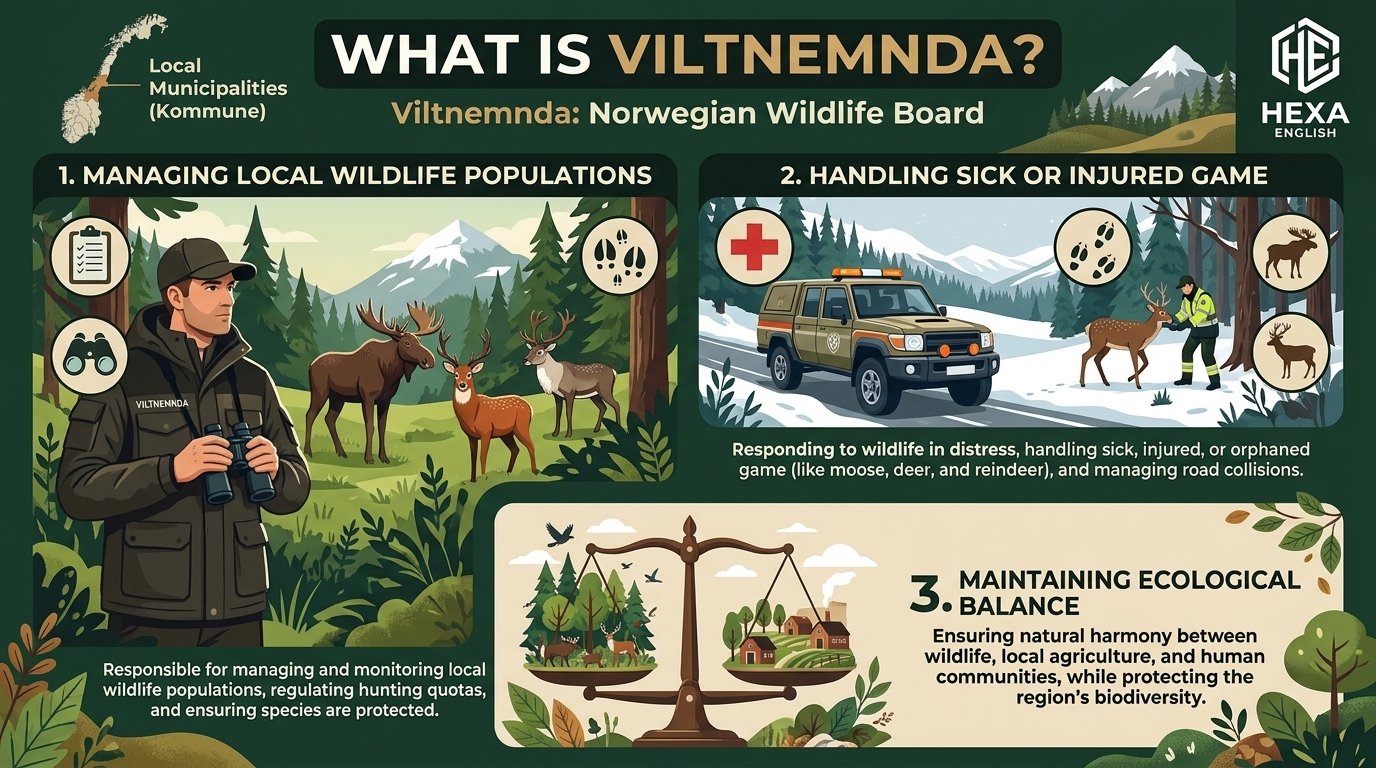
Viltnemnda is a Norwegian municipal wildlife committee or board function that handles local wildlife management within national law and municipal delegation. It connects national rules to local ground conditions, where moose cross roads, deer damage crops, and hunters need clear quotas. Its work is public administration, not private rescue, and its power is limited by law, species, and local organisation. Understanding those limits helps residents, drivers, landowners, and visitors act correctly and quickly.
Viltnemnda matters most when people and wildlife meet in the same place, because forests, farms, roads, and towns overlap across much of Norway. A moose on a road at dusk, a beaver dam flooding a farm track, or a deer herd grazing a field all need a lawful and practical response. Local knowledge helps here, since terrain, herd size, and road risk differ sharply between coastal, inland, and northern areas. National law sets the frame, while local bodies apply it to specific places and cases.
Viltnemnda also matters for hunters and landowners, because hunting in Norway is structured rather than open access, with approved areas, multi year plans, and annual quotas. A hunter needs permission tied to land and area, not just a general wish to hunt. A landowner needs to know how damage claims, permits, and herd plans fit together before acting. Clear local administration reduces conflict between hunting, farming, conservation, and public safety.
Viltnemnda should not be confused with a single national office, a charity, or a police unit, because each of those has a different job in Norway. Police handle incident reporting and public safety response, while national agencies set policy and regional bodies handle wider species issues. Municipal wildlife work sits between those levels, closer to the field than a ministry and narrower than a national agency. That middle position is its strength and its limit.
What Viltnemnda Means
Word Parts: Vilt and Nemnd
Viltnemnda combines two Norwegian words, with vilt meaning wildlife or game and nemnd meaning committee or board. The definite form adds a ending that points to a specific committee, so the full term reads as the wildlife committee in context. English translations vary between wildlife committee, wildlife board, and municipal wildlife board, depending on the source and the local form. All three point to the same local function, not to three different national bodies.

The word vilt covers wild animals and game, not pets, farm animals, or zoo animals, and that scope shapes every decision. A committee dealing with vilt focuses on wild species in their natural or semi natural habitats, including moose, deer, beaver, and geese. Farm animal welfare, pet rescue, and livestock disease control follow different rules and different authorities. Keeping that scope clear prevents the wrong office from being contacted in an emergency.
The word nemnd signals a committee with a defined task, not a single officer acting alone on personal judgement. Committees work through meetings, records, and delegated powers, even when field staff carry out the practical work. That structure matters for accountability, because decisions should be traceable to law, evidence, and a recorded process. A single phone call does not create a committee decision by itself.
Wildlife Board, Committee, or Local Office
English readers may meet wildlife board in one source and wildlife committee in another, but both usually describe the same municipal function. The difference is translation style, not a separate legal category, and local Norwegian pages may use viltnemnd, viltforvaltning, or fallvilt instead. Searchers should look for the municipality name plus one of those terms, rather than expecting one fixed English title everywhere. Function matters more than the exact English label in this system.
A local wildlife office may be a department function rather than a named committee, especially where a municipality organises wildlife work inside an environmental or planning department. Staff in that department can still carry out municipal wildlife tasks, approve plans, and coordinate field response. The public route is therefore the municipality first, not a search for a committee name that may not exist locally. That practical point saves time in both urgent and non urgent cases.
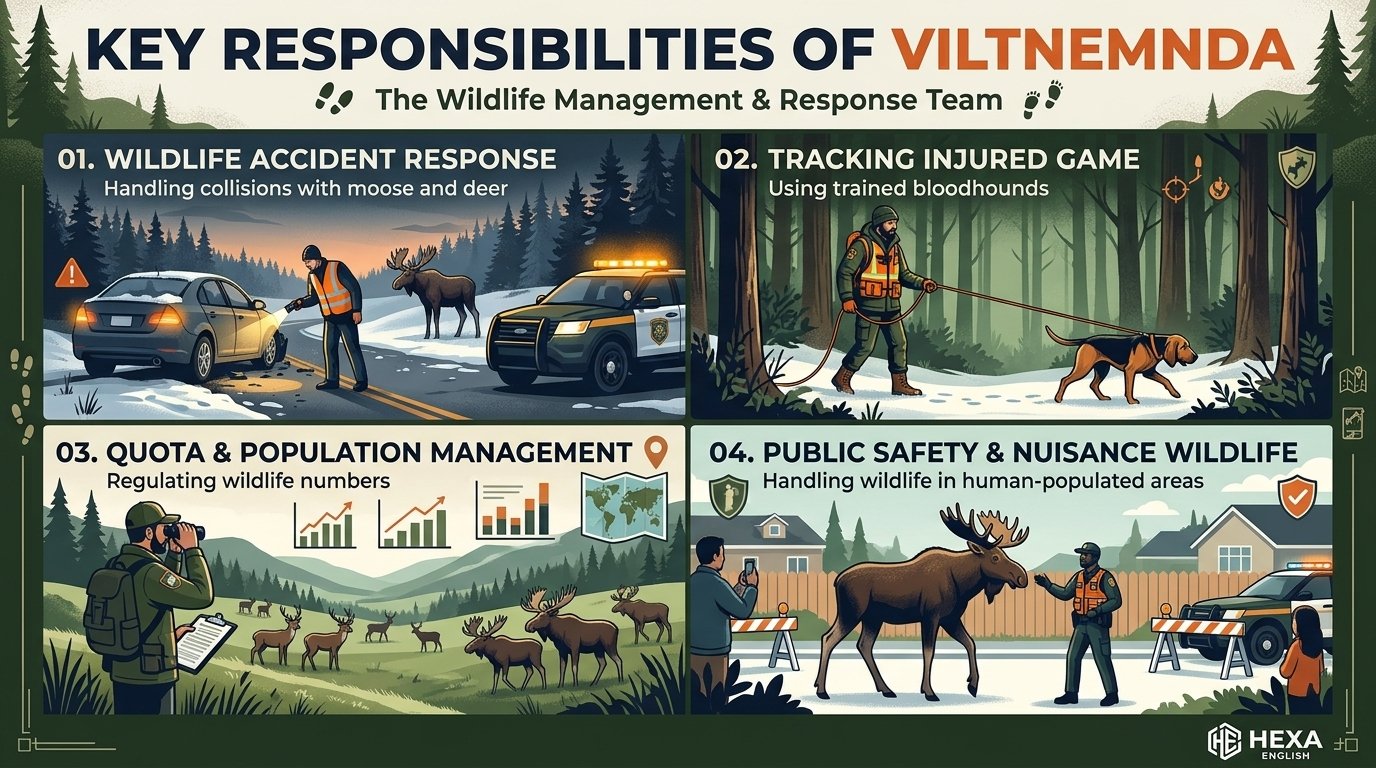
A municipal wildlife function also works with field teams, hunters, landowners, and police, rather than doing every field task through committee meetings. Committee members or municipal staff may set direction, while trained trackers and dog handlers search for injured animals after a collision. That split between decision and field action is normal in public administration. It also explains why a committee meeting is not the right first call after a road accident.
What Viltnemnda Is Not
Viltnemnda is not a national rescue agency, because there is no single national viltnemnda office serving every municipality in Norway. Rescue style language can mislead readers into expecting a national hotline, a national team, and a national response time. In reality, response routes run through police for collisions and through the relevant municipality for local wildlife matters. Knowing that route first is more useful than searching for a national number that does not exist.
Viltnemnda is not the police, even though police play a central role after wildlife collisions and in public safety incidents. Police log incidents, secure scenes where needed, and alert the appropriate wildlife responders, while municipal wildlife staff handle the wildlife assessment and follow up. That division protects both people and animals, since police focus on safety and traffic while wildlife responders focus on the animal. Readers should not expect a committee to replace police in an emergency.
Viltnemnda is not a hunting club, a landowner association, or a conservation charity, even though hunters, landowners, and conservation interests all take part in local wildlife discussions. A committee or municipal function must balance those interests within law, rather than serving one group alone. Hunters provide data and field knowledge, landowners hold hunting rights and bear damage, and conservation goals protect biodiversity. Balance, not advocacy for one side, is the public task.
Does Every Municipality Have a Viltnemnda
Separate Committee Form
Some municipalities maintain a separate elected wildlife committee, with members appointed by the municipal council and substitutes chosen through local council processes. That form is the closest match to the literal term viltnemnda, and it gives wildlife matters a visible local forum. Members may bring knowledge of hunting, forestry, agriculture, local ecology, or wildlife administration, depending on local appointments. Their decisions still depend on law and on powers delegated by the municipality.
A separate committee form helps public accountability, because meetings, agendas, and minutes can show what was discussed and decided. Residents can follow quota discussions, damage cases, and herd plans through municipal records, subject to lawful access limits. That transparency also helps hunters and landowners understand why a quota or permit decision went a particular way. A visible committee does not, however, gain extra legal power simply by being visible.
A separate committee does not mean unlimited local power, since national law, regulations, and higher level authorities still set the frame. A committee cannot authorise hunting outside the legal season, ignore protected species rules, or decide large carnivore cases that belong elsewhere. Its authority must be traced to a specific legal basis and to municipal delegation for that case. Readers should always ask what law and what delegation support a decision.
Department Function Form
Other municipalities organise wildlife work through a department or administrative unit, without a separate committee called viltnemnda. Staff in an environmental, planning, or technical department may handle wildlife cases, hunting area approvals, and field coordination as part of wider municipal duties. That form can be just as lawful as a committee form, because the municipality holds the underlying public responsibility. The absence of the exact name does not mean wildlife work is missing.
A department function can be faster for routine cases, since staff can process permits, plans, and reports without waiting for a committee meeting cycle. It can also be harder for the public to follow, since decisions may appear in general municipal case records rather than in a dedicated wildlife committee agenda. Residents should therefore search municipality pages for wildlife management, fallen game, and environmental services, not only for the word viltnemnda. Function and contact route matter more than the label.
A department function still needs legal grounding, trained field responders, and clear cooperation with police and regional authorities. Staff cannot invent powers, ignore animal welfare rules, or bypass appeal rights simply because no committee meets. Case handling rules, reasoned decisions, and access to records still apply to municipal administrative decisions. The form changes how work is organised, not whether law applies.
Shared and Intermunicipal Arrangements
Some wildlife issues cross municipal boundaries, especially for herds, river systems, and wide ranging species, so cooperation between municipalities is often necessary. A management area for moose or deer may cover several municipalities, with one municipality holding a formal role for certain approvals under cooperation rules. That arrangement prevents each municipality from setting conflicting goals for the same herd. It also means a resident may need to check a joint plan, not only a single municipality page.
Shared arrangements can cover field response as well, where neighbouring municipalities coordinate trackers, dog handlers, and equipment for injured animal searches. A small municipality may rely on a shared team or on neighbouring capacity, rather than maintaining a full team alone. That cooperation improves coverage in rural areas, where distances are long and incidents are sporadic. It also means response times and team names can vary by region.
Shared arrangements do not erase local accountability, because each municipality still holds its own legal responsibilities and records. A joint plan should name the participating municipalities, the area covered, and the formal approval route for that area. Readers dealing with a herd plan or a damage case should check whether the area is joint, and which municipality holds the formal file. That check avoids sending an application to the wrong office.
| Municipality form | What it looks like | How to find it |
|---|---|---|
| Separate elected committee | Named wildlife committee, council appointed members, meeting minutes | Municipality site, council and committee pages, search viltnemnd |
| Department function | Wildlife tasks inside environmental or planning department, staff case handling | Municipality site, environmental services, search viltforvaltning |
| Shared or intermunicipal arrangement | Joint herd plan or shared field team across municipalities | Municipality site, joint plan documents, search bestandsplanområde and fallvilt |
How to Find Your Local Form
Start with the official municipality website for the place where the matter occurred, not with a general web search for a national committee. Use Norwegian search terms such as viltforvaltning, viltnemnd, and fallvilt on that municipality site, since English pages may be thinner or missing. Look for environmental services, nature management, hunting, and fallen game sections, and note the named office or contact form. That route usually leads to the correct local function faster than a broad search.
For ordinary questions, use the municipality contact route shown on that official page, and include species, place, date, and what you need in the first message. A clear first message helps staff route a hunting plan, damage report, or permit question to the right case handler. For road collisions, do not spend time searching for a committee contact first, since police reporting comes first and police alert the wildlife responders. Urgency changes the route, and collision cases follow the police chain.
For a decision you disagree with, look for the decision letter first, since it should name the legal basis, reasons, and appeal route for that case. Meeting minutes can show what an elected body discussed, but minutes alone are not always the full case file, and supporting assessments or maps may sit elsewhere. Ask the municipality for clarification if the decision letter is unclear, rather than guessing at the appeal body or deadline. That habit protects both the reader and the case.
Viltnemnda vs Villreinnemnda vs Fallvilt
Viltnemnda: Municipal Wildlife Function
Viltnemnda, as used in this guide, means the municipal wildlife committee or board function that handles local wildlife administration within its delegated powers. Its core topics include deer management, hunting areas and plans, hunting permits, damage cases, and fallen game coordination, subject to species and legal limits. It does not control every wildlife topic in Norway, and it does not replace national or regional authorities. Its value lies in local knowledge applied within a national frame.
A municipal wildlife function works best when it separates three questions: what species is involved, what legal basis applies, and what local delegation exists. Deer cases often sit locally, while large carnivore cases often sit regionally or nationally, and wild reindeer cases often need a wider board. Asking those three questions first prevents a common error, which is assuming one local body can decide every wildlife matter. Species and law, not convenience, decide the route.
A municipal wildlife function also needs evidence, because hunting quotas, damage permits, and population goals should rest on data rather than opinion alone. Harvest reports, collision registers, landowner reports, habitat notes, and scientific assessments all feed into better decisions. Local observation matters, but it should be recorded, checked, and weighed alongside wider data where available. That evidence habit supports both sustainability and public trust.
Villreinnemnda: Wild Reindeer Board
Villreinnemnda is a wild reindeer management board, and it is not interchangeable with viltnemnda despite the similar name. Wild reindeer often move across large mountain areas and municipal boundaries, so their management needs a wider geographic approach than a single municipality can provide. A wild reindeer board therefore focuses specifically on wild reindeer populations and habitats across its area. Readers dealing with reindeer should look for the reindeer board route, not assume a municipal committee holds the whole case.
Wild reindeer management also involves habitat protection, migration routes, and coordination across land use, hunting, and conservation interests. A single municipality decision cannot easily cover a herd that crosses several municipalities and land types. Regional coordination, scientific monitoring, and habitat planning therefore play a larger role for reindeer than for a local deer herd. That wider scope is the key difference, not just a different name.
Confusing the two boards can cause wrong applications, wrong contacts, and missed deadlines, especially for hunters, landowners, and planners working near reindeer areas. A reindeer case sent to a municipal wildlife office may need forwarding, which costs time and creates confusion. Check species first, then board type, then municipality or region, before submitting a plan or permit request. That order keeps reindeer cases on the correct track.
Fallviltgruppe and Fallviltvakt
Fallvilt refers to fallen game, meaning wild animals found dead or injured, often after vehicle collisions or other incidents. A fallviltgruppe is a fallen game group, while fallviltvakt can refer to a fallen game duty or watch service that responds to such cases. These terms describe response functions, not the full municipal wildlife committee, even though the same municipality may organise both. Readers should treat fallvilt as a response topic, not as a synonym for viltnemnda.
A fallvilt response team typically includes trained trackers and dog handlers, who search for injured animals that have fled after a collision. A certified handler and an approved tracking dog, known in Norwegian field terms as an ettersøksekvipasje, can follow tracks and assess injury where an untrained search would fail or create risk. Prompt reporting and accurate marking of the last seen point help that team work faster and more humanely. That field detail is why police reporting and site marking matter so much.
Fallvilt work also includes carcass handling, road clearance, documentation, and data for future prevention, not only animal dispatch. Each case should be logged with species, place, time, and outcome, so collision hotspots and seasonal patterns can be studied. That data can support fencing, warning signs, speed measures, and habitat planning over time. A single collision report therefore serves both an immediate animal welfare need and a longer term safety need.
| Term | Meaning | Main job |
|---|---|---|
| Viltnemnda | Municipal wildlife committee or board function | Local wildlife administration, hunting plans and permits, damage cases, fallen game coordination |
| Villreinnemnda | Wild reindeer board | Wild reindeer populations and habitats across a wider area |
| Fallvilt | Fallen game | Dead or injured wild animals, often after collisions |
| Fallviltgruppe | Fallen game group | Organised local group for fallen game response |
| Fallviltvakt | Fallen game duty or watch | Duty service that responds to fallen game cases |
| Ettersøksekvipasje | Search team | Certified handler and approved tracking dog searching for injured game |
Norway Wildlife Law After 1 July 2026
Viltressursloven: The Current Wildlife Resources Act
Norway introduced the Wildlife Resources Act, known in Norwegian as Viltressursloven, with effect from 1 July 2026, replacing the older Wildlife Act from 1981. That date matters for every English guide written before July 2026, since older pages that present the 1981 act as current are now outdated. Readers should check the current Lovdata text for the law in force, rather than relying on a 2025 summary alone. Lovdata is the Norwegian law database used for official legal texts, and it should be the first check for a current legal question.
The new act largely continues the existing division of wildlife responsibilities, according to government summaries reported in 2026 guidance, while updating the framework for modern wildlife management. Municipalities did not suddenly gain control over all wildlife in 2026, and many practical local responsibilities remained local. That continuity point is important, because a law change does not automatically change every local contact, quota, or permit form overnight. Local organisation and regulations still shape how the law works in practice.
The new act also sits alongside regulations and guidance, so reading the act alone may not answer a hunting, damage, or collision question fully. Hunting time rules, deer management regulations, species rules, and local plans all add detail within the national frame. A hunter, landowner, or driver should therefore check the act, the relevant regulation, and the local plan or decision for that case. That three layer check is the safest way to avoid an outdated or incomplete answer.
What Stayed the Same
State ownership of wild game remains a core principle in Norwegian wildlife law, meaning wild animals are not owned by private landowners simply because they appear on private land. Hunting rights, by contrast, are tied to landownership and land use rules, which creates a system where private hunting rights operate inside public conservation goals. That distinction explains why a landowner can hold hunting rights while the state retains overall wildlife ownership and regulation. Readers from the United States should note this difference early, since it changes assumptions about access and control.
National law still sets the frame for hunting, seasons, methods, reporting, and protected species, while municipalities handle defined local tasks within that frame. That frame includes humane treatment duties, population sustainability goals, and knowledge based decision making, which are explained further below. Local bodies cannot override national protections or seasons by local preference alone. They can, however, apply local goals, plans, and permits where law and regulations allow them to do so.
Local knowledge still matters, because population development, grazing resources, forestry damage, farming damage, and road accidents differ by place and season. A moose plan for an inland forest valley will differ from a roe deer plan for a suburban edge, even under the same national law. Local data, landowner reports, and field observation help translate national goals into workable local decisions. That local layer is where viltnemnda, in its committee or department form, adds most value.
Naturmangfoldloven and the Precautionary Principle
The Nature Diversity Act, known as Naturmangfoldloven from 2009, requires wildlife decisions to be knowledge based and precautionary, with attention to ecosystem effects and long term sustainability. Knowledge based means decisions should rest on available scientific and local evidence, not on guesswork or single anecdotes alone. Precautionary means uncertainty should lead to caution, especially where harm to biodiversity or habitats could be serious or hard to reverse. Those two principles shape how quotas, permits, and damage decisions should be reasoned.
The Nature Diversity Act also connects wildlife decisions to habitat protection, species protection, and land use planning, so a hunting or damage decision cannot be viewed in isolation. A beaver dam case, for example, touches water, roads, farming, and habitat at once, while a deer plan touches forestry, farming, road safety, and biodiversity. Decision makers should therefore weigh wider ecosystem effects, not only the immediate animal or crop in front of them. That wider view is a legal expectation, not just good practice.
Priority species rules add another protection layer, where specific vulnerable species and their functional habitats receive legal restrictions through regulations and action plans. The Norwegian Biodiversity Information Centre provides Red List assessments, which are scientific risk assessments, while priority species status itself comes through a legally binding regulation process. Readers should not treat a Red List entry alone as a permit ban, nor ignore a priority species restriction where one applies. Species status must be checked case by case on official maps and guidance.
Administrative Law: Reasons, Access, and Appeals
Administrative law in Norway, through Forvaltningsloven, requires individual decisions to be properly reasoned and gives parties and others with a legal interest appeal rights in covered cases. A decision letter should therefore show the legal basis, the facts relied on, the reasoning, and the appeal route and deadline for that case. That letter is the most important document for anyone who disagrees with a municipal wildlife decision. Readers should keep it, read it fully, and ask for clarification if any part is unclear.
Public access and consultation are different processes, and confusing them can lead to missed opportunities or false expectations. Public access concerns access to municipal documents and minutes, subject to lawful exceptions, while consultation concerns giving affected groups a chance to provide information before wider rules are finalised. A hunting permit case and a broader local regulation therefore follow different participation routes. Check the decision type first, then the participation route that applies to it.
Appeal deadlines and appeal bodies depend on the decision type, the legal basis, and how the municipality has organised its authority. General administrative guidance describes a three week appeal window for many individual decisions, but the decision letter for a specific case controls over a general summary. Do not assume every wildlife action can be appealed in the same way, since some actions are field responses or general guidance rather than appealable individual decisions. When in doubt, ask the municipality in writing and keep the reply with the case file.
Who Does What: Authority by Species and Problem
Moose, Red Deer, and Roe Deer
Municipal deer management is the clearest municipal wildlife area, covering population goals, approved hunting areas, and hunting permits for moose, deer, and roe deer where hunting is open. Current deer management regulations, as reported in 2026 guidance, say municipalities shall set management goals for those species where hunting is open. Those goals can consider population development, grazing resources, damage to farming and forestry, and wildlife accidents on roads and railways. That goal setting role links hunting directly to safety, farming, and forestry outcomes.
A municipality also deals with approved hunting areas, called vald, and population management plans for moose and deer, which are explained in the hunting section below. Those tools translate population goals into area boundaries, herd plans, and annual harvest decisions. A hunter or landowner working with moose or deer should therefore start with the municipality and the relevant vald and plan, not with a national office. Local plans are the working documents for deer hunting in practice.
Roe deer in suburban areas show the limits of normal deer tools, since safe shooting, minimum land area, and public safety rules can all fail near homes. A suburban roe deer problem may need fencing, deterrence, habitat advice, and coordinated municipal planning, rather than a simple hunting permit. That hard case is a useful reminder that municipal power is real but bounded by safety law and local conditions. Readers should expect a slower, more coordinated answer for suburban deer than for rural deer.
Wild Reindeer and Wider Areas
Wild reindeer management needs a wider geographic approach, because herds move across mountain areas and municipal boundaries and depend on connected habitats. A wild reindeer board, villreinnemnda, therefore focuses on reindeer populations and habitats across its area, rather than on a single municipality alone. That wider board structure helps align hunting, habitat protection, and land use across the herd range. Readers should check the reindeer board route for reindeer cases, not only a local municipality page.
Reindeer habitat protection also involves migration routes, calving areas, and disturbance limits, which can affect roads, tourism, energy projects, and other land uses. A local decision that ignores a migration corridor can harm a herd even if it looks harmless in one municipality alone. Regional coordination, scientific monitoring, and habitat maps therefore play a larger role for reindeer than for a local deer herd. That coordination need is why reindeer boards exist as a separate concept.
Sami reindeer herding adds a cultural and legal dimension in northern Norway, where traditional herding, land rights, and indigenous representation intersect with wildlife management. Sami representatives in northern municipalities and Sami institutions play a role in ensuring cultural considerations are heard, especially where herding and wild reindeer management overlap. Readers should not treat Sami herding and wild reindeer management as the same topic, since domesticated reindeer herding and wild reindeer populations are distinct. Check the specific context before generalising about northern Norway.
Wolf, Bear, Lynx, and Wolverine
Large carnivore management is mainly regional and national in Norway, with municipalities playing a more limited and sometimes delegated role. The Norwegian Environment Agency has described municipal roles in carnivore management as limited, while regional authorities and national agencies handle wider population, damage, and control decisions. A municipality may administer local damage control teams or carry out delegated damage control in special cases, but it does not generally authorise large carnivore removal on its own. Species and legal provision decide the route for every carnivore case.
That limit matters for public safety and livestock protection, because a wolf, bear, lynx, or wolverine case can involve regional damage teams, national guidance, and strict legal conditions. A resident who reports a large carnivore sighting should follow the route given by the municipality, regional authority, or police for that area, rather than assuming a local committee can decide removal. Documentation, such as photos, tracks, time, and place, helps the correct authority assess risk and response. Do not approach, feed, or attempt to scare a large carnivore without official guidance for that situation.
Large carnivore cases also involve protected status, population goals, and international obligations, which vary by species and region and cannot be summarised as one simple rule. Lynx, wolf, bear, and wolverine each have different management histories, population targets, and legal protections, so a rule for one species should never be copied to another. Readers should check the species specific guidance from the Environment Agency and regional authority for the area and year in question. That species check is essential before any action or claim.
Beaver, Geese, and Red Fox
Beaver cases often involve flooding, road damage, and forestry impacts, where a dam can raise water levels across fields, tracks, and roads. Municipal wildlife work may include assessing the dam, considering non lethal options such as flow devices, and deciding whether a permit for intervention is lawful and proportionate. Flow devices can help manage water levels without removing the dam entirely, but they need correct placement and maintenance. A beaver case should be documented with water levels, damage, and affected land before any intervention is requested.
Geese cases often involve crop grazing and field damage, especially where large flocks feed on farmland during migration or breeding periods. Non lethal deterrence, such as scaring and field management, is usually considered first, while lethal control needs a lawful basis, evidence of serious damage, and permit conditions. Geese species and seasons differ, so a general geese rule should not be applied to every flock or field. Landowners should record dates, flock size estimates, crop type, and damage photos for a damage case file.
Red fox hunting in Norway is ordinary hunting within a legal season, not the same as strictly protected large carnivore management, according to 2026 hunting guidance summaries. Those summaries report a nationwide red fox hunting period from 15 July to 15 April under current hunting time rules, with landowner conditions and access rules still applying locally. That date range is reported guidance, so hunters must check the current hunting time rules and land permission before hunting. Trapping rules are specific, including approved live capture box traps and humane handling duties where trapping is used.
| Species or problem | Lead level | Municipal role |
|---|---|---|
| Moose, red deer, roe deer | Municipal, within national frame | Population goals, vald, herd plans, hunting permits |
| Wild reindeer | Wider regional board | Local input, habitat coordination, herd range planning |
| Wolf, bear, lynx, wolverine | Mainly regional and national | Limited role, delegated damage control in special cases, local damage teams administration |
| Beaver | Municipal and local, species and law dependent | Damage assessment, non lethal options, permit decisions where lawful |
| Geese | Municipal and local, species and season dependent | Damage assessment, deterrence advice, permit decisions where lawful |
| Red fox | Hunting within national season rules | Landowner permission, local access conditions, reporting duties |
Hunting Quotas and Bestandsplan, Step by Step
Vald: Approved Hunting Area
A vald is an approved hunting area in Norwegian deer management, and it provides the geographic unit for herd plans and hunting permits. Landowners and hunting teams work within vald boundaries, which are approved through municipal processes under deer management regulations. That approval step matters, because hunting rights and harvest data need a defined area to be meaningful. A vald is not simply any piece of land where someone wishes to hunt.

Vald approval also connects to minimum land area rules, known as minstareal, which set area thresholds for certain hunting arrangements. Those thresholds help ensure hunting areas are large enough for safe and sustainable management, rather than fragmented into tiny plots. Landowners with small parcels may need to cooperate within a larger vald or management area to meet area and safety requirements. Check the current regulation and municipality guidance for the species and area in question, since thresholds and rules can vary.
A vald boundary should be checked before a hunting season, since boundaries, ownership, and plan status can change over time. Hunters should confirm they hold hunting rights for that vald, that the plan is current, and that any permit conditions are understood. Landowners should confirm who holds hunting rights, what plan applies, and how harvest data will be reported. That pre season check prevents most hunting area disputes.
Bestandsplan: Multi Year Herd Plan
A bestandsplan is a multi year plan for managing a wildlife population, setting population goals and describing planned annual harvesting for that population. Landowners and hunting teams propose herd plans, including goals for population size and harvest strategies, which are then reviewed against municipal objectives, biological data, and road safety concerns. That review step turns a local wish into a managed plan with measurable goals. A bestandsplan is therefore a planning document, not a single season permit by itself.
A bestandsplan area, known as a bestandsplanområde, may cover several municipalities, with cooperation rules for approvals where the area crosses boundaries. The municipality containing the largest part of the relevant area can hold a formal role for certain approvals, according to 2026 guidance summaries. That cooperation rule prevents conflicting goals for the same herd across neighbouring municipalities. Hunters and landowners should therefore check whether their herd plan is single municipality or joint, and which office holds the formal file.
A bestandsplan should include population goals, harvest strategy, and monitoring, so future decisions can be judged against the plan rather than against memory. Goals may consider population development, grazing resources, forestry and farming damage, and road accidents, as noted in deer management guidance. Monitoring through harvest reports and field data then shows whether the plan is working or needs adjustment. A plan without monitoring is a wish list, not a management tool.
Annual Quota: Sex, Age, and Harvest Data
Annual quotas translate a bestandsplan into specific harvest decisions for a season, including how many animals, and of which sex and age classes, may be harvested. Sex and age matter because harvesting calves, adult females, and adult males has different effects on future population size and herd structure. A quota that ignores age and sex can distort a herd even when the total number looks reasonable. That is why harvest data records sex, age, and weight where required, rather than only a total count.
Hunters report results in detail, and in some cases jawbones or antlers are collected for age verification, according to competitor process summaries. That reporting creates a feedback loop, where this season harvest data informs next season quota decisions. Incomplete or late reporting weakens that loop, since managers must then decide with gaps in the data. Hunters should therefore treat reporting as part of hunting, not as optional paperwork after the season ends.
Quota decisions should also weigh road safety and damage data, not only population size, since a herd that is ecologically stable can still cause serious road risk or crop damage. Collision registers, landowner damage reports, and forestry damage notes all feed into local goal setting. That wider data set helps explain why two areas with similar herd sizes can receive different quotas. Local conditions, not a national average, should drive the local quota.
Monitoring and Feedback Loop
Monitoring turns hunting from a one off harvest into an adaptive system, where each season teaches the next season what to adjust. Harvest statistics, calf recruitment, hunting effort, collision data, and field observations together show whether a population is rising, stable, or falling. A single year of data can mislead, since weather, food, and reporting effort also affect results. Multi year trends, plan goals, and wider scientific assessments give a safer basis for quota changes.
Feedback loops also need transparency, so hunters, landowners, and residents can see how data led to a decision. Municipal minutes, plan documents, and decision letters should show the evidence and reasoning behind a quota or permit, subject to lawful access limits. That transparency supports trust, even when stakeholders disagree with the outcome. A decision that cannot be traced to evidence will be harder to defend on appeal or in public discussion.
Monitoring should include non hunting data as well, such as camera trap observations, field surveys, and citizen reports where those are collected systematically. Camera traps and field technology can help track presence and movement, but they do not replace harvest and collision data for quota decisions. Technology should support, not replace, the legal and scientific framework for wildlife management. Step 2 readers should be wary of any claim that a single app or drone survey alone sets a quota.
1. Confirm species and area. Identify the species, vald, and bestandsplan area before any hunting or permit question, since authority and rules depend on all three.
2. Check land permission. Confirm hunting rights for that land and area, since hunting without land permission is not lawful even inside a general season.
3. Read the current plan. Check the bestandsplan goals, harvest strategy, and monitoring duties for that area and season, not only last year plan.
4. Check season and method rules. Confirm current hunting time rules, weapon rules, and method rules for that species, since seasons and methods vary by species.
5. Apply for the correct permit. Use the municipality and vald route for moose and deer permits, and check whether a joint area changes the formal office.
6. Hunt within quota and conditions. Follow sex, age, area, and reporting conditions exactly, since exceeding a permit can lead to penalties under wildlife law.
7. Report harvest fully. Report sex, age, weight, and other required data promptly, and provide jawbones or antlers where collection is required for verification.
Wildlife Collisions and Injured Animals: What to Do
Stop Safely and Secure the Scene
After a wildlife collision, the first duty is personal safety, because a road scene with traffic, darkness, and a large injured animal can become more dangerous quickly. Stop safely where possible, turn on hazard warning lights, and wear a reflective vest if one is available in the vehicle. Secure the scene with a warning triangle when it is safe to do so, without walking into traffic or approaching a stressed animal. Those steps protect drivers, passengers, and later responders.
If people are injured, emergency help comes first, before wildlife reporting or vehicle inspection. Norwegian guidance summaries list 113 for medical emergencies and 112 for police emergencies, while 02800 is listed for police non emergency reporting. Those numbers appear in Norwegian guidance summaries, so travellers should verify them on an official police page before a trip, and store the correct numbers in a phone. In a serious injury case, do not delay an emergency call to search for a committee contact.
If the animal has fled, note the last seen point and direction of travel, since that information helps the search team more than a vague area description. Mark the point safely if police instruct you to do so, using a visible object or marker that does not create a traffic hazard. Do not leave the scene without reporting, even if the animal is no longer visible, since an injured animal may suffer without assistance. Reporting is a legal and welfare duty, not an optional courtesy.
Call Police First
For a wildlife collision in Norway, call police first, using the non emergency police number for a collision without personal injury, and emergency numbers where people are injured or danger is immediate. Norwegian guidance summaries list 02800 as the police non emergency number for wildlife collision reporting. That number is reported in guidance summaries, so check it on an official police page before relying on it during travel. Police log the incident, assess road safety, and alert the appropriate wildlife responders.
When calling, give location, animal description, and direction travelled, plus any visible injury, road conditions, and vehicle damage that affects safety. Location should be as precise as possible, using road number, nearest place name, kilometre marker, or phone map coordinates where available. Animal description should include species if known, size, colour, and whether the animal fled, stayed, or is blocking the road. Clear information shortens search time and reduces risk for responders.
Follow police instructions about marking, waiting, and scene safety, since police coordinate the response chain for that incident. Police may ask you to stay available for follow up, to mark the last seen point, or to move to a safe waiting place. Do not assume the case is closed once you have called, since the wildlife team may need further details about tracks or direction. Stay reachable until police confirm the next step.
Fallvilt Search: Tracker and Dog Team
After police notification, a fallvilt response team may be activated, including trained trackers and dog handlers who search for injured animals that fled into surrounding terrain. A certified handler and approved tracking dog team can follow tracks or blood trails, assess injury severity, and decide on humane dispatch or veterinary treatment where lawful. That team works under wildlife law and animal welfare duties, not on personal judgement alone. Prompt reporting gives that team the best chance to find the animal quickly.
Search work requires skill and authorisation, because an injured moose or deer can be dangerous, stressed, and hard to locate in forest or darkness. Untrained searchers should not chase, corner, or attempt to handle a large injured animal, since that can cause further suffering and personal injury. Marking the last seen point, giving accurate direction, and staying out of the search area helps the team work safely. Public help is most useful before the team arrives, through reporting and marking, not through independent pursuit.
Search outcomes are documented, including location, species, age and sex where possible, injury assessment, and outcome, for collision registers and future prevention. That documentation helps identify high risk road sections, seasonal patterns, and fencing or warning needs. It also creates accountability for humane dispatch decisions, since each case should be traceable to assessment and law. A well documented case therefore serves both animal welfare and road safety planning.
Humane Dispatch, Treatment, and Carcass Handling
An injured animal is not automatically killed after a collision, since qualified personnel must assess injury, suffering, and recovery prospects before deciding. Some animals can be treated or released, while others with severe injuries require humane dispatch to prevent prolonged suffering. That assessment must follow animal welfare law and wildlife law, not public pressure or convenience alone. Readers should not attempt euthanasia themselves without proper authorisation and training.
Humane dispatch, where required, should be carried out by trained and authorised personnel using lawful methods, with attention to safety, suffering, and public protection. Competency in marksmanship, tracking, and animal handling is part of professional standards reported in Norwegian wildlife guidance. That professional standard protects both the animal and the public, since a poorly handled dispatch can be inhumane and dangerous. Public observers should keep distance and follow responder instructions during field work.
Carcass handling follows road clearance, public health, and data duties, so a dead animal should not simply be left blocking a road or moved without guidance. Responders handle removal, disposal, and reporting according to local procedures and health rules. Drivers should not keep a dead wild animal found on the road without checking the legal route, since ownership, reporting, and health rules apply to wild game. When in doubt, ask police or the municipality before moving or keeping a carcass.
1. Stop safely. Pull over where safe, turn on hazards, wear a reflective vest, and place a warning triangle only when it is safe to do so.
2. Check people first. Call emergency services at once if anyone is injured, and do not delay that call to deal with the animal or vehicle.
3. Call police. Report the collision on the police non emergency number for a non injury case, or emergency numbers where danger or injury is present.
4. Give precise details. Provide road, place, direction, species, size, injury signs, and the direction the animal travelled after impact.
5. Mark the last seen point. Mark the point safely if police instruct you to do so, using a visible marker that does not create a traffic hazard.
6. Do not chase the animal. Stay out of the search area, do not corner a stressed animal, and do not attempt dispatch without authorisation.
7. Stay reachable. Remain available for police and wildlife team follow up, and follow instructions about waiting or moving to safety.
8. Record for insurance. Note the police incident details, photos of vehicle damage where safe, and repair records, since insurers may need a police incident reference.
Wildlife Damage: Crops, Forestry, Roads, and Homes
Document Damage First
Wildlife damage cases start with evidence, since a claim or permit request without dates, photos, and species signs is hard to assess fairly. Photograph damage from several angles, note dates and times, record crop or forest type, and note tracks, droppings, or other species signs where they can be identified safely. That record helps municipal staff distinguish deer, geese, beaver, or other species, and helps them judge scale and urgency. A vague report that an animal caused damage somewhere last month is much weaker than a dated, located record.
Damage documentation should also include place and ownership details, such as field location, forest stand, road section, or garden area, plus any previous damage at the same place. Repeated damage at one hotspot may point to a habitat, corridor, or fencing issue, rather than a single animal event. Landowners should keep a simple log across a season, with dates, weather notes where relevant, and actions already tried. That log supports both permit decisions and prevention advice.
Damage photos should be honest and complete, showing both damaged and undamaged areas where possible, so scale can be judged fairly. A close up of one eaten plant does not prove field scale loss, while a wide shot plus close ups gives a clearer picture. Avoid moving evidence or staging damage, since credibility matters for compensation and permit cases. Accurate documentation protects landowners as much as it protects decision makers.
Non Lethal First
Non lethal measures come first in most damage cases, because fencing, deterrence, habitat management, and flow devices can reduce damage without killing animals. Fencing can protect crops, gardens, and forestry plots, although fencing one plot can redirect animals to neighbouring land if used alone. Scaring, field management, and deterrents can help for geese and deer, but they need timing, consistency, and realistic expectations. Non lethal measures should be tried, recorded, and assessed before lethal control is requested, unless public safety requires faster action.
Beaver flow devices offer a targeted non lethal option for flooding, by managing water levels through a dam without removing the dam entirely. Flow devices need correct design, placement, and maintenance, and they may not suit every dam, road, or water system. A beaver case should therefore be assessed on site, with water levels, road risk, and habitat effects all considered. A flow device is a management tool, not a universal fix for every beaver dam.
Non lethal measures also include habitat and land use advice, such as planting choices, corridor management, and roadside vegetation management that reduce attraction or risk. Wildlife corridors can steer animals away from farms and roads, while deer resistant planting can reduce garden damage in some settings. Those measures take time and coordination, so they suit long term damage reduction better than emergency response. A damage plan that combines short term deterrence with long term habitat work usually lasts longer than a single intervention.
Skadefelling: Damage Control Permits
Skadefelling means damage control killing in Norwegian wildlife management, where a permit authorises targeted lethal removal to prevent serious damage or protect public safety. Lethal control is an exception, not a routine first step, and it requires a lawful basis, evidence of serious damage or risk, and permit conditions. Applicants should show attempted deterrents, damage evidence, and acceptance of monitoring conditions where those apply. That proportionality test protects both wildlife and the credibility of damage decisions.
Damage control permits are species and situation specific, so a permit for one species, place, and time does not authorise general hunting or removal elsewhere. Permit conditions may limit method, time, area, reporting, and carcass handling, and exceeding those conditions can lead to penalties under wildlife law. Landowners and hunters should read permit conditions fully before acting, and keep records of actions taken under the permit. A permit is a narrow authorisation, not a broad hunting licence.
Large carnivore damage control follows narrower and higher level rules, as noted in the authority section, so a municipal damage permit should never be assumed for wolf, bear, lynx, or wolverine. Regional and national authorities, damage teams, and strict legal conditions govern those cases, with municipal roles limited or delegated in special cases. A landowner facing large carnivore livestock loss should follow the regional and national route for that species and area, and document losses promptly. Speed matters for evidence, but authority still decides the legal route.
Compensation: What to Check, Not Promise
Wildlife damage compensation in Norway is case and species dependent, so no single promise about payment, amount, or timing can be made for every landowner. Some damage schemes cover specific species, damage types, and documented losses, while other cases receive prevention advice or permit decisions instead of payment. Landowners should check the current scheme, eligibility, documentation, and deadline for their species and damage type before assuming compensation. A municipality or regional authority can direct a case to the correct scheme, but the scheme rules control the outcome.
Compensation claims need evidence and timing, including damage photos, dates, species signs, field records, and any expert assessment where required. Late claims with no record are harder to assess, since damage may have changed or other causes may have intervened. Keep original photos, logs, and correspondence with the case file, and note any prevention measures already tried. That file also helps if a claim is questioned or appealed.
Compensation should not be treated as a substitute for prevention, since repeated payments for the same hotspot without fencing, habitat, or management changes can repeat the same loss next season. A good damage outcome often combines a fair claim process with a prevention plan for the next season. Landowners should ask what prevention measures are recommended, what support is available, and how success will be measured. That combined approach reduces future damage and future claims.
Roe Deer in Suburbs: Why Normal Tools Fail
Roe deer in suburbs create a hard management problem, because normal rural hunting tools break down near homes, gardens, and busy roads. Safe shooting angles, minimum land area rules, and public safety buffers can all fail inside a housing estate, even where deer numbers are high. Damage permits face high public visibility, legal liability, and lack of safe backdrop for shooting. Municipal response through fallen game teams is reactive by nature, and cannot alone lower total herd density across a suburb.
Suburban roe deer management therefore needs coordinated planning, including fencing advice, garden management, traffic measures, habitat planning, and public communication, rather than a single hunting permit. Fencing individual gardens can redirect deer to neighbouring gardens, so area wide advice works better than isolated fences. Traffic measures, such as warning signs and speed management on high risk sections, can reduce collisions even when herd density stays high. That coordinated approach is slower, but it respects safety law and public concern.
Public communication matters in suburban deer cases, since residents may disagree sharply about feeding, fencing, culling, and deer welfare. Some residents feed deer, which can increase local density and road risk, while others want removal at once. Municipal guidance should explain why normal tools fail, what measures are lawful, and what residents can do to reduce attraction and risk. Clear communication reduces conflict, even when it cannot satisfy every resident at once.
| Damage type | First steps | Lethal control position |
|---|---|---|
| Crop grazing by deer or geese | Document, photograph, log dates, try fencing and deterrence | Only with lawful basis, serious damage evidence, and permit conditions |
| Forestry damage by deer | Document stand, scale, species signs, seek management advice | Only within herd plan, permit, and legal conditions |
| Beaver flooding | Document water levels, road and field risk, consider flow device | Only with assessment, lawful basis, and permit conditions |
| Garden damage in suburbs | Document, fencing advice, reduce attraction, area coordination | Highly limited by safety law, public visibility, and safe backdrop |
| Livestock loss to large carnivores | Document promptly, follow regional route, protect remaining stock | Narrow, regional and national rules, delegated municipal role only in special cases |
Members, Meetings, Minutes, and Appeals
Who Sits on a Committee
Where a separate wildlife committee exists, members are appointed by the municipal council, with substitutes chosen through local council processes, according to municipality guidance summaries. Members may bring practical knowledge from hunting, farming, forestry, biology, environmental management, or local administration. That mix aims to balance field experience with ecological and administrative knowledge, rather than relying on one interest alone. Member backgrounds should be visible through council records, so residents can see who decides local wildlife matters.
Committee size and term vary by municipality, so no single member count or term length should be presented as a national rule. Larger municipalities may have larger committees, while smaller municipalities may use a department function instead of a committee. Term arrangements follow local council cycles and local regulations, not a universal wildlife committee term. Readers should check the specific municipality council page for size, term, and appointment rules for that committee.
Members do not gain personal wildlife powers by appointment, since their authority comes from law and municipal delegation for specific cases. A member cannot authorise hunting, damage control, or animal dispatch on personal authority alone, outside the legal basis and decision process for that case. That limit protects residents, hunters, and animals from informal decisions. It also means a conversation with a member is useful for guidance, but not a substitute for a formal decision.
Meetings, Minutes, and Public Access
Municipal elected bodies keep minutes for meetings, including time, place, attendance, matters considered, decisions made, and voting results, under Local Government Act rules reported in 2026 guidance. Except for parts lawfully excluded from public access, those minutes are generally available to the public. That record helps residents trace how a quota, plan, or damage decision was discussed and decided. Minutes are not always the full case file, since supporting assessments, applications, and maps may sit elsewhere in municipal records.
Public access to documents is separate from consultation, as noted earlier, and both processes have their own rules and limits. Access requests should name the case, decision, or meeting clearly, and allow time for municipal processing and lawful exclusions. Consultation, by contrast, gives affected groups a chance to provide information before wider rules are finalised, and it does not apply to every individual permit in the same way. Readers should choose the correct route for their goal, access or input, before contacting the municipality.
Meeting regularity varies by municipality and workload, with some committees meeting seasonally around hunting and quota cycles and others meeting more often. Peak hunting and rut periods can increase workload, but meeting frequency should be checked on the specific municipality page rather than assumed. Residents who want to follow a quota or plan should check the meeting calendar, agenda, and minutes for that municipality, and note any public comment windows. That calendar check is more reliable than a general claim about quarterly meetings.
How to Read a Decision Letter
A wildlife decision letter should show legal basis, facts, reasoning, appeal route, and deadline for that case, under administrative law principles. Start by identifying the decision itself, then the law and regulation cited, then the facts relied on, then the reasoning that links facts to law. Note any conditions, such as area, time, method, reporting, and monitoring, since conditions limit what the decision authorises. Keep the letter with photos, logs, and correspondence for that case, since those together form the working file.
A decision letter may also show who decided, when, and through what process, including committee, department, or joint area approval where relevant. That process detail matters for appeals, since the appeal body can depend on how the municipality organised its authority. If the letter names an appeal body, follow that body, not a general guide. If the letter is unclear about appeal rights, ask the municipality in writing for clarification before the deadline passes.
Decision letters should be checked for errors promptly, including wrong species, wrong area, wrong dates, or missing conditions, since errors can affect lawfulness and safety. A prompt written correction request is safer than acting on a mistaken letter and hoping the error will be overlooked. Hunters and landowners should not act beyond the letter, even if a verbal conversation suggested a wider permission. Written decisions control over informal assurances in administrative cases.
Appeal Route and Deadline Checklist
Appeal rights depend on decision type and legal basis, so the first step is to confirm whether the action is an appealable individual decision at all. Some wildlife actions, such as general guidance or emergency field response, may not carry the same appeal route as a permit or quota decision. The decision letter should state whether appeal is available, to which body, and by what deadline for that case. Follow that letter first, and use general administrative guidance only as a background check.
General administrative guidance describes a three week appeal window for many individual decisions, counted from when notification reaches the party, but that general window does not replace the specific deadline in a decision letter. Waiting too long can affect appeal rights, so readers should diary the deadline on receipt and seek advice promptly if the case is complex. An appeal should state what decision is challenged, what outcome is sought, and what facts or law support that outcome. Keep a copy of the appeal and proof of sending with the case file.
Appeal bodies for municipal decisions can include municipal council, county council, or a designated appeal body, depending on how the municipality organised its authority and on the decision type. That variation means a general appeal guide cannot name the correct body for every case. Check the decision letter, the municipality appeal guidance, and, where relevant, the County Governor route for regional matters. A misdirected appeal can lose time, even if the underlying concern is valid.
1. Read the decision letter fully. Identify decision, legal basis, facts, reasoning, conditions, appeal body, and deadline before acting or appealing.
2. Check species and area. Confirm the decision covers the correct species, vald, plan area, and time period, and note any error in writing promptly.
3. Gather the case file. Collect photos, logs, plan documents, minutes, and correspondence that support or challenge the decision, with dates and places.
4. Ask for clarification if needed. Ask the municipality in writing about unclear legal basis, conditions, or appeal route, and keep the reply with the file.
5. Diary the deadline. Note the appeal deadline on receipt, and do not rely on a general three week summary over the specific decision letter.
6. State the appeal clearly. Name the decision, the outcome sought, and the facts and law relied on, and keep proof of sending.
Viltnemnda for US Readers
Useful Analogies, With Limits
For US readers, viltnemnda can feel like a mix of local government and wildlife administration, but no single US body matches it exactly. A county commission offers a local elected forum, a state wildlife agency offers game management expertise, and a roadkill response unit offers collision follow up. Viltnemnda, in its committee or department form, blends local decision making with national law in a way that sits between those US examples. That blend is useful as an introduction, but it breaks down if pushed too far.
A US state wildlife agency usually manages game within a state, with state seasons, licences, and enforcement, while a Norwegian municipality manages defined local tasks within national law. A US county commission usually handles local government, roads, and land use, but not game quotas in the same integrated way. A Norwegian municipality therefore holds a different mix of powers, with national law setting the frame and local bodies applying deer plans, permits, and damage cases. Readers should use analogies to orient, not to predict legal outcomes.
A US roadkill response unit offers a closer field analogy for fallvilt work, since both involve police notification, search, dispatch, and documentation after collisions. Even there, differences remain in reporting numbers, team organisation, carcass rules, and insurance processes. A US driver in Norway should follow Norwegian police reporting first, not US state roadkill rules, and should check Norwegian guidance before travel. Analogy helps understanding, but Norwegian procedure controls in Norway.
State Ownership vs US Public Trust
Norwegian wildlife law rests on state ownership of wild game, while US wildlife law often uses a public trust model where states hold wildlife in trust for the public. Both models reject private ownership of wild animals by landowners, but they express that idea through different legal histories and institutions. In Norway, hunting rights tied to land operate inside state ownership and national regulation, while in the United States, hunting access and licensing vary sharply by state and land type. That difference changes how access, permission, and enforcement feel in practice.
Landowner hunting rights in Norway do not equal public hunting access, since permission to hunt on specific land and within an approved area is still required. A US reader used to public land hunting in some states should not assume the same access in Norway, where landowner permission, vald, and plan rules shape hunting. Conversely, a Norwegian reader used to land tied hunting rights should not assume US private land rules apply in the United States. Each system needs its own access check before hunting.
Enforcement also differs, since Norwegian wildlife decisions sit inside municipal, regional, and national administrative law, with reasoned decisions, public access, and appeal routes described earlier. US enforcement often sits inside state wildlife agency and court systems, with state specific licences, seasons, and penalties. A hunter or landowner crossing systems should therefore check the current law, licence, and permit route for the country and area in question, not carry assumptions across borders. Legal systems travel poorly without a fresh check.
What US Hunters, Drivers, and Students Must Not Assume
US hunters visiting Norway must not assume a US hunting licence alone grants hunting rights in Norway, since land permission, area approval, season, method, and reporting rules all apply. Foreign hunter rules, exam recognition, and licence requirements should be checked on official Norwegian guidance before travel, with enough time to complete any required process. A hunting trip plan that ignores vald, bestandsplan, and local permit routes risks a wasted trip or a legal problem. Plan the legal route first, then travel and equipment.
US drivers in Norway must not assume US roadkill rules apply, since Norwegian collision reporting, police notification, and fallvilt search follow Norwegian procedure. Drivers should learn the police reporting route, keep emergency and non emergency numbers verified from official police guidance, and know how to mark a last seen point safely. Driving at dusk and dawn in moose and deer areas needs extra vigilance, especially in autumn when rut and hunting activity increase movement. A rental car driver should check wildlife safety guidance before rural driving, not after a first close call.
US students and researchers must not assume English guides from 2025 remain current after the July 2026 law change, since older pages may still cite the 1981 act as current. Research should start with Lovdata for law, Environment Agency guidance for species and carnivore limits, and municipality pages for local form and decisions. Secondary English guides can help with translation and orientation, but they should not be cited as legal authority in academic or policy work. That source hierarchy protects both accuracy and credibility.
| US analogy | What is similar | What is different, do not assume |
|---|---|---|
| County commission | Local elected forum, local decisions, public minutes | Does not set game quotas in the same integrated way |
| State wildlife agency | Game management, seasons, licences, enforcement | Norway uses national law plus municipal tasks, not a single state agency model |
| Roadkill response unit | Police notification, search, dispatch, documentation | Reporting numbers, team organisation, carcass and insurance rules differ |
| Public land hunting | Hunting as a regulated public activity | Norway hunting needs land permission and approved area, not general public access |
| Public trust wildlife | Wildlife not privately owned | Norway uses state ownership plus land tied hunting rights, a different legal mix |
Common Misunderstandings, Corrected
It Is Not a National Rescue Service
A common misunderstanding treats viltnemnda as a national animal rescue service with a single hotline and a national team. That picture is wrong, since viltnemnda describes a municipal wildlife function, and response routes run through police and local municipality channels. A national rescue hotline search will waste time in an urgent collision case, while a police call will start the correct chain. Save police and municipality routes before travel, not a generic rescue number.
Rescue language also creates false expectations about treatment, rehabilitation, and release for every injured wild animal. Some injured animals can be treated or released, while others require humane dispatch after assessment, and some cases involve road clearance and data rather than rescue. Qualified responders decide based on injury, suffering, safety, and law, not on public wishes alone. Understanding that range helps the public accept difficult outcomes without assuming a failure occurred.
It Does Not Set National Seasons Alone
Another misunderstanding treats a municipal wildlife body as the sole setter of hunting seasons, when national law and regulations set the wider season frame. Municipal bodies work within that frame through local goals, herd plans, and permits, but they cannot create a national season or override protected species rules locally. A hunter who relies only on a local conversation may miss a national season change, method rule, or species protection. Check national season rules plus local plan and permit conditions together.
Season rules also vary by species, area, and year, so a season that applied last year or in another area may not apply this year or here. Red fox, moose, deer, geese, and other species each have their own season and method considerations, and local plan conditions add further detail. Hunters should therefore check the current hunting time rules and local permit for the specific species and area before hunting. A general season summary is orientation, not a permit.
An Injured Animal Is Not Automatically Killed
A third misunderstanding assumes every injured animal must be killed after a collision, which is not automatically true under Norwegian wildlife and animal welfare law. Qualified personnel assess injury, suffering, recovery prospects, and safety before deciding between treatment, release, and humane dispatch. That assessment protects animals from unnecessary killing and protects the public from unsafe handling. Readers should not pressure responders toward a particular outcome, and should not attempt dispatch themselves without authorisation.
Assessment also takes time and evidence, since an animal that fled may need a tracker and dog team to locate and assess it properly. A quick roadside judgement by an untrained observer cannot replace that search and assessment, especially in forest, darkness, or difficult terrain. Prompt reporting and accurate marking help assessment happen faster, which is the most useful public contribution. Patience after reporting is part of humane response, not indifference.
A Committee Cannot Act Beyond Law and Delegation
A fourth misunderstanding treats committee membership or local popularity as a source of unlimited power, when authority actually comes from law and delegation. A committee or department cannot authorise hunting outside seasons, ignore protected species rules, decide large carnivore cases that belong elsewhere, or bypass appeal rights. Its decisions must cite a legal basis, rest on evidence, and follow the correct process for that case. That limit is a protection for residents, hunters, landowners, and wildlife alike.
Delegation also means local variation is lawful, since municipalities can organise wildlife work differently within national law. A decision that looks different in two municipalities may still be lawful, if each follows its own delegation, plan, and legal basis. Readers should therefore compare decisions by law and evidence, not by assuming every municipality must act identically. Variation is a feature of local administration, not proof of error by itself.
A US Rule Does Not Apply in Norway
A fifth misunderstanding carries US wildlife rules into Norway, including public land access, state licence assumptions, roadkill handling, and hunting seasons. Those rules do not apply in Norway, where state ownership, land tied hunting rights, national seasons, and municipal administration create a different system. A US reader should treat every US assumption as a question to check against Norwegian law and guidance, not as a default. That check prevents legal problems and wasted trips.
Travel and study materials should also be checked for date, since pre July 2026 English guides may present the 1981 act as current and may miss Viltressursloven changes. A guide that was accurate in 2025 can be outdated in 2026 on law, even if its definition and collision steps remain useful. Check the publication and update date, then verify law on Lovdata and procedure on police and municipality pages. Date awareness is part of accuracy for this topic.
Every Municipality Does Not Work the Same Way
A sixth misunderstanding assumes every municipality has a separate committee with the same size, term, and powers, when local organisation actually varies. Some municipalities use a separate committee, others use a department function, and others use shared arrangements for herds or field response. Member backgrounds, meeting cycles, and contact routes therefore differ by place. Readers should check the specific municipality page for form, contact, and minutes, rather than copying a general committee picture onto every town.
That variation also affects contact expectations, since a resident in one municipality may reach a named committee, while a resident elsewhere reaches an environmental department officer. Both routes can be correct, but they look different and respond through different case systems. A contact message that names species, place, date, and need helps staff route the case correctly regardless of form. Form varies, but the need for clear information does not.
Contact Routes by Problem Type
Emergency and Collision Route
For a wildlife collision, police come first, with emergency numbers used where people are injured or danger is immediate, and the police non emergency route used for a non injury collision. Norwegian guidance summaries list 02800 for police non emergency reporting, 113 for medical emergencies, and 112 for police emergencies. Those numbers are reported in guidance summaries, so verify them on an official police page before travel and store them in a phone. Police log the incident and alert wildlife responders, so a police call starts the correct chain.
For an injured animal found outside a road collision, the route depends on place, species, and urgency, so start with police or municipality guidance for that area. A large animal near a road or town may need police coordination for safety, while a small injured animal in a garden may need municipality or veterinary guidance. Do not handle a wild animal without guidance, since handling can cause injury, disease risk, and further suffering. Describe species, place, injury signs, and behaviour clearly in the first contact.
For a dangerous animal, such as a large carnivore near people or livestock, follow the regional and national route for that species and area, and keep distance while reporting. Do not approach, feed, or attempt to scare the animal without official guidance for that situation, since behaviour and legal protection vary by species. Document time, place, and behaviour from a safe distance where possible, and note any livestock or property risk. Safety and correct authority matter more than speed of removal in these cases.
Non Urgent Conflict Route
For non urgent wildlife conflicts, such as crop damage, garden damage, or beaver flooding, start with the municipality environmental or wildlife office for the place where the damage occurred. Include species if known, place, dates, photos, damage scale, and measures already tried, so staff can assess the case without repeated questions. That first message should also state what outcome is sought, such as advice, assessment, permit guidance, or compensation scheme direction. Clear information shortens case handling and improves advice quality.
For a hunting plan or permit question, start with the municipality and vald route, including species, area, land permission, and plan status in the first message. Landowners and hunting teams should engage early, bringing harvest data and field observations to help shape quotas and plans. Early engagement helps managers weigh population, damage, and road safety data before a season, rather than after a quota is set. Late questions can still be answered, but they have less influence on a plan already approved.
For a decision appeal or document access question, start with the decision letter and municipality case office, naming the decision, date, and case reference where available. Ask specifically whether the request concerns appeal, access to minutes, or access to supporting documents, since those routes differ. Keep copies of the decision, appeal, and municipality replies together, since that file supports any further appeal or clarification. A clear, written route protects both the reader and the case.
| Problem type | First contact | What to include |
|---|---|---|
| Road collision, injured animal on road | Police first, then wildlife responders via police | Location, species, direction, injury signs, road safety risk |
| People injured, immediate danger | Emergency services at once | Location, injuries, danger, number of people affected |
| Crop, forestry, or garden damage | Municipality environmental or wildlife office | Species, place, dates, photos, scale, measures tried |
| Beaver flooding, geese grazing | Municipality environmental or wildlife office | Water levels or flock details, damage, place, dates, photos |
| Hunting plan, vald, quota, permit | Municipality and vald route, plus landowner | Species, area, land permission, plan status, harvest data |
| Large carnivore sighting or livestock loss | Regional and national route for that species, via municipality or police guidance | Species, time, place, behaviour, livestock or safety risk |
| Decision appeal or minutes access | Municipality case office, using decision letter | Decision date, reference, outcome sought, facts and law relied on |
Mistakes to Avoid
1. Calling a committee instead of police after a collision. A committee search wastes urgent time, while police logging starts the wildlife search chain at once. Save police routes before rural driving, and use municipality routes for non urgent questions only. Urgency decides the first call, not the topic name.
2. Chasing an injured animal yourself. Chasing can cause further suffering, personal injury, and a harder search for trained responders. Mark the last seen point safely, report accurately, and stay out of the search area. Public help is most useful through reporting, not pursuit.
3. Assuming every municipality has the same committee. Municipal organisation varies, with committee, department, and shared forms all lawful within national law. Check the specific municipality page for form and contact, rather than copying a general picture. Variation is normal, not a sign of missing service.
4. Treating a 2025 guide as current law. Older English guides may still cite the 1981 act as current, while Viltressursloven took effect on 1 July 2026. Check Lovdata for current law, and check the guide update date before relying on it. Date awareness prevents an outdated legal answer.
5. Copying a US wildlife rule into Norway. US public land access, state licences, and roadkill rules do not apply in Norway, where state ownership and land tied hunting rights create a different system. Check Norwegian land permission, season, area, and reporting rules before hunting or handling wildlife. Assumptions across borders cause legal problems.
6. Acting beyond a permit or decision letter. A verbal conversation does not widen a written permit, quota, or damage decision, since conditions limit area, time, method, and reporting. Read the decision letter fully, follow conditions exactly, and ask in writing if any part is unclear. Written decisions control over informal assurances.
7. Requesting lethal control without evidence or deterrence. Damage permits need serious damage evidence, attempted non lethal measures where relevant, and a lawful basis for lethal action. A vague complaint without dates, photos, or measures tried is weak, even where damage is real. Document first, try proportionate deterrence, then apply through the correct route.
8. Sending a large carnivore case to the wrong authority. Municipal wildlife bodies do not generally authorise large carnivore removal, since regional and national authorities handle those cases. A misdirected case loses time and creates confusion, especially where livestock or safety risk is urgent. Check species first, then follow the regional and national route for that species.
9. Keeping a dead wild animal without checking the route. Wild game ownership, reporting, and health rules apply to carcasses, so a road found animal cannot simply be kept without guidance. Ask police or the municipality before moving or keeping a carcass, and follow carcass handling instructions for that case. A quick check prevents a legal and health problem.
10. Presenting page claims as verified statistics. Member counts, municipality counts, harvest percentages, and compensation totals from content pages are not official statistics without a live official source check. Label page claims as page claims, and use official harvest, collision, and population data only after checking year, geography, and species. Accuracy beats a confident but unverified number.
Expert Tips
1. Start with species, then law, then local form. Species decides whether a case is municipal, regional, or reindeer board work, law decides what is lawful, and local form decides who handles it. That order prevents most wrong contacts and wasted applications. Write those three answers down before contacting any office.
2. Save police and municipality routes before travel. Store verified police numbers and the municipality wildlife page for places you will drive, hunt, or stay, before a rural trip. A saved route beats a roadside search in darkness, rain, or poor signal. Check numbers on an official police page, not only on a travel blog.
3. Photograph damage with scale and context. Wide shots plus close ups, with dates and place notes, make a damage case assessable without repeated visits. Include undamaged areas where possible, so scale can be judged fairly. A complete photo set supports permits, advice, and compensation scheme direction.
4. Engage early on herd plans. Landowners and hunting teams should bring harvest data and field observations to plan discussions before quotas are set, not after. Early data helps managers weigh population, damage, and road safety together. Late objections still matter, but they influence a plan less than early evidence.
5. Treat reporting as part of hunting. Harvest reporting, including sex, age, and weight where required, feeds next season quotas and herd health assessment. Incomplete reporting weakens the feedback loop and can lead to less accurate quotas. Report promptly and completely, and keep a copy for your own records.
6. Read decision letters like a checklist. Legal basis, facts, reasoning, conditions, appeal body, and deadline should all be identified before acting. Note any error promptly in writing, and diary the appeal deadline on receipt. A checklist reading habit prevents most permit and appeal mistakes.
7. Use minutes to understand, not to replace the file. Meeting minutes show what an elected body discussed and decided, but supporting assessments and maps may sit elsewhere. Ask for the full case file where needed, and note lawful access limits. Minutes plus decision letter plus supporting documents together give the full picture.
8. Separate access from consultation. Access concerns documents and minutes, while consultation concerns input before wider rules are finalised. Choose the correct route for your goal, and name the case or rule clearly in your request. A mislabelled request can delay the answer you actually need.
9. Drive with wildlife in mind at dusk and dawn. Moose and deer movement increases around dusk, dawn, and autumn rut periods, especially on forest roads and near water. Slow down in signed wildlife areas, watch road edges, and avoid swerving into oncoming traffic or ditches. Braking in lane is usually safer than a sudden swerve, according to road safety guidance summaries.
10. Check law date on every English guide. A guide published before July 2026 may still present the 1981 act as current, even if its definition and collision steps remain useful. Check update date, then verify current law on Lovdata and procedure on police and municipality pages. Freshness is a trust signal for this topic, not a cosmetic detail.
Quick Quiz
Question 1: What does viltnemnda mean?
Viltnemnda means wildlife committee or wildlife board, from vilt meaning wildlife or game and nemnd meaning committee or board. It describes a municipal wildlife function in Norway, not a national rescue agency. English translations vary, but the local function and legal limits matter more than the exact label.
Question 2: Does every municipality have a separate viltnemnda?
No, organisation varies by municipality, with separate committee, department function, and shared arrangements all possible within national law. Some municipalities maintain a named committee, while others handle wildlife work through a department. Check the specific municipality page for form and contact, rather than assuming a universal committee.
Question 3: What is the difference between viltnemnda and villreinnemnda?
Viltnemnda is a municipal wildlife function, while villreinnemnda is a wild reindeer board covering reindeer populations and habitats across a wider area. Reindeer herds cross municipal boundaries, so a wider board structure is needed for that species. Check species first, then board type, before submitting a case.
Question 4: Who do you call first after hitting a moose in Norway?
Call police first, using emergency numbers where people are injured or danger is immediate, and the police non emergency route for a non injury collision. Police log the incident and alert wildlife responders, including fallvilt search teams where needed. Do not spend urgent time searching for a committee contact first.
Question 5: What law replaced the 1981 Wildlife Act in Norway?
Viltressursloven, the Wildlife Resources Act, took effect on 1 July 2026 and replaced the 1981 Wildlife Act, while largely continuing the division of responsibilities. Older English guides that present the 1981 act as current are now outdated on law. Check the current text on Lovdata before relying on a pre 2026 guide.
Question 6: What is a bestandsplan?
A bestandsplan is a multi year herd plan that sets population goals and planned annual harvesting for a wildlife population in an area. Landowners and hunting teams propose plans, which are reviewed against municipal goals, biological data, and road safety concerns. Annual quotas then translate plan goals into season harvest decisions by sex and age where required.
Question 7: Can a municipality authorise wolf removal on its own?
Not generally, since large carnivore management is mainly regional and national, with municipal roles limited or delegated in special cases. A wolf case should follow the regional and national route for that species and area, with documentation of time, place, and behaviour. Do not assume a local committee can authorise removal for a large carnivore.
Question 8: Can you appeal a municipal wildlife decision?
Some individual decisions can be appealed, depending on decision type, legal basis, and municipality organisation, while other actions may not carry the same appeal route. The decision letter should name the appeal body and deadline for that case, and general guidance describes a three week window for many individual decisions. Follow the specific decision letter over a general summary, and diary the deadline on receipt.
FAQs
What does viltnemnda mean in English?
Viltnemnda means wildlife committee or wildlife board in English, from vilt meaning wildlife or game and nemnd meaning committee or board. It describes a Norwegian municipal wildlife function, not a single national agency. English translations vary by source, so check function and municipality form rather than expecting one fixed title everywhere.
How do you pronounce viltnemnda?
Viltnemnda is pronounced in Norwegian with stress on the first syllable, roughly VILT-nem-da, although dialect and speaking speed can change the exact sound. English speakers should not worry about perfect pronunciation when contacting a municipality, since species, place, and need matter more than accent. Written Norwegian terms on a municipality page help staff route a case correctly even if pronunciation is uncertain.
Is viltnemnda a government agency?
Viltnemnda is a municipal public function, not a standalone national government agency with its own national office. Municipalities hold local wildlife responsibilities within national law, and they may organise that work through a committee, a department, or a shared arrangement. National agencies set policy and regional bodies handle wider issues, while municipal functions apply law locally. That layered system is the correct picture, not a single agency model.
Does every municipality in Norway have a viltnemnda?
No, not every municipality necessarily maintains a separate committee called viltnemnda, even though municipal wildlife responsibilities exist across Norway. Some municipalities use a department function, and some use shared arrangements for herds or field response. That variation is lawful within national law, so readers should check the specific municipality page for form and contact. Absence of the exact name does not mean wildlife work is missing locally.
How do I find my local viltnemnda or wildlife office?
Start with the official municipality website for the place where the matter occurred, and search for viltforvaltning, viltnemnd, or fallvilt on that site. Look for environmental services, nature management, hunting, and fallen game sections, and note the named office or contact form. For road collisions, call police first rather than searching for a committee contact, since police alert wildlife responders.
Is there a national viltnemnda office I can call?
No, there is no single national viltnemnda office serving every municipality, so a national hotline search will not lead to the correct local route. National agencies handle policy and wider species issues, while municipalities handle defined local tasks. For a local case, use the municipality route, and for a collision, use the police route first. That two route system is faster than searching for a national number that does not exist.
What is the difference between viltnemnda and villreinnemnda?
Viltnemnda is a municipal wildlife function, while villreinnemnda is a wild reindeer board focused on reindeer populations and habitats across a wider area. Wild reindeer move across municipal boundaries, so a wider board structure is needed for that species. A reindeer case sent only to a municipal office may need forwarding, which costs time and creates confusion.
What is fallvilt in Norway?
Fallvilt means fallen game, meaning wild animals found dead or injured, often after vehicle collisions or other incidents. Fallvilt response includes search, assessment, humane dispatch or treatment where lawful, carcass handling, road clearance, and documentation. Fallvilt is a response topic, not a synonym for the full municipal wildlife committee, even though the same municipality may organise both functions.
What is a fallviltgruppe?
A fallviltgruppe is a fallen game group organised locally to respond to dead or injured wild animals, often after collisions. It may include trained trackers and dog handlers who search for animals that fled after impact. That group function differs from a committee that sets plans and permits, even where the same municipality organises both. Readers should use fallvilt terms when searching for response services, and committee terms when searching for plans and decisions.
What does a viltnemnda actually do day to day?
Day to day municipal wildlife work includes deer management goals, hunting area and plan approvals, hunting permits, damage assessments, and fallen game coordination, subject to species and legal limits. It also includes record keeping, cooperation with police and regional authorities, and advice to landowners, hunters, and residents. Field response, plan review, and case handling together form the practical workload, with seasonal peaks around hunting and rut periods.
Who appoints viltnemnda members?
Where a separate committee exists, members are appointed by the municipal council, with substitutes chosen through local council processes, according to municipality guidance summaries. Members may bring knowledge from hunting, farming, forestry, biology, environmental management, or local administration. Committee size and term vary by municipality, so check the specific council page for that committee rather than assuming a national size or term.
Can I attend a viltnemnda meeting?
Attendance depends on municipality meeting rules, meeting type, and lawful access limits for that meeting, so check the specific municipality calendar and agenda first. Elected body meetings often have public elements, while some case discussions may be closed for lawful reasons. Minutes can show what was discussed and decided, subject to lawful exclusions, even where attendance was limited. Ask the municipality about meeting access for a specific committee and date.
Are viltnemnda minutes public?
Minutes for elected municipal bodies are generally available to the public, except for parts lawfully excluded from access, under Local Government Act rules reported in 2026 guidance. Minutes include time, place, attendance, matters considered, decisions made, and voting results for covered meetings. Supporting assessments, applications, and maps may sit elsewhere in municipal records, so minutes alone are not always the full case file. Ask for the full case file where needed.
Can I appeal a municipal wildlife decision in Norway?
Some individual decisions can be appealed, depending on decision type, legal basis, and municipality organisation, while other actions may not carry the same appeal route. The decision letter should name the appeal body and deadline for that case, and general administrative guidance describes a three week window for many individual decisions. Follow the specific decision letter over a general summary, and seek clarification in writing if the appeal route is unclear.
What changed under Viltressursloven on 1 July 2026?
Viltressursloven, the Wildlife Resources Act, took effect on 1 July 2026 and replaced the 1981 Wildlife Act, while largely continuing the division of wildlife responsibilities. That change updates the legal framework for hunting, capture, killing, and wildlife administration, and it makes older guides that present the 1981 act as current outdated on law. Readers should check the current Lovdata text and relevant regulations for a specific case, rather than relying on a pre 2026 summary alone.
Is the 1981 Wildlife Act still in force in Norway?
No, the 1981 Wildlife Act, known as Viltloven, was replaced by Viltressursloven with effect from 1 July 2026, according to 2026 government and guidance summaries. Some older rules, practices, and local arrangements continue under the new framework, but the 1981 act itself should not be presented as current law. Check Lovdata for the current act and regulations, and check the update date on any English guide that still centres the 1981 act.
Who owns wild animals in Norway?
Wild game in Norway is owned by the state, not by private landowners simply because animals appear on private land, under Norwegian wildlife law principles. Hunting rights, by contrast, are tied to landownership and land use rules, so landowners can hold hunting rights inside public conservation goals. That distinction explains why permission, area approval, and season rules all matter even where hunting rights are held locally. Check land permission and area rules before hunting.
Does viltnemnda set hunting seasons in Norway?
No, a municipal wildlife body does not set national hunting seasons alone, since national law and regulations set the wider season frame. Municipal bodies work within that frame through local goals, herd plans, and permits, but they cannot override national protections or seasons locally. Hunters should check national season rules plus local plan and permit conditions together, for the specific species and area, before hunting.
How are moose hunting quotas decided in Norway?
Moose quotas come from herd plans, population data, and local goals, translated into annual harvest decisions by sex and age where required. Landowners and hunting teams propose multi year bestandsplan goals, which are reviewed against municipal objectives, biological data, damage data, and road safety concerns. Harvest reporting then feeds back into next season decisions, creating an adaptive loop rather than a fixed annual number. Local conditions, not a national average, drive the local quota.
What is a bestandsplan?
A bestandsplan is a multi year herd plan that sets population goals and planned annual harvesting for a wildlife population in an area. It connects population development, grazing resources, damage, and road safety into a managed plan, rather than a single season harvest wish. Annual quotas then translate plan goals into specific season decisions, with monitoring through harvest reports and field data. A bestandsplan area may cover several municipalities under cooperation rules.
What is a vald in Norwegian hunting?
A vald is an approved hunting area in Norwegian deer management, providing the geographic unit for herd plans and hunting permits. Landowners and hunting teams work within vald boundaries approved through municipal processes, with minimum land area rules helping ensure areas are large enough for safe and sustainable management. Hunters should confirm hunting rights, plan status, and permit conditions for that vald before a season, since boundaries and plans can change.
What happens if I hit a moose with my car in Norway?
Stop safely, check people first, call police, give precise location and animal details, mark the last seen point if instructed, and do not chase the animal. Police log the incident and alert wildlife responders, including fallvilt search teams where needed, to assess injury and handle carcass and road clearance. Reporting is required even if the animal fled, since an injured animal may suffer without assistance. Keep police incident details for insurance and follow up.
Should I chase or move an injured wild animal myself?
No, do not chase, corner, or handle a large injured wild animal without guidance, since that can cause further suffering and personal injury. Mark the last seen point safely if police instruct you to do so, report accurately, and stay out of the search area for trained responders. A certified handler and approved tracking dog team can search more safely and effectively than an untrained observer. Public help is most useful through reporting and marking, not pursuit.
Can viltnemnda remove problem animals in towns or on private land?
A municipal wildlife function can assess problem animals and, where lawful, advise on deterrence, permits, or removal, but it cannot act beyond species rules, safety law, and delegation. Non lethal measures come first in most damage cases, while lethal control needs a lawful basis, serious damage or risk evidence, and permit conditions. Large carnivore cases follow regional and national routes, not a general municipal removal power. Check species and legal basis before expecting removal.
Does the municipality control wolves and bears?
Not generally, since large carnivore management is mainly regional and national, with municipal roles limited or delegated in special cases. Municipalities may administer local damage control teams or carry out delegated damage control where authorised, but they do not generally authorise large carnivore removal alone. A wolf or bear case should follow the regional and national route for that species and area, with prompt documentation of time, place, and behaviour from a safe distance.
Conclusion
Viltnemnda is best understood as a municipal wildlife function in Norway, not as a national rescue agency, a police unit, or a hunting club. It applies national law locally through deer goals, hunting areas and plans, permits, damage cases, and fallen game coordination, within limits set by species, law, and municipal delegation. That local layer matters because terrain, herds, and road risk differ sharply across Norway, while national law alone cannot capture every local condition.
Viltnemnda also rewards a careful reader, since municipality form varies, large carnivore authority sits higher, wild reindeer needs a wider board, and the 2026 law replaced older guidance. Checking species first, then law, then local form prevents most wrong contacts, wasted applications, and outdated legal answers. A decision letter, a municipality page, and a current Lovdata check together give a safer basis than any single secondary guide, however readable it may be.
Viltnemnda work succeeds when residents report collisions promptly to police, landowners document damage clearly, hunters report harvest fully, and decision makers reason from evidence rather than opinion alone. Those habits protect people on roads, animals in the field, crops and forests, and public trust in local administration. If you face a wildlife issue in Norway, start with the correct route for that problem: police first after a collision, municipality first for non urgent local cases, and current official law first for any legal question.

Dilawar Mughal is an SEO expert with 8 years of hands-on experience helping websites grow their organic traffic, rankings, and revenue. He specializes in content-driven SEO, local SEO, and Pinterest SEO, and builds practical, results-focused strategies for businesses and publishers.
