
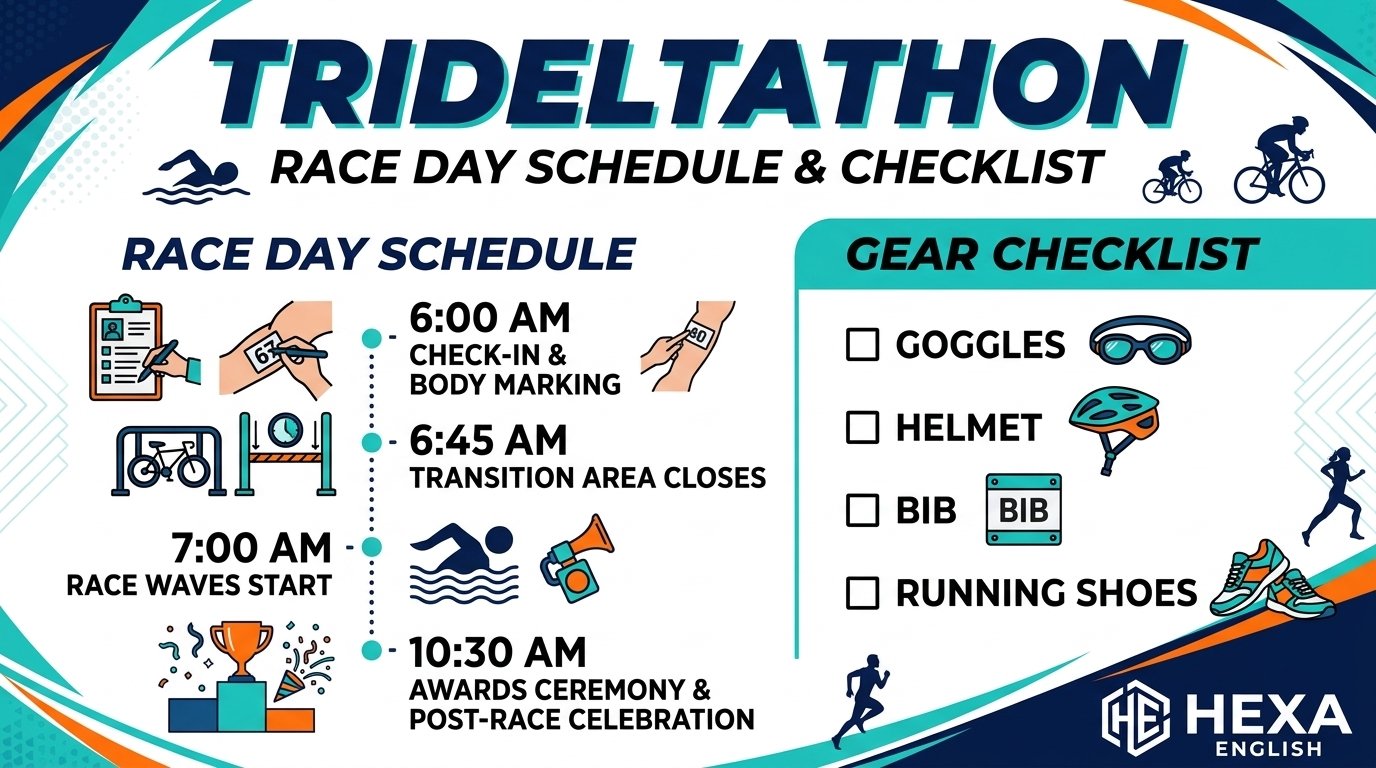

Trideltathon is a Knoxville sprint pool triathlon held at the University of Tennessee Student Aquatic Center, with a short, beginner friendly course. The race uses a 400 meter pool swim, a 6 mile campus bike ride, and a 3 mile campus run. That combination makes it shorter than a standard sprint triathlon, yet still a real multisport race.
Trideltathon is not a generic triathlon type, a national series, or a training method that anyone can run anywhere. The name belongs to a specific Knoxville event supported by Delta Delta Delta volunteers, with proceeds going to East Tennessee Children’s Hospital on historical listings. Searchers who treat it as a general distance will miss the venue, the format, and the entry rules.
Trideltathon also carries a date warning that every reader must see before planning travel, training, or registration. The latest race listings found in research show the 2020 edition, listed as the 36th year, with online registration closed on that listing. No current date, entry fee, or open registration was verified in that research, so the next edition must be checked directly with the organizer.
Trideltathon rewards careful reading, because course details changed across editions, including indoor and outdoor pool wording and one reverse format year. A reader who copies a 2009 course note as current, or a 2014 reverse format as regular, will prepare for the wrong race. Edition years matter for this event, and they are labelled throughout the sections below.
What Trideltathon Is, in One Clear Answer
Knoxville Event, Not a Generic Triathlon Type
Trideltathon is a named Knoxville race, not a distance category that other races can claim by using similar lengths. Other races may use a 400 meter swim, a short bike, and a short run, yet they are not Trideltathon unless they are the Knoxville event. That distinction protects readers from travelling to the wrong race or registering for a different event by mistake.

The name combines Tri Delta and triathlon, reflecting Delta Delta Delta sorority support for the Knoxville race. Volunteer support from sorority members appears in race listings across many editions, alongside race timing, course marshals, and race day help. The sorority connection is part of the event identity, not a separate race in another city.
Trideltathon also appears as a generic chapter event name at other universities, where chapters run a Tri-Delta-thon for St Jude Children’s Research Hospital. Those chapter events are not the Knoxville race, even when they share a similar name and a charitable purpose. Readers should check city, venue, organizer, and distances before assuming two events with similar names are the same race.
Distances: 400 Meter Swim, 6 Mile Bike, 3 Mile Run
Trideltathon distances are 400 meters swimming, 6 miles cycling, and 3 miles running, in that order for the regular format. The swim equals 8 lengths of a 50 meter pool lane sequence, the bike equals a short campus tour, and the run equals a campus loop. Those distances place the race in the mini sprint range, below a standard sprint triathlon.
A standard sprint triathlon commonly uses 750 meters swimming, 20 kilometers cycling, and 5 kilometers running, which is longer on every leg than Trideltathon. An Olympic distance triathlon uses 1,500 meters swimming, 40 kilometers cycling, and 10 kilometers running, which is far longer still. Trideltathon therefore suits a first timer who can already swim, bike, and run separately, but who does not yet want Olympic distance training.
Distance labels can mislead, because mini sprint and sprint are used loosely across race directories and local events. Some directories call Trideltathon a mini sprint, while others call it a sprint triathlon, and both labels point to the same Knoxville distances. Readers should trust the three numbers, 400 meters, 6 miles, and 3 miles, more than any single distance label.
Current Status Check Before You Plan
Current status for Trideltathon is unverified for a future edition at the time of the research behind this resource. The TriSignUp and RunSignUp listings fetched show April 19, 2020, from 8:30am to 10:30am Eastern time, with online registration closed. That listing does not prove the race ended permanently, and it does not prove a new edition is open.
Readers should check Race Day Events first, since that organizer appears on race listings for the Knoxville event. Then check TriSignUp and RunSignUp for a new edition, a new date, a new price, and a new course description. If no new edition appears, do not book travel, do not assume a spring date, and do not copy a 2020 price or packet time as current.
Status checking also protects training plans, because a 6 week plan aimed at a guessed April date can end weeks before or after a real race. A training plan should start only after a verified race date exists, or should be treated as general fitness training rather than race preparation. That discipline saves disappointment and wasted peak training.
| Fact | Trideltathon, regular format | Source label |
|---|---|---|
| Venue | University of Tennessee Student Aquatic Center, Knoxville, Tennessee | Race listings, 2020 edition |
| Swim | 400 meters, indoor pool on 2020 listing | Race listings, 2020 edition |
| Bike | 6 miles, UT campus and Neyland Drive | Race listings, 2020 edition |
| Run | 3 miles, UT campus | Race listings, 2020 edition |
| Start time on listing | 8:30am Eastern time | Race listings, 2020 edition |
| Organizer on listings | Race Day Events | Race listings and directories |
| Beneficiary on listings | East Tennessee Children’s Hospital, proceeds | Race listings, historical editions |
| Sanctioning on 2020 listing | NOT a USA Triathlon sanctioned event | Race listings, 2020 edition |
Trideltathon at a Glance
Venue: UT Student Aquatic Center, Knoxville
The venue is the University of Tennessee Student Aquatic Center, at 2106 Andy Holt Avenue, Knoxville, Tennessee 37996, on race listings. The pool provides a controlled swim start, lane structure, and spectator access that open water races cannot offer. Campus roads provide the bike and run courses, with landmarks that help spectators follow the race.
Campus venues also create parking and access rules that change by year, construction, and university events. Historical course notes mention a parking garage on Volunteer Boulevard between Caledonia and Andy Holt Avenue, plus a lot west of Stokely Athletic Center. Those parking notes are historical, from 2009 and 2010 listings, and must be checked against a current edition guide before race day.
Spectators benefit from a campus race layout, because the swim, transition, bike, and run all sit close together compared with a rural open water race. Family members can watch the swim start, see transition, and catch the run finish without long drives between legs. Spectators should still check current spectator rules, since pool access and campus road closures vary by edition.
Individual Versus Relay Entry at a Glance
Individual entry covers all three legs solo, with one athlete swimming, cycling, and running in sequence. Relay entry splits the three legs across team members, so one person swims, another cycles, and another runs. Relay teams suit friends, families, and students who want to try triathlon without training for all three sports alone.
Age rules on the fetched listing state individual entry open to ages 10 to 99, and relay entry open to ages 7 to 99. Those ages are listing ages for the 2020 edition, not a guarantee for a future edition, and upper age 99 likely reflects a listing cap rather than a tested eligibility rule. Parents should check current age rules, guardian requirements, and relay team size before registering a young athlete.
Awards on the 2020 listing include overall, age group, and relay division awards, which reward fastest overall athletes, fastest athletes within age groups, and fastest relay teams. Award categories can change by edition, participant numbers, and organizer decisions, so current award lists must be checked on a new edition page. Awards matter less than finishing safely for most first timers, yet they help explain race results.
Beneficiary and Volunteers
Beneficiary wording on historical race listings states that proceeds go to East Tennessee Children’s Hospital, a local children’s hospital in the Knoxville region. That beneficiary is specific to the Knoxville race listings, and it should not be replaced with a national charity name without a current edition check. Race proceeds, donation amounts, and fundraising totals were not stated in the fetched listings, so no amount is claimed here.
Volunteer support on historical listings comes from Delta Delta Delta sorority members, who help with race day roles and community spirit. Volunteer roles can include registration, transition help, course marshals, water stops, and finish area support, depending on organizer needs. Volunteers make a campus race feel welcoming, especially for first timers who need directions and encouragement.
Beneficiary confusion arises because Tri Delta national philanthropy is St Jude Children’s Research Hospital, partnered since 1999. That national partnership covers many chapter events across the United States and Canada, including letter writing campaigns and campus fundraisers. It does not automatically make St Jude the beneficiary of the Knoxville race, whose listings name East Tennessee Children’s Hospital instead.
Sanctioning: What NOT USAT Sanctioned Means
Sanctioning wording on the 2020 listing states that Trideltathon is NOT a USA Triathlon sanctioned event, which matters for rules, insurance, and membership. A USA Triathlon sanctioned event follows USA Triathlon rules, requires membership or a one day license in many cases, and uses sanctioned officials and procedures. A non sanctioned event follows organizer rules instead, which may be similar in spirit yet different in detail.
Non sanctioned status does not mean unsafe or unofficial in a general sense, since many local races run safely without national sanctioning. It does mean readers should not assume USA Triathlon rules, age group standards, or membership requirements apply automatically. Current edition rules, helmet rules, and course rules must be read on the organizer page for that edition.
Sanctioning can also change by edition, so a future edition could seek sanctioning even though the 2020 listing did not carry it. Readers should check sanctioning status on a new edition page, rather than copying the 2020 status forward forever. That check also affects whether a USA Triathlon membership or one day license would be needed.
The Course, Leg by Leg
Swim: 400 Meter Indoor Pool, Time Trial Start
The swim on the 2020 listing is a 400 meter indoor pool swim, which suits beginners who fear open water, waves, and sighting. Indoor pools remove wind, currents, and water temperature surprises, while lane ropes and pool walls give clear structure. A pool swim still demands fitness, breathing control, and comfort in crowded lanes, so practice remains essential.
Swim format on the 2020 listing uses a time trial start at about 7 second intervals, with swimmers entering one at a time. Swimmers are seeded fastest to slowest by estimated 400 meter swim time, so faster swimmers start earlier and slower swimmers start later. Seeding reduces overtaking chaos, yet slower swimmers should still expect faster swimmers to pass in later lanes.
Swim format detail states that swimmers swim each 50 meter lane, 8 lanes total, by ducking under the rope at the end of each length. A swimmer steps into lane one, swims its length, ducks under the lane rope, and continues into lane two, repeating until 8 lengths are complete. That lane sequence differs from a normal lap swim, so first timers should practice ducking under ropes and changing lanes before race day.

Historical swim format from 2009 used about 5 second intervals, also fastest first, with the same lane duck under pattern. The interval change from 5 seconds to 7 seconds shows why current edition details must be checked, since start spacing affects congestion and total swim duration. A swimmer who trains for a mass start will still benefit, yet should practice a calm, individual start instead.
T1: Pool Exit to Bike Rack
Transition one, called T1, covers the change from swimming to cycling, including pool exit, transition area entry, helmet, shoes, and bike mount. Historical course notes state that swimmers exit the pool by stairs on the right, exit the pool area by a door, and proceed to the bike area. That exit route is historical, and current transition layout must be checked on a new edition guide.
Bike racks on historical course notes are numbered, with each athlete assigned a spot for bike and equipment. Numbered racks reduce confusion, yet athletes must still know their rack number, row, and exit direction before the race starts. A short transition walkthrough on race morning, where allowed, prevents costly mistakes under race pressure.
Helmet rules on historical course notes state that hard shell helmets are required at all times, even during warm up. That rule reflects standard triathlon safety practice, where a helmet must be fastened before touching the bike. Athletes should practice fastening a helmet with wet hands, since pool water and race nerves can make simple straps feel difficult.
Bike: 6 Mile UT Campus and Neyland Drive Tour
The bike leg on the 2020 listing is a 6 mile tour of the UT campus and Neyland Drive, which is short enough for a beginner yet hilly enough to demand pacing. Historical course notes from 2017 describe a two lap campus tour with a few rollers broken up by a flat section along Neyland Drive. Rollers mean short, rolling hills rather than one long climb, yet they still reward steady effort over early sprinting.
Bike safety notes from 2009 warn that the course is open to traffic, with caution required at intersections and course maps to be reviewed before race day. Open traffic means cars, pedestrians, and campus activity may share or cross the course, even with marshals present. Athletes must obey traffic directions, ride predictably, and never assume a road is fully closed unless a current edition guide states so clearly.
Bike safety notes from 2009 also warn that the bike course contains railroad tracks, with extreme care required at crossings. Railroad tracks can catch narrow road tires, especially when crossed at a shallow angle or when wet. Athletes should cross tracks at a near right angle where safe, slow before the crossing, and check a current course map for whether tracks remain on the route.
T2: Bike to Run
Transition two, called T2, covers the change from cycling to running, including bike racking, helmet removal, shoe change, and run exit. T2 often feels strange for beginners, because legs feel heavy after cycling, a sensation coaches call brick legs. A short brick workout in training, cycling then running, helps athletes learn that heavy feeling before race day.
T2 layout for Trideltathon follows the same transition area as T1 in most campus sprint designs, with bike racks, run shoes, and race number placement in one zone. Athletes should place run shoes, a race belt, and nutrition in a clear, compact spot, without spreading gear into a neighbour’s space. A tidy transition saves time and reduces stress, especially for first timers.
Helmet rules in T2 require athletes to keep the helmet fastened until the bike is racked, under standard triathlon practice. Removing a helmet while still holding the bike, or before racking, can draw a penalty in sanctioned races and creates a safety risk in any race. Current edition rules must be checked, since non sanctioned events may word the rule differently.
Run: 3 Mile Campus Run
The run leg on the 2020 listing is a 3 mile campus run, passing Neyland Stadium and Thompson Boling Arena, which gives spectators clear landmarks and athletes a memorable finish. Historical course notes describe a fairly hilly run, with water stops at miles 1 and 2 in the 2009 edition. Hills on a campus run often come from roads and walkways between buildings, not from mountain trails, yet they still demand pacing.
Run course bans on historical course notes state no headphones, pets, strollers, skates, or skateboards of any kind on the course. Those bans protect athletes, volunteers, and spectators on narrow campus paths, where a stroller or a pet could create a collision risk. Current edition bans must be checked, since bans can change, yet headphones bans remain common in triathlon for safety and official communication.
Run pacing for a 3 mile leg after swimming and cycling should feel controlled at the start, steady in the middle, and strong at the finish for most beginners. Athletes who sprint the first half mile often slow sharply later, especially after a hilly bike leg. A conservative first mile, a steady second mile, and a push in the final mile usually produces a better overall time and a better finish feeling.
| Leg | Distance | Key format point | Beginner tip |
|---|---|---|---|
| Swim | 400 meters | Indoor pool, time trial start, seeded, 8 lanes with duck under | Practice lane changes and calm starts |
| T1 | Transition | Pool exit to numbered bike rack, helmet fastened first | Walk transition before the race where allowed |
| Bike | 6 miles | Campus and Neyland Drive, rollers, open traffic caution historical | Pace rollers, cross tracks at a safe angle |
| T2 | Transition | Bike racked before helmet removal, run shoes ready | Practice brick runs to learn heavy legs |
| Run | 3 miles | Campus run past Neyland Stadium and Thompson Boling Arena, hilly historical | Start controlled, finish strong |
Individual Versus Relay: Which Entry Fits You
Individual: Ages 10 to 99 on Listing, All Three Legs Solo
Individual entry suits athletes who can swim 400 meters, bike 6 miles, and run 3 miles in sequence, even at a slow and steady pace. Individual athletes control pacing, transitions, and race strategy alone, which builds confidence and a complete multisport experience. Individual entry also suits students and adults who want a personal spring goal on a campus course.
Individual entry demands training in all three sports, plus transition practice, which takes more weekly time than a single sport race. A beginner individual plan should build swim comfort first, since swim anxiety causes more race day problems than bike or run fitness for many first timers. A 6 week plan can work for a fit beginner, while a less fit beginner may need 8 to 12 weeks.
Individual age wording on the listing, ages 10 to 99, should be read as a listing range, not as a claim that every age in that range can safely race without preparation. Young athletes need guardian consent, supervision, and age appropriate training, while older athletes need medical clearance where relevant and a realistic pacing plan. Current edition age rules and guardian requirements must be checked before registering a minor.
Relay: Ages 7 to 99 on Listing, Split Swim Bike Run
Relay entry suits teams who want to share the race, with one member swimming, one cycling, and one running. Relay teams let a strong swimmer, a strong cyclist, and a strong runner each contribute their best leg, while friends and family share the experience. Relay entry also suits a first timer who wants to try one leg before committing to a full individual race.
Relay entry still demands team coordination, including transition handoffs, timing chip transfer, and a shared race plan. Relay members must know where handoffs happen, who carries the timing chip, and how to enter and exit transition without interfering with individual athletes. A short team meeting before race day, plus a transition walkthrough where allowed, prevents most relay mistakes.
Relay age wording on the listing, ages 7 to 99, is broader than individual entry, which reflects the lower load of a single leg. A 7 year old relay swimmer still needs swim competence, supervision, and a safe transition plan, while a 7 year old relay runner still needs run fitness and course awareness. Current edition relay rules, team size, and guardian requirements must be checked before registering a young relay member.
Awards: Overall, Age Group, and Relay Division
Awards on the 2020 listing include overall, age group, and relay division awards, which recognize fastest athletes overall, fastest athletes within age groups, and fastest relay teams. Age group awards help athletes compare against peers of similar age, rather than only against elite overall winners. Relay awards help teams celebrate a shared result, even when no single member could win individually.
Award details such as age group bands, award depth, and ceremony time were not stated in the fetched listing excerpt, so no specific award count is claimed here. Current edition award information must be checked on a new edition page, including whether awards are given on race day or mailed later. First timers should focus on finishing safely and enjoying the race, with awards as a bonus rather than a goal.
Student Pricing: Available on Listing, Amount Not Stated
Student pricing wording on the 2020 listing states that special student pricing is available, yet no student price amount appears in the fetched listing text. That gap matters, because a student cannot budget from a phrase alone, and a future edition may change student eligibility or price. Current student pricing, student ID requirements, and student registration deadlines must be checked on a new edition page.
Student pricing also raises a verification question for readers who are not University of Tennessee students. Some races offer student pricing only to enrolled students at a specific university, while others offer student pricing more broadly. Readers should not assume eligibility from a phrase, and should check student definition, ID proof, and registration channel before paying.
| Entry type | Listing age range | Legs per person | Best for |
|---|---|---|---|
| Individual | Ages 10 to 99 on 2020 listing | Swim, bike, and run solo | Athletes who can train all three sports |
| Relay | Ages 7 to 99 on 2020 listing | One leg per team member, typically | Friends, families, students, first time teams |
| Relay split example | Check current team size rules | Swimmer, cyclist, runner | A team with different strengths |
Is Trideltathon a Good First Triathlon
Why a Pool Swim Helps Beginners
A pool swim helps beginners because water conditions stay predictable, with no waves, currents, wind, or murky water to navigate. Beginners can focus on breathing, stroke, and pacing, rather than sighting buoys, fighting waves, or managing open water anxiety. A time trial start also helps, because swimmers enter one at a time instead of fighting a mass start in open water.
A pool swim still challenges beginners, because lane changes, ducking under ropes, and passing require practice and calm. Swimmers who only practice straight laps in one lane may feel confused when they must change lanes every 50 meters. A practice session that mimics the lane sequence, with calm starts and lane changes, builds race day confidence quickly.
Pool swim comfort also depends on seed time honesty, since seeding fastest to slowest only works when athletes estimate their 400 meter time accurately. An athlete who underestimates swim time may start too early and be passed often, while an athlete who overestimates may start too late and face congestion. Honest seed times help everyone, including the athlete who submits them.
Why Short Distances Help, and Where They Still Challenge
Short distances help beginners because training time stays manageable, with 6 to 12 weeks often enough for a fit beginner to prepare. A 400 meter swim, 6 mile bike, and 3 mile run can be completed in under 2 hours by many beginners, including transitions, based on historical race duration windows. Short distances also reduce injury risk compared with long course training, when built gradually and with rest days.
Short distances still challenge beginners, because three sports in sequence create unique fatigue, especially the bike to run transition. An athlete who can run 3 miles alone may struggle to run 3 miles after swimming and cycling, due to tired legs and changed breathing. Brick workouts, which combine cycling and running in one session, teach that transition feeling before race day.
Short distances also challenge pacing judgment, because beginners often start too fast on the swim or bike and fade on the run. A campus course with rollers and hills punishes early sprinting more than a flat course, since hills demand extra effort at the wrong moment. A conservative start, steady middle, and strong finish usually beats an all out start for first timers.
Who Should Not Start With a Triathlon Yet
A triathlon may not suit a beginner who cannot yet swim 400 meters comfortably, even with rests, or who fears water deeply without any swim training. Swim safety comes first in triathlon, because a swim leg with no safe exit or rescue access can become dangerous quickly. Such athletes should build swim lessons and pool comfort first, then return to triathlon planning.
A triathlon may also not suit a beginner with an unmanaged medical condition, recent injury, or no medical clearance where relevant, without clinician guidance. Endurance exercise, heat, and race stress can aggravate some conditions, and a race is not the place to test a new medical situation. General training information here is not medical advice, and readers with health concerns should seek clinician guidance before training or racing.
Pool Triathlon Versus Open Water Triathlon
Pool triathlons suit beginners who want predictable water, lane structure, and easy rescue access, with no sighting or wave navigation. Open water triathlons suit athletes who want lake, river, or ocean racing, with mass starts, wetsuits, and sighting skills. Both formats count as triathlons, yet they demand different swim skills and different race day preparation.
Open water skills include sighting every few strokes, swimming near other athletes, and exiting water onto a beach or dock, none of which a pool race requires in the same way. Pool skills include lane changes, ducking under ropes, and time trial starts, which open water athletes may never practice. Athletes should choose a format that matches current swim comfort, then train for that format specifically.
| Format | Swim setting | Start style | Best for |
|---|---|---|---|
| Pool triathlon, Trideltathon style | Indoor pool, lanes, controlled | Time trial, seeded, one at a time | Beginners, swim anxiety, predictable conditions |
| Open water triathlon | Lake, river, or ocean, buoys | Mass start or wave start, often | Athletes comfortable with sighting and waves |
| Reverse format, 2014 Trideltathon only | Run, bike, swim order | Historical special format | History interest, not current format guidance |
How to Train for Trideltathon
Baseline Check Before a Training Plan
Baseline training should confirm that an athlete can swim, bike, and run separately at a comfortable pace before combining them. A useful baseline from a Knoxville training page states that a novice should be able to comfortably run 20 minutes to begin a sprint program. That baseline is a training program entry point, not a race qualification rule, and it helps set realistic plan length.
Swim baseline should focus on comfort and breathing, not speed, with an ability to swim 400 meters with rests if needed during early training. Bike baseline should focus on handling, braking, and road awareness, with a bike in good mechanical order and a helmet that fits correctly. Run baseline should focus on steady running or run walk intervals, with shoes that fit and no current injury pain.
Baseline training should also include rest days, sleep, and gradual progression, since sudden jumps in swim, bike, or run volume increase injury risk. A beginner who adds too much too fast often develops shin pain, knee pain, or shoulder fatigue, which then derails the whole plan. Gradual progression, with one harder session followed by easier sessions, builds fitness more safely.
6 Week Beginner Plan for Exact Distances
A 6 week beginner plan suits a fit beginner who already exercises regularly and can swim, bike, and run separately at a basic level. Weeks 1 and 2 build consistency, with short swim, bike, and run sessions plus one brick workout in week 2. Weeks 3 and 4 build distance toward race distances, with longer swims, bikes, and runs plus transition practice.
Weeks 5 and 6 build race simulation and taper, with a practice race simulation in week 5 and reduced volume in race week. Race simulation should include a pool swim sequence, a bike ride, a transition, and a short run, at a controlled pace rather than maximum effort. Race week should focus on rest, gear checks, course review, and sleep, rather than last minute hard training.
A 6 week plan must stay flexible for illness, weather, and life events, since missed sessions happen often. A missed session should be skipped, not doubled the next day, to protect against injury and fatigue. Athletes who miss a full week should extend the plan or choose a later race, rather than cramming training into a few days.
8 to 12 Week Plan for a Standard Sprint, If You Want More
An 8 to 12 week plan suits a less fit beginner, a nervous swimmer, or an athlete who wants a standard sprint after Trideltathon. A longer plan allows more swim technique work, more bike handling practice, and more run walk progression without rushed volume jumps. A longer plan also allows more brick workouts, transition practice, and race simulation sessions.
A standard sprint plan commonly uses 750 meters swimming, 20 kilometers cycling, and 5 kilometers running as target distances, which exceed Trideltathon distances on every leg. Athletes who train for a standard sprint will find Trideltathon distances comfortable, yet should still practice the specific pool swim format. Training for a longer race does not replace format practice for a pool swim sequence.
Brick Workouts: Bike to Run Practice
Brick workouts combine cycling immediately followed by running in one session, teaching legs to switch from pedalling to running efficiently. A beginner brick workout might include a 20 minute easy bike ride followed by a 10 minute easy run, with a quick shoe change in between. Brick workouts should start short and easy, then build gradually as fitness and confidence grow.

Brick workouts also teach transition skills, including helmet handling, shoe changes, race belt placement, and pacing after cycling. Athletes should practice brick workouts in race shoes and race gear where possible, to avoid surprises on race day. A brick workout that feels awkward at first usually feels smoother after 3 or 4 repetitions across several weeks.
Transition Practice at Home
Transition practice at home can use a driveway, garage, or backyard to simulate T1 and T2 without a full race course. Athletes can practice laying out gear in order, fastening a helmet with wet hands, changing shoes quickly, and racking a bike safely. A short practice session of 15 minutes, repeated weekly, often saves more race time than an extra hard bike workout.
Transition practice should also include timing chip and race belt handling, since fumbling with a chip or belt under pressure wastes time and creates stress. Athletes should practice putting on a race belt while moving, checking that a timing chip stays secure, and exiting transition in the correct direction. A calm transition routine, practiced at home, feels automatic on race day.
| Week | Swim focus | Bike focus | Run focus | Brick and transition |
|---|---|---|---|---|
| Week 1 | Short pool sessions, breathing and comfort | Short easy rides, handling and braking | Short easy runs or run walk intervals | Gear check, helmet fit |
| Week 2 | Build toward 200 to 300 meters total | Build toward 4 to 5 miles | Build toward 1.5 to 2 miles | First short brick, bike then run |
| Week 3 | Build toward 400 meters with rests | Build toward 6 miles | Build toward 2 to 2.5 miles | Transition practice, shoe change |
| Week 4 | 400 meters steady, lane change practice | 6 miles with rollers if possible | 2.5 to 3 miles steady | Brick workout, longer run after bike |
| Week 5 | Race simulation swim sequence | Race simulation bike at race pace | Race simulation run after bike | Full practice transition, T1 and T2 |
| Week 6 | Short easy swims, rest | Short easy rides, bike check | Short easy runs, rest | Gear pack, course review, sleep |
Beginner Clinic Example: Fleet Feet Knoxville, Historical Program Only
A Fleet Feet Knoxville training page lists a Triathlon 101 program for novice triathletes, with a goal to complete a sprint distance triathlon. That page lists pool swim sessions at Davis YMCA, clinics for bike maintenance, race day prep, transition setup, and nutrition planning, plus weekly coach emails and a technical shirt and swim cap. Those program features describe a training program model, not a Trideltathon entry package.
That same page lists yearly sessions including Early Spring, February to April, 6 weeks to TriDeltathon Sprint Tri, plus Late Spring to Foothills Sprint Tri and Summer to Springbrook Sprint Tri. That early spring session shows Trideltathon served as a target race for a Knoxville training program, which supports its beginner friendly reputation. Program year, price, and current availability were not verified for a future edition, so that session must be treated as historical program context only.
Gear Checklist for a Pool Sprint
Must Have Gear
Must have gear for a pool sprint includes a swimsuit or tri suit, goggles, swim cap, bicycle, hard shell helmet, and running shoes. A tri suit allows an athlete to swim, bike, and run in one outfit, reducing changing time in transition. A swimsuit plus bike shorts and a run top can also work for a beginner, with a quick change in transition where rules allow.
Goggles must fit without leaking and without excessive pressure, since a leaking goggle during a 400 meter swim can ruin pacing and confidence. Athletes should test goggles in training, adjust straps before race day, and bring a spare pair if possible. Swim caps help with hair management and identification, and some races provide a cap with registration.
Bicycles for a beginner sprint can be a road bike, hybrid bike, or mountain bike, provided the bike fits, brakes work, and tires hold air. A proper bike fit matters more than an expensive bike for a short campus course, since a poorly fitted bike causes discomfort and handling problems. Athletes should get a basic bike safety check before race week, including brakes, gears, chain, and tire pressure.
Helpful Gear
Helpful gear includes a race belt, elastic laces, transition bag, water bottle, bike pump, and spare tube. A race belt holds a race number without safety pins through clothing, and elastic laces allow faster shoe changes in transition. A transition bag keeps gear organized for race morning, while a water bottle supports hydration before, during, and after the race.
Helpful gear also includes sunscreen, a towel, and a change of clothes for after the race, especially for a campus race with a finish area and awards. A towel helps dry off after the pool swim and transition, while a change of clothes helps athletes stay comfortable for awards and photos. Athletes should pack helpful gear the night before, rather than searching for items on race morning.
Do You Need a Triathlon Bike
A triathlon bike is not required for a beginner sprint, and many first timers finish happily on a road, hybrid, or mountain bike. Triathlon bikes use aero bars and a forward position for speed, yet they demand handling practice and a proper fit to be safe. Beginners should prioritize fit, braking, handling, and comfort over aero speed for a 6 mile campus bike leg.
Bike choice should also consider course hills, traffic, and railroad tracks on historical Trideltathon course notes, where handling matters more than top speed. A mountain bike with wide tires may handle tracks and campus roads comfortably, while a road bike may feel faster on flat sections. Athletes should test their chosen bike on similar roads and hills before race day.
Wetsuit: Usually Not Needed for an Indoor Pool Swim
Wetsuits are usually not needed for an indoor pool swim, since pool water temperature is controlled and wetsuit buoyancy offers little benefit over 400 meters. Wetsuits also add transition time, since removing a wetsuit with wet skin takes practice and can slow T1 significantly. Current edition rules must be checked, since some races restrict wetsuits for pool swims or set water temperature rules.
Open water races differ, because wetsuits provide warmth and buoyancy in lakes, rivers, and oceans, especially in cold water. Athletes planning an open water race after Trideltathon should practice wetsuit swimming separately, including removal in transition. Pool race experience alone does not teach wetsuit removal, sighting, or mass start skills.
| Gear item | Must have or helpful | Beginner note |
|---|---|---|
| Swimsuit or tri suit | Must have | Tri suit reduces changing, swimsuit plus shorts also works |
| Goggles | Must have | Test fit in training, bring a spare pair if possible |
| Swim cap | Must have or provided | Check whether race provides a cap |
| Bicycle, fitted and safe | Must have | Road, hybrid, or mountain bike can work for beginners |
| Hard shell helmet | Must have | Fastened before touching bike, practice with wet hands |
| Running shoes | Must have | Fit matters more than brand, test on brick runs |
| Race belt and elastic laces | Helpful | Faster transitions, less fumbling under pressure |
| Transition bag, water bottle, spare tube | Helpful | Pack the night before race morning |
Race Morning: Packet, Transition, and Timeline
Packet Pickup Example: Race Morning 6:30am on 2020 Listing
Packet pickup wording on the 2020 listing states that packets may be picked up on race morning starting at 6:30am at the race venue, with day of race registration also available at that time on that listing. Packet pickup usually provides a race number, timing chip, swim cap where provided, and race instructions. That 6:30am time is historical, tied to an 8:30am start, and must not be copied as a current packet time without a new edition check.
Packet pickup also appeared on a prior day at Fleet Feet in historical listing notes, with a packet pickup date to be announced and a beginner clinic on April 13 at 6pm at the UT Aquatic Center. That combination shows race week often includes both a store packet pickup and a race morning option, yet details change by edition. Current packet locations, times, and ID requirements must be checked on a new edition page.
Athletes should arrive early enough for packet pickup, body marking, bike racking, timing chip pickup, and a pre race meeting, even when race morning registration is offered. Historical course notes for 2010 advised arrival by 6:30am, with a pre race meeting at 7:45am, for a race with over 400 competitors. Early arrival reduces stress, allows a transition walkthrough, and leaves time for gear problems.
Body Marking, Timing Chip, and Bike Racking
Body marking involves writing race numbers on arms and legs with a marker, so officials, photographers, and medical staff can identify athletes. Body marking usually happens at packet pickup or transition entry, with volunteers marking numbers in a standard location. Athletes should keep body marking visible and dry, and should not wash it off before the race starts.
Timing chips record swim, transition, bike, run, and finish splits, with mats at key course points. Historical course notes mention ChampionChip timing, with chips distributed on race morning and returned immediately after finishing, plus a $30 charge for not returning a chip in 2010 notes. Timing chip rules, return rules, and charges vary by edition and timing company, so current rules must be checked.
Bike racking involves placing a bike in an assigned numbered rack spot, with helmet, shoes, and gear arranged in that spot. Athletes should rack bikes early, check tire pressure, check brakes, and walk from swim exit to bike rack to run exit before the race starts. A calm racking routine prevents lost gear, wrong rack spots, and transition direction mistakes.
Pre Race Meeting and Start Time
Pre race meetings explain course rules, transition rules, swim start order, safety cautions, and finish procedures for that edition. Historical notes advise a pre race meeting at 7:45am for a race with an 8:30am start, though meeting times vary by edition. Athletes should attend the pre race meeting even if they have raced before, since course, traffic, and swim format details change.
Start time on the 2020 listing is 8:30am Eastern time, with an end time of 10:30am Eastern time on that listing. That 2 hour window reflects a short sprint race with time trial swim starts, not a full day endurance event. Current start time, wave order, and finish cutoff, if any, must be checked on a new edition page before planning arrival and spectator times.
Spectator Guide: Campus Parking Historical Notes
Spectator parking historical notes mention a parking garage on Volunteer Boulevard and a lot west of Stokely Athletic Center, from 2009 and 2010 course information. Those notes help spectators understand campus parking options, yet garage availability, fees, and road closures change with university events and construction. Current spectator parking, road closures, and pool viewing rules must be checked on a new edition guide.
Spectators should plan to arrive early, wear comfortable shoes, and bring water and sun protection for a campus race with walking between swim, transition, and finish areas. Spectators should also respect transition boundaries, course marshals, and athlete space, since transition areas are working zones rather than viewing stands. A spectator who follows marshal directions helps athletes race safely and finish happily.
| Race morning step | Historical example, 2020 listing unless noted | Verify for current edition |
|---|---|---|
| Packet pickup | Race morning from 6:30am at venue, plus prior day option to be announced | Location, time, ID, and day of race registration |
| Body marking and timing chip | Body marking at venue, chip distributed race morning, returned after finish | Chip return rule and any charge |
| Bike racking | Numbered rack spot, bike and gear in assigned space | Rack number, transition entry and exit |
| Pre race meeting | Historical 7:45am meeting for 8:30am start in 2010 notes | Meeting time and location for current edition |
| Race start | 8:30am Eastern time on 2020 listing | Start time, wave order, finish cutoff |
Safety, Rules, and Course Cautions
Helmet Required at All Times, Even Warm Up
Helmet safety on historical course notes states that hard shell helmets are required at all times, even during warm up, which is a strong safety rule for campus racing. A helmet protects the head during a fall, a collision, or a bike handling error, even at low speed on campus roads. Athletes should wear a helmet whenever they sit on a bike in the race area, not only during the timed bike leg.
Helmet fit matters as much as helmet presence, since a loose or tilted helmet offers less protection and can slip during a fall. A helmet should sit level on the head, cover the forehead, and fit snugly with straps adjusted under the chin. Athletes should check helmet fit in training, replace a helmet after a crash, and follow manufacturer guidance on helmet age and damage.
Open Traffic Course Caution, Intersections, Railroad Tracks
Open traffic caution from 2009 course notes states that the course is open to traffic, with caution required at intersections and course maps to be reviewed before race day. Open traffic racing demands defensive riding, predictable lines, and obedience to marshals and traffic officials. Athletes must never assume a car will stop, a pedestrian will yield, or a road is closed unless a current edition guide states so clearly.
Railroad track caution from 2009 course notes warns athletes to be extremely careful at railroad tracks on the bike course. Tracks can catch narrow tires, especially when crossed at a shallow angle, when wet, or when a tire slips into a groove. Athletes should slow, choose a safe crossing angle, and check a current course map for whether tracks remain on the route in a new edition.

Intersection caution also applies to the run leg, where campus paths, roads, and pedestrian crossings intersect with athlete flow. Runners should stay on the marked course, follow marshal directions, and watch for vehicles, cyclists, and pedestrians at crossings. A runner who cuts a corner or leaves the marked course risks a wrong turn, a collision, or disqualification under race rules.
Run Course Bans Historical: No Headphones, Pets, Strollers, Skates, Skateboards
Run course bans on historical course notes state no headphones, pets, strollers, skates, or skateboards of any kind on the course. Headphone bans help athletes hear marshal instructions, traffic warnings, and other athletes, especially on narrow campus paths. Pet and stroller bans protect athletes, animals, and children from collisions in a timed race environment.
Current edition bans must be checked, since bans can change with venue, insurance, and organizer policy, yet similar bans remain common in triathlon. Athletes who rely on music for pacing should train without headphones before race day, so race day silence does not feel strange. Spectators with pets or strollers should check spectator areas and viewing rules, rather than bringing them onto the course.
Heat, Hydration, and Medical Support, General Information Only
Heat and hydration information here is general information only, not medical advice, and athletes with health concerns should seek clinician guidance before training or racing. Endurance exercise in heat increases sweat loss, heart rate, and fatigue, especially on a hilly campus course in spring warmth. Athletes should drink before feeling thirsty, use water stops where provided, and slow down if they feel dizzy, nauseous, or confused.
Medical support at races usually includes first aid staff, volunteers, and a medical tent or contact point, with procedures for athletes who feel unwell during the race. Athletes who feel chest pain, breathing difficulty, confusion, severe dizziness, or signs of heat illness should stop immediately and seek medical help, rather than pushing to finish. Finishing a short sprint race never outweighs a serious medical risk, and officials would rather help an athlete early than late.
If You Feel Unwell During a Race
Feeling unwell during a race should trigger a stop, assess, and seek help response, not a push through pain response. Athletes should move to a safe spot off the course where possible, alert a marshal or volunteer, and accept medical assessment even if symptoms seem mild. Race officials can help with water, shade, transport, and medical referral, and they prefer early reports over late collapses.
Spectators who see an athlete in distress should alert a marshal, volunteer, or medical staff member promptly, with location and symptoms described clearly. Spectators should not give medication, food, or drink to an athlete who is confused, vomiting, or unable to swallow safely, unless directed by medical staff. Clear, calm reporting helps medical teams respond faster and more accurately.
History of Trideltathon
Early Editions and Reverse Retro Format in 2014
Early edition evidence includes a 2003 forum post mentioning a Tri-deltathon on April 25, 2004, in Knoxville, on the UT campus, with a 400 meter swim, 6 mile bike, and 3 mile run. That forum post describes the race as a very short sprint and fun to go all out for short distances, which matches later listings. Forum evidence is anecdotal, yet it confirms the race existed in the early 2000s with the same core distances.
The 2014 edition used a REVERSE RETRO format, with run, bike, swim order, as in the first 20 editions before chip timing made swim time trial starts possible. That reverse format celebrated the 30th edition, with special retro shirts and awards, relay availability, and a first leg position in the Fleet Feet Grand Prix Sprint series. Reverse format racing changes pacing, transition, and finish dynamics completely, so it must never be presented as the regular Trideltathon format.
Reverse format history also explains why old course notes differ on swim start, transition order, and finish location. A reader who finds a reverse format description without a year label may prepare for a run first race, when the regular format starts with a swim. Edition year labels prevent that error, and current edition format must be checked before training for a specific order.
Timeline: 2004 to 2020 Editions Found
Timeline evidence shows consistent core distances across editions, with format, pool, and edition number changing over time. The 2009 edition used an outdoor pool swim at the Student Aquatic Center in one description, while the 2020 edition used an indoor pool swim. That pool difference may reflect weather, facility scheduling, or listing wording, yet it shows why a current edition guide must be checked for pool location.
Edition numbers in listings include 31st year in 2015 descriptions, 36th year in 2020 listings, which align roughly with a race founded in the mid 1980s. Exact founding year was not verified in fetched results, so no founding year is claimed here beyond edition numbers stated in listings. A founding year claim would require an organizer history page or archive source, not an edition number calculation alone.
| Year found | Edition or event note | Format or course note |
|---|---|---|
| 2004, forum post 2003 | Tri-deltathon, UT campus, very short sprint | 400 meter swim, 6 mile bike, 3 mile run |
| 2009 | TriFind results edition | Outdoor pool swim wording, 5 second time trial start, hilly run, water stops miles 1 and 2 |
| 2010 | 25th Annual, over 400 competitors in notes | Parking garage and lot notes, arrival by 6:30am, pre race meeting 7:45am |
| 2014 | 30th edition, REVERSE RETRO | Run, bike, swim order, retro shirts and awards, Fleet Feet Grand Prix first leg |
| 2015, description in 2017 directory | 31st year | Regular swim, bike, run format, Delta Delta Delta volunteers, East Tennessee Children’s Hospital |
| 2017, directory date | BeginnerTriathlete race entry | Mini sprint, 400 meters, 6 miles, 3 miles, Race Day Events organizer |
| 2020 | 36th year, TriSignUp and RunSignUp listings | Indoor pool swim, 7 second time trial start, 8:30am start, NOT USAT sanctioned, expected participation 350 |
Oldest Running Pool Triathlon Claim: Organizer Claim Only
Oldest running pool triathlon wording appears in race listings as the oldest running pool triathlon in the country, a bold claim that should be treated as an organizer claim, not independently verified fact. No national registry, historical archive, or independent comparison was found in fetched results to confirm that no older pool triathlon exists elsewhere. Step 2 readers should quote that claim as an organizer claim, with the listing year attached, rather than as settled history.
Organizer claims help explain race pride and longevity, yet they do not replace evidence for founding year, continuous operation, or national comparison. A race can be long running and beloved without holding a national record, and a record claim needs a stronger source than a race description. Readers who repeat the claim without a label risk spreading an unverified superlative as fact.
Knoxville Track Club and Delta Delta Delta Roles Over Time
Knoxville Track Club appears in early philanthropy wording, with a newspaper catalogue entry stating Trideltathon was sponsored by Delta Delta Delta sorority and the Knoxville Track Club to support East Tennessee Children’s Hospital. That early wording shows a partnership between a sorority and a local running club, which suits a campus charity race. Later listings name Race Day Events as organizer, with Delta Delta Delta volunteers, showing organizer roles evolved over time.
Role evolution matters because sponsor, organizer, volunteer, and beneficiary are different roles, even when the same names appear across editions. A sorority can sponsor and volunteer without organizing timing, course safety, and registration, while a race organizer can manage logistics without owning the charitable mission. Readers should check current edition roles on a new edition page, rather than copying early role wording forward.
Trideltathon Versus Other Sprint Triathlons
Trideltathon Versus Standard Sprint
Trideltathon differs from a standard sprint triathlon by shorter distances on every leg, with 400 meters versus 750 meters swimming, 6 miles versus about 12.4 miles cycling, and 3 miles versus 3.1 miles running. The swim difference is largest, since 400 meters is just over half a standard sprint swim, while the run difference is smallest, since 3 miles is close to 5 kilometers. Trideltathon therefore feels easier on the swim, yet still demands a real run after cycling.
Standard sprint training plans commonly use 12 weeks for a beginner, with one daily workout and optional extra sessions, according to a USA Triathlon sprint plan description. Trideltathon training can use a shorter 6 week plan for a fit beginner, since distances are shorter, yet swim comfort and transitions still need practice. Athletes should choose plan length by current fitness and swim comfort, not by distance label alone.
Trideltathon Versus Olympic, Half Ironman, Ironman
Olympic distance triathlon uses 1,500 meters swimming, 40 kilometers cycling, and 10 kilometers running, which is about 3.75 times the Trideltathon swim, about 4 times the bike, and about 2 times the run. Half Ironman, also called Ironman 70.3, uses 1.2 miles swimming, 56 miles cycling, and 13.1 miles running, which is a long course event with very different training. Ironman uses 2.4 miles swimming, 112 miles cycling, and 26.2 miles running, which is a full day endurance event.
Those comparisons show why Trideltathon should never be described as an Ironman, a half Ironman, or an Olympic triathlon, even loosely. Distance labels matter for training, gear, nutrition, and safety, and a reader who confuses a mini sprint with an Ironman will train incorrectly and dangerously. Trideltathon is a short, beginner friendly sprint, not a long course championship.
Trideltathon Versus Foothills Sprint and Springbrook Sprint
Foothills Sprint Tri and Springbrook Sprint Tri appear on a Fleet Feet Knoxville training page as target races for Late Spring and Summer programs, after an Early Spring program targeting Trideltathon. That sequence suggests Knoxville beginners often start with Trideltathon in early spring, then progress to longer sprint races later in the year. That progression makes sense, since Trideltathon distances are shorter than many standard sprints.
Foothills and Springbrook distances were not stated in the fetched training page excerpt, so no distance comparison is claimed here beyond program order. Readers should check current Foothills and Springbrook race pages for distances, dates, and formats before planning a progression. A training progression should follow verified race distances, not assumed sprint lengths.
Trideltathon Versus Other Tri Delta Chapter Events
Other Tri Delta chapter events, such as Butler University Delta Lambda chapter events Flapjack Attack and Tri-Delta-thon, raise money annually for St Jude Children’s Research Hospital according to a campus map page. Those events share a Tri Delta identity and a charitable purpose, yet they are not the Knoxville race, with different cities, venues, organizers, and distances. Readers should not copy Butler event details into Knoxville race planning.
Chapter event distinction also clarifies national versus local philanthropy for Tri Delta members and supporters. National partnership with St Jude covers many chapters, while local chapter philanthropy can support a regional children’s hospital, such as Dolly Parton Children’s Hospital for the UTK chapter. Knoxville race listings name East Tennessee Children’s Hospital, which is a third, race specific beneficiary that must be kept separate from both national and chapter examples.
| Race or distance | Swim | Bike | Run | Best comparison point |
|---|---|---|---|---|
| Trideltathon, Knoxville | 400 meters, pool | 6 miles, campus | 3 miles, campus | Mini sprint, beginner friendly, pool format |
| Standard sprint | 750 meters | 20 kilometers, about 12.4 miles | 5 kilometers, about 3.1 miles | Longer swim and bike, similar run |
| Olympic, standard distance | 1,500 meters | 40 kilometers | 10 kilometers | Much longer on every leg |
| Half Ironman, 70.3 | 1.2 miles | 56 miles | 13.1 miles | Long course, very different training |
| Ironman, full | 2.4 miles | 112 miles | 26.2 miles | Full day endurance, not comparable |
How to Verify the Next Race Before You Register
Check Race Day Events First
Verification starts with Race Day Events, the organizer named on race listings and directories for the Knoxville event. Readers should search for Race Day Events plus Trideltathon, then look for a current edition page with date, location, distances, entry types, prices, and registration status. If no current edition page appears, readers should not assume a race date from an old listing or a training program page.
Verification should also include contact information, such as an organizer email, phone, or contact form on a current edition page, where available. A polite, specific message asking for next edition date, price, student pricing, sanctioning, and course format often resolves uncertainty faster than repeated web searches. Readers should record the reply date and content, since organizer plans can change during a season.
Check TriSignUp and RunSignUp for a New Edition
Verification continues with TriSignUp and RunSignUp, which host race listings, results, and participant lists for the Knoxville event. Readers should check for a new edition listing with a future date, open registration, and a full description, rather than the 2020 listing with closed registration. A new edition listing should also show current venue, start time, packet pickup, and course notes, which may differ from historical notes.
Verification should also include results pages, which can show whether a race ran recently, even when a registration page has not been updated. Results pages with recent dates, finish times, and age group placements provide stronger evidence of a current race than a training page mention alone. Readers should still confirm registration through the organizer, since results alone do not prove a future edition is open.
Check Date, Price, Student Price, Refund Policy, Sanctioning, Course Map, and Swim Format
Verification checklist should cover date, price, student price, refund policy, sanctioning, course map, and swim format, in that order, before paying. Date and price prevent travel and budget mistakes, refund policy protects against illness or cancellation, and sanctioning affects rules and membership needs. Course map and swim format prevent training for the wrong route or the wrong swim start.
Verification checklist should also cover age rules, relay rules, packet pickup, parking, and award categories, since those details affect families, teams, and spectators. A race with a new venue, a new course, or a new swim format may look like Trideltathon by name yet feel different in practice. Readers who verify all checklist items arrive prepared, while readers who verify only date and price often face race morning surprises.
What to Do If No Current Edition Is Listed
If no current edition is listed, readers should treat Trideltathon as historical until proven otherwise, and choose another verified Knoxville or Tennessee sprint race for training goals. Fleet Feet Knoxville training pages, local triathlon clubs, and race calendars can suggest alternative sprint races with current dates and formats. Training for Trideltathon distances still helps for another short sprint, even when the Knoxville race itself is unverified.
Readers who love the Knoxville race specifically should set a periodic check, such as checking organizer and listing pages before each spring season, rather than checking daily. A spring season check aligns with historical April timing, without assuming April remains correct for a future edition. Patience and verification beat travel on an old date, every time.
1. Search Race Day Events plus Trideltathon. Look for a current edition page with date, venue, distances, and registration status.
2. Check TriSignUp and RunSignUp. Look for a new edition listing, not the 2020 listing with closed registration.
3. Record date, price, and student price. Note amounts, deadlines, and student eligibility in writing before registering.
4. Record refund and transfer policy. Note cancellation, transfer, and deferral rules, since races can change or cancel.
5. Record sanctioning and rules. Note whether a new edition is USA Triathlon sanctioned or organizer ruled, plus helmet and course bans.
6. Record course map and swim format. Note swim start style, lane sequence, bike route, run route, and transition layout.
7. Record packet pickup and parking. Note packet locations, times, ID needs, and spectator parking for race day.
8. Contact the organizer if anything is unclear. Ask specific questions, record the reply date, and do not travel on an unverified date.
Mistakes to Avoid
1. Travelling on a 2020 date. A 2020 listing with closed registration does not prove a future race date, and travelling on that date wastes time and money. Verify a current edition on organizer and listing pages before booking travel or accommodation.
2. Assuming a current entry fee. No current entry fee was found in fetched research, and student pricing amounts were also missing from listings. Do not budget from a training program fee, a historical shirt price, or a different race fee.
3. Calling Trideltathon a generic triathlon. Trideltathon is a specific Knoxville race, not a distance category, a national series, or a training method. Generic triathlon advice helps, yet it cannot replace venue, format, and organizer checks for this named race.
4. Merging beneficiaries. Knoxville race listings name East Tennessee Children’s Hospital, while Tri Delta national philanthropy is St Jude, and UTK chapter local philanthropy is Dolly Parton Children’s Hospital. Those three beneficiaries are different, and merging them misleads donors and supporters.
5. Copying a 2014 reverse format as current. The 2014 edition used a run, bike, swim reverse retro format for its 30th anniversary, while regular editions use swim, bike, run order. Training for reverse order without a current format check prepares an athlete for the wrong race.
6. Copying 2009 course notes as current. Historical course notes mention railroad tracks, open traffic, and specific parking lots, which may have changed with campus construction and race planning. Current course maps and safety notes must be checked before race day, even when historical notes feel detailed.
7. Believing the quantum reality claim. A staging site page claiming Trideltathon reshaped reality through quantum experiments has no connection to the Knoxville race and no verifiable research. That page should be ignored completely, not cited, summarized, or used as a definition.
8. Skipping pool swim format practice. A pool swim with time trial starts, seeding, and lane duck under sequences feels different from normal lap swimming. Athletes who skip format practice often feel confused, crowded, or panicked during the swim leg, even when they can swim 400 meters alone.
9. Starting too fast on a hilly campus course. A campus bike and run with rollers and hills punishes early sprinting, especially after a swim leg. A controlled start, steady middle, and strong finish usually produces a better time and a better race feeling for beginners.
10. Ignoring helmet and transition rules. A helmet must be fastened before touching the bike, and a bike must be racked before helmet removal, under standard triathlon practice. Athletes who ignore those rules risk penalties in sanctioned races and safety risks in any race, even a short sprint.
Expert Tips
1. Train the swim first. Swim comfort determines race day confidence more than bike or run speed for most first timers. Build pool sessions gradually, practice lane changes, and test seed time honesty before race week.
2. Practice transitions weekly. Short transition practice sessions teach helmet handling, shoe changes, and racking faster than extra hard workouts. A 15 minute transition drill, repeated weekly, often saves more race time than a long bike ride.
3. Do at least 3 brick workouts. Brick workouts teach heavy legs after cycling, pacing after swimming, and nutrition timing in sequence. Start with short, easy bricks, then build toward race distance bricks in the final training weeks.
4. Walk the transition area early. A race morning walkthrough reveals swim exit, bike rack, run exit, and finish direction before race pressure begins. Athletes who walk transition feel calmer, find gear faster, and make fewer direction mistakes.
5. Pack gear the night before. Packing the night before prevents forgotten goggles, helmets, shoes, timing chips, and race numbers on race morning. A checklist with gear, nutrition, clothing, and spectator items helps athletes and families stay organized.
6. Eat and drink familiar foods only. Race week and race morning should use foods and drinks already tested in training, not new gels, bars, or drinks tried for the first time. Familiar nutrition reduces stomach problems, which can ruin an otherwise strong race.
7. Arrive early for packet and body marking. Early arrival allows packet pickup, body marking, bike racking, and pre race meeting without rushing. Historical notes advise arrival by 6:30am for an 8:30am start, though current times must be checked.
8. Choose a relay team with clear roles. Relay teams work best when swimmer, cyclist, and runner roles, handoff points, and timing chip transfer are agreed before race day. A short team meeting plus a transition walkthrough prevents most relay confusion.
9. Support the cause, not only the race. Readers who care about children’s hospital fundraising should check current beneficiary wording, donation options, and fundraising pages on a new edition page. Donating directly to a verified hospital page, where available, avoids confusion between race proceeds and separate fundraising campaigns.
10. Keep a race verification notebook. A notebook with organizer check dates, edition years, prices, rules, and course notes prevents stale fact errors across seasons. Readers who update that notebook each spring will never confuse a 2020 listing with a current race again.
Quick Decision Quiz
Question 1: What is Trideltathon in one sentence?
Trideltathon is a Knoxville sprint pool triathlon at the University of Tennessee Student Aquatic Center, with a 400 meter swim, 6 mile bike, and 3 mile run. That sentence captures venue, format, and distances, which are the three facts most searchers need first.
Question 2: Is Trideltathon a good first triathlon?
Yes, Trideltathon suits many first timers, because short distances and a pool swim reduce open water fear and training load. First timers still need swim comfort, bike handling, run fitness, and transition practice, since three sports in sequence always challenge beginners.
Question 3: Can I do Trideltathon as a relay team?
Yes, relay entry exists on historical listings, with ages 7 to 99 on the 2020 listing, and a split across swim, bike, and run team members. Current relay team size, age rules, and handoff procedures must be checked on a new edition page before registering a team.
Question 4: Do I need a triathlon bike for Trideltathon?
No, a road, hybrid, or mountain bike can work for a beginner sprint, provided the bike fits, brakes work, and tires hold air. A triathlon bike offers speed advantages, yet handling, fit, and comfort matter more than aero bars for a 6 mile campus bike leg.
Question 5: Do I need a wetsuit for Trideltathon?
Usually no, because an indoor pool swim uses controlled water temperature and a short 400 meter distance. Wetsuits add transition time and offer little benefit over 400 meters in a pool, though current edition rules must be checked for any wetsuit restriction or requirement.
Question 6: Is Trideltathon USA Triathlon sanctioned?
No, on the 2020 listing Trideltathon is NOT a USA Triathlon sanctioned event, which means organizer rules control that edition. A future edition could seek sanctioning, so sanctioning status must be checked on a new edition page rather than copied forward forever.
Question 7: Who benefits from Trideltathon?
Historical race listings state that proceeds go to East Tennessee Children’s Hospital, with volunteer support from Delta Delta Delta sorority members. That local beneficiary differs from Tri Delta national philanthropy, St Jude Children’s Research Hospital, and from UTK chapter local philanthropy, Dolly Parton Children’s Hospital.
Question 8: When is the next Trideltathon?
Next race date is unverified from fetched research, since the latest listing found shows April 19, 2020, with online registration closed. Readers should check Race Day Events, TriSignUp, and RunSignUp for a new edition, and should not travel or train for a guessed date.
FAQs
What is trideltathon?
Trideltathon is a Knoxville sprint pool triathlon at the University of Tennessee Student Aquatic Center, with a 400 meter swim, 6 mile bike, and 3 mile run. The race is supported by Delta Delta Delta volunteers, with proceeds going to East Tennessee Children’s Hospital on historical listings. It is a specific named race, not a generic triathlon distance or a national series.
Where is trideltathon held?
Trideltathon is held at the University of Tennessee Student Aquatic Center, at 2106 Andy Holt Avenue, Knoxville, Tennessee 37996, on race listings. The swim uses the aquatic center pool, while the bike and run use UT campus roads, including Neyland Drive, Neyland Stadium, and Thompson Boling Arena landmarks. Current venue details must be checked on a new edition page before race day.
How long is trideltathon?
Trideltathon covers 400 meters swimming, 6 miles cycling, and 3 miles running, plus two transitions between legs. Total race time for many beginners falls under 2 hours including transitions, based on historical race duration windows, though individual times vary sharply by fitness and pacing. A 2020 listing shows an 8:30am to 10:30am event window, which reflects a short sprint race rather than a full day event.
How far is the trideltathon swim?
The trideltathon swim is 400 meters, swum as 8 lengths of a 50 meter lane sequence in a pool format. Swimmers enter one at a time in a time trial start, seeded fastest to slowest, and duck under lane ropes to change lanes. That format differs from open water mass starts, and first timers should practice lane changes before race day.
How far is the trideltathon bike?
The trideltathon bike is 6 miles, described as a tour of the UT campus and Neyland Drive on race listings. Historical course notes describe a two lap campus tour with rollers and a flat Neyland Drive section, plus open traffic caution and railroad track caution. Current bike route, laps, traffic controls, and track crossings must be checked on a new edition course map.
How far is the trideltathon run?
The trideltathon run is 3 miles, described as a campus run passing Neyland Stadium and Thompson Boling Arena on race listings. Historical course notes describe a fairly hilly run, with water stops at miles 1 and 2 in the 2009 edition. Current run route, hills, water stops, and course bans must be checked on a new edition guide before race day.
Is trideltathon a sprint triathlon?
Trideltathon is best described as a mini sprint or short sprint triathlon, since its distances fall below a standard sprint triathlon. A standard sprint commonly uses 750 meters swimming, 20 kilometers cycling, and 5 kilometers running, which exceeds Trideltathon on every leg. Race directories use both mini sprint and sprint labels for Trideltathon, so readers should trust the three distances more than the label.
Is trideltathon a good first triathlon?
Trideltathon suits many first timers, because short distances, a pool swim, and a campus course reduce open water fear and long training load. First timers still need swim comfort, bike handling, run fitness, and transition practice, since three sports in sequence always challenge beginners. Athletes who cannot yet swim 400 meters comfortably should build swim lessons and pool comfort before racing.
When is the next trideltathon?
Next race date is unverified from fetched research, since the latest listing found shows April 19, 2020, with online registration closed. Readers should check Race Day Events, TriSignUp, and RunSignUp for a new edition, and should record date, price, and course details from a current edition page. Travelling or training for a guessed date, without verification, risks wasted time and money.
How do I register for trideltathon?
Registration on historical listings points to Race Day Events, with TriSignUp and RunSignUp hosting race listings and results. The 2020 listing states online registration is closed, so no current registration link, price, or deadline is claimed here. Readers should find a current edition page, check registration status, student pricing, refund policy, and age rules, then register through the organizer channel for that edition.
How much does trideltathon cost?
Current entry fee for trideltathon is not verified in fetched research, since no current edition price appears in race listings. Historical listings mention special student pricing available, yet no student price amount appears in fetched listing text. Readers should check a current edition page for individual price, relay price, student price, late registration price, and refund policy before budgeting.
Is trideltathon USAT sanctioned?
Trideltathon is NOT a USA Triathlon sanctioned event on the 2020 listing, which means organizer rules control that edition rather than USA Triathlon sanctioned rules. That status affects membership needs, rule wording, and official procedures, though it does not by itself prove a race unsafe or unofficial. Future edition sanctioning must be checked on a new edition page, since sanctioning can change by edition.
Who organizes trideltathon?
Race listings and directories name Race Day Events as the organizer for the Knoxville Trideltathon, with Delta Delta Delta sorority members providing volunteer support. Early philanthropy wording also names the Knoxville Track Club as a sponsor alongside Delta Delta Delta, showing organizer and sponsor roles evolved over time. Current organizer, timing company, and volunteer roles must be checked on a new edition page.
Who benefits from trideltathon?
Historical race listings state that proceeds go to East Tennessee Children’s Hospital, a local children’s hospital in the Knoxville region. No proceeds amount, donation total, or fundraising target appears in fetched listing text, so no amount is claimed here. Readers who want to support that hospital should check current edition beneficiary wording and donation channels on a new edition page.
Does trideltathon benefit St Jude?
Trideltathon race listings do not name St Jude Children’s Research Hospital as the Knoxville race beneficiary, even though Tri Delta national philanthropy is St Jude. St Jude partnership covers many Tri Delta chapter events nationally, while Knoxville race listings name East Tennessee Children’s Hospital specifically. Readers should keep national partnership, chapter events, and Knoxville race beneficiary as three separate facts.
Can kids do trideltathon?
Kids can participate in trideltathon through relay entry from ages 7 to 99 and individual entry from ages 10 to 99, according to listing ages on the 2020 edition. Those ages are listing ranges, not current registration proof, and young athletes need guardian consent, supervision, and age appropriate training. Current edition age rules, guardian requirements, and relay team size must be checked before registering a minor.
How does the trideltathon pool swim work?
Pool swim format on the 2020 listing uses a time trial start at about 7 second intervals, with swimmers seeded fastest to slowest by estimated 400 meter time. Swimmers swim each 50 meter lane, 8 lanes total, by ducking under the rope at the end of each length, then exit by stairs and proceed to transition. First timers should practice lane changes, calm starts, and seed time honesty before race day.
Do I need a wetsuit for trideltathon?
Wetsuits are usually not needed for an indoor pool swim, since pool water temperature is controlled and the distance is only 400 meters. Wetsuits also add transition time, since removal with wet skin takes practice and can slow T1 significantly. Current edition rules must be checked for any wetsuit restriction, since pool race rules differ from open water race rules.
Do I need a triathlon bike for trideltathon?
A triathlon bike is not required for a beginner sprint, and a road, hybrid, or mountain bike can work provided the bike fits and passes a safety check. Bike fit, braking, handling, and tire condition matter more than aero bars for a 6 mile campus bike leg. Athletes should test their chosen bike on similar roads and hills before race day, and check helmet rules for the current edition.
What gear do I need for trideltathon?
Essential gear includes a swimsuit or tri suit, goggles, swim cap, bicycle, hard shell helmet, and running shoes, plus a race belt and water bottle as helpful extras. A transition bag, bike pump, spare tube, towel, sunscreen, and change of clothes help with race morning organization and post race comfort. Athletes should pack gear the night before, test goggles and shoes in training, and check current edition gear rules.
What is T1 and T2 in trideltathon?
T1 is the transition from swimming to cycling, covering pool exit, bike rack, helmet fastening, shoe change, and bike mount. T2 is the transition from cycling to running, covering bike racking, helmet removal after racking, shoe change, and run exit. Transitions count toward total race time, and practice at home with a tidy gear layout often saves more time than extra hard training.
How hilly is the trideltathon bike and run?
Historical course notes describe the bike as a campus tour with rollers and a flat Neyland Drive section, and the run as fairly hilly with water stops at miles 1 and 2 in 2009. Rollers mean short, rolling hills rather than one long climb, yet they still demand steady pacing and careful gear use. Current hills, laps, and water stops must be checked on a new edition course map, since campus routes can change.
How do I train for trideltathon in 6 weeks?
A 6 week beginner plan suits a fit beginner who already exercises regularly and can swim, bike, and run separately at a basic level. Weeks 1 and 2 build consistency, weeks 3 and 4 build toward race distances, week 5 adds race simulation, and week 6 tapers with rest and gear checks. Athletes who miss a full week, feel injured, or cannot yet swim comfortably should extend training or choose a later race.
How do I check if trideltathon is open for registration?
Check Race Day Events first, then TriSignUp and RunSignUp for a new edition listing with a future date and open registration status. Record date, price, student price, refund policy, sanctioning, course map, swim format, packet pickup, and parking from a current edition page. If no current edition appears, treat Trideltathon as historical until proven otherwise, and choose another verified sprint race for training goals.
Conclusion
Trideltathon is a short, welcoming, and distinctly Knoxville race, with a pool swim that calms beginner fears and campus legs that reward steady pacing. The 400 meter swim, 6 mile bike, and 3 mile run create a complete triathlon experience without the training load of a standard sprint, Olympic, or Ironman distance. Relay entry, student pricing on historical listings, and charitable support add community spirit that many larger races cannot match.
Trideltathon also demands verification before celebration, because the latest listing found shows 2020, with registration closed, and no current date or price verified. A reader who checks Race Day Events, TriSignUp, and RunSignUp first, then trains for exact distances, will avoid the most common error in this search: travelling or training for an old date. A reader who ignores that check risks disappointment, even with perfect fitness and gear.
Start by verifying the next edition, then build training around the exact distances, practice pool swim format and transitions, and pack gear the night before race morning. If no current edition appears, keep the training, choose another verified sprint race, and check again before the next spring season. Trideltathon remains a strong first triathlon goal when its date is real, its course is current, and its preparation matches its short, sharp, campus challenge.

Dilawar Mughal is an SEO expert with 8 years of hands-on experience helping websites grow their organic traffic, rankings, and revenue. He specializes in content-driven SEO, local SEO, and Pinterest SEO, and builds practical, results-focused strategies for businesses and publishers.
