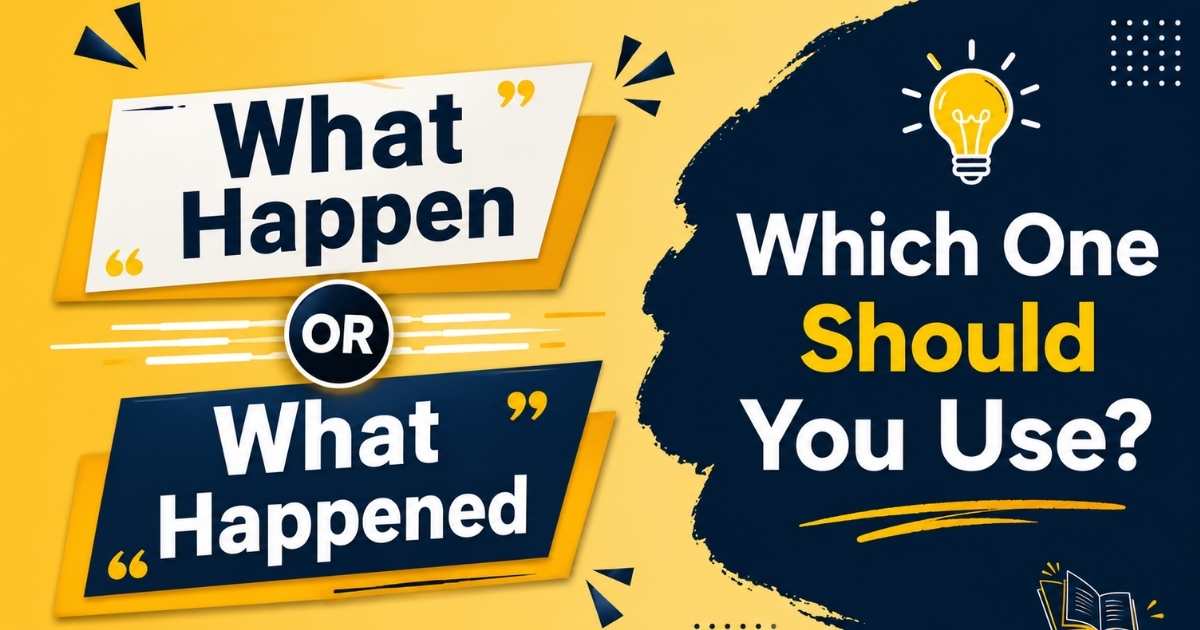

Ever typed a quick message and paused, unsure whether to write what happen or what happened? You’re not the only one. This tiny mix-up shows up everywhere texts, social media comments, even casual conversations and it trips up learners and native speakers alike. The confusion usually comes down to one small detail: verb tense.
While both phrases look almost identical, only one follows standard English grammar rules. Understanding the real difference between what happen or what happened isn’t just about sounding “correct” it’s about communicating clearly, confidently, and professionally in every conversation, message, or piece of writing you create.
Understanding Why “What Happen” Feels Right
“What happen” often sounds fine simply because it’s easy to say. Spoken English tends to compress words, drop endings, and blur sounds together, so “what happened” can come out sounding almost like “what happen” in fast conversation.
There’s also a language-transfer factor. In many languages including Hindi, Urdu, Chinese, and Indonesian verbs don’t change form to show past tense the way English verbs do. Time is often understood from context instead. Learners who are used to that pattern naturally carry it into English, leaving the verb “happen” untouched even when talking about the past.
Add in texting culture, where speed matters more than accuracy, and it’s easy to see how “what happen” spreads. Repetition makes it feel normal, even though it isn’t grammatically correct.
How Verb Tenses Communicate Time
English relies heavily on verb tense to show when something takes place. Without the right tense, a sentence can become confusing or simply wrong, even if every other word is correct.
| Tense | Function | Example |
| Present | Describes now or habitual actions | Things happen for a reason. |
| Past | Describes completed actions | What happened last night? |
| Future | Describes actions yet to occur | What will happen tomorrow? |
Notice that the verb form shifts depending on the timeline. That single change adding “-ed” carries all the information about when an event occurred. Skip it, and the sentence loses that time signal entirely.
Understanding the Verb Happen
“Happen” is an intransitive verb, meaning it doesn’t take a direct object. You can’t “happen” something the way you can “throw” a ball. Instead, “happen” simply describes an event occurring or taking place.
Because it’s a regular verb, its past tense follows the standard rule: add “-ed” to the base form.
- Base form: happen
- Past tense: happened
- Present participle: happening
This regularity is actually good news for learners there’s no irregular spelling to memorize, just the standard “-ed” ending.
Related post: Myself vs My Self: The Complete Guide to Meaning, Grammar, Identity & Real-World Usage
Why “What Happen” Is Grammatically Incorrect
“What happen” fails because it uses the base form of the verb to ask about something that has already occurred. English doesn’t allow that combination. When you’re referring to a completed event, the verb must carry past tense marking.
Here’s why each version below breaks the rule:
- ❌ What happen yesterday?
- ❌ What happen last night?
- ❌ What happen to your phone?
- ❌ What happen in the meeting?
Every one of these sentences references a finished event (“yesterday,” “last night,” “to your phone” implying damage already done), yet the verb stays in its base, untensed form. That mismatch between timeline and verb is exactly what makes the phrase incorrect.
Why “What Happened” Works
“What happened” works because the “-ed” ending correctly signals that the event is over. The tense of the sentence matches the timeline being described, so the meaning is immediately clear.
- ✔ What happened yesterday?
- ✔ What happened last night?
- ✔ What happened to your phone?
- ✔ What happened in the meeting?
Each of these reads naturally because the verb and the timeframe agree. There’s no guessing about when the event took place the grammar tells you directly.
Subject Questions vs Object Questions
One detail that trips people up is the missing “did.” Normally, English past-tense questions use “did” plus the base verb, such as “Did you see the movie?” So why doesn’t “what happened” need a “did”?
The answer lies in sentence structure. English questions fall into two categories:
- Subject questions the question word is the subject of the sentence. No auxiliary verb (do/does/did) is needed.
- Object questions the question word refers to something other than the subject, so an auxiliary verb is required.
In “What happened?”, the word “what” acts as the subject it’s standing in for whatever event took place. Since the subject already carries the action, adding “did” would be redundant (“What did happened?” is incorrect). Compare that to “What did you see?”, where “you” is the subject and “what” is the object, so “did” is necessary.
| Question Type | Example | Auxiliary Verb Needed? |
| Subject question | What happened? | No |
| Object question | What did you see? | Yes |
When to Use “What Happened”
Use “what happened” any time you’re asking about something that has already occurred. Common situations include:
- Asking about a past event or incident: “What happened at the game last night?”
- Reacting to unexpected news: “What happened? I heard the flight was cancelled.”
- Clarifying an accident or mistake: “The vase is broken what happened?”
- Following up on a story: “So what happened after you left the office?”
- Formal or professional contexts: emails, reports, interviews, and academic writing all require “happened,” not “happen.”
If time markers like yesterday, last week, earlier, or just now appear in the sentence, that’s a strong signal you need the past tense.
Why “What Happen” Should Be Avoided
Even though “what happen” shows up in casual texting, song lyrics, or dialect speech, it should be avoided in any setting where clarity and professionalism matter.
- It’s marked wrong in exams and academic writing.
- It weakens the tone of professional emails and reports.
- It can make a fluent speaker sound less credible or less careful.
- It signals a gap in tense understanding that’s easy to fix once you know the rule.
Grammar mistakes like this don’t usually block communication entirely, but they do create small “rhythm breaks” for the listener or reader moments where the sentence feels slightly off, even if the meaning is understood.
Spoken English vs Written English
Spoken and written English don’t always follow identical rules. Casual speech is full of shortcuts, and “what happen” sometimes slips through in fast conversation, texting, or song lyrics for stylistic reasons.
| Context | Acceptable Form | Notes |
| Formal writing (emails, essays, reports) | What happened | Always required |
| Academic or exam settings | What happened | “What happen” marked incorrect |
| Casual texting or slang | What happen (informal only) | Not standard, but common |
| Song lyrics or stylized speech | What happen | Used for rhythm, not grammar accuracy |
The takeaway: written and professional English should always use “what happened.” Save the shortcuts for informal texting where grammar isn’t the priority.
Common Mistakes Related to “What Happened”
Beyond dropping the “-ed,” a few related errors show up often:
- Adding an unnecessary auxiliary verb: “What did happened?” incorrect, since “what” already functions as the subject.
- Using “happen” with past time markers: “What happen yesterday?” the time marker demands past tense.
- Confusing “happen” and “happens”: “Happens” is present tense for habitual or general events (“Accidents happen”), not for a single past occurrence.
- Forgetting that “happen” is correct after modal verbs: “What will happen?” or “What might happen?” are both correct, because the modal verb (will, might, could) already establishes the tense.
Real-Life Examples: Correct vs Incorrect Usage
Seeing the two forms side by side makes the pattern easy to remember.
| Incorrect | Correct |
| What happen to your car? | What happened to your car? |
| I heard the news, what happen? | I heard the news, what happened? |
| What happen at the party last night? | What happened at the party last night? |
| Nobody told me what happen. | Nobody told me what happened. |
| What happen in the meeting? | What happened in the meeting? |
A quick trick: read the sentence aloud. If it describes something already finished, your ear should expect the “-ed” ending even before you think about the rule consciously.
Quick Rule to Remember
- Use “happened” for anything that has already occurred.
- Use “happen” for general truths, habits, or after a modal verb (will, might, could, may).
- Never pair “happen” with a past time marker like yesterday, last night, or earlier.
- No “did” is needed before “happened” because “what” is the subject of the question.
Is “what happen” ever correct?
No. It’s not correct in standard English, though it appears in casual speech, texting, or song lyrics.
Why doesn’t “what happened” need “did”?
Because “what” functions as the subject of the question, and the past tense is already built into “happened.”
Can I use “happen” for the past under any circumstance?
Only with a modal verb, such as “What could happen?” the modal itself sets the tense.
Is “what happen” acceptable in text messages?
It’s common informally, but it’s still grammatically incorrect and should be avoided in professional or academic writing.
How can I remember the rule quickly?
If the event already occurred, add “-ed.” If it’s ongoing, general, or future, use the base form or a modal verb.
Conclusion
At the end of the day, the debate over what happen or what happened comes down to one simple rule: past events need past tense. “What happened” is the grammatically correct choice, while “what happen” remains a casual shortcut that doesn’t belong in formal writing, exams, or professional messages.
Once you understand why “what” acts as the subject and doesn’t need a helping verb like “did,” the confusion clears up for good. Keep an eye out for time markers, read your sentences aloud, and let that small “-ed” ending do its job your English will sound sharper and more confident every time.

Benjamin Reed is a passionate writer who shares insightful and engaging content on lifestyle, trends, and everyday topics.
