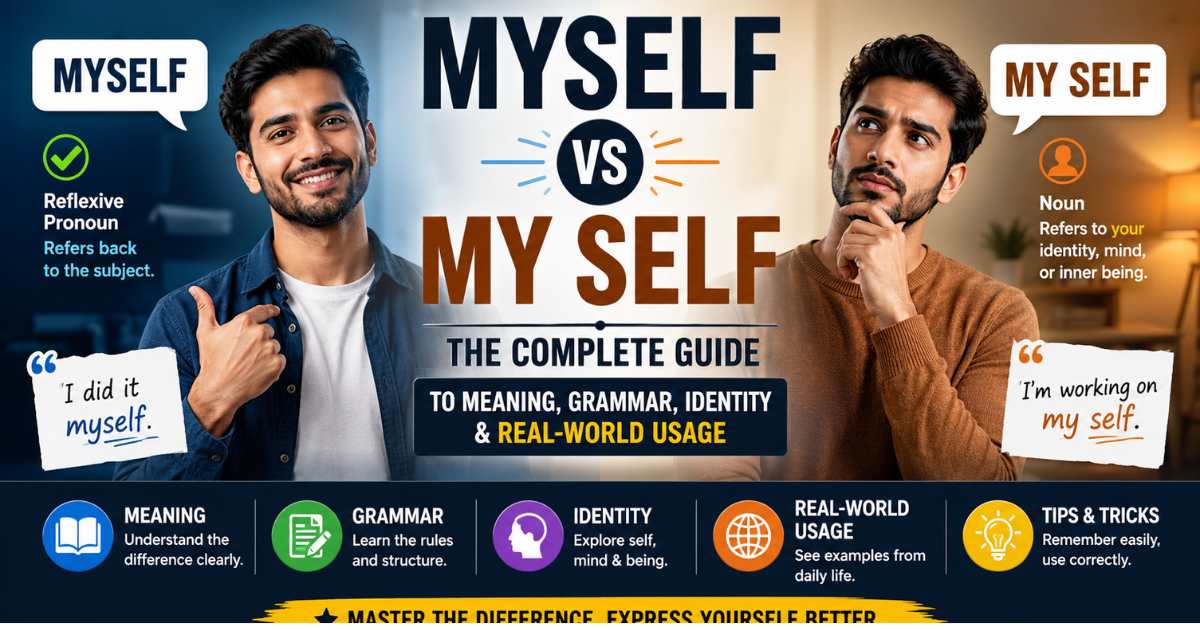

Myself vs My Self confuses many people. You type a sentence. You pause. You wonder which form is right. This happens because Myself vs My Self look almost the same. They sound the same too. But they are not the same thing. One is a grammar word. The other is about identity. Learning Myself vs My Self helps you write clearly. It also helps you sound more confident.
This guide explains Myself vs My Self in simple words. You will see easy examples. You will learn quick rules. You will avoid common mistakes. Myself vs My Self is not hard once you know the trick. A single space changes the whole meaning. Grammar uses one form. Identity uses the other. By the end, Myself vs My Self will feel simple and clear to you.
Myself vs My Self: What’s the Real Difference?
In one sentence: “myself” is a reflexive or intensive pronoun, while “my self” is a two-word phrase about identity, consciousness, or inner life.
| Feature | Myself | My Self |
| Part of speech | Reflexive/intensive pronoun | Possessive + noun |
| Common use | Everyday grammar | Psychology, philosophy, reflective writing |
| Frequency | Very common | Rare |
| Example | I taught myself to cook. | I’m learning to accept my self. |
| Can be removed from sentence? | Sometimes (intensive use) | No it’s the core subject of the thought |
That single space decides whether you’re writing about an action or about who you are.
What “Myself” Really Means in English
“Myself” as a Reflexive & Intensive Pronoun
“Myself” is the reflexive form of “I.” It shows up when the person doing something and the person receiving that action are one and the same, or when a speaker wants to add weight to their own involvement.
Two main functions of “myself”:
- Reflexive the subject acts on itself: I cut myself while chopping vegetables.
- Intensive (emphatic) the word adds emphasis but isn’t grammatically required: I fixed the sink myself.
A quick way to tell them apart: in reflexive sentences, removing “myself” breaks the meaning. In intensive sentences, the sentence still stands without it.
Correct Examples in Everyday Sentences
Reflexive Use
- I hurt myself during the workout.
- She asked me to introduce myself.
- I promised myself I’d finish the project on time.
Intensive Use
- I baked the cake myself.
- I, myself, don’t agree with that plan.
- I’ll handle the client call myself.
Incorrect Uses of “Myself” (Very Common!)
Many people reach for “myself” when they actually mean “I” or “me,” usually because it sounds more formal. It isn’t it’s simply wrong in those cases.
- ❌ Please send the invoice to myself. → ✔️ Please send the invoice to me.
- ❌ John and myself will attend the meeting. → ✔️ John and I will attend the meeting.
- ❌ Myself and the team reviewed the file. → ✔️ The team and I reviewed the file.
Remember: “myself” can only appear in a sentence that already contains “I” as the subject.
Understanding “My Self” (Two Separate Words)
“My self” isn’t a grammatical pronoun at all. Here, “self” behaves like a regular noun, describing your identity, mind, or inner being, while “my” simply shows possession the same way “my heart” or “my mind” would work.
What “My Self” Actually Means
It refers to the person you are beneath the surface your character, awareness, or inner experience rather than an action you perform.
Examples
- Meditation helps me reconnect with my true self.
- I’m working on accepting my self, flaws included.
- Losing that job changed my sense of self completely.
Where “My Self” Is Commonly Used
Psychology
Therapists and researchers use phrases like “sense of self” or “authentic self” when discussing identity, self-esteem, and personal growth.
Philosophy
Thinkers have long debated the nature of “the self” as a concept questions about consciousness, free will, and what makes a person who they are.
Literature
Writers and poets have used “my self” as two words for centuries, often to add emotional or reflective weight to a line, separating the acting “I” from the inner being.
Why “Myselves” Is Incorrect Always
There is no such word as “myselves.” Because “I” is inherently singular, its reflexive form cannot be pluralized. When multiple people are involved, English switches to a completely different word: ourselves.
- ❌ We hurt myselves.
- ✔️ We hurt ourselves.
How “Myself” Functions in Grammar
Reflexive Structure: Subject = Object
In a reflexive sentence, the subject performs the action, and that same person receives it:
I (subject) taught (verb) myself (object) Spanish.
Intensive Structure: Adding Emphasis
In intensive use, “myself” restates the subject purely for emphasis. Take it out, and the core sentence survives untouched: I signed the lease (myself).
Identity & Philosophy: The Non-Reflexive “Self”
“Self” as a Concept
Outside of grammar, “self” stands on its own as a noun describing identity and inner experience. Concepts like self-awareness, true self, and social self all treat “self” as something you have or explore, not an action you perform.
How Spacing Changes Meaning
| Sentence | Meaning |
| I found myself in the crowd. | I physically located myself (reflexive). |
| I found my self, finally. | I discovered who I really am (identity). |
| I love myself. | I care for who I am (everyday affection/action). |
| I love my self. | I honor my inner being (reflective, poetic). |
Common Errors and How to Avoid Them
Using “Myself” Instead of “Me” or “I”
This is the most frequent mistake. If “I” isn’t already in the sentence, “myself” has no job to do there.
Using “My Self” When “Myself” Is Correct
Writing “my self” in an everyday action sentence (I did it by my self) is a spacing error it should be “myself.”
Adding “Myself” to Sound Formal
“Myself” is not a fancier version of “I” or “me.” Using it that way is a classic hypercorrection.
Confusing Identity With Grammar
Reflective writing about your inner world calls for “my self”; describing an action calls for “myself.” Mixing the two muddies both meaning and tone.
Quick Decision Guide to Remember the Difference
Ask yourself: Is it about grammar or identity?
If the sentence describes an action circling back to you, use “myself.” If it describes who you are inside, use “my self.”
Fast Test
Remove the word. If the sentence still works and only loses emphasis, “myself” is correct. If the word is the actual subject of your thought, you likely mean “my self.”
One-Line Rule
Grammar = myself. Identity = my self.
Real-Life Examples & Micro Case Studies
Case Study 1: Email at Work
An employee writes, “Please loop in Sarah or myself.” The correct version is “Please loop in Sarah or me,” since there’s no reflexive or intensive need here.
Case Study 2: Personal Journal Entry
A journaling app user writes, “Today I finally made peace with my self.” This is correct the entry is about identity and inner acceptance, not an action.
Case Study 3: Classroom Grammar
A teacher explains reflexive pronouns using “I taught myself the answer” versus the incorrect “I taught my self the answer,” showing students that grammar lessons default to “myself.”
Case Study 4: Meditation Coaching
A mindfulness coach tells clients, “Sit quietly and listen to your self,” deliberately using the two-word form to highlight introspection rather than physical action.
FAQs
Is “myself” the same as “me”?
No. “Myself” can only be used reflexively or for emphasis, while “me” is the standard object pronoun in all other cases.
Can I use “myself” to sound more polite or formal?
No. Using “myself” instead of “I” or “me” for formality is a common but incorrect habit called hypercorrection.
Is “my self” ever grammatically correct?
Yes, when “self” is used as a noun referring to identity or inner being, such as in psychology or reflective writing.
Is “myselves” a real word?
No. “Myself” has no plural form; the correct plural reflexive pronoun is “ourselves.”
How can I quickly tell which one to use?
Ask if the sentence is about an action (use “myself”) or about identity and inner life (use “my self”).
Do native speakers get this wrong too?
Yes, very often. Confusing “myself” with “me” is one of the most common mistakes even among fluent, educated speakers
Conclusion
Myself vs My Self is a small difference with a big impact. One word handles grammar. The other word handles identity. Once you understand Myself vs My Self, mistakes become easy to spot. You stop guessing. You start writing with confidence.
Remember this simple rule for Myself vs My Self. Use “myself” for actions and emphasis. Use “my self” for identity and reflection. This one rule solves most confusion. It works in emails, essays, and everyday speech.
Mastering Myself vs My Self makes your writing sharper. It also makes your thinking clearer. Language shapes how we express who we are. Myself vs My Self shows this in a simple way. Keep this guide close. Use it whenever doubt creeps in.

Benjamin Reed is a passionate writer who shares insightful and engaging content on lifestyle, trends, and everyday topics.
