

Inland vs outland spousal sponsorship Canada is a route choice, not a different outcome, because both routes lead to the same Canadian permanent residence. That shared outcome matters, because couples often waste weeks searching for a faster visa, when the real differences are travel, work, speed, and appeal rights.
Location decides eligibility first, travel decides flexibility second, and refusal risk decides safety third. Get those three facts clear before filing, and most couples can choose a route without guessing.
Inland vs Outland in One Line
Inland fits a partner living with you in Canada throughout processing, outland fits a partner abroad or a partner in Canada who needs travel freedom and appeal rights.
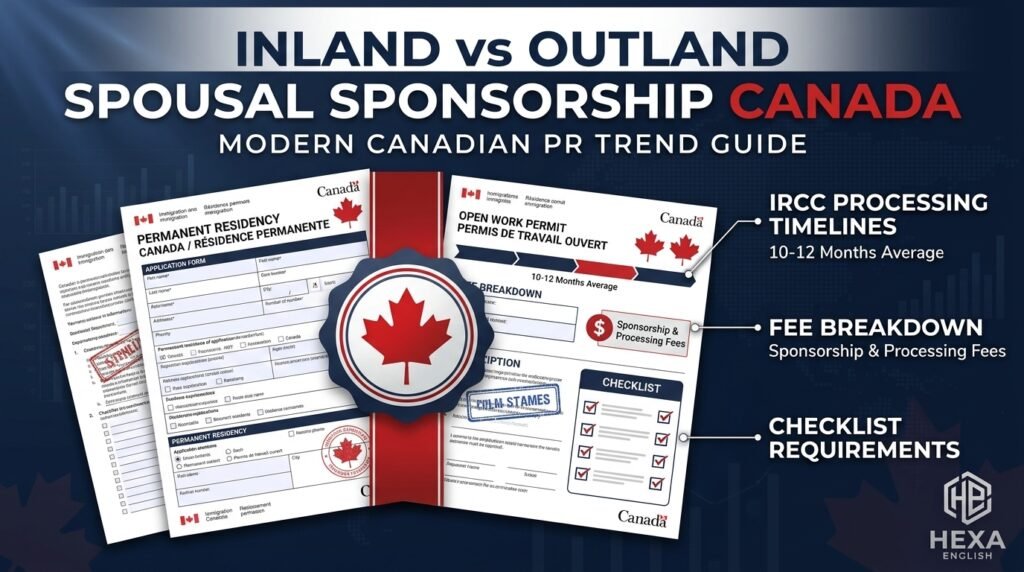
A partner living with you in Canada can often choose either route, so the choice is strategic, not just geographic. That strategic choice, per Canadim, is why many couples living together in Canada deliberately choose outland, for faster time and appeal rights.
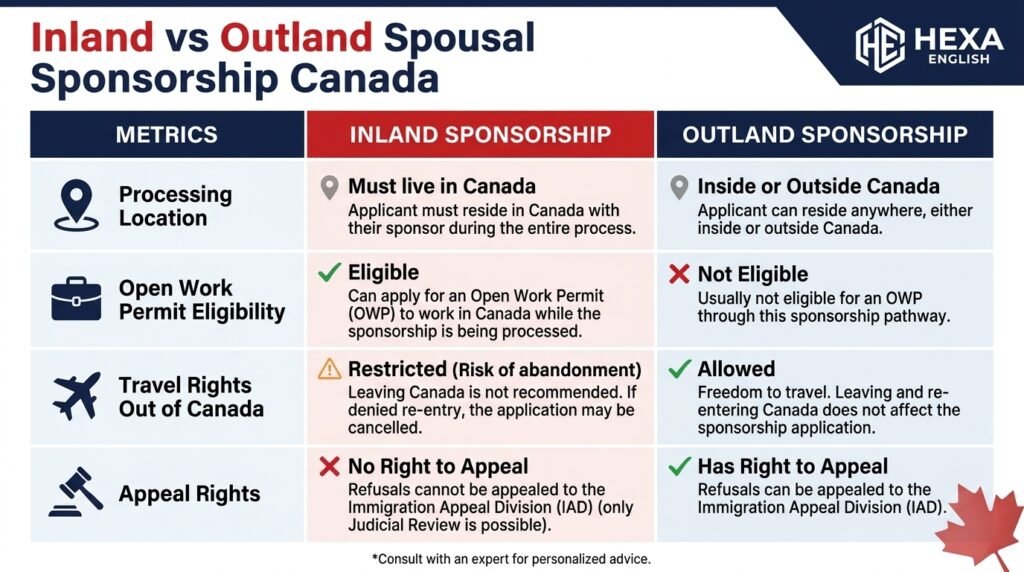
| Decision | Inland | Outland |
|---|---|---|
| Partner location | In Canada, living with sponsor, throughout | Abroad, or in Canada, assessed as Family Class |
| Work while waiting | Yes, SOWP after AOR, if living in Canada with sponsor | Yes, SOWP after AOR, if living in Canada with sponsor, not while abroad |
| Travel while waiting | Risky, leaving and denied re-entry can abandon file | Flexible, subject to visa and entry rules |
| Appeal if refused | Generally no IAD appeal, Federal Court judicial review only | Generally IAD appeal within 30 days, de novo, new evidence |
| Conjugal partner | No, not eligible inland | Yes, eligible outland |
| Best for | Partner in Canada, no travel need, status tolerance matters | Partner abroad, travel need, or any refusal risk |
The Two Routes, Defined
IRCC rarely uses the words inland and outland in its own guides, per Moving2Canada, but those terms are how couples, lawyers, and RCICs describe the two classes. That naming gap causes confusion, because a couple can search IRCC and find class names, not inland and outland labels.
Inland: Spouse or Common-Law Partner in Canada Class
Inland sponsorship is the Spouse or Common-Law Partner in Canada Class, known as SCLPC, for a spouse or common-law partner living with the sponsor in Canada. That inland class requires the partner to live with the sponsor in Canada throughout processing, and to still be cohabiting in Canada when permanent residence is granted, per Cedar Path Immigration.
Inland applications are processed through IRCC Case Processing Centre in Mississauga, Ontario, per Moving2Canada, with biometrics in Canada at Service Canada. That inland processing centre matters for mailing, biometrics, and interview location, not for the final outcome.
Inland tolerates a lapse in status in some cases, under a spousal public policy, per Wild Mountain Immigration, which is a practical draw for couples where status has expired. That status tolerance should be checked with a lawyer or RCIC, because it does not apply to every lapse, and it does not remove other admissibility issues.
Outland: Family Class
Outland sponsorship is Family Class, for a spouse, common-law partner, or conjugal partner, whether the partner lives abroad or lives in Canada. That outland class is the default under IRPA, per Kingwell Immigration Law, while inland is the exception for couples already together in Canada.
Outland applications are processed through IRCC Case Processing Centre in Sydney, Nova Scotia, then through a visa office responsible for the partner country of residence, per Moving2Canada. That visa office step matters for processing time, interview location, and document requests, because visa offices vary in workload.
Outland allows a partner living in Canada to apply as Family Class, even while living with the sponsor, per Canadim and Cedar Path Immigration. That in Canada outland option is the key strategic point many couples miss, because they assume living in Canada forces an inland filing.
Same Outcome, Different Experience
Both routes lead to the same permanent residence, with the same rights to live, work, and study anywhere in Canada, and later citizenship after 3 years physical presence. That same outcome means the route choice should be made on experience during processing, not on a belief that one route gives a better visa.
Both routes require the same genuineness test, the same sponsor eligibility, the same undertaking, and the same medical, police, and security checks. That shared core means a weak genuineness file will not become strong by switching routes, it will only change travel, work, and appeal options.
Both routes carry the same federal fees, about $1,345 including biometrics, per April 30 2026 fee list summaries, with $180 per dependent child. That same fee rule means cost should not decide the route, except for Quebec undertaking fees and third party costs, which differ by location.
Processing Times, Reconciled, With Check Dates
Processing times conflict across competitor pages, because some pages quote the IRCC service standard, some quote older tool figures, and some quote current tool figures. That conflict is the main trust loss in this niche, so Step 2 must show a reconciliation, not one merged time.
IRCC Service Standard Versus Current Tool Figures
IRCC service standard for spousal sponsorship is 12 months, per Wild Mountain, GoFar Global, and SiLaw, but that 12 month figure is a target, not the current wait. That target versus wait split, per GoFar Global, means anyone quoting 12 months today is quoting the standard, not the reality.
IRCC processing times tool figures, last updated October 9 2026, per Wild Mountain and GoFar Global, are about 26 months inland and about 18 months outland, outside Quebec. That October 2026 tool figure should be rechecked on the IRCC tool on the day of filing, because tool figures change monthly.
Earlier 2026 figures show the same direction, but different numbers: May 2026 figures inland 25 months and outland 16 months, per The Way Immigration, and Canadim figures inland 21 months and outland 15 months. That older versus current spread shows why a check date matters more than a single number.
Outside Quebec: Inland 26 Months, Outland 18 Months, October 9 2026
Outside Quebec, inland about 26 months and outland about 18 months, per October 9 2026 IRCC tool summaries, is the current headline figure to use, with a check date. That 8 month gap, per Amir Ismail September 3 2026 figures, is why outland is often described as faster, even for couples living together in Canada.
Outland queue figures, about 65,600 people waiting outland and about 55,600 waiting inland, per GoFar Global October 2026 summary, are single source queue counts, not IRCC guarantees. That queue label matters, because a queue count does not predict an individual file time.
Sponsor approval stage typically takes 1 to 2 months, per GoFar Global, with the remaining time for the principal applicant permanent residence stage. That stage split helps a couple understand why sponsor approval early does not mean a fast final decision.
Quebec: Inland 32 Months, Outland 33 Months
Quebec-destined applications take longer, about 32 months inland and about 33 months outland, per GoFar Global and Mirzoyan Immigration summaries of September 3 2026 figures. That Quebec time, per SiLaw, averages about 35 months total with the MIFI undertaking step, in some summaries, so present Quebec as a range, not a single figure.
Quebec federal backlog, not MIFI processing alone, is the main delay, per Immigration.ca Quebec guide, because IRCC receives more Quebec-destined family class applications than Quebec annual admission spaces allow. That structural backlog, per Immigration.ca, saw only 7 percent of Quebec spouse, partner, and child applications finalised within the 12 month service standard in 2024, versus 84 percent in the rest of Canada.
Quebec MIFI step itself is fast for complete files, most within about 3 months, per MIFI summaries via Sponsorship Attorney. That fast MIFI step versus slow federal step split helps a couple understand why a CSQ early does not mean a fast final decision.
Why Times Change and What Slows a File
Completeness is the biggest avoidable delay, per Wild Mountain and GoFar Global, because an incomplete package can be returned and restart the wait. That completeness rule means a careful first filing is faster than a fast but incomplete filing.
Visa office workload, country of residence, biometrics, medicals, background checks, security screening, interview, and additional document requests all affect time, per Wild Mountain, GoFar Global, and Magellan Immigration. That multi factor list means a couple cannot control all delays, but they can control completeness, prompt responses, and accurate translations.
Relationship assessment interviews, inconsistency checks, and procedural fairness letters add time, per SiLaw, because officers must resolve credibility concerns before deciding. That interview and PFL time should be built into planning, especially for files with short relationships, age gaps, or prior refusals.
Work Permits While You Wait: Spousal Open Work Permit
Spousal open work permit, or SOWP, is the most copied error in this niche, because many pages still say SOWP is inland only. That inland only claim is wrong, per current competitor summaries, and Step 2 must correct it clearly.
SOWP on Either Route, If Living in Canada With Sponsor
A partner living in Canada with the sponsor can apply for a SOWP on either inland or outland route, once IRCC issues acknowledgement of receipt, or AOR, per Wild Mountain, Canadim, and Blacksy Immigration. That either route SOWP rule, per Blacksy October 2026 guide, covers both inland and outland applicants physically living in Canada with the sponsor.
SOWP is an open work permit, not tied to one employer, with no Labour Market Impact Assessment, no job offer, and no named employer, per Wild Mountain SOWP guide. That open permit design lets a partner work for almost any employer, full time or part time, and change jobs without applying again, while permanent residence is processed.
SOWP is temporary status linked to sponsorship, not permanent residence, and not a standalone right to remain in Canada, per Wild Mountain SOWP guide. That temporary status warning matters, because a SOWP does not cure other inadmissibility issues, and it expires if the underlying sponsorship ends.
SOWP After AOR, Exceptions, and Extension
SOWP processing is reported at about 4 months after AOR, per JCA Law and Blacksy Immigration, with some summaries reporting 3 to 4 months and others 4 to 6 months. That SOWP time range should be presented as a competitor reported range, with a check on the IRCC tool, not as a guarantee.
Exceptions to the AOR rule include a partner whose status expires within 2 weeks, who may apply before AOR arrives, per JCA Law and Blacksy Immigration. That 2 week exception should be checked with a lawyer or RCIC, because it is narrow and time sensitive.
A partner without status must wait for approval in principle, or AIP, letter, per Blacksy Immigration, before applying for SOWP under the public policy. That no status AIP rule is different from the valid status AOR rule, and it should not be merged.
SOWP can be extended for up to 2 more years while the permanent residence application is still pending, per JCA Law and Blacksy Immigration. That extension rule helps a couple plan income during a long inland wait, but it does not change the permanent residence timeline.
SOWP public policy has been extended through December 31 2026, per The Way Immigration and Immigration.ca summaries, but that date must be verified on IRCC on the day of filing. That public policy date warning matters, because a public policy can end, change, or be replaced, and a couple should not assume it will still apply at filing.
No SOWP While Abroad
A partner abroad cannot get a SOWP until they are physically in Canada with the sponsor and with status, per Wild Mountain and Canadim. That abroad no SOWP rule means an outland partner abroad must rely on separate work authorisation, a visitor visa, or no work in Canada, while waiting.
A partner abroad can apply for a visitor visa while sponsorship is in process, with faster processing once AOR is issued, per Blacksy Immigration, but the visitor visa still has to be approved on its own merits. That visitor visa discretion, per Canadim dual intent note, means a pending sponsorship does not guarantee a visitor visa.
A partner in Canada as the spouse of a worker or student may hold a different permit, such as C41 or C42, per Blacksy Immigration, which is separate from SOWP. That different permit note prevents a couple from confusing a spousal open work permit with a spouse of worker or student permit.
Travel During Processing
Travel is the second main strategic difference, after appeal rights, because inland travel risk can abandon a file, while outland travel is built for mobility. That travel split should be decided before filing, not after a family emergency arises.
Inland Travel Risk and Abandonment
Inland travel is risky, per Wild Mountain, Canadim, and Cedar Path Immigration, because if a partner leaves Canada and is denied re-entry, the inland application could be considered abandoned. That abandonment risk, per Canadim inland page, applies even where travel was for a family emergency, because re-entry is not guaranteed.
Long and frequent absences are not recommended during inland processing, per Moving2Canada, even where re-entry is granted, because absences can raise cohabitation and genuineness questions. That absence warning means inland couples should plan travel carefully, with a lawyer or RCIC, before leaving.
Inland requires the partner to live with the sponsor in Canada throughout processing, and to still be cohabiting in Canada when permanent residence is granted, per Cedar Path Immigration. That cohabitation at grant rule means a long separation during inland processing can create a problem at the final stage, not just at re-entry.
Outland Travel Flexibility and Visa Rules
Outland travel is generally flexible, per Canadim, Wild Mountain, and Cedar Path Immigration, because the partner can live and travel outside Canada during processing, subject to visa and entry rules. That outland flexibility is built for couples living apart, or for partners who need to travel for work or family.
Outland travel flexibility does not mean unrestricted entry to Canada, because a partner abroad still needs a visitor visa or eTA, and entry is discretionary, per Canadim dual intent note. That discretion warning means a pending outland sponsorship does not guarantee entry, even with a valid visa.
Outland partners in Canada can travel and return, subject to their temporary status and visa, without the same abandonment risk as inland, per Cedar Path Immigration. That outland in Canada travel advantage is why many couples living together in Canada choose outland, for travel freedom plus appeal rights.
Visitor Visa, Dual Intent, TRV, and eTA
Dual intent means a person can intend to visit Canada temporarily and also intend to become a permanent resident, per Canadim, and it is recognised by Canada. That dual intent recognition helps an outland partner apply for a visitor visa while sponsorship is pending, but it does not guarantee approval.
Temporary Resident Visa, or TRV, and Electronic Travel Authorization, or eTA, are both discretionary, with officers assessing ties, funds, travel history, and genuineness, per general IRCC guidance. That discretion rule should be stated clearly, because a couple that assumes a TRV will be granted can be surprised by a refusal.
A visitor visa application after AOR may receive faster processing, per Blacksy Immigration, but faster processing does not mean approval. That faster processing note should be presented as a competitor reported benefit, with a check on IRCC guidance, not as a guarantee.
Appeal Rights on Refusal: The Main Strategic Difference
Appeal rights are the single most important row in any inland versus outland table, per The Way Immigration, because they change what happens if IRCC refuses. That appeal split should be decided before filing, especially for files with any refusal risk.
Outland: IAD Appeal Within 30 Days, De Novo, New Evidence
Outland refusal generally carries a right to appeal to the Immigration Appeal Division, or IAD, of the Immigration and Refugee Board, per SiLaw, Kingwell Immigration Law, and JR Law Office. That IAD appeal, per JR Law Office, is under Section 63(1) of IRPA, for Family Class sponsors, and it is a full hearing where the original decision can be overturned.
IAD appeal deadline is 30 days, per Canadian Immigration Experts and Amir Ismail Pakistan guide, with a de novo hearing where new evidence can be submitted and a fresh assessment is made, per Kingwell Immigration Law. That de novo, new evidence rule is fundamentally different from judicial review, because it allows a couple to fix evidence gaps.
IAD appeal exceptions include serious criminality, security, and other specified grounds, per SiLaw, where appeal rights may be limited or excluded. That exception note should be checked with a lawyer, because it changes the appeal strategy for those files.
Inland: No IAD Appeal, Federal Court Judicial Review Only
Inland refusal generally has no IAD appeal, per SiLaw, Kingwell Immigration Law, JR Law Office, and Mirzoyan Immigration, with the only remedy being judicial review at the Federal Court. That no IAD appeal rule, per JR Law Office, is stark: a couple that files inland with missing documents or confusing gaps loses the full appeal safety net.
Federal Court judicial review is narrow, strict, and expensive, per JR Law Office, because the judge only checks if the officer made a legal error, not whether the decision was right on the merits. That legal error only rule, per Kingwell Immigration Law, means new evidence to prove love cannot be introduced in judicial review, unlike in an IAD appeal.
Judicial review requires leave, or permission, from the Federal Court, per general Federal Court procedure, and it does not guarantee a new decision, only a reconsideration where legal error is found. That leave and reconsideration warning should be presented as lawyer advice territory, not as a DIY remedy.
Reapply, Reconsideration, and Appeal: Which Fits
Reapplying after refusal is always an option, per Canadim, but it requires addressing the refusal reasons in a new application, with new or additional evidence, and a review of the refusal letter and GCMS notes. That reapply with stronger evidence rule, per Canadim, means a second filing should not repeat the first filing without changes.
Reconsideration, where IRCC made an error, is a separate request, per general IRCC guidance, and it should be made only where a clear error is shown, not as a substitute for an appeal. That reconsideration narrowness should be checked with a lawyer, because it does not stop appeal deadlines.
Appeal versus reapply versus reconsideration should be decided by a lawyer, based on refusal reasons, new evidence availability, and appeal deadline, per Canadim and Kingwell Immigration Law. That lawyer decision note matters, because a wrong choice can waste appeal deadlines or filing fees.
Who Can Sponsor and Who Can Be Sponsored
Sponsor and applicant eligibility is shared across routes, except for conjugal partners and inland cohabitation, so a couple should check eligibility before choosing a route. That eligibility first rule prevents a route choice that cannot be filed.
Sponsor Eligibility, Residence, and Age
Sponsor must be a Canadian citizen or permanent resident, at least 18 years old, and living in Canada, unless a Canadian citizen living abroad with intent to return when the partner becomes a permanent resident, per Canadim and SiLaw. That citizen abroad exception, per Canadim, does not apply to permanent residents living abroad, who must live in Canada to sponsor.
Sponsor must not be receiving social assistance, except disability benefits, per Canadim and Immigration.ca, and must sign a sponsorship agreement and undertaking, IMM 1344. That social assistance rule, per Immigration.ca, is about current receipt, not about income level, because there is no minimum income in most spousal cases.
Sponsor must complete a sponsor questionnaire, IMM 5540, and provide proof of citizenship or permanent residence, proof of address in Canada, and evidence of employment or income where required, per Immigration Canada Documents guide. That sponsor document list should be checked against the current IRCC guide, because forms change.
Sponsor Bars and the 5 Year Bar
Sponsor cannot sponsor if undischarged bankruptcy, subject to a removal order, failed to comply with a previous sponsorship undertaking, or convicted of certain offences against a family member, per Immigration Canada Documents guide. That sponsor bar list should be checked with a lawyer, because some bars are time limited and some are permanent.
Sponsor cannot sponsor a new spouse or partner if they were sponsored as a spouse themselves and became a permanent resident less than 5 years ago, per Amir Ismail outland guide and CELPIP.biz inland guide. That 5 year bar, per Amir Ismail, applies even if the earlier relationship has ended, and it is a common preventable refusal.
Sponsor who previously sponsored a spouse within the last 3 years, per some competitor summaries, may face a bar, but that 3 year figure conflicts with the 5 year bar for sponsored sponsors, so Step 2 must present the 5 year bar as the main rule and direct couples to IRCC guidance for other bars. That bar conflict warning prevents a couple from relying on a wrong bar period.
Spouse, Common-Law, and Conjugal Partner Definitions
Spouse is a person legally married to the sponsor, regardless of where the marriage took place, provided the marriage is legally valid in the country where it occurred and in Canada, per VisaVio and SiLaw. That marriage validity rule means a marriage that is not valid in Canada, such as a polygamous marriage, cannot be sponsored as a spouse, per general IRCC guidance.
Common-law partner is a person who has lived with the sponsor in a conjugal relationship for at least 12 continuous months, per Canadim, SiLaw, and Cedar Path Immigration. That 12 month cohabitation rule, per Canadian Immigration Experts, allows short separations for work or family where the relationship continued, but the 12 months must be genuine and provable through joint documents.
Conjugal partner is a person in a committed relationship for at least 1 year, but who could not live together or marry due to circumstances beyond their control, such as immigration restrictions, religious reasons, or sexual orientation, per VisaVio and SiLaw. That conjugal barrier rule, per Cedar Path Immigration, requires proof of both the relationship depth and the barrier, and conjugal partners cannot be living in Canada, per Cedar Path.
Dependent Children
Partner children can be included if under 22 and not married or in a common-law relationship, or 22 plus and dependent since before 22 due to a physical or mental condition, per Cedar Path Immigration. That dependent child definition should be checked on IRCC on the day of filing, because age and dependency rules change.
Children in the custody of an ex partner must still be declared and examined, per Cedar Path Immigration, even where they are non accompanying. That declaration rule is a common mistake, because a couple may omit a non accompanying child, only to face a later sponsorship bar for that child.
Baby born before the partner becomes a permanent resident must be added to the application, and will also receive permanent resident status, per Amir Ismail Pakistan guide. That baby addition rule should be acted on promptly, with a lawyer or RCIC, because it affects medical, documents, and processing.
Money: Fees, Undertaking, and No Minimum Income Rule
Money for spousal sponsorship is simpler than for other programs, because there is no minimum income in most cases, but the undertaking is a serious legal commitment. That no income but serious undertaking split should be explained clearly, to prevent a couple from thinking no income means no financial responsibility.
Federal Fees, April 30 2026 Increase
Federal fees, per April 30 2026 IRCC fee list summaries via Immigration.ca, are $1,260 for sponsorship, principal applicant processing, and Right of Permanent Residence Fee, or $660 without RPRF, plus $85 biometrics per person or $170 family max, total about $1,345, plus $180 per dependent child. That April 2026 fee figure, per Immigration.ca and Amir Ismail outland guide, replaces the older $1,080 total, which is outdated and should not be presented as current.
RPRF, $600, is refunded if the application is withdrawn or refused, per Immigration.ca, and it is charged at the rate in force when you pay it. That RPRF refund rule helps a couple understand why paying RPRF upfront does not mean losing it on refusal, but it does not mean other fees are refunded.

Additional costs include medical exams, police certificates, document translation and certification, and professional representation, per Yenmek Immigration Services, which are not included in IRCC fees. That third party cost warning helps a couple budget beyond the $1,345 headline figure.
Quebec Undertaking Fee
Quebec undertaking fee, per Sponsorship Attorney January 1 2026 figures, is $335 for the first person and $135 for each additional person. That Quebec fee, per Sponsorship Attorney, conflicts with older $289 figures in FinanExp and other pages, so Step 2 must present the January 1 2026 figure with a check on MIFI, not the older figure.
Quebec sponsors also pay the federal fees, plus the Quebec undertaking fee, per Immigration.ca, so Quebec total cost is higher than rest of Canada total cost. That Quebec extra fee rule should be in any Quebec budget, with a check on MIFI for current amounts.
3 Year Undertaking, Social Assistance, and Repayment
Sponsor undertaking for a spouse, common-law, or conjugal partner lasts 3 years from the date the sponsored person becomes a permanent resident, per Immigration.ca and SiLaw. That 3 year undertaking, per Sugimoto Visa, continues even if the relationship breaks down, and it cannot be shortened or cancelled once permanent residence is granted, per Immigration.ca.
If the sponsored partner receives social assistance during the undertaking period, the sponsor may have to repay it and will be barred from sponsoring again until repayment, per Immigration.ca. That repayment and bar rule is the financial consequence of the undertaking, and it should be explained before signing, not after.
Quebec undertaking durations differ for dependent children: at least 10 years or until 18 for children under 16, and at least 3 years or until 25 for those 16 and over, per Sponsorship Attorney. That Quebec dependent duration split should be checked on MIFI, because it differs from the federal 10 year dependent rule in some summaries.
Income Exception: Dependent Child With Dependent
No minimum income requirement applies in most spousal cases, per Canadim, Immigration.ca, and SiLaw, unlike Parents and Grandparents Program, which has a Minimum Necessary Income test. That no LICO rule, per GoFar Global, means a sponsor does not need to meet Low Income Cut-Off, but must show they are not on social assistance and can meet basic needs.
Income exception applies where the sponsored partner has a dependent child who themselves has a dependent child, per Immigration.ca and GoFar Global, in which case the sponsor must meet the income requirement in Financial Evaluation form IMM 1283. That dependent with dependent exception is narrow, but it changes the filing, so it should be checked where dependent children are involved.
Quebec applies its own financial capacity rules where relevant, per Immigration.ca, with income verification through Revenu Québec in some summaries. That Quebec financial capacity note should be checked on MIFI, because Quebec rules differ from federal rules.
Quebec: MIFI Undertaking, CSQ, and Intake Cap
Quebec spousal sponsorship adds a provincial step that rest of Canada does not have, which is why Quebec times are longer and intake windows matter. That Quebec extra step should be planned before filing, not after a federal filing is already in progress.
Quebec process, per Sponsorship Attorney, is: file federal sponsorship and permanent residence application, IRCC confirms sponsor eligibility and invites continuation with MIFI, mail signed undertaking, spouse application for permanent selection, supporting documents, and fee in the calendar window, MIFI processes most complete files within about 3 months, receive accepted undertaking and CSQ, then IRCC completes medical, security, and admissibility checks and issues permanent residence. That Quebec sequence, per Sponsorship Attorney, shows why an incomplete MIFI file returned by mail with no chance to correct can push a couple into a later window.
Quebec intake suspension, per SiLaw and Doherty Fultz Immigration, began July 9 2025, with no new undertakings for spouse, de facto, conjugal, and dependent 18 plus accepted until June 25 2026, with narrow exceptions such as where the sponsor or sponsored person has a minor dependent child meeting specific conditions. That suspension window, per SiLaw, should be verified on MIFI on the day of filing, because intake windows fill quickly and can change.
Quebec applications that escape both cap and schedule, per Immigration.ca Quebec guide, include sponsor dependent child, minor child to be adopted, orphaned minor brother, sister, nephew, niece, grandson, or granddaughter, adult dependent child who depends on a parent because of a physical or mental condition, and applications adding a dependant to a case already in queue. That exception list should be checked on MIFI, because it affects whether a couple can file during a cap period.
Documents and Genuineness Evidence, by Route
Documents and genuineness evidence are shared across routes, with route specific additions for inland cohabitation, outland visa office, and Quebec undertaking. That shared plus route specific structure helps a couple build one evidence package, then add route documents, rather than building two separate packages.
Shared Documents
Shared documents include marriage certificate for spouses, statutory declaration of common-law union IMM 5409 for common-law partners, passports, birth certificates, police certificates, medical exam results, biometrics, sponsor questionnaire IMM 5540, and sponsorship agreement and undertaking IMM 1344, per Immigration Canada Documents guide. That shared list should be checked against the current IRCC guide, because forms and document checklists change.
Relationship proof, per VisaVio and SiLaw, includes joint lease agreements, utility bills in both names, joint bank account statements, insurance policies listing both partners, photos together spanning the relationship, travel itineraries, communication records, and letters from friends and family. That relationship proof list is the core of genuineness, because IRCC officers scrutinise spousal files carefully for genuine relationships, per Immigration Canada Documents guide.
Inland Only Documents
Inland only documents include proof of living together in Canada, such as joint lease, joint bills, and joint address evidence, plus valid temporary status evidence, such as visitor, worker, or student status, per Canadim inland page. That inland cohabitation proof should cover the full period in Canada, not just a single bill, because inland requires living together throughout processing.
Inland only documents also include SOWP application evidence, where applicable, such as AOR, same address proof, and status evidence, per JCA Law SOWP guide. That SOWP document list should be prepared alongside the permanent residence package, to avoid delays in work authorisation.
Outland Only Documents
Outland only documents include visa office specific documents, such as country specific police certificates, translations, and interview location evidence, per general visa office guidance. That visa office specificity means a couple should check the visa office instructions for the partner country of residence, not just the general IRCC guide.
Outland only documents also include travel history, visitor visa history, and dual intent evidence, where a partner in Canada on a visitor visa applies outland, per Canadim dual intent note. That dual intent evidence helps an officer understand why a partner in Canada is applying outland, rather than inland.
Genuineness Framework: Timeline, Joint Life, Visits, Social Recognition
Genuineness test, under Section 4 of IRPR, per SiLaw and Euro Consultants, asks whether the relationship is genuine and not entered into primarily for immigration purposes. That Section 4 test is disjunctive, per Canadian Immigration Experts, meaning failing either limb, not genuine or primarily for immigration, is enough to refuse, so consistent evidence of a shared life matters.
Genuineness evidence framework, per SiLaw and VisaVio, includes timeline of relationship, joint finances, cohabitation, communication, visits, and social recognition, with consistency and credibility as the test, per 1to1 Immigration. That framework helps a couple organise evidence by theme, rather than dumping photos without a timeline.
Short relationships, age gaps, prior refusals, and inconsistent histories are red flags, per Amir Ismail Pakistan guide and SiLaw, but they are not automatic refusals, they require stronger evidence and preparation. That red flag versus automatic refusal split should be explained, with a direction to a lawyer or RCIC for those files.
Process, Step by Step, by Route
Process steps are similar across routes, with different processing centres, biometrics locations, and interview locations. That similar but different process helps a couple understand why a route choice changes logistics, not just time.
Inland Process: Mississauga, AOR, SOWP, AIP, PR Grant
Inland process, per Moving2Canada and Blacksy Immigration, is: file sponsor and principal applicant applications together online through PR Portal, IRCC Case Processing Centre Mississauga confirms completeness and issues AOR, partner living in Canada with sponsor applies for SOWP after AOR, sponsor approval, applicant admissibility checks, approval in principle where applicable for no status cases, then permanent residence grant while still cohabiting in Canada. That inland sequence, per Blacksy, should be followed in order, because SOWP and AIP timing depend on AOR and sponsor approval.
Inland biometrics are collected in Canada at Service Canada, per The Way Immigration, with medical exam within Canada through an IRCC designated panel physician. That inland biometrics and medical location split matters for scheduling, because a partner abroad cannot use a Canadian Service Canada location for an inland file.
Outland Process: Sydney, Visa Office, Sponsor Approval, PR Grant
Outland process, per Moving2Canada and Canadim, is: file sponsor and principal applicant applications together online through PR Portal, IRCC Case Processing Centre Sydney confirms completeness and issues AOR, sponsor approval, file transferred to visa office for partner country of residence, applicant admissibility checks, medical, police, and security checks, interview where required, then permanent residence grant and landing. That outland sequence, per GoFar Global, includes sponsor approval in 1 to 2 months, with the remaining time for the applicant stage.
Outland biometrics are collected in the partner home country at an authorised centre, per The Way Immigration, with medical exam through an IRCC designated physician in the partner country. That outland biometrics and medical location split matters for scheduling, because a partner in Canada applying outland may still need to follow visa office instructions for biometrics and medicals.
Medical, Biometrics, Police Certificates, and Interview
Medical exam is required for all sponsored spouses, with an IRCC designated panel physician, per OpenVisa, with results valid for 12 months in some summaries. That medical validity warning means a couple should book medicals early, but not so early that results expire before a decision, with a lawyer or RCIC to time medicals.
Biometrics, fingerprints and photo, are required unless exempt, per JCA Law, with $85 per person or $170 family max, per Immigration.ca. That biometrics fee and exemption rule should be checked on IRCC, because exemptions vary by age and prior biometrics.
Police certificates are required from every country where the partner lived for 6 months or more since age 18, per general IRCC guidance, with translations where required. That police certificate rule should be prepared early, because some countries take months to issue certificates.
Interview may be required for both parties, per SiLaw, with inconsistencies as a major red flag. That interview warning means a couple should prepare together, with consistent timelines, visits, and joint life evidence, and with a lawyer or RCIC where interview risk is high.
Status Management in Canada
Status management is the most practical inland issue, because a partner in Canada must maintain status, extend status, or restore status, while waiting for permanent residence. That status management guide should be read before filing inland, not after status expires.
Visitor Extension, Maintained Status, and Restoration Within 90 Days
Partner in Canada must apply to extend visitor status before it expires, to gain maintained status and legally remain in Canada, per Amir Ismail inland guide. That extension before expiry rule is critical, because maintained status only applies where an extension is filed before expiry, not after.
If status expires before an extension is filed, restoration may be required within 90 days, per Amir Ismail inland guide. That 90 day restoration window, per general IRCC guidance, should be acted on promptly, with a lawyer or RCIC, because restoration is not automatic and it does not cure all status problems.

Status management during inland processing is active, per Mirzoyan Immigration, with rolling status checks and parallel SOWP files adding touchpoints that lengthen the queue. That active status management warning means a couple should track status expiry dates, SOWP expiry dates, and permanent residence milestones together, not separately.
No Status Inland Public Policy and Approval in Principle
No status inland public policy, per Wild Mountain and Blacksy Immigration, allows some partners without valid status to apply inland, with SOWP only after approval in principle. That no status public policy should be checked with a lawyer or RCIC, because it does not apply to every no status case, and it does not remove other admissibility issues.
Approval in principle, or AIP, is a stage where IRCC confirms the partner meets inland class requirements, before final permanent residence, per Blacksy Immigration. That AIP stage matters for no status SOWP timing, because a no status partner must wait for AIP, not just AOR, to apply for SOWP.
Re-Entry Risk Inland
Re-entry risk inland, per Canadim and Cedar Path Immigration, means leaving Canada during inland processing can end status, and a partner may not be allowed back, with the file treated as abandoned. That re-entry risk should be explained before any travel, with a lawyer or RCIC, because even a short trip can have serious consequences.
Re-entry risk inland is different from outland travel risk, because outland does not require cohabitation in Canada throughout, and does not treat leaving as abandonment in the same way. That inland versus outland re-entry split is why travel plans should decide the route, not just time.
Switching Routes, Withdrawing, and Reapplying
Switching routes after filing is not a direct transfer, it requires withdrawal and reapplication, with clock and fees restarting. That no direct switch rule, per OpenVisa, Amir Ismail, and MDC Canada, should be decided before filing, because switching after filing wastes time and money.
No direct switch, per OpenVisa, means IRCC does not allow a direct switch between processing classes, you must withdraw the current application and submit a completely new one under the other stream, starting the clock over. That clock restart warning, per Amir Ismail, includes losing all fees and waiting time, which makes initial stream selection critical.
Withdrawing a sponsorship application is possible at any time before the sponsored person becomes a permanent resident, per Canadim, but once permanent residence is granted, withdrawal is not possible. That withdrawal before PR rule should be checked with a lawyer, because withdrawal affects SOWP, status, and appeal rights.
Reapplying after withdrawal or refusal requires addressing the original reasons, with new evidence, GCMS notes review, and a lawyer or RCIC where refusal risk remains, per Canadim. That reapply with stronger evidence rule prevents a second filing from repeating the first filing without changes.
If IRCC Sends a Procedural Fairness Letter
Procedural fairness letter, or PFL, is sent when a visa officer intends to refuse based on credibility concerns, per Amir Ismail Pakistan guide, giving 30 days to respond with additional evidence or explanations. That PFL 30 day deadline, per Amir Ismail, is the last chance to address officer concerns, and it should not be ignored.
PFL response should be prepared with a lawyer or RCIC, with consistent evidence, timeline corrections, and explanations for inconsistencies, per general PFL guidance. That lawyer preparation note matters, because a PFL response that introduces new inconsistencies can worsen a file, rather than fix it.
PFL is not a refusal, it is an opportunity to respond before a decision, per general IRCC procedure, but it signals serious concerns. That PFL as opportunity versus refusal split helps a couple act urgently, without assuming the file is already lost.
If Your File Is Delayed Beyond the Published Time
Delayed file review should start with the record, not an assumed deadline, per Mirzoyan Immigration, because IRCC gives no fixed timetable for each internal stage. That record first rule means a couple should check AOR, sponsor approval, biometrics, medicals, and GCMS notes, before assuming a delay is abnormal.
Written status request, per Canadian Immigration Experts, should confirm timelines against current IRCC processing times and send a written status request, where a file is simply not being decided. That written request step should be done through the IRCC web form, with file numbers and dates, not through repeated phone calls alone.
Writ of mandamus, per Canadian Immigration Experts, asks the Federal Court to compel a decision, not an approval, where a file is unreasonably delayed, often tied to security screening. That mandamus remedy should be discussed with a lawyer, because it is a legal remedy with costs and timelines, not a DIY form.
US Resident Scenarios
US resident scenarios matter because the prompt lists Country as Us, but the topic is Canadian, so Step 2 must cover US residents without confusing US and Canadian law. That US scenario section is a gap in most competitor guides, which focus on general visa offices, not US specific logistics.
Partner Living in the US, Sponsor in Canada
Partner living in the US, sponsor in Canada, should generally apply outland, with the visa office for US residents handling the applicant stage, per general visa office guidance. That US resident outland route allows travel flexibility, IAD appeal rights, and visitor visa applications with dual intent, subject to discretion.
Partner living in the US needs US police certificates, medical exam through an IRCC designated panel physician in the US, and biometrics at an authorised centre in the US, per general IRCC guidance. That US logistics list should be checked on IRCC, because panel physician and biometrics locations change.
Partner living in the US who travels to Canada during processing should check visitor visa or eTA requirements, entry discretion, and status on entry, with a lawyer or RCIC, before travelling. That US travel check prevents a partner from assuming a US passport or visa guarantees entry, when entry is discretionary.
Sponsor Canadian Citizen Abroad Intending to Return
Sponsor Canadian citizen living abroad, intending to return to Canada when the partner becomes a permanent resident, can sponsor outland, per Canadim, with proof of intent to return. That citizen abroad exception does not apply to permanent resident sponsors living abroad, who must live in Canada to sponsor, per Canadim.
Sponsor citizen abroad should provide evidence of intent to return, such as job, housing, family ties, and travel plans, per general IRCC guidance, with a lawyer or RCIC where intent evidence is weak. That intent evidence rule matters, because a vague intent to return can lead to refusal or delay.
Decision Checklist: Which Route Fits Your Couple
- Partner location: If partner is abroad, choose outland, if partner is in Canada living with you, choose either, with travel and appeal deciding.
- Travel need: If partner needs to travel for work, family, or emergency, choose outland, if partner can stay in Canada throughout, inland is viable.
- Work need: If partner needs to work while waiting and lives in Canada with you, either route allows SOWP after AOR, so work alone does not force inland.
- Refusal risk: If any refusal risk exists, short relationship, prior refusal, age gap, inconsistent history, choose outland for IAD appeal safety net.
- Status: If partner has valid status in Canada, either route works, if partner has no status, inland public policy may apply, with a lawyer or RCIC.
- Conjugal partner: If conjugal, choose outland, because conjugal is not eligible inland.
- Quebec: If Quebec-destined, check MIFI intake, CSQ, and Quebec times before filing, because Quebec adds a step and a backlog.
- Time: If faster average time matters and partner is outside Quebec, outland is generally faster, per October 2026 tool figures, but recheck the tool.
- Fees: If fees matter, federal fees are the same, but Quebec undertaking fees and third party costs differ, so budget by destination.
- Advice: If any checklist item is uncertain, get a free assessment or paid consultation with a licensed lawyer or RCIC before filing, because switching after filing wastes time and fees.
Mistakes to Avoid
- Choosing inland only because partner is in Canada. Partner in Canada can often choose outland, for faster time, travel, and appeal rights, per Canadim.
- Assuming SOWP is inland only. Partner living in Canada with sponsor can apply for SOWP on either route after AOR, per Wild Mountain and Canadim.
- Assuming 12 months is the current wait. 12 months is the IRCC service standard target, not the current tool figure, per GoFar Global, recheck the tool.
- Assuming older fees are current. Older $1,080 total is outdated, April 30 2026 fees total about $1,345, per Immigration.ca, check the fee list.
- Travelling during inland processing without advice. Leaving and denied re-entry can abandon an inland file, per Canadim, get advice before travelling.
- Filing an incomplete package to save time. Incomplete package can be returned and restart the wait, per Wild Mountain, file complete first.
- Ignoring a procedural fairness letter deadline. PFL gives 30 days to respond, per Amir Ismail, do not ignore it, get lawyer or RCIC help.
- Switching routes after filing without understanding cost. No direct switch, withdraw and reapply, clock and fees restart, per OpenVisa and Amir Ismail.
- Omitting a non accompanying dependent child. Children in ex partner custody must still be declared and examined, per Cedar Path, omitting can bar later sponsorship.
- Filing Quebec without checking intake. Quebec intake cap and CSQ step can block filing, per SiLaw and Sponsorship Attorney, check MIFI first.
Tips for Inland vs Outland Spousal Sponsorship Canada
- Recheck IRCC tool on filing day. Times change monthly, so use the tool figure with a check date, not a competitor page figure alone.
- Recheck IRCC fee list on filing day. Fees changed April 30 2026, so use the fee list figure, not an older guide figure.
- Recheck MIFI intake on filing day, if Quebec-destined. Intake windows fill quickly, so check MIFI before filing, not after.
- Build a genuineness timeline first. Timeline, joint finances, cohabitation, communication, visits, and social recognition, in order, before writing forms.
- Get GCMS notes after a refusal. GCMS notes show officer reasoning, per Canadim, and they guide reapply or appeal strategy.
- Track status expiry dates together. Visitor status, SOWP expiry, and permanent residence milestones, in one calendar, to avoid status lapse.
- Prepare for interview together. Consistent timelines, visits, and joint life evidence, with a lawyer or RCIC where interview risk is high.
- Keep all documents. Keep quotes, permits, insurance, and photos, for IRCC, MIFI, and future applications, with file numbers and dates.
- Do not invent approval rates. Approval rates in marketing pages are not IRCC data, so do not rely on a 98 percent claim, per The Way marketing note.
- Get advice before filing a complex file. Refusal risk, status lapse, criminal, medical, or complex history files should be reviewed by a licensed lawyer or RCIC before filing.
FAQs
What is the difference between inland and outland spousal sponsorship Canada?
Inland is Spouse or Common-Law Partner in Canada Class, for a partner living with the sponsor in Canada throughout, while outland is Family Class, for a partner abroad or in Canada, with travel flexibility and IAD appeal rights. That route difference changes travel, work, speed, and appeal, but not the final permanent residence outcome.
Which is faster, inland or outland spousal sponsorship?
Outland is generally faster outside Quebec, per October 9 2026 IRCC tool summaries, about 18 months outland versus about 26 months inland. That 8 month gap should be rechecked on the IRCC tool on the day of filing, because tool figures change monthly.
Which is better, inland or outland spousal sponsorship?
Better depends on location, travel, work, status, and refusal risk, not on speed alone, because inland offers status tolerance while outland offers travel and appeal rights. That decision checklist, in the section above, should be used to choose, with a lawyer or RCIC where any factor is uncertain.
Can I apply outland while living in Canada with my partner?
Yes, a partner living in Canada with the sponsor can often apply outland, per Canadim and Cedar Path Immigration, even while living together in Canada. That in Canada outland option is strategic, because it preserves travel flexibility and IAD appeal rights, while still allowing SOWP after AOR if living in Canada with the sponsor.
Can I apply inland if my partner is abroad?
No, inland requires the partner to live with the sponsor in Canada throughout processing, per Canadim and Cedar Path Immigration, so a partner abroad should generally apply outland. That inland location rule means a partner abroad cannot file inland and then travel to Canada to meet the requirement, without a lawyer or RCIC to assess status and re-entry risk.
Can my spouse work while waiting for PR on inland sponsorship?
Yes, a partner living in Canada with the sponsor can apply for a spousal open work permit after AOR on inland sponsorship, per Wild Mountain and JCA Law, with processing about 4 months. That SOWP allows work for almost any employer, while permanent residence is processed, but it does not start until the permit is approved.
Can my spouse work while waiting for PR on outland sponsorship?
Yes, if the partner is living in Canada with the sponsor, they can apply for a spousal open work permit after AOR on outland sponsorship, per Wild Mountain, Canadim, and Blacksy Immigration. That outland SOWP rule corrects the inland only myth, but a partner abroad cannot get a SOWP until they are in Canada with status.
When can my spouse apply for a spousal open work permit?
Partner living in Canada with the sponsor can generally apply for a SOWP after acknowledgement of receipt, or AOR, per JCA Law and Blacksy Immigration, with narrow exceptions for status expiring within 2 weeks and for no status waiting for approval in principle. That AOR timing should be checked on IRCC, because public policy dates and exceptions change.
Can my spouse apply for a work permit before AOR?
Generally no, except where status expires within 2 weeks, when a partner may apply before AOR arrives, per JCA Law and Blacksy Immigration. That 2 week exception is narrow and time sensitive, so it should be checked with a lawyer or RCIC before relying on it.
Can my spouse work while abroad on outland sponsorship?
No, a partner abroad cannot work in Canada on a SOWP until they are physically in Canada with the sponsor and with status, per Wild Mountain and Canadim. That abroad no SOWP rule means an outland partner abroad must rely on separate work authorisation, a visitor visa, or no work in Canada, while waiting.
Can my spouse travel while waiting for inland sponsorship?
Travel during inland processing is risky, per Wild Mountain and Canadim, because leaving Canada and being denied re-entry can cause the inland application to be considered abandoned. That travel risk should be discussed with a lawyer or RCIC before any travel, even for a family emergency.
Can my spouse travel while waiting for outland sponsorship?
Travel during outland processing is generally flexible, per Canadim and Cedar Path Immigration, subject to visa and entry rules, because outland does not require cohabitation in Canada throughout. That travel flexibility does not guarantee entry to Canada, because visitor visa and eTA decisions remain discretionary.
What happens if my partner leaves Canada during inland processing?
Leaving Canada during inland processing can end status, and if re-entry is denied, the inland application could be considered abandoned, per Canadim. That abandonment consequence should be explained before travel, with a lawyer or RCIC, because even a short trip can have serious consequences.
What happens if my partner is denied re-entry during inland processing?
Denied re-entry during inland processing can cause the inland application to be treated as abandoned, per Canadim, with no IAD appeal for inland refusal. That denied re-entry consequence is why inland travel should not be undertaken without advice, even where a valid visa exists.
What happens if inland spousal sponsorship is refused?
Inland refusal generally has no IAD appeal, per SiLaw and Kingwell Immigration Law, with the only remedy being Federal Court judicial review for legal error, plus reapplication with stronger evidence. That inland refusal consequence should be considered before filing inland, especially for files with any refusal risk.
What happens if outland spousal sponsorship is refused?
Outland refusal generally carries an IAD appeal within 30 days, per SiLaw and Kingwell Immigration Law, with a de novo hearing and new evidence, plus reapplication and reconsideration options. That outland refusal safety net is a main reason many couples choose outland, even when living together in Canada.
Can I appeal an inland spousal sponsorship refusal to the IAD?
No, inland refusal generally has no IAD appeal, per JR Law Office Section 63(1) IRPA note, with Federal Court judicial review as the only onward remedy. That no IAD appeal rule should be stated clearly in any inland filing decision, because it changes the risk of filing a weak file inland.
Can I appeal an outland spousal sponsorship refusal to the IAD?
Yes, outland refusal generally carries an IAD appeal, per SiLaw and Kingwell Immigration Law, except for serious criminality, security, and other specified grounds, which should be checked with a lawyer. That outland IAD appeal is a full hearing, not just a paper review, with new evidence allowed.
How long do I have to appeal an outland refusal to the IAD?
Outland IAD appeal deadline is 30 days, per Canadian Immigration Experts and Amir Ismail, from the refusal, with a de novo hearing and new evidence. That 30 day deadline should be diarised on receipt of refusal, with a lawyer, because missing it can lose appeal rights.
What is a Federal Court judicial review for inland refusal?
Federal Court judicial review checks whether the officer made a legal error, not whether the decision was right on the merits, per Kingwell Immigration Law and JR Law Office, with leave required and no new merits evidence. That legal error only rule makes judicial review narrower, stricter, and more expensive than an IAD appeal.
Can I present new evidence in a Federal Court judicial review?
No, judicial review generally does not allow new evidence to prove the relationship on the merits, per JR Law Office, because the judge only reviews legal error in the original decision. That no new evidence rule is why inland files with evidence gaps are risky, because gaps cannot be fixed in judicial review.
Can I reapply after a spousal sponsorship refusal?
Yes, reapplying after refusal is possible, per Canadim, but it requires addressing refusal reasons in a new application, with new evidence, GCMS notes review, and a lawyer or RCIC where refusal risk remains. That reapply with stronger evidence rule prevents a second filing from repeating the first filing without changes.
Can I switch from inland to outland sponsorship after filing?
No direct switch is allowed, per OpenVisa and Amir Ismail, you must withdraw the current application and submit a completely new one under the other stream, losing fees and waiting time. That no direct switch rule makes initial stream selection critical, because switching after filing wastes time and money.
Can I switch from outland to inland sponsorship after filing?
No direct switch is allowed, per MDC Canada and OpenVisa, you must withdraw the outland application and reapply under inland, with delays and fees restarting. That switch cost should be considered before filing, especially where a partner moves to Canada during outland processing.
What is the cost of switching spousal sponsorship routes?
Switching routes costs new federal fees, new biometrics where required, new third party costs, and lost waiting time, per OpenVisa and Amir Ismail, because withdrawal and reapplication restart the clock. That switch cost should be quantified before deciding to switch, with a lawyer or RCIC, because it is not just a form change.
Do I need a minimum income to sponsor my spouse in Canada?
No minimum income applies in most spousal cases, per Canadim and Immigration.ca, unlike Parents and Grandparents Program, but the sponsor must not be on social assistance except disability, and must sign a 3 year undertaking. That no LICO rule, per GoFar Global, has a narrow exception where the sponsored partner has a dependent child with a dependent, when IMM 1283 income rules apply.
Conclusion
Inland vs outland spousal sponsorship Canada becomes clear once location, travel, work, speed, and appeal rights are checked in order. Inland fits a partner living with you in Canada throughout, with no travel need and status tolerance mattering, while outland fits a partner abroad, a partner needing travel, or any file with refusal risk.
Keep three rules close: recheck IRCC times and fees on filing day, correct the SOWP myth by remembering work permits follow living in Canada with the sponsor, not the route alone, and protect appeal rights by choosing outland where any refusal risk exists. Add a Quebec check for MIFI intake and CSQ where Quebec-destined, and a lawyer or RCIC review where status, criminal, medical, or genuineness issues exist.
Get a free assessment or paid consultation with a licensed Canadian immigration lawyer or RCIC before filing, use the decision checklist above to choose your route, and file a complete package with a genuineness timeline, joint life evidence, and route specific documents.

Dilawar Mughal is an SEO expert with 8 years of hands-on experience helping websites grow their organic traffic, rankings, and revenue. He specializes in content-driven SEO, local SEO, and Pinterest SEO, and builds practical, results-focused strategies for businesses and publishers.
