


Tree trimming is selective branch removal for health, safety, clearance, and shape, not a general haircut for a tree. That selective rule matters, because every cut should have a clear purpose: remove dead wood, fix structure, clear a roof, or let light and air move.
Cost depends on size, species, access, and condition, timing depends on species and disease risk, and safety depends on power lines, height, and method. Get those three facts clear before calling for quotes, and most price and advice differences will make sense.
Angi reports a national average of $460 for professional tree trimming, with a typical range of $200 to $760, and a low of $75 and a high of $1,800. HomeGuide reports $80 to $1,000 per tree, with an average of $250 to $500, so treat both figures as competitor reported ranges, not as a guaranteed quote.
Tree Trimming in One Line
Trim a tree to remove dead, diseased, damaged, or crossing branches, raise it for clearance, thin it for light and wind, and reduce it only by cutting back to a live lateral, never by topping it.
A tree that looks overgrown does not always need heavy cutting, because a light cleaning plus a small thinning often fixes safety and light problems. That light first rule protects live crown, which powers growth and wound closure.

| Decision | Action | Next step |
|---|---|---|
| Dead, diseased, or broken branches | Clean, any time | Remove deadwood, check for disease spread |
| Branches over roof, driveway, or sidewalk | Raise, for clearance | Set clearance height in writing, 8 feet walk, 14 feet road |
| Dense canopy, low light, high wind load | Thin, selectively | Remove no more than 25 percent live crown in one season |
| Tree too tall or wide for space | Reduce, to laterals | Cut to a lateral at least one third the parent diameter |
| Storm damaged or previously topped tree | Restore, over years | Multi year plan, not one heavy cut |
| Branches near power lines | Stop, call utility | Do not climb, do not cut near energized lines |
Tree Trimming Versus Tree Pruning: What the Words Mean
Homeowners, lead sites, and arborists use trimming and pruning in overlapping ways, which causes quote confusion. That confusion is easy to fix, by asking a crew to name the pruning type, not just to trim the tree.
Everyday Use Versus Professional Use
In everyday US use, trimming often means cutting back overgrown branches for appearance, clearance, or safety. In professional use, pruning is the standard term, defined by ANSI A300, with five types and measurable limits.
EastLake Tree Services, Atlanta, states that pruning is selective removal for health, structure, or safety, following ANSI A300 standards. That professional definition helps a homeowner compare quotes, because a crew that names a type is pricing specific cuts.
Panorama Tree Service, Florida, notes that trimming and cutting are different jobs: trimming keeps the tree, while cutting, or full removal, takes the whole tree down. That keep versus remove split should be clear in any quote, before work starts.
Why the ANSI A300 Names Matter for Quotes
ANSI A300, published as one consolidated document since January 1, 2024, per West Coast Tree, defines pruning types, cut placement, and limits. That standard gives a homeowner a shared language, so two crews can price the same cuts.
A written specification should state the pruning type, the branch size range, the location in the canopy, and the clearance height, per PlantRef and Tree Trimming Directory guides. That specification turns a vague trim into a comparable job: clean and thin, no more than 20 percent, no topping cuts.
A quote that only says trim the tree, with no type, no size range, and no clearance, cannot be compared to another quote. That vague quote is a red flag, because it hides method, limits, and cleanup scope.
The Five ANSI A300 Pruning Types
ANSI A300 pruning types are not marketing labels, they are work descriptions with different objectives, cuts, and limits. That type system lets a homeowner ask for the right job, not just a cheaper job.
Crown Cleaning
Crown cleaning removes dead, dying, diseased, weakly attached, and low vigor branches from the crown. That cleaning is the safest cut, the lowest impact cut, and the minimum annual maintenance for most trees near homes, per Panorama Tree Service.
Cleaning should be done every 3 to 5 years for most mature trees, per Davey Tree, with deadwood removed any time it is found. That any time rule applies to dead, diseased, and broken branches, which should not wait for dormant season.
A cleaning quote should state the minimum dead branch diameter to remove, for example dead branches 1.5 inches and larger throughout the crown, per Tree Trimming Directory. That diameter detail prevents a crew from removing only small twigs and calling the job cleaned.
Crown Thinning
Crown thinning selectively removes small live branches near the outer canopy edge, to reduce density and increase light and wind penetration. That thinning should leave the tree looking the same from the street, per West Coast Tree, not stripped or lion tailed.

Thinning should remove no more than 25 percent of the live crown in one annual growing season, per ANSI A300 summaries, with some guides recommending 15 to 20 percent for a single visit. That 25 percent cap protects photosynthesis, wound closure, and stability.
Thinning should never strip interior branches and leave only outer foliage, a practice called lion tailing, which creates a dense, weak outer shell prone to breakage, per Joshua Tree, Florida. That lion tailing warning is one of the most important quality checks in any thinning job.
Crown Raising
Crown raising removes lower branches to provide vertical clearance over roofs, driveways, sidewalks, streets, and views. That raising should be done gradually over years on young trees, to avoid trunk taper problems, per Tree Awareness, South Jersey.
Clearance heights in competitor guides are 8 feet over pedestrian walks and 14 feet over vehicle travel lanes, per Panorama Tree Service and PlantRef. That clearance table should be written into a quote, with exact heights for each location, not just raise the tree.
Raising should maintain at least 60 percent of total tree height as live crown, per Practice Test Geeks ANSI summary, to keep the tree stable and photosynthetically healthy. That live crown ratio rule prevents a crew from raising a tree so high that it becomes top heavy and unstable.
Crown Reduction
Crown reduction shortens height or spread by cutting back to a live lateral branch at least one third the diameter of the cut stem, per ANSI A300 summaries. That lateral rule is what separates reduction from topping, which cuts to indiscriminate stubs.
Reduction is used to pull limbs back from a roofline, building wall, or utility line, without leaving stubs, per Tree Trimming Directory. That pull back purpose should be stated in a quote, with the clearance target in feet, not just reduce the tree.
Species tolerance matters for reduction, per ANSI A300, because some species, such as bigleaf maple, tolerate reduction better than others, such as Douglas fir, per West Coast Tree. That species tolerance check should come before a reduction quote, not after.
Crown Restoration
Crown restoration improves structure and appearance of trees damaged by storms, vandalism, or poor pruning practices, such as topping. That restoration is a multi year strategy, per Panorama Tree Service, not a single heavy cut.
Restoration for a previously topped tree involves selecting new leaders, removing weak water sprouts over time, and rebuilding a stable crown. That multi year plan should be written with a schedule, so a homeowner understands why one visit cannot fix years of topping damage.
Restoration for a storm damaged tree involves removing broken branches, assessing structural defects, and planning corrective cuts over seasons. That storm restoration plan should be combined with a risk assessment, to decide which limbs can stay and which must go.
Tree Trimming Cost by Size, Type, and Location
Cost ranges conflict across sources, so Step 2 must show ranges by source, not one merged price. That reconciliation builds trust, because homeowners who get three quotes will see three different prices anyway.
Cost Reconciliation: Angi, HomeGuide, HomeStars, and More
Angi reports a national average of $460, with a typical range of $200 to $760, a low of $75, and a high of $1,800. Angi also reports crepe myrtle trimming at $80 to $400, and giant pine trimming at $200 to $1,800, showing how species and size change price.
HomeGuide reports $80 to $1,000 per tree, with an average of $250 to $500, hourly rates of $100 to $150, and emergency rates up to $250 per hour. HomeGuide also notes that prices rise for diseased trees and for trees near buildings or power lines.
HomeStars, a Canada directory context, reports $75 to $150 per hour or $250 to $1,200 per tree, with total projects at $300 to $2,500. HomeStars also reports small trees under 30 feet at $250 to $600, medium trees 30 to 60 feet at $400 to $1,200, and large trees over 60 feet at $800 to $2,500.
HomeBlue reports $225 per hour for a 3 man crew, with a range of $193 to $257, and 3 to 4 hours of work at $580 to $1,020, with an average of about $800. HomeBlue notes that location, tree condition, height, and power line proximity drive price, with higher cost of living areas at the higher end.
LawnGuru reports an average tree job cost of $425, with pricing varying by tree size, number of trees, and difficulty. EastLake Tree Services, Atlanta, reports $200 to $800 per tree, with small ornamental trees from $150 and large oaks or hardwoods at $600 to $1,200.
That spread shows why a single price cannot be trusted: scope differs, with debris, haul away, stump, permits, and crane work sometimes included and sometimes separate. A written quote with scope is the only reliable price for a specific tree.
| Size band | Angi city examples, June 2026 | HomeGuide national range | Notes |
|---|---|---|---|
| Under 25 feet | Raleigh $125 to $350, New York $200 to $500, Detroit $100 to $400, Dallas $100 to $350 | $80 to $1,000 per tree overall, average $250 to $500 | Small trees, ground or pole work, no crane |
| 25 to 50 feet | Raleigh $300 to $850, New York $450 to $1,000, Detroit $200 to $900, Dallas $200 to $850 | Hourly $100 to $150, emergency up to $250 per hour | Medium trees, climbing or bucket truck |
| Over 50 feet | Raleigh $500 to $1,800, New York $800 to $2,200, Detroit $400 to $2,100, Dallas $500 to $1,800 | Large tree premium for access, condition, and power lines | Large trees, climbing, bucket truck, or crane |
That table uses Angi city examples from June 2026, with Raleigh average $452, New York average $518, Detroit average $461, and Dallas average $474. That city labelling matters, because a reader who checks Angi will find those city averages, not a new invented national average.
Cost Factors: Size, Species, Access, Condition, and Location
Size drives cost most, because larger trees need more time, more crew, and often a bucket truck, climbing crew, or crane. That size premium rises sharply above 50 feet, where access and rigging become standard.
Species drives cost second, because dense canopies, brittle wood, disease, and fruit or flower mess change time and disposal. That species factor, per Angi, includes crepe myrtle at $80 to $400 versus giant pine at $200 to $1,800, a wide range for a reason.
Access drives method, because a tree in an open front yard can be worked from a bucket truck, while a tree in a courtyard, behind a pool, or beside a house needs climbing and rigging. That access premium, per Angi New York, can add $500 to $2,000 for crane or rooftop rigging in tight lots.
Condition drives risk and time, because dead, diseased, tangled, or storm damaged trees need slower, more careful work. That condition premium, per HomeGuide, includes diseased trees and trees near buildings or power lines, which cost more than healthy trees in open yards.
Location drives labour, insurance, and disposal rates, with Angi city averages showing Raleigh $452, New York $518, Detroit $461, and Dallas $474 in June 2026. That city spread shows why a national average cannot replace a local quote.
Number of trees, emergency timing, permits, and cleanup also affect price, with emergency and after hours work costing more than scheduled work. That emergency premium, per HomeStars, ranges from $500 to $3,000 for post storm emergency trimming, versus $300 to $2,500 for scheduled work.
Cost by City: Raleigh, New York, Detroit, Dallas, and Atlanta
Raleigh, North Carolina, Angi June 2026, reports an average of $452, with most homeowners spending $265 to $1,768, and large loblolly pines at $250 to $1,700. That Raleigh range reflects towering pines, sprawling oaks, strict tree protection ordinances, and ice and thunderstorm exposure.
New York, New York, Angi June 2026, reports an average of $518, with most homeowners spending $304 to $2,027, and medium trees at $450 to $1,000. That New York range reflects tight lots, overhead utility lines, dense canopy, and London plane trees, plus crane or rooftop rigging premiums.
Detroit, Michigan, Angi June 2026, reports an average of $461, with most homeowners spending $271 to $1,805, and trees 25 to 50 feet at $200 to $900. That Detroit range reflects older housing stock, mature urban canopy, emerald ash borer damage, and Great Lakes storm exposure.
Dallas, Texas, Angi June 2026, reports an average of $474, with most homeowners spending $278 to $1,856, and trees under 25 feet at $100 to $350. That Dallas range reflects hot summers, drought stress, severe thunderstorms, pecans, and younger ornamental plantings.
Atlanta, Georgia, EastLake Tree Services, reports $200 to $800 per tree, with small ornamental trees from $150 and large oaks or hardwoods at $600 to $1,200. That Atlanta range is a company guide, not an Angi city average, so it should be labelled as such.
Hourly Rates, Crew Rates, and Emergency Rates
Hourly rates in competitor guides range from $75 to $150 per hour for a single trimmer, to $100 to $150 per hour in HomeGuide, to $225 per hour for a 3 man crew in HomeBlue. That hourly versus crew distinction matters, because a crew rate includes multiple workers, equipment, and disposal, while a single rate does not.
Emergency rates rise to $250 per hour in HomeGuide, and to $500 to $3,000 per emergency job in HomeStars. That emergency premium should be confirmed in writing before work starts, where possible, even in urgent cases.
A quote should state whether it is per tree, per hour, or per crew, with a time estimate and a scope list. That rate type clarity prevents a per hour quote from becoming an open ended bill, and a per tree quote from excluding debris or cleanup.
When to Trim Trees: Timing by Species and Season
Timing depends on species, goal, and climate, with dormant season as the general rule and disease windows as the main exceptions. That timing table is the most useful section for a homeowner, because wrong timing can invite disease, reduce flowering, and stress a tree.
General Rule: Dormant Season
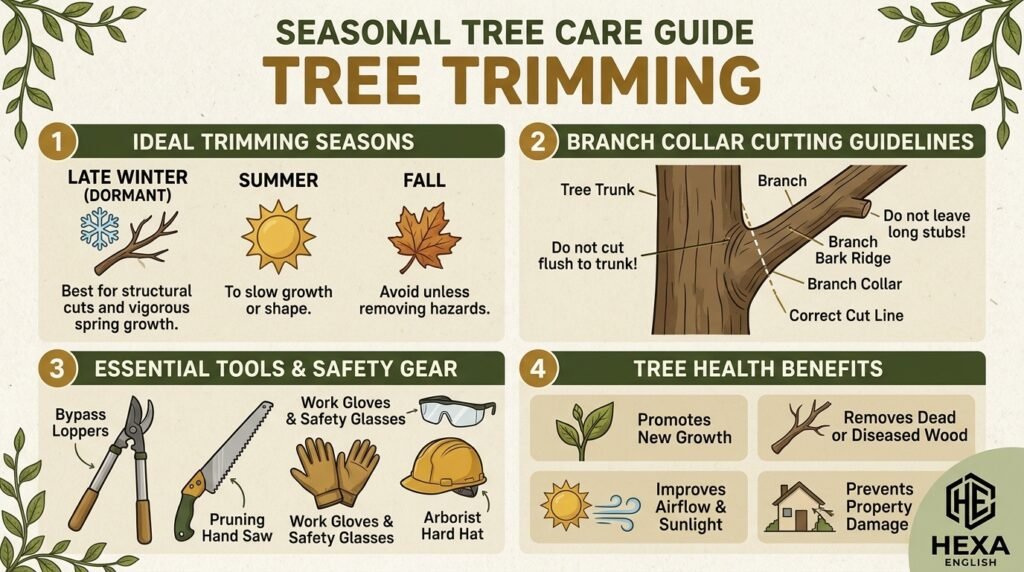
For most deciduous trees, the best time is late winter to early spring, before buds break, per Landscape Calculator and Davey Tree. That dormant window, January to February in the South and February to March in the Midwest and Northeast, offers visible structure without leaves, low insect and disease activity, and fast wound closure when growth resumes.
Dead, diseased, and broken branches can be removed any time, per Arbor Vision and Davey Tree, because safety and disease control should not wait for dormant season. That any time rule applies to deadwood, not to major live crown work, which should wait for the right window.
Fall major pruning should be avoided for most species, because early fall cuts can stimulate growth vulnerable to winter damage, per Alibaba gardening guide and Saul Land Management. That fall warning should be in every timing section, because fall is a common homeowner mistake.
Summer light trimming is acceptable for safety, corrective, and evergreen candle work, but major pruning should be saved for dormancy, per Alibaba guide. That summer light rule helps a homeowner understand why a crew may do a small summer safety cut, but decline a large summer reduction.
Timing by Tree Type Table
| Tree type | Best trimming time | Avoid, and why |
|---|---|---|
| Oak | Late winter, December to February | April to July, oak wilt risk, sap beetles attracted to fresh cuts |
| Maple | Late winter, before bud break | Spring heavy bleeding, not harmful but messy, per Landscape Calculator |
| Elm | Late winter | Spring to summer, elm bark beetle and Dutch elm disease risk |
| Birch | Late winter or late summer | Spring bleeding, per Arbor Vision, prune in winter thaw or late summer |
| Ash | Late winter | Emerald ash borer areas need assessment first, per Detroit Angi notes |
| Pine, spruce, fir, cedar | Late winter or early summer candles | Mid summer to fall, per Landscape Calculator, avoid heavy cuts in heat |
| Dogwood, redbud, spring flowering | Immediately after bloom | Late summer to fall, removes next year buds |
| Crape myrtle | Late winter, light shaping only | Avoid crape murder, heavy topping that ruins form |
| Apple, pear, cherry, peach | Late winter, before bloom | Fall, promotes disease, per Landscape Calculator |
| Citrus | Late winter to early spring, after frost risk | Heavy cuts in hottest summer, stress and sunburn risk |
| Fig, pomegranate | Late winter to early spring, before new growth | Heavy summer cuts, stress and reduced fruit |
| Palm | Spring or early summer | Hurricane season if avoidable, per Landscape Calculator |
| Hedge, topiary | Late summer, per GardenAtoZ | Heavy spring cuts that remove new growth unevenly |
That timing table uses Landscape Calculator, Alibaba guide, Arbor Vision, and GardenAtoZ, with disease windows labelled by source. That source labelling matters, because oak wilt and Dutch elm disease windows vary by region and should be verified with local extension.
Oak Wilt, Dutch Elm Disease, and Other Timing Exceptions
Oak wilt is a fungal disease that spreads through connected root systems and via sap beetles attracted to fresh cuts, per Landscape Calculator. That oak wilt mechanism explains why oak trimming in April to July, in affected regions, significantly elevates risk.
In oak wilt areas, wounds should be painted with latex paint within 15 minutes of cutting during active transmission months, per Landscape Calculator. That paint timing rule is an exception to the general no wound dressing rule, and it should be labelled as oak specific.
Dutch elm disease spreads via elm bark beetles attracted to fresh cuts, so elm trimming should avoid spring to summer in affected areas, per Landscape Calculator. That elm window, like oak, should be verified with local extension, because disease pressure varies by region.
Maple and birch bleeding, or heavy sap flow in late winter and early spring, is not harmful, per Landscape Calculator and Arbor Vision, but it can be messy. That bleeding note helps a homeowner understand why a crew may prune maples and birches in late summer instead of late winter.
How Often to Trim Trees: Frequency by Age and Type
Frequency depends on species, age, growth rate, health, and proximity to structures, with young trees needing more frequent structural work and mature trees needing less frequent maintenance. That age and type table prevents both under pruning and over pruning.
| Tree group | Typical frequency | What each visit should include |
|---|---|---|
| Young trees, 1 to 5 years | Every 1 to 2 years, structural | Central leader, branch spacing, branch angle, competing leaders, crossing branches |
| Young trees, first 10 years | Every 1 to 3 years, light shaping | One leader, well spaced limbs, small cuts under 3/4 inch, per Arbor Vision |
| Mature trees, 5 to 20 years | Every 3 to 5 years | Cleaning, thinning, raising, clearance, deadwood, structure check |
| Established trees, over 20 years | Every 5 to 7 years, with monitoring | Cleaning, deadwood, disease check, structural check, per Pelfrey Tree |
| Fast growing species | Every 1 to 2 years | Cleaning, thinning, end weight reduction, storm readiness |
| Deciduous trees, general | Every 1 to 3 years, per Marshall Tree | Dormant cleaning and thinning, structure check |
| Evergreen trees | Every 4 to 5 years | Dead, damaged, and crossing branches only, minimal shaping |
| Fruit trees | Annually, late winter | Thinning for light and air, fruit production, disease control |
| Palms | Annually or semi annually, per HomeAdvisor | Dead fronds, seed pods, health check, not over trimming live fronds |
| Hedges, topiary | As needed, often late summer | Shearing for shape, not tree pruning, per GardenAtoZ |
| Trees near structures | As needed, after inspection | Clearance, deadwood, storm readiness, per Kansas Tree Experts |
| Storm damaged trees | Immediately, after assessment | Broken branch removal, risk assessment, restoration plan |
That frequency table uses Davey Tree, Pelfrey Tree, Marshall Tree, Kansas Tree Experts, and HomeAdvisor, with young and mature ranges labelled. That labelling matters, because a fast growing tree near a house needs more frequent work than a slow growing tree in an open yard.
Over pruning, or removing too much live crown too often, can cause gradual decline over years, due to reduced photosynthesis and energy needed to seal wounds, per Davey Tree. That over pruning warning should be in every frequency section, because frequent heavy cuts are worse than infrequent light cuts.
Signs Your Tree Needs Trimming
Signs are more reliable than a calendar, because a tree that looks healthy may still have deadwood, crossing branches, or clearance problems. That signs first rule helps a homeowner call a crew when needed, not just every 3 years.
Dead or diseased branches should be removed as soon as possible, to prevent further damage and disease spread, per Pelfrey Tree and Marshall Tree. That deadwood rule applies any time, not just in dormant season.
Overgrown or crossing branches that rub against each other create wounds that invite disease, per Pelfrey Tree and Davey Tree. That rubbing branch check should be done from the ground, with binoculars if needed, not by climbing.
Branches leaning too close to a home, power lines, or pathways, or growing too close to a roof, driveway, or sidewalk, indicate a clearance trim is needed, per Marshall Tree and Kansas Tree Experts. That clearance sign should be measured, with a target clearance height, not just eyeballed.
Trees appearing misshapen, unbalanced, or leaning, or with unusually slow growth or unhealthy foliage, indicate a structural or health assessment is needed, per Marshall Tree. That misshapen sign should trigger an arborist assessment, not just a trim, because structure and health problems need diagnosis first.
Excessive canopy density blocking light to lawn, garden, or solar panels, or blocking a view, street light, or sign, indicates a thinning or raising trim is needed, per Kansas Tree Experts. That density sign should be balanced against live crown limits, to avoid over thinning.
Storm damage, including broken, hanging, or cracked branches, should be assessed immediately after a storm, per Pelfrey Tree. That storm sign should trigger a safety check from the ground, not a climb, with a crew called for hanging branches.
Safety: Power Lines, Utilities, and When to Call a Pro
Tree trimming is one of the most dangerous jobs in the US, combining fall hazards, struck by risks, and electrical exposure, per Washington State Department of Labor and Industries hazard alert, via Occupational Health and Safety. That danger framing should be in every safety section, because homeowners often underestimate tree work risk.
Utility Responsibility: Main Line Versus Service Drop
In most states, electric utility companies are responsible for trimming trees near power lines, per HomeGuide, while homeowners are responsible in some areas for cutting trees near the low voltage service drop to their homes. That main line versus service drop split should be verified with the local utility, before any work.
A homeowner should call the local utility company to determine responsibility, per HomeGuide, before hiring a crew or attempting any work near lines. That utility call is free, and it prevents a homeowner from paying for work the utility should do, or from doing work that should be done by a qualified line clearance arborist.
For trees near phone, cable, and power lines, the utility should be contacted first, with a description of the tree, location, and line type. That utility first rule applies even for small branches, because line voltage and clearance rules are not visible from the ground.
10 Foot Approach Distance and Qualified Line Clearance
Unqualified persons must maintain a minimum approach distance of at least 10 feet from energized conductors up to 50 kV, per ANSI Z133 and OSHA summaries, via Practice Test Geeks. That 10 foot rule is a hard stop, not a guideline, for homeowners and non qualified crews.
If work requires encroaching within that 10 foot zone, the only safe and compliant action is to notify the electric utility and halt work until lines are de-energized or shielded, per Practice Test Geeks ANSI summary. That halt and notify rule should be stated clearly, because it prevents electrocution.
Qualified line clearance arborists, with specific training and equipment, can work closer to lines under utility rules, but homeowners should not attempt that work. That qualified versus unqualified split should be in every power line section, with a utility call as the first step.
Climbing, Bucket Truck, and Crane Decisions
Climbing, bucket truck, and crane decisions depend on height, access, tree condition, and proximity to structures and lines, with a crew making the decision based on a pre job hazard assessment. That hazard assessment, per Washington State hazard alert, should include qualified supervision, arborist grade ropes, harnesses, and rigging systems.
Climbing spikes, or gaffs, should not be used on live trees being pruned, because spikes puncture cambium and bark on every step, per Tree Trimming Directory. That spikes rule is a quality check: a crew that uses spikes on a live prune is damaging the tree, not just climbing it.
Bucket trucks are used where access allows, for crown work and sectional cutting, while climbing is used where a bucket truck cannot reach, and cranes are used for large, hazardous, or restricted trees. That method choice should be stated in a quote, with access and property protection included.
DIY Limits: What Homeowners Can and Cannot Do Safely
DIY tree work should be limited to small, ground level branches with proper tools, and even then only with safety gear, sharp tools, and a clear plan. That ground level limit is the main DIY rule, and it should not be stretched to taller trees.
Homeowners can safely handle small ornamental trees and low branches from the ground, using hand pruners, loppers, and pole pruners, per Strobert Tree Services tool guide. That ground level tool list, hand pruners for small branches, loppers for branches up to 2 inches, and pole pruners for high branches without a ladder, should be presented as a limit, not as a climbing guide.
Homeowners should not climb trees, use chainsaws in trees, work near power lines, or remove large limbs over roofs, driveways, or sidewalks, because those jobs need training, rigging, and insurance. That no climb, no chainsaw in tree, no power line rule should be stated as a hard stop.
LawnGuru notes that small to medium tree work can be done from the ground or with pole saws, while large or hazardous trees requiring climbing or specialised equipment should be handled by a dedicated arborist. That small versus large split is a practical DIY limit, with a pro referral for large trees.
Equipment costs for occasional tree work often exceed hiring a pro when safety gear, specialised tools, and disposal fees are factored in, per VisionaryEcho palm guide and general tree cost logic. That cost comparison helps a homeowner see why a pro quote can be cheaper than a DIY rental, once gear and disposal are counted.
Mistakes to Avoid: Topping, Lion Tailing, and Over Pruning
Mistakes in tree trimming cause long term damage that cannot be fixed by one good trim, so a mistakes table is more valuable than a tips list alone. That mistakes first framing helps a homeowner spot bad work before it happens.
| Mistake | What happens | What to do instead |
|---|---|---|
| Topping | Heading large limbs to stubs, starving roots, opening heartwood to decay, triggering weak water sprouts, per Tree Trimming Directory | Crown reduction to a lateral at least one third parent diameter |
| Lion tailing | Stripping interior branches, leaving dense outer shell, prone to breakage, starving interior of sunlight, per Joshua Tree | Selective thinning near outer edge, keeping interior foliage |
| Flush cuts | Cutting into branch collar, damaging cambium, slowing wound closure, inviting decay | Cut just outside branch collar, respecting branch bark ridge |
| Over pruning, over 25 percent | Removing too much live crown in one season, reducing photosynthesis, causing gradual decline, per Davey Tree | Remove no more than 25 percent live crown, split work over seasons |
| Climbing spikes on live trees | Puncturing cambium and bark on every step, creating wounds and disease entry, per Tree Trimming Directory | Rope and harness spikeless climbing, or aerial lift |
| Wound dressing misuse | Sealing moisture and decay inside wound, slowing closure, except oak wilt paint exception | No dressing, except latex paint for oak in transmission months, per Landscape Calculator |
| Wrong season cuts | Oak wilt, Dutch elm disease, reduced flowering, stressed growth, per Landscape Calculator | Follow timing by species table, verify with local extension |
| Shearing a tree like a hedge | Dense outer shell, weak interior, unnatural form, per Joshua Tree | Selective pruning, not shearing, for trees, shearing only for hedges |
| Dull tools | Torn cuts, slow wound closure, disease entry, per Saul Land Management | Sharp, clean tools, disinfected between diseased trees |
| Ignoring disease signs | Disease spread, structural failure, larger removal later, per Saul Land Management | Remove diseased branches promptly, assess, test where needed |
That mistakes table uses ANSI A300, Davey Tree, Joshua Tree, Tree Trimming Directory, and Landscape Calculator, with each mistake labelled. That labelling matters, because a homeowner who can name topping and lion tailing can reject a bad quote.
Permits, HOA Rules, Neighbor Law, and Insurance
Permits, HOA rules, neighbor law, and insurance are local, vary sharply, and can block trimming even when a homeowner and a crew agree it is needed. That local variation means Step 2 must direct readers to official city, county, HOA, and utility sites, not to a single national rule.
Permits and Protected Trees by City
Permit rules for trimming vary by city, county, and tree type, with routine pruning often requiring no permit, while significant structural alteration or canopy coverage change may require a permit, per Panorama Tree Service Hillsborough County note. That routine versus significant split should be verified with the city, before work.
Protected trees, heritage trees, and street trees often have stricter rules than private yard trees, with permits, mitigation, or replacement requirements, per Angi Raleigh and Detroit notes. That protected tree rule means a homeowner should check city tree protection ordinances before trimming a large, old, or street tree.
Small residential trees usually do not require a permit for routine trimming, per LawnGuru, but large or protected species might, so check city and tree size. That small versus large split is a general guide, not a legal rule, and it should be verified locally.
HOA Approval Versus City Permit
HOA rules apply in addition to municipal rules, not instead of them, per general tree service guidance and palm removal HOA notes. That addition rule means a homeowner who needs both HOA architectural review approval and a city permit must get both, not just one.
If an HOA requires approval and a city requires a permit, a crew can often produce documentation that satisfies both processes in one site visit. That single visit documentation saves time, but it still requires two approvals, not one.
Ignoring HOA or city rules can lead to stop work orders, fines, and liability if trimming causes damage, per general tree service guidance. That penalty warning should be verified on the official HOA and city sites, before work.
Neighbor Trees and Property Line Rules
A homeowner can legally trim overhanging branches from a neighbor tree that extend into their property line, per HomeGuide, but may not go onto the neighbor property or destroy the tree. That property line rule is a general US guide, not legal advice, and it should be verified with local law.
Trimming to the property line should be done carefully, without harming the tree structure, because destroying a tree can lead to liability, even when branches overhang. That no destruction rule should be stated clearly, with a recommendation to notify the neighbor first.
Shared trees, trees on a boundary, and fallen trees involve shared cost, shared responsibility, and local law, which vary by state and city. That shared tree complexity should be framed as a reason to get a written agreement and, where needed, legal advice, not as a simple split.
Insurance and Liability
A licensed, insured crew should provide a certificate of insurance on request, per Sonoran Tree Care, B and C Tree Service, and Huntsville Quality Tree Service examples. That certificate check protects a homeowner from liability if a worker is injured or property is damaged during trimming.
Most homeowner insurance policies do not cover injury or property damage from DIY tree work, per general tree service guidance and palm removal insurance notes, and ANSI Z133 is the safety standard the industry follows. That DIY insurance gap is a strong reason to hire a pro for any tree above small ornamental size.
For storm damage, insurance coverage depends on policy, cause, and documentation, with photos before trimming helping a claim. That photo documentation should be done before work, not after, because a trimmed tree cannot be photographed for a claim.
The Trimming Process, Step by Step
A professional trimming job follows a predictable sequence, with assessment first, then a written specification, then cleaning, thinning, raising, and reduction in order, then cleanup. That sequence matters, because each step controls a different risk: health, structure, clearance, and disposal.
Assessment and Written Pruning Specification
Assessment starts with species, age, height, trunk diameter, lean, disease, and proximity to structures, pools, fences, roofs, and power lines. That assessment determines pruning type, method, and timing, with a risk assessment for deadwood and weak unions.
A written pruning specification should state the pruning type, branch size range, location in the canopy, clearance height, and debris and cleanup scope, per PlantRef and Tree Trimming Directory. That written specification allows a homeowner to compare bids accurately, and to check work after it is done.
A written specification should also state the live crown limit, for example no more than 20 percent or 25 percent, and the no topping, no lion tailing, and no spikes rules. That limits section prevents a crew from doing heavy work that was not agreed, and it gives a homeowner a clear check after work.
Cleaning, Thinning, Raising, and Reduction in Order
Cleaning comes first, to remove dead, diseased, and broken branches, because deadwood is a safety hazard and a disease source. That cleaning first order ensures safety work is done even if time runs short, before aesthetic work.
Thinning comes second, to reduce density and improve light and wind penetration, with selective cuts near the outer canopy edge. That thinning second order ensures light and wind work is done after safety work, not instead of it.
Raising comes third, to provide clearance over roofs, driveways, sidewalks, and streets, with exact clearance heights in feet. That raising third order ensures clearance work is done after cleaning and thinning, so clearance cuts do not remove healthy structure unnecessarily.
Reduction comes last, where needed, to shorten height or spread by cutting back to a lateral at least one third the parent diameter. That reduction last order ensures size work is done only where clearance or structure requires it, not as a default.
Cleanup, Haul Away, and Debris Options
Cleanup should leave the yard clean, with branches, leaves, and debris hauled away or left only if agreed in writing, per LawnGuru and HomeGuide. That cleanup standard should be confirmed before work, with pool, patio, and roof cleaning where debris falls in those areas.
Debris options include chip and haul, mulch left on site, logs left for firewood, and green waste disposal, with local rules varying. That debris choice should be agreed before work, because chip and haul costs more than leaving mulch, and firewood needs cutting and stacking.
A crew should inspect work with the homeowner after cleanup, to confirm pruning type, clearance, and cleanup standard were met. That post work inspection, per Angi hiring guide, allows a homeowner to check work before final payment, and to leave a review based on actual work.
After Trimming: Watering, Mulching, and Monitoring
After trimming, a tree needs water, mulch, and monitoring, not fertiliser immediately, because wound closure and root health matter more than fast growth. That post trimming care section closes the trimming loop, from cut to recovery.
Watering after trimming should follow normal species needs, with extra water during drought or heat stress, but not overwatering, which causes root rot. That watering rule should be species specific, with local extension guidance for the area.
Mulching after trimming should use a 2 to 4 inch layer, kept away from the trunk, to retain moisture, suppress weeds, and protect roots, per general arborist guidance. That mulch ring, not a mulch volcano against the trunk, prevents bark decay and pest problems.
Monitoring after trimming should check wound closure, new growth, water sprouts, and disease signs at 30, 90, and 180 days, per general post pruning care logic. That monitoring schedule helps a homeowner spot problems early, and call a crew back where needed.
Fertilising after trimming should be done only where soil tests show a deficiency, not as a default, because excess fertiliser can stress a tree. That soil test first rule prevents a homeowner from fertilising a stressed tree into more stress.
Emergency Tree Trimming: Storm, Lean, and Power Lines
Emergency trimming follows a triage sequence: safety first, then documentation, then crew, then cleanup. That triage order prevents a homeowner from making a dangerous situation worse by climbing, cutting, or touching power lines.
If a tree is leaning after a storm, cracked, or hanging over a house, roof, or driveway, stay clear, keep people and pets away, and call a licensed, insured emergency crew. That stay clear rule is the first emergency step, because a leaning tree can fall without warning.
If a tree has contacted power lines, do not touch the tree, the lines, or anything touching them, and call the utility and emergency services first. That power line rule is a hard stop, because electrocution risk is immediate and invisible.
Document damage with photos before trimming, where safe, because photos help insurance claims and permit documentation. That photo step should be done from a safe distance, not by climbing or approaching a leaning tree.
Emergency pricing is higher than scheduled pricing, because after hours, weekend, and storm demand increase labour and equipment costs. That emergency premium, per HomeStars $500 to $3,000 and HomeGuide $250 per hour, should be confirmed in writing before work starts, where possible.
After emergency trimming, stump, cleanup, and restoration can be scheduled separately, because emergency work focuses on hazard removal first. That emergency versus restoration split helps a homeowner understand why an emergency quote may not include full cleanup or replanting.
How to Choose a Tree Trimming Company
Choosing a company should follow a checklist, not a single price, because scope, insurance, and method matter more than a low bid. That checklist system prevents a low bid that excludes debris, permits, or cleanup.
Quote Checklist
A written quote should include species and height, pruning type, branch size range, clearance height, method, debris and haul away, cleanup standard, damage responsibility, permit responsibility, and payment terms. That written scope, per general tree service hiring guidance, allows a homeowner to compare bids accurately.
Licence, insurance certificate, and ISA certification should be verified before work, with certificates available on request, per Huntsville Quality Tree Service and EastLake examples. That verification step protects a homeowner from liability and from unqualified crews.
Reviews, years in business, and local service area should be checked, with a preference for companies that specialise in trees, not just general landscaping. That tree specialisation matters, because tree structure, disease, and safety differ from lawn and hedge work.
Red flags include a quote without scope, no insurance certificate, no permit discussion, a demand for full payment upfront, and a promise to top a tree for a lower price. That red flag list helps a homeowner walk away from a risky bid, even when the price looks low.
Mistakes to Avoid
- Trimming without a written pruning type. A vague trim quote cannot be compared, so ask for cleaning, thinning, raising, reduction, or restoration by name.
- Topping a tree to reduce height. Topping creates weak water sprouts and decay, so use crown reduction to a lateral instead.
- Lion tailing a dense canopy. Stripping interior branches creates a weak outer shell, so thin selectively near the outer edge.
- Making flush cuts into the branch collar. Flush cuts damage cambium and slow wound closure, so cut just outside the collar.
- Removing more than 25 percent live crown in one season. Over pruning reduces photosynthesis and causes gradual decline, so split work over seasons.
- Using climbing spikes on a live prune. Spikes puncture bark and cambium, so use spikeless climbing or an aerial lift.
- Trimming oaks in April to July in oak wilt areas. Fresh cuts attract sap beetles, so trim oaks in dormant season and paint wounds where required.
- Trimming near power lines yourself. Unqualified persons must stay 10 feet from energized lines up to 50 kV, so call the utility first.
- Assuming debris and haul away are included. Debris scope is often separate, so confirm chip, haul, mulch, and cleanup in writing.
- Choosing by lowest price alone. A low bid that excludes scope, insurance, or cleanup can cost more than a higher bid with full scope.
Tips for Tree Trimming
- Get 2 to 3 written quotes. Compare pruning type, size range, clearance, debris, and cleanup, not just price.
- Verify licence, insurance, and ISA certification. Ask for a certificate of insurance before work starts, not after.
- Check permits, HOA rules, and utility responsibility first. Get city, HOA, and utility approvals before scheduling, to avoid stop work orders.
- Call 811 before stump or root work. Map utilities before digging, to prevent strikes and damage, where stump work is included.
- Confirm live crown limit in writing. Get no more than 25 percent, no topping, no lion tailing, and no spikes in the quote.
- Photograph before trimming. Photos help insurance claims, permit documentation, and post work checks, especially for storm cases.
- Ask about method: climbing, bucket truck, or crane. Confirm method, access, and property protection before work, especially for tall and tight sites.
- Confirm cleanup standard. Agree on haul away, mulch, firewood, and yard condition before work, not after.
- Plan monitoring after trimming. Check wound closure, new growth, and disease signs at 30, 90, and 180 days.
- Keep all documents. Keep quotes, permits, insurance certificates, and photos for insurance, HOA, and future sale records.
FAQs
How much does tree trimming cost?
Tree trimming costs $80 to $1,000 per tree in HomeGuide, with an average of $250 to $500, and $460 on average in Angi, with a typical range of $200 to $760. That range depends on size, species, access, and condition, so get a written local quote for a specific tree.
How much does it cost to trim a small tree?
Small trees under 25 feet cost $100 to $350 in Raleigh, $200 to $500 in New York, $100 to $400 in Detroit, and $100 to $350 in Dallas, per Angi June 2026 city guides. That small tree range assumes open access and no crane, so tight access or disease can increase the price.
How much does it cost to trim a large tree?
Large trees over 50 feet cost $500 to $1,800 in Raleigh, $800 to $2,200 in New York, $400 to $2,100 in Detroit, and $500 to $1,800 in Dallas, per Angi June 2026 city guides. That large tree range reflects climbing, bucket truck, or crane work, plus rigging and disposal.
How much does tree trimming cost per hour?
Tree trimming costs $100 to $150 per hour in HomeGuide, $75 to $150 per hour in HomeStars, and $225 per hour for a 3 man crew in HomeBlue. That hourly versus crew distinction matters, because a crew rate includes multiple workers, equipment, and disposal.
How much does emergency tree trimming cost?
Emergency tree trimming costs $500 to $3,000 per job in HomeStars, with hourly emergency rates up to $250 per hour in HomeGuide. That emergency premium reflects after hours, weekend, and storm demand, and it should be confirmed in writing where possible.
Is tree trimming and pruning the same?
In everyday use, trimming and pruning are used interchangeably, but in professional ANSI A300 language, pruning is the standard term with five types, while trimming is often used for general branch removal or shaping. That language difference matters for quotes, because a crew that names a pruning type is pricing specific cuts.
What is the difference between tree trimming and tree pruning?
Tree trimming often focuses on cutting back overgrown branches for appearance, clearance, or safety, while tree pruning focuses on selective removal for health, structure, and safety, following ANSI A300 standards, per EastLake Tree Services. That focus difference means pruning follows a type and a limit, while trimming alone may not.
What is the difference between tree trimming and tree cutting?
Tree trimming keeps the tree and removes only selected branches, while tree cutting, or full removal, takes the entire tree down, often followed by stump grinding and site cleanup, per Panorama Tree Service. That keep versus remove split should be clear in any quote, before work starts.
What is the difference between tree trimming and tree removal?
Tree trimming is maintenance that preserves the tree, while tree removal is a one time job that eliminates the tree, with loss of shade, privacy, and canopy cover, per Panorama Tree Service. That preservation versus elimination split means trimming should be tried first, where safety and health allow.
When is the best time to trim trees?
For most deciduous trees, the best time is late winter to early spring, before buds break, when the tree is dormant, structure is visible, and disease activity is low, per Landscape Calculator and Davey Tree. That dormant window varies by region, January to February in the South and February to March in the Midwest and Northeast.
When is the best time to trim oak trees?
Oak trees should be trimmed in late winter, December to February, to avoid oak wilt risk in April to July, when sap beetles are attracted to fresh cuts, per Landscape Calculator. That oak window should be verified with local extension, because oak wilt pressure varies by region.
When is the best time to trim maple trees?
Maple trees should be trimmed in late winter, before bud break, with a note that spring pruning can cause heavy sap bleeding, which is not harmful but messy, per Landscape Calculator. That bleeding note helps a homeowner understand why a crew may prune maples in late summer instead.
When is the best time to trim fruit trees?
Fruit trees, including apple, pear, cherry, and peach, should be trimmed in late winter, before bloom, to improve fruit production and structure, per Landscape Calculator and Arbor Vision. That fruit window should be followed annually, because fruit production depends on annual thinning for light and air.
When is the best time to trim evergreen trees?
Evergreen trees, including pine, spruce, fir, and cedar, should be trimmed in late winter or early summer when new growth, or candles, are half extended, per Landscape Calculator and Alibaba guide. That evergreen window avoids heavy cuts in mid summer to fall, when heat stress is high.
When is the best time to trim flowering trees?
Spring flowering trees, including dogwood and redbud, should be trimmed immediately after bloom, to avoid removing next year buds, per Landscape Calculator. That after bloom rule applies to early bloomers, while summer bloomers should be trimmed in late winter, per Saul Land Management.
Should I trim trees in fall?
Major trimming in fall should be avoided for most species, because early fall cuts can stimulate growth vulnerable to winter damage, per Alibaba guide. That fall warning applies to major live crown work, not to deadwood removal, which can be done any time.
Should I trim trees in summer?
Light trimming in summer is acceptable for safety, corrective, and evergreen candle work, but major pruning should be saved for dormancy, per Alibaba guide. That summer light rule helps a homeowner understand why a crew may do a small summer safety cut, but decline a large summer reduction.
How often should trees be trimmed?
Mature trees should be trimmed every 3 to 5 years, young trees every 1 to 2 years for structure, evergreens every 4 to 5 years, and fruit trees annually, per Davey Tree, Pelfrey Tree, and Marshall Tree. That frequency table should be adjusted for species, growth rate, health, and proximity to structures.
How often should young trees be trimmed?
Young trees should be trimmed every 1 to 2 years for the first several years, to establish a central leader, well spaced limbs, and strong branch angles, per Pelfrey Tree and Fellers Tree Service. That young tree frequency is light structural work, not heavy cutting, with small cuts that heal quickly.
How often should mature trees be trimmed?
Mature trees should be trimmed every 3 to 5 years, with cleaning, thinning, raising, and clearance checks, per Davey Tree and Pelfrey Tree. That mature frequency should be shortened where a tree overhangs a roof, driveway, patio, or frequently used yard space.
How often should fruit trees be trimmed?
Fruit trees should be trimmed annually in late winter, to encourage airflow, sunlight penetration, and fruit production, per Marshall Tree and Arbor Vision. That annual fruit rule is different from shade trees, because crop depends on annual thinning, not just occasional cleaning.
How often should evergreen trees be trimmed?
Evergreen trees should be trimmed every 4 to 5 years, focusing on dead, damaged, and crossing branches, rather than shaping, per Marshall Tree. That evergreen frequency reflects natural form retention, with minimal shaping needed compared to deciduous trees.
What are the signs a tree needs trimming?
Signs include dead, diseased, or damaged limbs, overgrown or crowded branches, branches leaning too close to a home, power lines, or pathways, misshapen or unbalanced form, and unusually slow growth or unhealthy foliage, per Marshall Tree and Pelfrey Tree. That signs list should trigger an assessment, not just a trim, where structure or health is in question.
Can I trim a tree myself?
Homeowners can trim small, ground level branches using hand pruners, loppers, and pole pruners, with safety gear and sharp tools, per Strobert Tree Services. That ground level limit should not be stretched to climbing, chainsaw in tree work, large limbs, or power line work, which need a pro crew.
Can I trim tree branches over my roof myself?
No, trimming branches over a roof should not be done by a homeowner, because fall zone, drop control, and roof damage risk require rigging, climbing, or bucket truck experience. That roof job should be done by a licensed, insured crew with a written plan for property protection.
Can I trim tree branches near power lines myself?
No, trimming branches near power lines should not be done by a homeowner, because unqualified persons must stay at least 10 feet from energized conductors up to 50 kV, per ANSI Z133 and OSHA summaries. That power line job should be handled by the utility or a qualified line clearance arborist, after a utility call.
Conclusion
Tree trimming becomes clear once pruning type, timing, frequency, and safety are checked in order. Clean deadwood any time, thin selectively with a live crown limit, raise for clearance with exact heights, and reduce only to a lateral, never by topping.
Keep three rules close: ask for the ANSI A300 pruning type by name, follow timing by species with oak and elm disease windows in mind, and get a written quote with scope, insurance, and cleanup. Add a licensed, insured, ISA certified crew for tall, leaning, and power line trees, and most trims will be safe, healthy, and ready for the next season.
Get 2 to 3 written local quotes for your specific tree, confirm pruning type, size range, clearance, and debris in writing, and keep all permits, photos, and insurance documents for your records.

Dilawar Mughal is an SEO expert with 8 years of hands-on experience helping websites grow their organic traffic, rankings, and revenue. He specializes in content-driven SEO, local SEO, and Pinterest SEO, and builds practical, results-focused strategies for businesses and publishers.
