

AI checker false positives are the error that can end a degree: your own writing, classified as machine made by a tool that never saw you write it. The score looks like proof.
It is a probability about patterns, and the difference matters.
This page separates the two. Every false positive rate below carries its source, its sample and its year, because on this topic the number without its owner is how innocent students get treated as statistics.
One rule runs through everything that follows, and it comes from the vendors themselves: a detector score is a signal, not a verdict.
Even Turnitin instructs educators not to use its score on its own to decide a misconduct case.
What a False Positive Is, and What It Is Not
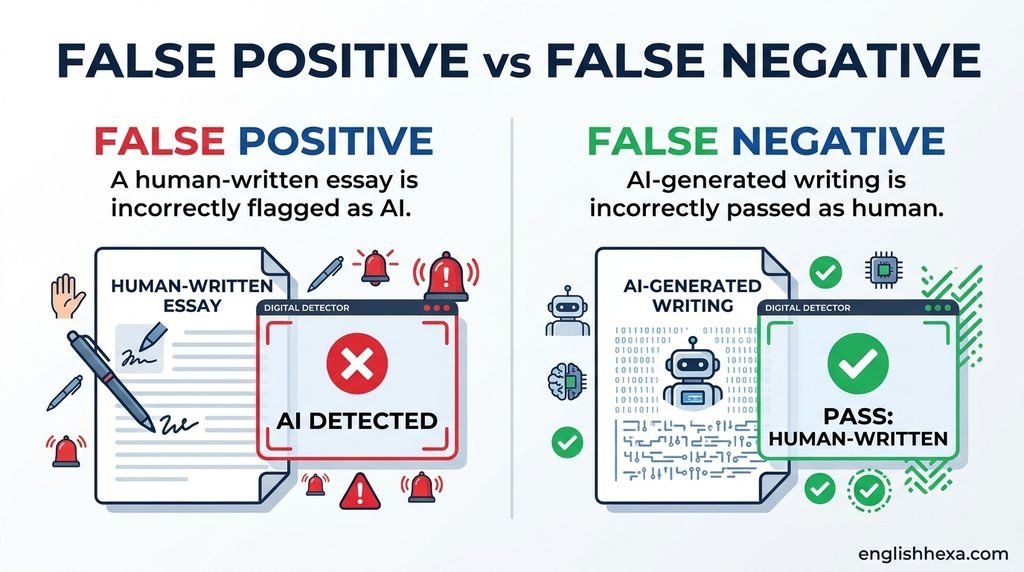
A false positive is a wrong verdict in one direction: human text classified as AI generated. Its mirror, the false negative, is AI text passed as human.
Every detector trades one error against the other at its chosen threshold.
The critical limit is what the tool observes. A detector reads the finished text only: word predictability, sentence variation, statistical habits. It cannot see drafts, effort, or you.
It estimates how the text was probably produced, and probably is doing heavy work in that sentence.
So a high score means one precise thing: this text matches the patterns the model associates with machine output. Formal, careful, predictable human writing matches those patterns too, which is why the rest of this page exists.
The Measured Rates, Tiered by Provenance
Rates on this topic arrive from four very different kinds of source, and they must not be averaged together. Read the tier before the number.
| The finding | Tier | Conditions that come with it |
|---|---|---|
| 61.3 percent average false positive rate on non native English essays | Peer reviewed (Liang et al., Patterns, 2023) | Seven 2023 era detectors; 91 TOEFL essays; native essays classified nearly perfectly in the same test |
| 4.2 percent false positive rate on human essays | Independent study (Computers and Education, 2024, as reported) | Turnitin; 500 human and 500 AI essays; about 91 percent of AI text detected |
| Roughly 750 wrongly labelled papers a year | Institutional arithmetic (Vanderbilt, 2023) | Assumes a 1 percent rate over about 75,000 annual papers; the university’s own reason for switching off |
| Under 1 percent false positive rate | Vendor claim (Turnitin) | Document level only, and only for papers scoring over 20 percent AI; sentence level estimate reported as revised to about 4 percent |
| Essentially zero on longer passages | Working paper summary (Chicago Booth, 2025, as reported) | A newer detector, Pangram; a summary of research, not yet a settled benchmark |
| 43 to 83 percent on student writing | Blog reported (2026 study claim) | Provenance and method not checkable from the citing pages; excluded from the verified findings here |
The Stanford led study in Patterns is the anchor. Its design was simple: the same seven detectors, two sets of certainly human essays.
On second language writing they failed at a rate that should have ended the debate about using scores as evidence.
Two precision points protect you from the common retellings. First, 61.3 percent is a 2023 figure about seven specific tools and one specific sample, not a permanent property of all detectors.
Second, Turnitin was not one of the seven tools Liang’s team tested; its evidence problem arrives through other tests and its own claim conditions.
The mechanism findings inside the study matter as much as the headline. When the researchers had ChatGPT rewrite the TOEFL essays with richer vocabulary, the false positive rate fell from 61.3 to 11.8 percent.
The detectors were not measuring machine involvement; they were measuring distance from a native register.
How to Read Any Rate You Are Quoted
Rates in this debate are quoted to end arguments, so interrogate them the same way every time, whoever offers the number, including this page.
- Whose test was it: peer reviewed study, independent replication, the institution itself, or the vendor selling the tool
- What text was tested: native or second language, long essays or short statements, raw or edited
- Which level was measured: whole documents above a threshold, or the individual sentences an accusation actually cites
- When was it run: detector versions change silently, and a 2023 rate describes 2023 tools
A number that survives all four questions is evidence. A number that cannot answer them is marketing or folklore, and it should carry no weight in a hearing, a policy, or a headline.
Turnitin’s Claim and the Condition Inside It
| The claim as usually quoted | What the documentation actually scopes it to |
|---|---|
| 98 percent accurate | The company’s 2023 whitepaper framing for its AI writing detection overall |
| False positive rate under 1 percent | Document level, for documents whose AI score exceeds 20 percent |
| Sentence level reliability | Estimate reported as revised from under 1 percent to about 4 percent in mid 2023 |
| Scores as misconduct evidence | Turnitin’s own guidance: not to be used in isolation; data for an educator’s informed decision |
None of this requires bad faith to go wrong in practice. A busy instructor sees one percentage on one dashboard, and the conditions live in documentation nobody opens during marking season.
The claim and its conditions simply travel separately.
The practical reading for students: when you are quoted a rate, ask which level, which threshold, which sample.
A document level claim says nothing about the flagged sentences in your essay, and the sentence is where accusations actually live.
Why It Happens: Perplexity, Burstiness and the Predictability Trap
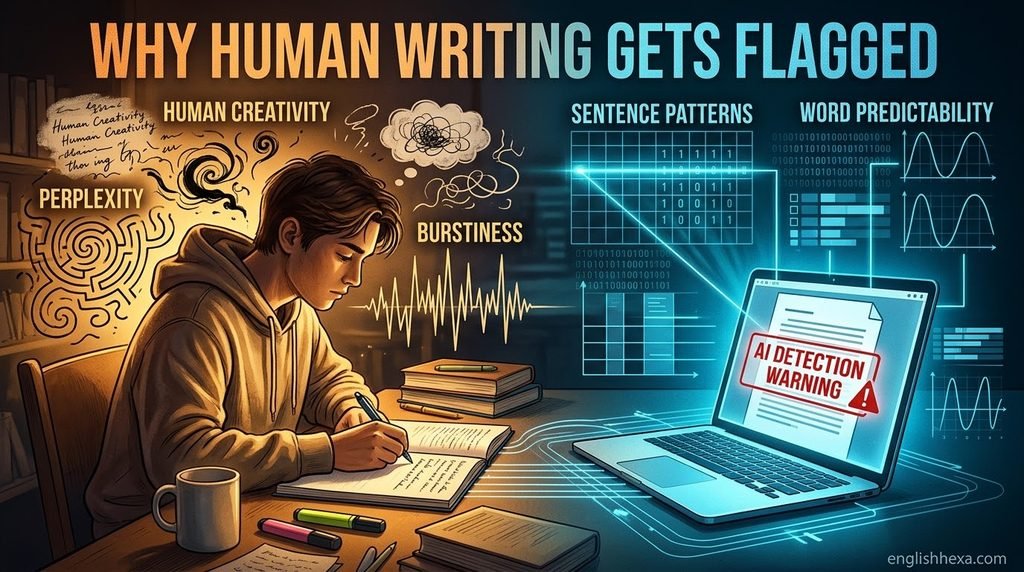
Perplexity: The Surprise Meter
Most detectors are built on perplexity, a measure of how predictable each word is to a language model. Machine text is engineered to choose the likely next word, so low perplexity reads as machine made.
The trap is that careful humans are predictable too. A second language writer choosing safe constructions, a scientist following a methods template, and an editor polishing prose toward clarity all push perplexity down for entirely human reasons.
On the only dimension the detector measures, caution, craft and computation look identical. That single sentence explains most false positives ever recorded, including the embarrassing demonstrations where founding era documents score as machine written.
Burstiness: The Rhythm Check

The second signal is burstiness, the variation in sentence length and complexity. Human writers naturally alternate short punches with long builds. Model output is more uniform, so uniform rhythm reads as synthetic.
Writers whose style or assignment demands uniformity absorb the penalty: technical reports, legal and medical prose, formulaic academic sections, and anyone taught to write in short, even, simple sentences, which includes most second language instruction.
Thresholds, Samples and Version Drift
Three quieter forces compound the problem. Thresholds are policy choices disguised as measurements: lower the bar and more AI is caught alongside more innocents.
Short samples give the model almost nothing to judge, so a few predictable sentences dominate.
And versions change silently. Vendors update models and thresholds without notice, so the same essay can score differently across tools, versions and months.
A student often cannot reproduce the evidence being used against them, a fairness problem universities themselves have cited.
Who Gets Flagged: The Patterned Risk Groups
False positives are not random weather. They fall on recognizable groups, which is what turns a technical flaw into a fairness problem.
Second language writers carry the documented heaviest risk, for the perplexity reasons above. International students write carefully in a language they are still mastering, and careful is precisely the profile the detector suspects.
Formulaic academic writers follow. Methods sections, literature reviews and APA or IEEE formatted work run on standard phrases by design. The more faithfully a student follows the template they were taught, the more machine like the template reads.
Edited writers are the third group. Grammar checkers and heavy proofreading strip out the irregularities detectors read as human. Adjudicators have already seen the pattern: one published UK case summary records Grammarly use being dismissed as misconduct evidence.
Neurodivergent writers are the fourth group in education reporting: repetitive phrasing, consistent word choices and non standard syntax overlap detector training patterns.
The peer reviewed base here is thinner than for second language writers, so the honest status is reported risk, still being studied.
Short text writers complete the set. Personal statements, scholarship essays and cover letters are short, polished and high stakes, the worst possible combination.
Reported cases include a scholarship statement flagged at nearly 100 percent by a student who wrote every word.
The Institutional Retreat: Universities That Switched Detection Off
Institutions that examined the evidence reached similar conclusions at increasing speed. The pattern below is drawn from the universities’ own notices and reputable reporting, with dates.
| When | Institution | What it did |
|---|---|---|
| April 2023 | University of British Columbia | Declined to enable Turnitin AI detection at launch |
| August 2023 | Vanderbilt University | Disabled it campus wide, citing opacity, privacy, bias and the 750 papers arithmetic |
| October 2023 | Georgetown University | Turned it off in similarity checks; faculty judged false positive harm worse than any benefit |
| March 2025 | Australian Catholic University | Switched the AI indicator off after the referral crisis detailed below |
| January 2026 | Curtin University | Disabled it on all campuses, naming ESL bias in its notice |
| February 2026 | Washington State University | Canceled its Turnitin AI detection contract |
| July 2026 | HEPI (UK policy institute) | Recommended suspending AI detection in misconduct proceedings |
The Australian case is the scale warning.
As the ABC News investigation into ACU reported, the university referred nearly 6,000 students for alleged misconduct in 2024, about 90 percent of them over AI use, then dismissed the cases resting solely on Turnitin’s detection.
Curtin’s decision is the fairness landmark: its official notice on disabling the tool acknowledged in plain language that detection disproportionately flags international students and non native English speakers.
When the institution says the quiet part in its own policy document, the debate is effectively over.
Trackers now list 50 to 60 plus institutions across several countries that have disabled, declined or restricted these tools.
Counts differ by tracker and criteria, which is itself the lesson of this page: on this topic, always ask who counted, and how.
Falsely Accused: Your First 48 Hours
If a flag lands on your work, the order of operations matters. Evidence decays and tempers do not help; paperwork does.
Step 1: Preserve everything before editing anything. Save drafts, notes, outlines and sources exactly as they are. Do not improve the flagged document; the untouched original and its history are your defence.
Step 2: Export your version history. Google Docs and Word record how a document changed across days.
A history showing paragraphs drafted, deleted and rewritten is something generation does not produce, and it is the strongest single exhibit students have.
Step 3: Gather earlier writing samples. Prior essays in your own voice let a reviewer compare patterns. Collect them now, with dates, before anyone asks.
Step 4: Ask for the process in writing. Which tool and version produced the score, what threshold your institution uses, what corroboration its policy requires, and what the appeal route is.
Institutions with defensible processes can answer; asking is reasonable and increasingly normal.
Step 5: Request passage level review. Ask for the flagged passages to be read alongside your drafts, not the headline percentage alone.
Sentence level flags carry the highest error estimates, so passages, not percentages, are the fair unit of review.
Step 6: Offer to discuss the work. A short oral defence, walking through your argument and choices, is powerful evidence. It is genuinely difficult to fake detailed knowledge of decisions you actually made while writing.
The evidence that overturns flags, in one checklist:
- Version history with timestamps across multiple days
- Drafts and deleted passages showing the text developing
- Notes, outlines and annotated sources predating the submission
- Earlier writing samples for voice comparison
- A record of permitted tools you used, disclosed accurately
Outcomes prove this works.
The UK’s student adjudicator has published case summaries, including an OIA case on AI and academic misconduct, where complaints were upheld or partly justified after detector led accusations, and institutions elsewhere have dismissed score only cases outright.
For Educators: Corroboration Rules That Make a Flag Fair
Most institutions are not choosing between detection and chaos. They are choosing between a score as a verdict and a score as one signal inside a process. The second survives scrutiny; the first keeps producing ACU scale corrections.
Start with the arithmetic your policy implies.
A false positive rate of even 1 percent across a large cohort is hundreds of innocent students; one Australian integrity expert estimated 0.7 percent would wrongly flag over 100,000 assessments a year nationally.
Base rates decide what a flag is worth before any individual case begins.
A defensible policy has five working parts:
- A corroboration rule: no misconduct finding on a detector score alone, stated in writing
- Passage level review: flagged sentences examined with drafts, not a dashboard percentage
- A documented appeal route with process evidence explicitly admissible
- Version awareness: staff told that scores shift across tools and updates, and that disagreement between tools is expected
- Population checks: outcomes monitored for second language and other patterned groups
Assessment design quietly does the rest. Drafted assignments, process checkpoints and short oral defences make authorship observable, which no detector score can do after the fact.
Institutions moving this way are not lowering standards; they are moving the evidence upstream.
Are Newer Detectors Fixing It?
Partly, on the current evidence, and the honest summary is narrowed, not closed.
A 2025 Chicago Booth working paper summary reported a newer detector, Pangram, at an essentially zero false positive rate on longer passages, ahead of established tools near 1 percent.
Vendors also report dramatic improvement on the famous test set: Pangram’s own re test of the 2023 TOEFL essays reports 0.00 percent false positives.
That is a first party result on a benchmark the industry has had years to tune against, and it should be weighted exactly that way.
Independent checks tell the more cautious half. Replications since 2023 still find elevated false positives on informal second language writing.
A May 2026 replication reported one major tool at 16 percent on informal ESL text. A 2026 revisit study found the native versus non native gap narrowed sharply for one detector, without disappearing.
The generation side moves too, which is the structural problem: detectors train on known generators, and the tools that write also edit.
Anyone who has watched an AI image generator improve across versions has seen the same race run in images. Expect continued improvement and continued error, in that order, and set policy accordingly.
Beyond Students: Jobs, Journals and Freelance Work
The same tools screen writing far from campus, and the same profile gets flagged: formulaic professional prose. Cover letters follow templates by convention. Resumes are compressed, polished and edited by tools. Both sit squarely in the predictability zone.
Freelance writers meet the flag from the client side, sometimes with payment withheld on a score the client cannot explain. Journal authors meet it at submission, where an editor’s dashboard substitutes for a conversation about the manuscript.
The defence transfers intact. Keep briefs, drafts and correspondence; show the work developing; offer earlier samples in the same voice.
Authorship evidence is a professional habit, not a student emergency measure, and the professionals who keep it answer a flag in one email.
Employers and editors sit in the educator’s chair here, with the same duties: read the passages, ask for the process, and never let a percentage end a working relationship without corroboration.
Mistakes and Myths
1. Quoting 61.3 percent as today’s universal rate. It is a 2023, seven tool, one sample result. Its lesson about mechanism and fairness endures; its number describes its test, and honest use keeps the date attached.
2. Quoting under 1 percent without its condition. Turnitin’s document level claim applies above a 20 percent AI score. The flagged sentences in a real accusation live at sentence level, where the reported estimate is about 4 percent.
3. Treating disagreement between detectors as a rounding issue. The same assignment has scored 62, 75 and 87 percent across three tools in a reported school case.
Disagreement at that size means the instruments measure differently, not that one needs recalibrating by eye.
4. Rewriting your essay to beat the score. Deliberately degrading good writing to look less predictable trades your grade and your learning for a number. The defence that works is evidence and review, as the adjudicated cases show.
5. Trusting a free pre check as armour. Free tools disagree with each other and with the system your school runs; the wider market is mapped in this site’s look at GFXRobotection AI software by GFXMaker.
Treat any pre check as a warning light: useful information about your risk, and no guarantee at all about a different tool’s verdict on a different day.
6. Deleting drafts to tidy up. Your messy process is your alibi. Version history, notes and failed paragraphs are the exhibits that end accusations; students who keep them win reviews that students who deleted them cannot.
Frequently Asked Questions
What is an AI checker false positive?
An AI checker false positive is a wrong verdict in one direction: text a person wrote is classified as AI generated.
The detector measured patterns in the finished text, usually predictability, and the patterns matched what it expects from a machine.
Can an AI checker be wrong?
Yes, and the vendors effectively say so.
Turnitin states its AI score should not be used on its own to decide a misconduct case, and independent studies have measured false positive rates far above the vendors’ headline figures on real student writing.
What false positive rate do AI detectors have?
It depends on the text and the test. Turnitin claims a document level rate under 1 percent for papers scoring over 20 percent AI.
A 2024 independent study measured 4.2 percent on human essays, and the 2023 Stanford led study averaged 61.3 percent on non native English essays.
Why did the Stanford study find 61.3 percent false positives?
Liang and colleagues (Patterns, 2023) ran seven detectors over 91 TOEFL essays by non native English speakers.
The essays used simpler, more predictable language, and detectors key on predictability, so the average false positive rate was 61.3 percent, against near perfect classification of US eighth grade essays.
Are AI detectors biased against non native English speakers?
The 2023 evidence says the detectors of that period were. Predictable second language writing scores as low perplexity, the same signal detectors read as machine text.
The finding has been replicated since, and Curtin University cited this bias by name when disabling detection in 2026.
Why does formal or formulaic writing get flagged?
Detectors reward surprise. Academic prose follows templates, standard phrases and careful structure, which lowers its unpredictability. A detector reading only statistical patterns cannot tell a disciplined human template from a model’s default output, so formulaic competence is penalized.
Can using Grammarly or a grammar checker cause a false positive?
It can raise a score. Heavy automated editing homogenizes sentence patterns and removes the irregularities detectors read as human.
UK adjudicator case summaries include a case where Grammarly use was dismissed as evidence of AI misconduct, and guidance is to accept edits selectively and keep your drafts.
Do short texts get flagged more easily?
Yes. A detector judging a paragraph or a personal statement has very little signal, so a few predictable sentences dominate the score.
Several of the most striking anecdotes, including scholarship statements flagged near 100 percent, involve short, careful, high stakes texts.
Why do different detectors give different scores for the same essay?
Each tool trains on different data, weighs different signals and sets a different threshold. One student’s assignment scored 62, 75 and 87 percent AI across three detectors in a widely reported school case.
Disagreement between tools is itself evidence that no single score is a verdict.
Is an AI score enough evidence to fail a student?
No major authority treats it as such.
Turnitin instructs educators not to use the score in isolation, universities that examined the question concluded the same, and adjudicators have upheld student complaints where a score was effectively the whole case.
A flag can start a review; it cannot finish one.
What should I do first if I am falsely accused of using AI?
Preserve everything before you edit anything: drafts, notes, outlines, sources, and the version history in your document app. Process evidence is what overturns flags, and it is much easier to keep than to reconstruct.
Then ask, in writing, for the review process and the evidence standard being applied.
How do I prove I wrote my essay?
Show the writing happening: version history with timestamps, earlier drafts, handwritten or typed notes, source annotations, and earlier samples of your writing for comparison.
An oral discussion of your own argument, a viva, is also strong evidence, because it is very hard to fake knowledge of choices you actually made.
Can I appeal an AI cheating accusation?
At most institutions, yes, through their academic misconduct appeal route.
Strong appeals attach process evidence, cite the detector’s documented false positive rates and the vendor’s own caution against sole reliance, and ask for the flagged passages to be reviewed alongside your drafts.
Legal defence services exist for serious cases.
What is version history and why does it matter?
Word processors such as Google Docs and Microsoft Word record how a document changed over time. A history showing paragraphs drafted, deleted and rewritten across days is something AI generation does not produce.
It is the single most persuasive authorship evidence a student can present.
Why did Vanderbilt University turn off Turnitin’s AI detector?
Vanderbilt disabled it in August 2023 citing no insight into how it works, privacy concerns, and false positive risk at scale: even a 1 percent rate on its 75,000 papers a year meant roughly 750 wrongly labelled papers annually.
Evidence of bias against non native speakers also featured.
What happened at Australian Catholic University?
ACU referred nearly 6,000 students for alleged misconduct in 2024, around 90 percent over AI use, as reported by the ABC.
The university later dismissed cases where the only evidence was Turnitin’s AI detection, and switched the AI indicator off in March 2025.
How many universities have disabled AI detectors?
Trackers maintained by education sites list more than 50 to 60 institutions that have disabled, declined or restricted AI detection since 2023, including UBC, Georgetown, Waterloo, Curtin and Washington State.
Counts vary by tracker and criteria, so cite the tracker and its date, not a bare number.
Did Turnitin change its false positive claim?
Reporting on Turnitin’s documentation says the company revised its sentence level false positive estimate from under 1 percent to about 4 percent in mid 2023.
Its document level claim stayed under 1 percent, for papers above the 20 percent AI threshold. The two levels are routinely confused.
What is perplexity and why does it cause false positives?
Perplexity measures how predictable each word is to a language model. Machine text is engineered to be predictable, so low perplexity reads as machine made.
The flaw is that careful humans are predictable too: second language writers, technical writers and good editors all lower perplexity for human reasons.
What is burstiness?
Burstiness is the variation in sentence length and complexity across a text. Human writing tends to alternate short and long sentences; model output is more uniform.
Detectors score low burstiness as machine like, which penalizes writers whose natural or required style is uniform, including many technical and second language writers.
Can neurodivergent writers be flagged more often?
Advocacy and education reporting says yes, because some neurodivergent writers naturally use repetitive phrasing, consistent word choices and non standard syntax that overlap detector training patterns.
The peer reviewed base here is thinner than for second language writers, so treat specific multiplier claims with caution and cite them as reported.
Can translated text be flagged as AI?
Yes. Translation, especially machine assisted translation, produces smooth, predictable phrasing, and the detector sees the surface, not the process.
Students who draft in their first language and translate into English are a recognized false positive group, which is another reason process evidence matters.
Why was the Declaration of Independence flagged as AI?
Demonstrations reported in education coverage have run founding era documents through free detectors and received very high AI scores, including figures of 95 to 100 percent for the Declaration of Independence on one popular tool.
Formal, balanced, predictable prose is exactly what these systems are built to suspect.
Do detectors flag edited or proofread human writing?
They can. Professional editing removes idiosyncrasy, and idiosyncrasy is much of what detectors read as human.
Heavily edited drafts, ghost edited work and text polished by grammar tools all sit closer to the machine profile than rough first drafts do.
What does a 100 percent AI score actually mean?
It means the detector’s model classified essentially all the analyzed text as matching its AI patterns, at its chosen threshold.
It is a statement about pattern matching, not a measurement of authorship, and short or formulaic texts reach 100 percent far more easily than varied long ones.
Should teachers use AI detectors at all?
The emerging institutional answer is: not as evidence of misconduct on their own. Universities that kept any use typically restrict detectors to a conversation starter, require corroborating evidence, and train staff on documented error rates.
Some jurisdictions and districts have moved to prohibit reliance on the scores entirely.
What is the difference between a false positive and a false negative?
A false positive flags human writing as AI; a false negative passes AI writing as human. Lowering a detector’s threshold catches more AI text and creates more false positives; raising it does the reverse.
Every detector chooses a point on that trade off, and the costs of the two errors fall on different people.
Why does a 1 percent false positive rate matter so much?
Scale. One percent of a large submission volume is a large number of innocent people. Vanderbilt’s arithmetic was about 750 papers a year on one campus.
An Australian integrity expert estimated even 0.7 percent would wrongly flag over 100,000 assessments a year across Australian higher education.
Which AI detector has the lowest false positive rate?
Newer entrants claim the crown. A 2025 University of Chicago Booth working paper summary reported Pangram with an essentially zero false positive rate on longer passages.
Treat rankings as dated snapshots: models change, and vendor re tests of famous datasets are first party results, not independent ones.
Are newer detectors better on ESL writing?
Vendors report large improvements, including near zero false positives when re testing the 2023 TOEFL dataset. Those re tests are first party, run on a famous benchmark tools could be tuned against.
Independent replications still find elevated rates on informal second language writing, so the gap has narrowed, not closed.
Can running my essay through a free detector first protect me?
It gives a warning, not a shield. Free detectors disagree with each other and with the institutional tool your school actually uses, and chasing a low score by degrading your writing has real costs.
The better protection is process evidence: drafts, notes and version history kept as you work.
What should schools do instead of relying on detectors?
The direction from universities and reports such as HEPI’s 2026 analysis is corroboration and process.
Design assessments that show drafting, use oral defences where authorship matters, and treat detector output as one signal reviewed by a human, with an appeal route.
Is it legal for a school to punish a student based on an AI score?
Rules vary by country, state and institution, and this is general information, not legal advice.
What is documented: adjudicators have found for students where detector evidence was handled unfairly, institutions have dismissed score only cases, and defence lawyers now specialize in these disputes.
Do employers and clients get false positives too?
Yes. Cover letters, resumes and freelance copy are screened with the same tools, and formulaic professional writing is a classic false positive profile.
Writers facing a client side flag use the same defence: drafts, briefs, correspondence and earlier samples that show the work being made.
What is AI detection anxiety?
Surveys report widespread student stress about wrongful flagging.
A 2026 Studiosity and YouGov survey of 2,373 UK university students found about three quarters of students who use AI reported significant stress over wrongful accusation, with international students reporting higher anxiety than domestic peers.
Can a detector tell if I used AI for only part of a document?
Tools that score sentence by sentence can highlight mixed patterns, and human plus AI documents are where scores get least stable.
Sentence level highlighting is also where false positive estimates are highest, so a partly flagged document needs passage level review, not a headline percentage.
Why do detectors keep changing their scores on the same text?
Vendors update models and thresholds without notice, and the same essay can score differently across versions, tools and even runs.
That instability is a core fairness complaint: a student cannot reproduce the evidence against them, which is why several universities cited opacity when switching the tools off.
What evidence do universities accept in an appeal?
Practice varies, but the accepted pattern across reported cases is process evidence: version history, drafts, notes and sources, earlier writing samples, and the student’s ability to discuss the work.
Cases have been dismissed or complaints upheld where institutions relied on the score alone and this material pointed the other way.
Should I rewrite flagged passages to lower the score?
Carefully, and only your own genuine revisions. Making your writing worse to please a detector is a real temptation and a bad trade: purposeful obscurity hurts your grade and your learning.
If a passage is flagged, the stronger moves are evidence and review; revision is for passages that genuinely read as generic.
Do AI detectors work on languages other than English?
Most were built and benchmarked mainly on English, and performance in other languages is less studied and more variable.
The bias mechanism, predictability, applies in any language, so caution about second language and translated writing applies at least as strongly outside English.
What is the base rate problem in AI detection?
When most submissions are honest, most flags can still be wrong. If AI misuse is uncommon in a cohort and the false positive rate is a few percent, a large share of flagged students are innocent.
Institutions that skip this arithmetic overestimate what a flag means, which is why corroboration rules exist.
What should I ask my school about its AI detector?
Ask which tool and version is used, its published false positive rate and on what text types, what corroboration policy requires beyond a score, whether you may see the full report, and what the appeal route is.
Institutions with defensible processes can answer all five; the questions themselves are reasonable and increasingly common.
Conclusion
AI checker false positives are not a glitch in an otherwise sound instrument. They are the predictable output of measuring predictability and calling it authorship, applied at a scale where small percentages become hundreds of wrongly accused people.
The record now points one way: peer reviewed bias findings, a vendor claim with conditions few read, institutions from Vanderbilt to Curtin switching the tools off, and adjudicators overturning score led cases.
A signal, reviewed with evidence, is fair. A score, treated as a verdict, is not.
If you take one action from this page, make it the boring one: keep your drafts and your version history from the first day of every assignment.
More explainers on how AI tools work, and where they fail, live across English Hexa and its AI and technology coverage on the blog, including a look at digital technology trends from Aggr8Tech.

Dilawar Mughal is an SEO expert with 8 years of hands-on experience helping websites grow their organic traffic, rankings, and revenue. He specializes in content-driven SEO, local SEO, and Pinterest SEO, and builds practical, results-focused strategies for businesses and publishers.

4 thoughts on “AI Checker False Positives”