


New Muslims guidance after Shahada usually arrives as a pile of disconnected advice, when what a person actually needs in the first days is an order: what first, what next, and what can honestly wait.
The order exists, and the sources agree on it. Wash, learn purification, memorize one short chapter, begin the prayers as you can, and get people around you. Nearly every serious guide runs that same skeleton.
Where this page differs: contested rulings print as named strands instead of one false certainty, the competing 30 day plans are compared in one table, and the family, work, and Ramadan playbooks are written out.
After Shahada in 30 Seconds
Your past is settled. Islam wipes out what came before it, in the narration at the heart of the FivePrayer conversion guide (Sahih Muslim 121). No prayers or fasts from before Islam are owed.
Step one is a bath, step two is learning. Ghusl, then wudu, then Surah Al-Fatiha, then the prayer’s movements. The sequence is detailed below with its evidence.
Gradual is the design, not a compromise. One plan starts with two prayers a day, another teaches all five in week one; pick the pace you will actually keep.
People are a step, not a bonus. A mentor matching hotline (1-877-949-4752), an 8 week convert class, and free academy courses exist for exactly this month.
What Just Happened: Sins Wiped, Nothing Owed

The forgiveness point is the emotional foundation of the whole topic, and the sources are unanimous. On accepting Islam, what came before is wiped out; the new Muslim starts with a clean record.
The corollary matters as much: there is no backlog. Nobody owes years of missed prayers or fasts from before Islam, a point the guides and the Q and A sources repeat because new Muslims keep asking.
Witnesses, the other day one anxiety, also resolve cleanly: recommended, not required for validity, across the Mishkah Academy Shahada guide, the FivePrayer key facts, and the fatwa strands. A mosque Shahada adds support and records; a sincere declaration at home stands on its own in the sources.
The First Steps Sequence, With Its Evidence
Step 1: ghusl, the full ritual bath. The evidence every source cites is the instruction given to Qays ibn Asim on accepting Islam (Sunan Abi Dawud 355). Its grading by school is the next section, because it genuinely differs.
Step 2: wudu, the minor ablution. Hands, mouth, nose, face, forearms, a wipe of the head and ears, and the feet, as the DuaForAll new Muslim guide and the beginner plans sequence it. Wudu is the daily skill; ghusl is the occasional one.
Step 3: memorize Surah Al-Fatiha. It is recited in every unit of prayer, which is why the strongest line in the set belongs to the two week plan: if you can memorize one thing in week one, make it Al-Fatiha.
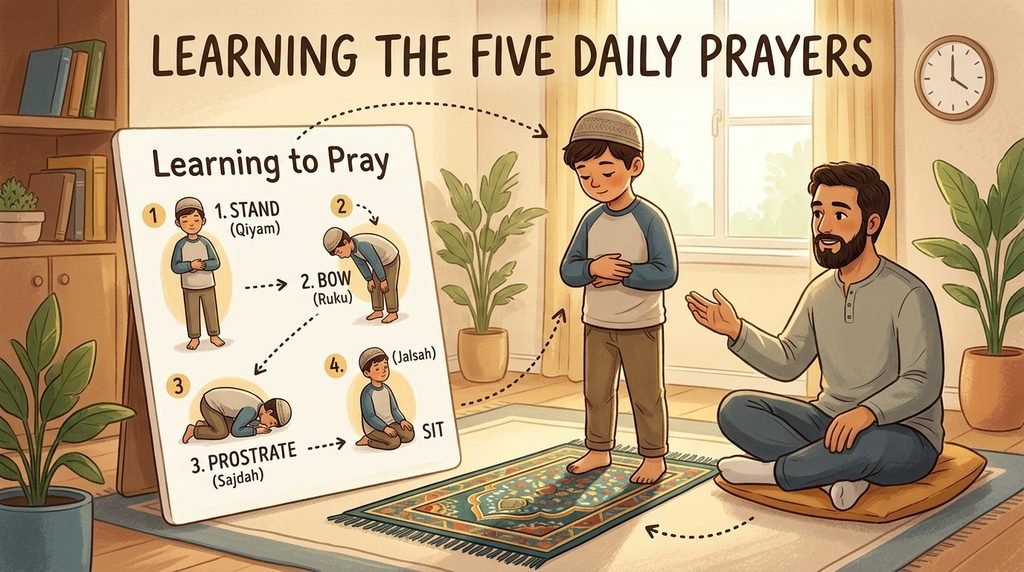
Step 4: the prayer’s structure. Opening takbeer, standing, bowing, prostration, the sitting testimony, and the closing tasleem, learned as movements first and words progressively, with a card or phone allowed while learning.
Step 5: basic daily duas. Eating, waking, entering the home, and the specific dua the Prophet taught a new Muslim (Sahih Muslim 2697), which the checklist at the ConvertingToIslam first steps checklist builds into its first days.
Step 6: a mosque and a class. Attend Friday prayer, introduce yourself, and enroll somewhere structured. One path, the Mohammad Siddiqui first steps checklist, ends at planning the first Ramadan; community carries a convert that far.
| Step | Action | Anchor |
|---|---|---|
| 1 | Ghusl | Sunan Abi Dawud 355 |
| 2 | Learn wudu | Beginner plans consensus |
| 3 | Memorize Al-Fatiha | Two week plan, days 3 to 7 |
| 4 | Prayer movements, card allowed | Salah Home week 1 |
| 5 | Daily duas | Sahih Muslim 2697 |
| 6 | Mosque, class, mentor | All guides |
Ghusl: The One Step the Schools Grade Differently
Read this as three strands, because that is what the sources contain. The school by school box at the GetRevertly after Shahada post grades it: Hanbali, required; Hanafi, Maliki, and Shafii majority, recommended.
The Hanafi strand, cited carefully by the Salah Home first 30 days guide from a fatwa body, calls convert ghusl desirable, becoming compulsory only when a state of major impurity independently requires it.
One dawah site lists after accepting Islam under when ghusl is required at the Shahada.org declaration site, without the school caveat its own linked sources support. That is the outlier presentation; the graded box is the honest one.
Two practical corollaries: ghusl is never demanded before the Shahada (delaying the declaration is the error, per the IslamQA answer on testimonies and wudu order, question 177), and a ghusl done weeks late does not reopen a valid Shahada.
The First 24 Hours
Hour one: the declaration and the bath. If the Shahada was public, accept the hugs and the phone numbers; you will need both kinds of support by week two.
Day one kit: an English Quran, a prayer timetable, and one learning app. The resource strand that recurs is The Clear Quran as the first translation, with Muslim Pro or Athan for prayer times.
Tell one trusted person. The strictest first day plan in the set includes informing family on day one; the most gradualist says tell one person you trust within 24 hours. The family section below handles the fuller conversation.
Sleep on a win. Day one ends with wudu learned or attempted, not with a transformed life.
Two Weeks vs 30 Days: The Plans Compared

Three real plans exist in the ranking set, and they disagree mainly about prayer pacing. Comparing them beats inventing a fourth, so the table carries their own structures.
The two week plan at the FivePrayer conversion guide runs days 1 to 3 on wudu, days 3 to 7 on Al-Fatiha, and days 7 to 14 on the full prayer structure. It is the fastest route to praying complete prayers.
The academy plan at the Mishkah Academy Shahada guide gives week 1 to salah, week 2 to creed (the six articles of faith), week 3 to community and Friday prayer, and week 4 to structured learning with an English Quran.
The blog plan at the Salah Home first 30 days guide runs purity and prayer basics, then the words of prayer, then community and a mentor, then Friday prayer and family. It is the only plan that schedules the family conversation.
| Plan | Week 1 | Week 2 | Week 3 | Week 4 |
|---|---|---|---|---|
| FivePrayer (2 weeks) | Wudu, then Al-Fatiha | Full prayer structure | (Plan ends) | (Plan ends) |
| Mishkah (30 days) | Salah basics | Creed, six articles | Community, Jumu ah | Course, English Quran |
| Salah Home (30 days) | Purity, prayer basics | Words of prayer | Masjid, mentor | Jumu ah, family |
Learning to Pray: Pacing and the Card Question
The pacing strands, honestly labelled. Two plans start with Fajr and Maghrib only, the bookends of the day, and build outward. One plan teaches all five prayer times in the first week. Neither is an error; they are different theories of momentum.
The card question has a clean answer: yes, while learning. Praying from a printed card or a phone is stated plainly by two guides, and it is how most adults actually bridge the memorization gap.
Set a graduation intention, not a deadline. The card retires piece by piece, Al-Fatiha first, then the short chapter, then the sitting words, until the phone stays in your pocket because it is no longer needed.
Missed prayers during the learning weeks draw the same counsel everywhere: do what you can now and add the rest, rather than abandoning prayer for being incomplete. Perfectionism is the dropout mechanism, not laziness.
What to Recite Before Al-Fatiha Is Memorized
This is a genuine school split, and the convert FAQ at the RevertGuide new Muslim FAQ handles it best. Its strands: a Hanafi position permits reciting a translation while a person cannot yet recite Arabic.
The other schools do not accept recitation in another language, and the cautious option valid across the positions is filling the standing with short Arabic remembrance, SubhanAllah being the example given.
The practical path most teachers land on: learn Al-Fatiha a verse or two a day by listening, exactly as one four week plan sequences it, so the interim question expires within a fortnight for most learners.
The Rulings Table: Required, Recommended, Not Required
Most convert anxiety is a sorting problem. The status table format, pioneered in the ranking set by the Talqeen Academy revert guide, separates what entry into Islam actually requires from what is recommended and what is simply separate.
| Item | Status on the strands |
|---|---|
| The declaration itself | The requirement; sincerity is the condition |
| Witnesses | Recommended, not required for validity |
| Ghusl after | Required (Hanbali) / recommended (majority) |
| Arabic name | Not required; bad meaning names change |
| Circumcision | Never a precondition; obligation strands conflict |
| Family permission | Not required for an adult |
| Fee or ceremony | None exists |
Keep this table. When a video promotes a recommended item into a requirement, the table is how you check before you panic.
Family: The Conversation Playbook

Family is a section in every guide and a script in none of them, so this playbook assembles the strands into usable moves. Timing first: the sources range from day one to week four to your own chosen moment; financial or housing dependence argues for the gradual end.
The anchors are kindness texts, not debate texts. Quran 31:15 instructs kind companionship even to parents who oppose the faith, and the Asma narration models keeping ties with a non Muslim mother who comes visiting.
Practical moves the sources support: tell the person most likely to respond well first; separate the announcement from an argument about theology; keep showing up to family life, meals, and obligations; and expect the second conversation to go better than the first.
The private practice strand exists for hard cases. A myths series at the IslamReligion myths about converting series permits converting now and practicing discreetly while preparing family gradually, and one service answers the timing question with three words: you choose when.
Work, School, and Jumu ah
No ranking guide covers work, so this section is built from the prayer windows themselves. Five prayers fall in wide windows; the working convert’s task is a quiet space, a short conversation with a manager, and wudu kept simple.
Friday prayer is the one fixed appointment: sermon plus two units, in the early afternoon window. Have the Jumu ah conversation with an employer before the first Friday, not after an absence needs explaining.
Students get the same logic on campus timetables, and the wider study skills shelf on this site, from our Revisely alternative guide to our Magic Hour AI review, covers the learning tools side of building a study routine that a structured Islam course can plug into.
Life admin runs in parallel for many converts. Planners will recognize the pattern in our moving across the country checklist and our office move planning guide.
Anyone restructuring work around prayer can borrow the systems thinking in our service business systems guide and our small business cash flow plan, with our business setup UAE documents guide for readers relocating to the Gulf.
The First Ramadan Pacing Plan
Every guide defers Ramadan to a later step; none writes the plan. Here is the pacing the strands support, assembled: arrive at Ramadan with the five prayers established, because fasting stacks onto prayer, not instead of it.
Prepare the body gradually if your clinician agrees: the sources counsel gentleness, mosque iftars exist specifically to welcome new Muslims, and exemptions for illness and medication are part of the law, not failures of it.
Expect the social side to carry you. Ramadan is the most communal month of the year; the loneliness that haunts month one rarely survives a month of shared iftars, which is one reason guides urge community before it arrives.
Questions of health, pregnancy, or medication belong to a clinician and a scholar together. This page gives pacing, not personal rulings, and flags the difference deliberately.
Mosque, Mentor, and Program: The Directory
WhyIslam hotline, 1-877-949-4752: a toll free ICNA line presented as 24/7 in English and Spanish, which arranges mosque visits and matches mentors by phone, per the program’s own description, credited here in text after its page refused my checker.
Embrace, an ICNA project, runs the fullest convert infrastructure in the set at the Embrace chapter page at ICNA Dallas: weekly convert led halaqahs, an 8 week Islam 101 class taught by a convert imam, neighbor nets, and seasonal programs.
New Muslim Academy offers free structured video courses with live mentor interaction at the New Muslim Academy course catalogue, including a one month beginning certificate and a watch and see salah course, while the New Muslims eLearning site runs a level, lesson, and quiz ladder for self pacers.
The local pattern is visible at the Masjid Al Madinah new Muslims page: a mosque page routing newcomers to the hotline’s free materials, named local Embrace organizers with phone numbers, and a downloadable conversion certificate for the imam to sign.
Scholar counsel reduces the directory to two duties, at the SeekersGuidance advice to a recent convert: learn your personally obligatory knowledge through formal study, and keep righteous company. Every program above is a delivery mechanism for one of those two.
Women After Shahada: The Strands on Pacing
The hijab question arrives early and the top guides mostly dodge it. The strand set, printed as strands: the four schools mainstream view treats covering as an obligation anchored in Quran 24:31.
The pacing counsel stages it: belief and prayer first, covering for prayer (where the mainstream view requires it for validity) and at the mosque, then wider settings over time, without pressure from anyone and without delaying for years.
Female mentorship matters more here than any ruling: the programs with same gender follow up and convert led women’s circles are the ones whose strands read as sustainable rather than performative.
The Questions the Guides Skip: Name, Certificate, Circumcision
Name: settled. No new name is required; the Prophet changed only names with bad meanings (Sahih Muslim 2139), and most Companions kept theirs.
The fatwa answer cited in the guides is number 109208 at the IslamQA answer on testimonies and wudu order‘s site. A legal name change, if ever chosen, is a civil process no guide explains, flagged as a gap.
Certificate: not required, sometimes useful. One dawah site, the Shahada.org declaration site, states it honestly: a certificate is not needed to be Muslim, and a mosque can provide a letter later if paperwork demands one, for Hajj or marriage.
Circumcision: never a precondition, strands in conflict. A myths series reports a majority obligatory view where no harm is feared; other fatwa strands grade it a stressed recommendation; the careful pages advise a doctor and a scholar and no timeline pressure.
Baptism: does not exist in Islam, which is why the AboutIslam scholar answer on conversion uses the question to teach the declaration itself. Ghusl is the only washing in the story.
Vet Your Teacher: Consumer Protection for Converts
One FAQ answer in the entire ranking set teaches converts to vet what they consume, at the RevertGuide new Muslim FAQ: pause if a course asks for money up front or pushes you to cut off other teachers and sources.
Extend it with the set’s own evidence: one academy in the research audits its own earlier overstatements and corrects them in print. Sources that correct themselves are the ones to keep; sources that only escalate urgency are the ones to leave.
The population data explains why this section exists: the Pew Research religious switching report reports that 20 percent of US Muslims were raised in another religion or none (2025), with roughly as many leaving as joining in the balance strand.
Guidance is retention. The converts who stay are the ones with a course, a mentor, and a community in the first month, which is why this page ends in a directory and not a dua list.
Wudu Troubleshooting for Beginners
Dry skin, cracked heels, and winter are the real curriculum here. Wudu is simple in description and fiddly in practice for the first fortnight, and the beginner plans know it, which is why one plan gives it three full days.
The errors that recur: washing limbs in the wrong order (forgiven while learning), missing the elbows or ankles, and doubting afterward whether a step happened.
The doubt rule is a mercy worth learning early: certainty is not removed by doubt. If you were sure you made wudu and later wonder, it stands.
Practical kit: a small towel by the sink, sleeves you can push up, and one slow observation of an experienced person at the mosque sink, which teaches more than ten diagrams.
Al-Fatiha in a Week: A Memorization Method
Al-Fatiha is seven short verses, and the day plan that sequences it across days 3 to 7 has the right instinct: the chapter is learned by listening loops, not by staring at transliteration.
Day one and two: listen to one reciter, slowly, verse by verse, and say verse one aloud until it is boring. Boring is the signal; move on only then.
Days three to five: add a verse a day and always recite from the beginning, so the joins between verses get as much practice as the verses themselves. Most stumbles live at the joins.
Days six and seven: recite the whole chapter inside a real prayer, with the card beside you for rescue. The card is allowed while learning; use it as a safety net, not a script, and the net retires itself within weeks.
Short Surahs and Daily Duas After Al-Fatiha
A second short chapter unlocks comfortable prayer. The four week plan in the research set sequences Al-Ikhlas, Al-Falaq, and An-Nas after Al-Fatiha, and the choice is practical: three chapters, each under six verses, covering the second recitation slot in every unit.
Duas come as a working set, not a library. The pocket book the guides converge on holds hundreds; your first ten are the functional ones: before eating, after eating, waking, sleeping, entering home, leaving home, entering the mosque, and the new Muslim dua from Sahih Muslim 2697.
The First Month, Week by Week
Week one: bath, wudu, first prayers attempted. Expect clumsiness. The win condition is showing up five times a day in some form, card in hand, not performing anything polished.
Week two: Al-Fatiha complete, movements smooth. Add the congregation once, ideally a Friday, and put faces to the mosque instead of treating it as a building you borrow.
Week four: family and forward planning. The blog plan schedules family here, the checklist path schedules the first Ramadan here, and both are right: by week four you have enough practice standing to talk about it and enough community to plan with.
The dip usually arrives between weeks two and six. Announcement energy fades before the friendship structure hardens; two ranking guides describe the same trough. Naming it in advance is most of the cure.
Mistakes New Muslims Are Warned About
Mistake one: trying to adopt everything in a week. The strictest plan and the most gradual agree on the failure mode; they differ only on remedy. Sequence beats intensity because intensity burns out by Friday.
Mistake two: learning Islam from arguments. Debate content teaches combat, not practice. The convert counsel in the research set routes beginners to structured study and company, and the debate channels to later, if ever.
Mistake three: hiding from every Muslim space out of embarrassment. Pronunciation shame keeps more converts home than doctrine ever did. The class for beginners is full of people mispronouncing the same words; that is what it is for.
Mistake four: paying for urgency. Courses that demand money up front, mentors who isolate you from other teachers, and certificates sold as requirements all fail the vetting checklist in the section above.
Mistake five: cutting family ties in the first flush of zeal. Every anchor text in the family section forbids it, and the converts who repair those ties later describe the cutting as the one regret. Keep the ties; pace the disclosure.
Returning to Islam After Years Away
Your restart is not a conversion, and one academy in the set insists on the distinction. A Muslim returning after years away does not retake the Shahada as an entry rite; the door back is repentance and resumed practice.
The rebuild uses the same order as this page: purification refreshed, Al-Fatiha re memorized (it returns faster than it first arrived), prayers rebuilt one time slot at a time, and company replaced deliberately, because the old environment is usually what the absence was made of.
Glossary: The Words You Will Hear This Week
Shahada: the declaration of faith, the two testimonies. Ghusl: the full ritual bath. Wudu: the minor ablution before prayer. Salah: the five daily prayers. Rak ah: one unit of prayer.
Fard: obligatory. Sunnah: the Prophet’s recommended practice. Madhhab: a school of law; Hanafi, Maliki, Shafii, and Hanbali are the four. Jumu ah: Friday congregational prayer. Halaqah: a study circle.
Fitrah: the natural disposition toward God every child is born with, the teaching behind the word revert. Fard al ayn: personally obligatory knowledge. Iqamah: the second call, given inside the mosque just before prayer starts.
Prayer Times and the Clock: Reading a Timetable
Five prayers, five windows, and one timetable to rule them. Dawn (Fajr) runs from true dawn to sunrise; noon (Dhuhr) after the sun passes its peak; afternoon (Asr) into the late day; sunset (Maghrib) the shortest window of all; night (Isha) until dawn.
The beginner’s simplification that actually works: pray each prayer well inside its window, not at its edges. Edge timing is where missed prayers breed, and the learning weeks need margin more than they need precision theatre.
Apps disagree by minutes because calculation conventions differ by region and school; the Asr start is the famous one, with two positions across the schools. Pick your local mosque’s timetable as the referee and let the app match it, not the reverse.
Money, Food, and Daily Life in Month One
Food changes are the most visible daily shift and the least sequenced in the guides. Pork and alcohol are the headline prohibitions; the strict strand stops both immediately, the gradualist strand counsels beginning at once while knowledge catches up. Both print here as strands.
Halal meat sourcing is a logistics question with local answers: a halal butcher, a certified brand, or the mosque’s list. School strands differ on some slaughter questions; ask locally, and do not let a grocery aisle become your first theological crisis.
Money practices arrive later in every sequence: zakat has a threshold and a lunar year behind it, so month one is for learning the concept, not calculating a payment.
What Progress Looks Like at 90 Days
Ninety days in, the realistic inventory reads like this. Five prayers most days, from memory, inside their windows. Al-Fatiha plus three short chapters. Wudu unhurried and undoubted. One class in progress. Two or three Muslim friends whose names you know.
Ramadan, whenever it lands, has a plan instead of a panic. Family knows, on whatever timeline you chose, and the relationship is being actively kept. Work has a prayed in rhythm rather than a daily negotiation.
What is not on the list: Arabic fluency, a new name, a transformed wardrobe, a settled position on every school difference. Those were never the 90 day curriculum, and measuring yourself against them is how steady converts talk themselves into quitting.
The sources that retain converts share one trait visible across this whole page: they treat the first season as a curriculum with a pace, a sequence, and people attached. Build yours in that image and the second season takes care of itself.
Frequently Asked Questions
1. What do I do immediately after taking the Shahada?
Take a full ritual bath (ghusl), then begin learning purification and prayer. Every guide in the set opens with the same order; the evidence and the school strands sit in the sequence section above.
2. What happens to my past sins when I become Muslim?
They are wiped out. The anchor narration, carried by every guide, is Sahih Muslim 121: Islam wipes out what came before it.
Your account starts clean on day one.
3. Do I have to make up prayers or fasts from before Islam?
**No.
Worship from before Islam is not owed.** The same forgiveness strand settles it across the guides and the Q and A sources; you start from today, not from a backlog.
4. Do I need witnesses for my Shahada to be valid?
Witnesses are recommended, not required for validity. That is the consensus strand across the guide key facts, the academy steps, and the fatwa sources.
A mosque setting still helps for support and records.
5. Can I take Shahada alone at home or online?
Sources present it as valid: the declaration is between you and God. Programs run online Shahada with team members present and follow up afterward, which adds people to a valid act.
6. Is ghusl obligatory after Shahada?
The schools differ, so the strands print separately. Hanbali: required.
Hanafi, Maliki and Shafii majority: recommended, becoming required if a state like janabah preceded it.
Never demanded before the Shahada itself.
7. I took my Shahada weeks ago and never did ghusl. Is my Shahada still valid?
Yes, completely. The reassurance strand is explicit: a delayed ghusl does not invalidate the declaration.
Do it now, and do not let anyone re-open a settled door.
8. How do I perform ghusl?
Intention in the heart, Bismillah, wash the hands, wash the private parts, perform wudu, pour water over the head three times, then the right side and the left. That is the narrated method, Sahih Muslim 479.
9. What should I learn first as a new Muslim?
Purification, one chapter, and the prayer’s movements, in that order. Wudu first, Surah Al-Fatiha by heart second, the structure of salah third.
Nearly every plan in the set agrees on the order.
10. How can I learn Islam step by step as a complete beginner?
One structured path at a time, finished in order. A free academy course, a mosque class, or a printed guide beats random videos; the course guidance sources are blunt about collecting half finished courses.
11. Do I have to do all five pillars straight away?
**No.
The pillars are adopted in sequence.** Prayer is the first practice, fasting arrives with Ramadan, and zakat and Hajj carry their own conditions of wealth, health, and ability.
12. Can I pray from a card or my phone while learning?
Yes, while learning. Two guides state it plainly.
The card is scaffolding on the way to praying from memory, not a permanent substitute and not a shameful one.
13. What do I recite before I have memorized Al-Fatiha?
The strands split by school. A Hanafi strand permits translation while you cannot recite Arabic; the cautious cross school option is short Arabic dhikr such as SubhanAllah, per the convert FAQ citing SeekersGuidance.
14. What if I miss prayers while I am still learning?
Do what you can now and build. The Q and A counsel is to start with the prayers you can manage and add the rest, rather than abandoning prayer because it is incomplete.
15. Do I have to stop everything sinful on day one?
Two strands, printed apart. One guide says the clear prohibitions stop immediately; gradualist sources answer that duties begin at once but rulings that have not yet reached you are not held against you.
16. Do I have to change my name after converting?
No. The consensus, anchored in a fatwa answer and the guides: only names with bad meanings or servitude to other than God change.
Most Companions kept their names, and so can you.
17. Should an adult male convert be circumcised?
Never a precondition, and it can wait. Obligation strands conflict: majority obligatory where no harm is feared, against recommended strands.
The careful counsel is a doctor and a scholar, in your own time.
18. Do I have to start wearing hijab straight after I become Muslim?
The mainstream school strand calls covering an obligation (Quran 24:31), and the pacing counsel stages it. Prayer and belief first, covering for prayer and mosque, then wider settings, without pressure from anyone.
19. Do I have to tell my family?
No fixed timing exists in the sources. One book puts family on day one, one plan schedules week four, one service says you choose when and how, one myths series permits private practice while you prepare them.
20. How do I keep good ties with non Muslim family?
Kindness is the anchor, not distance. Quran 31:15 commands kind companionship to parents, and the Asma narration (Sahih al-Bukhari 2620) models keeping ties with a non Muslim mother.
Conversion does not license cutting family off.
21. Will I get a certificate after my Shahada?
Not automatically, and it is not required to be Muslim. Mosques can issue a letter or certificate, which matters later for Hajj or marriage paperwork, per the dawah site and mosque pages.
22. How do I find a mosque near me?
Use a mosque finder, or call the hotline. One guide links a finder site; the WhyIslam line (1-877-949-4752) arranges mosque visits and local contacts for callers.
23. What happens at my first Jumu ah?
Friday prayer replaces the noon prayer. Arrive early, sit for the sermon in silence, then pray two rak ah with the congregation.
Many mosques run new Muslim welcomes afterward; ask at the door.
24. How do I pray at work?
No ranking guide covers this yet, a gap worth naming. The working strands: pray inside each prayer’s window, agree a quiet space with your manager early, and keep wudu simple in a sink.
25. Should I sign up for a course? Which one?
Yes: one at a time, and finish it. The convert Q and A names the free academy and seminary routes and warns against course collecting.
The directory above compares the real options.
26. How do I find a mentor?
Through programs, not luck. The hotline matches mentors by phone, Embrace runs convert neighbor nets, and mosque new Muslim coordinators pair newcomers locally.
Ask for the pairing; it rarely announces itself.
27. What is the WhyIslam hotline?
A toll free ICNA line: 1-877-WHY-ISLAM (1-877-949-4752). Presented as 24/7 in English and Spanish, for questions, free literature, mosque visits, and mentor matching.
28. What is Embrace?
An ICNA project for converts, founded in 2017. Weekly convert led halaqahs, an 8 week Islam 101 class taught by a convert imam, neighbor nets, and Ramadan and Eid programs for new Muslims.
29. What is the difference between a convert and a revert?
Convert is the ordinary English word; revert rests on the fitrah teaching. Every child is born in a natural disposition toward God, so embracing Islam reads as a return.
Neither term measures sincerity.
30. How long am I a new Muslim?
One service FAQ problematizes the label itself: it hardly fits someone five years in. Treat new Muslim as a season of structured learning, not an identity with an expiry date.
31. I pray but feel nothing. Is something wrong with me?
No. The Q and A strand answers plainly: feelings fluctuate for everyone, and the counsel is consistency in the basics plus company that steadies you, not chasing experiences.
32. What if I do not fit in at the mosque?
A known convert experience with its own article in the set. Try another mosque, start with the new Muslim class rather than the main hall, and let a mentor be the bridge.
33. I lost my family support after becoming Muslim. Is there help?
Yes, through the convert infrastructure. Embrace chapters, mosque coordinators, and the hotline exist for exactly this; the demand is documented in the Q and A hubs, so you are not an exception.
34. When do I start fasting?
With your first Ramadan, by design. Every guide places fasting late in the sequence.
Prepare gradually, and take medication or health questions to a clinician, not a comments section.
35. What books should a new Muslim read first?
An English Quran translation first (The Clear Quran is the common pick), then the Bahammam New Muslim Guide, then Fortress of the Muslim for daily duas. That is the convergent strand across the resource lists.
36. Which apps help a beginner pray?
Times apps (Muslim Pro, Athan) plus a teaching app. Pick one that labels its school; one popular beginner app is Hanafi based, and a convert app runs wudu to full prayer in seven days.
37. I converted years ago and stopped practicing. Where do I restart?
Your case is separate from converts, as one academy insists. Repentance, the basics rebuilt in the same order, and righteous company.
The first steps are identical; the paperwork is not.
38. Do converts to Islam get baptized?
**No.
There is no baptism in Islam.** A scholar answer at a counseling site uses the question to explain that entry is the declaration itself; ghusl is the washing that does exist.
39. What does fard al ayn mean for me?
Personally obligatory knowledge: what every Muslim must know to practice. Scholar counsel to converts makes formal study of it one of two duties, alongside righteous company.
40. How do I vet a teacher or course?
Use the one consumer protection strand in the entire ranking set. Pause if a course demands money up front or pushes you to cut off other teachers.
Prefer known institutions and scholar reviewed material.
41. What is obligatory and what is optional for a new Muslim?
Fard is what God obligated; sunnah is the Prophet’s recommended practice beneath it. Learning which is which, step by step, is not a preliminary to the curriculum.
It is the curriculum.
42. Why do sources disagree about ghusl and other rulings?
Because the four schools weigh the same evidence differently. Good guides flag the school behind a ruling.
This page prints the strands side by side instead of merging them into a false single answer.
Conclusion
New Muslims guidance after Shahada reduces to a short order of operations: wash, learn purification, memorize one chapter, pray as you can, and get people around you before the dip arrives.
Hold the strands apart where the schools differ, hold the consensus firmly where it exists, and let one structured course, not the open internet, carry your first month.
Start from our EnglishHexa home page, pick one program from the directory above this week, and let the checked sources, not the loudest video, set your pace.

Dilawar Mughal is an SEO expert with 8 years of hands-on experience helping websites grow their organic traffic, rankings, and revenue. He specializes in content-driven SEO, local SEO, and Pinterest SEO, and builds practical, results-focused strategies for businesses and publishers.
