

Revisely alternative searches begin with a hidden problem. The name Revisely belongs to two different products, and they serve opposite audiences.
One is a study suite for students, at revisely.com. The other is an essay grading tool for teachers, at revisely.ai.
Most comparison pages quietly assume the student product. Teachers land on them, find flashcard apps, and leave worse informed than they arrived.
This page opens with the fork, then compares by job. Setting a test, revising alone, drilling flashcards, and grading writing are four different purchases.
Prices here carry their source and month, because this category’s listings disagree with each other in ways that matter.
The tools coverage sits inside EnglishHexa’s technology and tools library, where software comparisons are the house specialty. This guide applies that habit to one crowded corner of edtech.
First, the Fork: Two Products Share the Revisely Name
The student product is a suite of three AI generators. Flashcards, quizzes, and notes, each sold as its own subscription, from your uploads.
Its framing is British exam revision. GCSE and A level students are the pictured audience, and the tools speak fifty plus languages.
The teacher product does something unrelated. It reads student essays and returns detailed, rubric based feedback for a teacher to review and approve.
Same name, opposite direction of travel. One helps students produce practice; the other helps teachers respond to finished work.
Decide which product you are leaving before comparing anything. Every lane below assumes you have, and the teacher lane waits at the end.
What Revisely (the Study Suite) Actually Is, and Its Limits
Uploads come first in the suite’s design. PDFs, Word documents, slides, images of notes, and video transcripts all feed the generators.
The free tier is best understood as a trial. The plans page, as summarized in August 2026, allows 3 AI flashcard decks per account.
The same free tier caps documents at 5 pages per upload and 25,000 characters per text paste. Exam Mode answers stop at 25.
Quizzes lean heavily on multiple choice. Short answer and open ended items appear in some flows, but choice questions are the center of gravity.
Each generator bills separately, which is the structural fact behind most switching. A student using all three tools holds three subscriptions, not one.
None of this makes the suite bad. It makes it specific: cheap for light self testing, and increasingly awkward as needs widen.
Why People Switch: The Four Triggers
Trigger one is the ceiling. Serious revision eats 5 pages and 25 answers in a single afternoon, and the wall arrives mid topic.
Trigger two is the question mix. Teachers and advanced students need matching, fill blank, and short answer items that multiple choice cannot imitate.
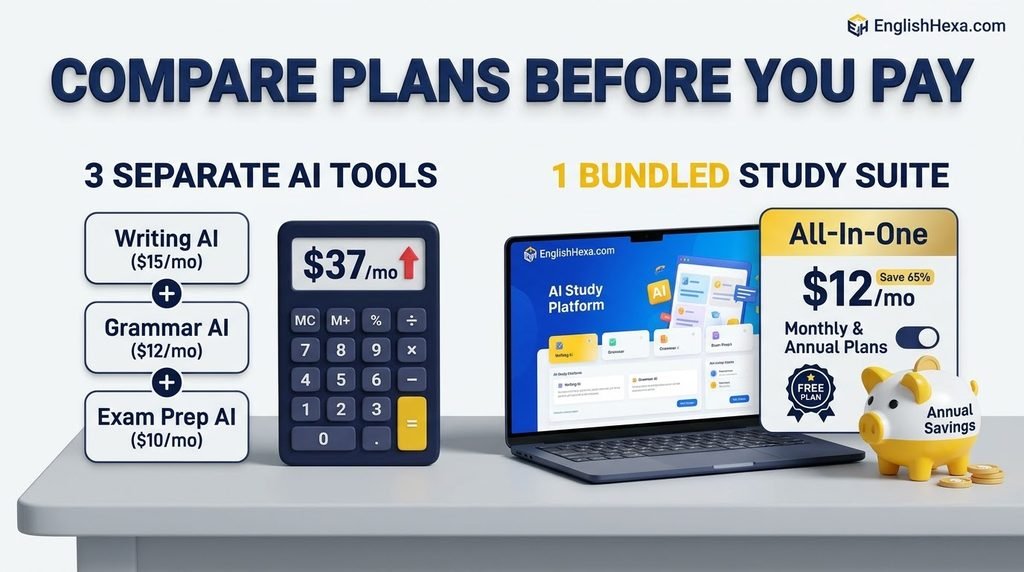
Trigger three is the bill shape. Three subscriptions for one study habit feels wrong once a rival offers the whole set in one plan.
Trigger four is the audience mismatch. Teachers seeking marking relief, and schools seeking class tools, need rosters, rubrics, and exports the suite never sells.
Name your trigger before shopping. Each lane below is built to answer exactly one of them, which keeps the shortlist honest and short.
The Alternatives by Job: Four Lanes

| Lane | Your job | Lead options | Pricing shape |
|---|---|---|---|
| Set a test | Graded quizzes for others | PDFQuiz, QuestionWell, PrepAI | Per tool plans, demo first |
| Revise alone | One suite for self study | Mindko, Quizgecko | Single subscription |
| Drill flashcards | Cards and spaced repetition | Cram, suite flashcard tiers | Low monthly |
| Grade writing | Rubric feedback on essays | Teacher lane platforms | Institutional or per seat |
The table is the whole method in miniature. Jobs first, tools second, features last, because features only matter inside a job.
Vendor pages will try to reverse that order, and the PDFQuiz comparison of Revisely alternatives is unusually honest about the split, conceding solo revision to the suite it replaces.
Lane One: Set a Graded Test for Others
Document first tools start where teachers actually live. You have a PDF, a deck, or a chapter, and you need questions from that exact material.
PDFQuiz is the lane’s reference design. Six question types, an answer key, editable Word or PDF export, and one shareable link that grades itself.
QuestionWell competes on alignment instead of volume. Its sets map to learning objectives, and exports reach the LMS platforms schools already run.
PrepAI brings the taxonomy angle. Its generation leans on Bloom’s levels, aiming questions above recall toward analysis and evaluation.
The lane’s shared test is delivery. If the output cannot be handed to a class with a key and a score, it belongs to the revision lane instead.
Lane Two: Revise Alone in One Suite
Solo revisers want everything from one upload. Mindko builds the fullest set: flashcards, quizzes, notes, a mind map, and a two host study podcast.
It adds two things the incumbent lacks entirely. A chat tutor answers from your own files, and active recall grading schedules your weak spots.
Quizgecko is the input maximalist of the lane. Text, files, webpages, audio, and YouTube all feed it, with Bloom scaling on the questions.
The suite question to ask is consolidation. One subscription replacing three is the entire pitch, so price the bundle against your three bills.
Mindko’s own comparison is worth reading critically, vendor bias and all, and the Mindko Revisely alternative page lays its feature table against the incumbent in the open.
Lane Three: Drill Flashcards Cheaply
Flashcards are a smaller job than suites pretend. Generation plus spaced repetition is the whole requirement for most card learners.
Cram occupies this lane with focus. AI generation from files and topics, repetition scheduling, and a single modest subscription.
Its comparison page contributes a useful pricing datum. It cites the incumbent at about 5.99 pounds monthly per tool, with a verify it yourself warning.
Anki remains the lane’s gravity well. Any generator whose paid tier exports to Anki respects your deck’s future; one that cannot is a landlord.
Choose this lane when cards are the habit and quizzes are occasional. Paying suite prices for a card only life is the common overspend.
Lane Four: Grade Writing With Rubrics
Teachers who arrived from the grading product need a different shelf entirely. The job is feedback on finished writing, at class scale, against criteria.
The category leaders are institutional in shape. Rubric builders, class rosters, LMS handshakes, and teacher approval queues are the feature list that matters.
Gradescope and Turnitin’s feedback tools anchor the established end. Newer AI scoring assistants compete on speed of first pass feedback.
Student suites cannot substitute here, however good their quizzes are. A flashcard generator has no opinion about your essay rubric, and never will.
If this is your lane, evaluate feedback quality on your own past papers. Vendor demos use flattering samples; your marking pile is the honest test.
Pricing, Honestly: Why Every Listing Shows a Different Number
Here is the category’s open secret, printed plainly. Three checkable sources give three different prices for the same product.
One rankings site, reading vendor pages on September 4, 2026, lists premium at 8.99 dollars monthly, or 3.99 billed annually.
A plans page summary from August 2026 shows an annual tier at 2.99 dollars monthly billed annually, with unlimited flashcards.
A directory profile publishes Basic at 19 dollars and Pro at 39, figures that cannot describe the same checkout as the other two.
The explanation is structural, not sinister. Three generators with three price pages get scraped one at a time, and each scraper keeps a different one.
The lesson travels beyond this product. In per tool pricing categories, quote the model and the month, never a single confident number.
Broader framing for that lesson lives in the AI vs SaaS tools comparison, which compares how AI tools package and price their tiers.
The Accuracy Box: AI Questions Need a Human Pass
Generated questions are drafts, not gospel. A 2026 systematic review of 71 studies measured how often AI written multiple choice items go wrong.
Error rates ranged from under 1 percent to 45 percent depending on source and setup. That spread is the most important number in this guide.
The practical rule follows directly. Read every generated item before it carries marks, and treat unreviewed quizzes as practice only.
Grounding helps and does not cure. Questions written from your document err less than questions written from a topic, but less is not zero.
The same skepticism protects students elsewhere in AI tooling, and the AI checker false positives guide shows how confident AI judgments fail in the checking direction too.
One ranking carries this research openly, to its credit, and the AI Rankings quiz generator ranking prints the caveat above its own recommendations, which is the standard to copy.
Migration Checklist: What Moves, What Does Not
Exports decide whether switching is a move or a hostage exchange. Inventory yours before canceling anything: decks, quizzes, notes, and scores.
Decks travel best where Anki export exists on your tier. Download everything you generated while the paid month is still active.
Quizzes travel worst. Generated sets rarely import cleanly elsewhere, so export PDF or Word copies as your archive of record.
Notes travel as documents, which is to say perfectly. Save the summaries as files and the knowledge survives any platform’s pricing decision.
Scores and streaks do not travel at all. Accept the reset, screenshot your analytics for the memories, and let the new system’s data accumulate.
Decision Table: Match Your Trigger to Your Tool
Hit the free ceiling weekly? Move to a single subscription suite and consolidate the three bills into one.
Need to hand a class a graded test? Choose the document first lane, and judge tools by export and answer key quality.
Cards only, budget tight? Stay in the flashcard lane, verify the Anki export, and ignore suite marketing entirely.
Marking essays at midnight? You were never the suite’s customer; the grading lane is your comparison set.
Still unsure after the lanes? Run the same chapter through two demos and count errors. Ten minutes of evidence beats ten comparison pages, including this one.
School buyers have one extra layer, covered in the online schools guide: procurement, privacy, and curriculum fit outrank features in institutional purchases.
Students weighing paid help models should read the landscape carefully too, and the online class help services guide maps the services students actually use around coursework.
Creators evaluating AI media tools will recognize the same pricing fog, and the Magic Hour AI review works through one such tool with the same source and date discipline.
Run This Test Before You Pay Anyone
Take one real chapter from your own material. Run it through two demos on the same afternoon, with the same settings where possible.
Count four things. Questions generated, errors you can spot, formats available, and the export you actually receive at the end.
Errors deserve a taxonomy, not a vibe. Wrong keys, unanswerable items, and questions the source never supported are three different failures.
Time the boring parts too. Editing ten questions to usable is the real product, so the tool that needs least editing wins ties.
Write the results in a table before opinions form. Memory edits test results within a week; ink does not.
The Suite Math Over a School Year
Per tool pricing looks small monthly and behaves differently annually. Three generators at even modest monthly rates triple the line item.
Suite pricing reverses the shape. One larger bill replaces three small ones, and the crossover arrives when the second generator becomes weekly.
Free tiers complicate the math honestly. A student under the ceiling pays nothing; a student over it pays every month of term.
Run your own usage before choosing. Count decks, quizzes, and note sets from last term, then price that actual basket in both models.
The cheapest tool is the one whose bill matches your basket. Everything else is marketing wearing a discount costume.
What Schools Should Ask Vendors
Procurement questions are unglamorous and decisive. Start with student data: what is stored, where, for how long, and what trains on it.
Move to fit. Curriculum alignment, language coverage, accessibility features, and LMS integration decide classroom value more than generation speed.
Ask about the assessment controls. Can teachers edit every item, lock answer keys, and export records when the contract ends?
Price the institution honestly. Per seat across a department, across every generator in use, for a full academic year, in writing.
Get the exit terms before the wedding. A vendor confident in its product makes leaving technically easy, and that confidence is data.
Reading Vendor Comparison Pages Critically
Every vendor in this category publishes a comparison page, and every one wins its own table. That is not corruption; it is genre.
Read them for the concessions, which are the honest parts. When a rival admits the incumbent suits solo revision, believe exactly that sentence.
Check which features the table omits. Missing rows are the author’s opinion of where they lose, printed in negative space.
Date every claim you borrow from them. Vendor pages update silently, and a price you cite in January may be fiction by March.
This guide follows its own rule. Its prices carry months, its product claims carry sources, and its recommendations carry jobs, not slogans.
Free Tiers, Compared as Trials

Treat every free tier in this category as a timed demonstration, whatever the marketing calls it. The question is what the demo lets you learn.
The incumbent’s free accounting is the strictest found. Three decks, five pages, and twenty five assessed answers teach the workflow and nothing about stamina.
Rivals compete on ceiling height precisely because they know this. A demo that survives a full week of real use produces better decisions than a feature list.
Spend free tiers on your hardest material, not your easiest. Edge cases are where generation quality separates, and they are free to test.
When the ceiling arrives mid task, note the feeling. That interruption, multiplied by a term, is the actual price of the free plan.
Who Should Not Switch
Honesty requires the reverse lane. If your use is light self testing in one subject, the incumbent’s annual tier is genuinely hard to beat on price.
If your decks live happily inside one app and exports mean nothing to you, migration costs buy nothing you will feel.
And if your school already runs an institutional platform happily, a student suite was never your comparison. Stability is a feature procurement forgets to score.
Switch when a trigger fires, not when a landing page sparkles. The triggers are listed above precisely so this decision stays boring and correct.
The Category in One View
Step back and the market sorts itself cleanly. Generators make material, suites organize a study life, and platforms run classrooms and institutions.
Confusion in this category is usually a level error. A generator is judged as a platform, or a suite is asked to grade like an institution.
Your job sits at exactly one level most weeks. Buy at that level, borrow upward through exports when needed, and the tool anxiety evaporates.
That is the whole argument of this guide, and it survives the next pricing change, redesign, or rebrand the category invents.
A Final Word on Evidence
This guide asked more of its sources than vendor pages ask of theirs. Where a claim could not be dated or attributed, it was cut or labeled.
You deserve the same standard from the tools themselves. Prefer the vendor whose limits are printed, whose exports are real, and whose concessions you can find.
Software chosen on evidence stays chosen longer. That durability, across a school year of daily use, is the only best alternative definition worth printing.
Keep This Guide’s Table, Whatever You Choose

The by job table near the top is designed to outlive its own recommendations. Tools will reprice and rebrand; jobs stay where they are.
When a new tool appears next term, do not restart your research. Ask which lane it enters, what it exports, and which trigger it answers.
Three questions, five minutes, and the newcomer is placed. That is the durable skill this category keeps trying to sell you as a subscription.
One Chapter, Two Tools, Tonight
End reading and start measuring. Pick your hardest chapter, the one with the diagram and the dense paragraph, and generate from it twice.
Use one suite demo and one specialist demo. Compare errors before features, exports before dashboards, and editing time before enthusiasm.
By tonight you will know more about your shortlist than a month of reviews could tell you. That is not a slogan; it is how evidence works.
The Human in the Loop Is the Feature
Every lane in this guide ends at the same desk: yours, reviewing. Generation made material cheap; judgment stayed scarce, and scarce things are where value lives.
Budget your review time as part of the subscription price. A tool that halves generation time and doubles checking time is not cheaper in the only currency teachers lack.
Choose accordingly, and the AI works for the classroom. Reverse the order, and the classroom works for the AI, which is the one outcome no lane in this guide recommends.
Bookmark the Lanes, Not the Logos
Logos will change hands, redesign, and occasionally vanish. The four jobs on this page will be assigned in classrooms long after today’s branding retires.
File this guide under decisions, not products. When the next tool launches to applause, the lanes will tell you in minutes whether it is news or noise.
That filing habit, applied across your whole software shelf, is worth more than any single alternative named here, including the good ones.
What Good Looks Like After the Switch
A month after a well matched switch, the signs are mundane. The ceiling stops appearing mid topic, the exports land where they should, and nobody talks about the tool.
Tools that fit become furniture. The study session, the class quiz, the marked essay: the work is visible and the software is simply where it happens.
If your new tool still dominates conversation at week six, the lane was wrong. Return to the triggers, retest honestly, and switch once more, properly.
Share This With the Person Who Pays
Students rarely choose school software, and teachers rarely hold the budget. If you are neither, your job in this decision is translation.
Send the payer the lane, the trigger, and the annual math, not the feature list. Budgets approve problems solved per year, never dashboards.
One page of that translation, built from this guide’s tables, outperforms a semester of hinting. Decisions improve when the chooser and the payer read the same evidence.
The Last Check Before You Subscribe
Before any card comes out, answer four questions in writing. Which trigger fired, which lane answers it, what the annual basket costs, and what exports you tested.
If any answer is a shrug, the demo work is unfinished. Return to the chapter test; it is cheaper than a year of the wrong subscription.
When all four answers are sentences, subscribe without drama. Decisions made this way rarely need revisiting, which is the entire point of the exercise.
Go Make the Material
Tool selection is procrastination’s favorite costume in education technology. Cap it at one evening, using this guide’s test, and return to the actual studying and teaching.
The best alternative is the one open in your next session, matched to your job, checked by your eyes. Everything after that sentence is commentary, including most of this page.
Decisions Age Well When They Are Written Down
Keep your test table and your four written answers with the subscription receipt. When renewal season questions the choice, the evidence answers, not your November memory.
That small archive is the difference between a tool stack and a pile of subscriptions. Build it once, and every future alternative search starts half finished.
Start With the Job, End With the Work
Every section of this guide returns to the same doorway. Walk through it once more, deliberately, and you are done deciding for this whole year.
One Evening Is the Budget
Set a timer for the decision itself: one evening, two demos, one written table. Whatever remains undecided after that is not research; it is delay wearing a lanyard.
Close the tabs, keep the table, and open the winner tomorrow with your next real chapter. The work, as always, is the point of the tool.
Frequently Asked Questions
1. What is the best Revisely alternative overall?
It depends on your job, by design. For setting graded tests from documents, PDFQuiz leads.
For solo revision in one subscription, Mindko and Quizgecko lead.
For flashcards, Cram.
For grading essays, the teacher lane platforms.
2. Is Revisely a study app or a grading tool?
Both, which is the trap. Revisely at revisely.com is a student study suite of flashcard, quiz, and notes generators.
Revisely at revisely.ai is a teacher tool giving rubric based feedback on essays.
Check the domain before comparing.
3. Why do websites show different prices for Revisely?
Because it sells three subscriptions. Different listings scrape different generators’ price pages at different dates: recent readings show about 2.99 to 3.99 dollars monthly on annual billing in two sources, and 19 to 39 in a directory.
4. What is the best free Revisely alternative?
For light use, the rivals’ free tiers. Several suite and quiz tools offer usable free plans with higher caps than 3 decks and 5 pages.
For serious daily revision, no free tier survives; the cheapest paid lane is flashcards only.
5. What is the best Revisely alternative for making quizzes from a PDF?
PDFQuiz. It is document first: upload a PDF, Word file, deck, or photo of notes and get a quiz in six question types with an answer key, editable export, and a shareable link that grades itself.
6. What is the best Revisely alternative for teachers?
Split the answer. For setting class quizzes, document first tools with LMS exports (QuestionWell, PDFQuiz) fit best.
For feedback on student writing, teachers need the grading lane: rubric platforms, not study suites.
7. What is the best Revisely alternative for grading essays?
The rubric based platforms. Established names include Gradescope and Turnitin’s feedback tools, with newer AI scoring assistants competing on first pass speed.
Judge them on your own past papers, not vendor demo essays.
8. Which Revisely alternative has the most question types?
PDFQuiz, with six. Single choice, multiple answer, true or false, fill in the blank, matching, and open ended.
The incumbent suite centers on multiple choice, which is exactly the limitation that pushes teachers to switch.
9. Which Revisely alternative exports to Anki?
Check the tier before the tool. The incumbent’s paid flashcard plans add Anki export, and flashcard lane rivals treat export as a core feature.
Export matters more than generation quality if you plan to keep decks for years.
10. Which Revisely alternative includes spaced repetition?
The focused flashcard tools and the big suites. Cram builds repetition scheduling into its core.
Mindko schedules spaced repetition across its whole study set and regenerates practice on weak spots rather than merely re showing cards.
11. Which Revisely alternative makes study podcasts?
Mindko. Its study set includes a two host study podcast generated from your material, alongside a concept mind map and a chat tutor.
The incumbent suite has no podcast or mind map generation at all.
12. Which Revisely alternative works best for GCSE revision?
The incumbent is built for it, rivals vary. Revisely’s framing is explicitly GCSE and A level revision.
Alternatives serve UK exams when their generation follows your uploaded past papers and textbooks; check language and curriculum settings per tool.
13. Why do people switch from Revisely?
Four triggers recur. The free ceiling (3 decks, 5 pages, 25 Exam Mode answers), multiple choice only quizzes, three separate subscriptions for one study habit, and teachers discovering a student suite cannot grade their essays.
14. What are Revisely’s free plan limits?
They are trial sized. Per the plans page summarized in August 2026: 3 AI flashcard decks, 5 pages per document upload, 25 Exam Mode answers, 25,000 characters per text upload, and 5 AI chat interactions daily.
15. Is Revisely multiple choice only?
Centered on it, not strictly limited to it. Multiple choice is the quiz generator’s core format.
Short answer and open ended items appear in some flows, but rivals advertise six types where the incumbent advertises one flagship format.
16. Does Revisely sell its tools separately?
Yes, that is the model. Flashcards, quizzes, and notes are three generators with three subscriptions.
The pricing confusion across the web comes from this structure: each listing tends to capture one generator’s price page.
17. Can I share a graded quiz link with an alternative?
Yes, in the test setting lane. PDFQuiz shares one link that students open and complete, with auto grading and score tracking.
That delivery model is the main reason teachers choose document first tools over study suites.
18. Which alternative aligns questions to learning objectives?
QuestionWell. Its sets are generated against learning objectives and export to popular LMS and quiz platforms.
For curriculum teams, alignment to objectives matters more than raw question volume or novelty formats.
19. Which Revisely alternative is best for live class quizzes?
Quizizz, now Wayground, leads there. Live gameplay, assigned homework modes, and class reports are its home ground.
Study suites, including the incumbent, are built for asynchronous self practice rather than a live room.
20. How accurate are AI generated quiz questions?
Variable enough to require checking. A 2026 systematic review of 71 studies found error rates in AI generated multiple choice questions from under 1 percent to 45 percent.
Source quality and human review explain most of that spread.
21. Should teachers check AI generated questions before using them?
Yes, before anything carries marks. Read every item, verify the key, and fix distractors.
Unreviewed generated quizzes are fine as self practice; graded use without review is how a 45 percent error tail reaches a real class.
22. Can I move my Revisely flashcards to another app?
Only as far as exports allow. Paid flashcard tiers that include Anki export make decks portable.
Quizzes and scores rarely transfer; export PDF or Word archives of anything you generated before canceling a subscription.
23. What file types do Revisely alternatives accept?
A wide, similar set. PDF, Word DOCX, PowerPoint PPTX, images including photos of notes (PNG, JPG), pasted text, and in some tools YouTube links, webpages, and audio.
The incumbent’s help center lists the document and image set.
24. Which alternative reads handwritten notes?
The OCR capable tools. PDFQuiz accepts photos of handwritten notes, and the incumbent suite accepts image uploads through its generators.
Handwriting quality drives accuracy, so test with your messiest page before committing.
25. Which Revisely alternative supports the most languages?
The incumbent claims 50 plus. Revisely states its generators work in more than 50 languages, a genuine strength for multilingual cohorts.
Rivals publish smaller lists; verify your exact language pair before paying.
26. Is Quizgecko a good Revisely alternative?
Yes, for breadth. Quizgecko accepts the widest input range, including audio and YouTube, scales questions with Bloom levels, and bundles flashcards and notes.
It is the natural upgrade when inputs, not price, are your constraint.
27. How does Mindko differ from Revisely?
Consolidation versus separation. Mindko generates one connected study set (cards, quizzes, notes, mind map, podcast, chat tutor) from a single upload and subscription.
Revisely sells three generators separately and generates no map or podcast.
28. How does PDFQuiz differ from Revisely?
Audience and delivery. PDFQuiz is built to give questions to someone else, with answer keys and exports.
Revisely is built to practice alone.
Same AI trick, opposite jobs, which is why this guide routes by job first.
29. What is the cheapest paid Revisely alternative?
The incumbent itself, on annual billing. Recent readings cluster near 3 to 4 dollars monthly billed annually for its premium tiers, the cheapest paid self test option in one ranking.
Directories showing 19 to 39 are capturing something else.
30. Do Revisely alternatives offer answer keys?
In the test lane, yes. PDFQuiz includes an answer key and explanations with its exports.
Study suites grade inside their own apps instead, which serves practice but not a teacher distributing a test on paper.
31. Which alternative is best for corporate training quizzes?
ProProfs and the assessment platforms. Certification, compliance, and training quizzes with scoring rules and records are their design center.
PrepAI’s institutional neighbors (ExamJet, Synap) also serve this buyer better than student suites do.
32. Which alternative is best for homeschool families?
The solo suites, on a family budget. One subscription covering cards, quizzes, and notes for a household beats per tool pricing.
Check sharing terms, since some licenses are single user by design.
33. Can a Revisely alternative make questions from YouTube videos?
Yes. Quizgecko and the incumbent suite both generate from YouTube material, and video summarization feeds notes in several tools.
Transcript quality decides question quality, so captioned lectures work best.
34. What should schools check before buying a Revisely alternative?
Data, fit, and total cost. Ask about student data use and retention (GDPR or FERPA context), curriculum and language fit, LMS integration, and the full year price across every generator your staff will actually use.
35. Is my uploaded material used to train the AI in these tools?
Policies differ; read them. Vendors state processing and retention terms on their own pages, and directories summarizing these tools explicitly note such terms are vendor stated, not independently verified.
Schools should contract, not assume.
36. Which Revisely alternative works without an LMS?
Yes. Document first tools and assessment platforms work standalone with links and exports.
LMS export is a convenience for institutions, not a requirement for a solo teacher or student.
37. Can I print quizzes from a Revisely alternative?
In the lanes built for delivery. PDFQuiz exports clean PDF and editable Word files with keys.
App first suites often keep quizzes inside the app, which is fine for practice and limiting for paper based classes.
38. Which alternative gives feedback on practice essays?
Mindko, in practice form. Its active recall grading scores your practice answers and regenerates work on weak spots.
For teacher graded essays against rubrics, that is the grading lane’s job instead.
39. What is Exam Mode in Revisely, and who matches it?
AI feedback on flashcard answers. Exam Mode gives personalized feedback on your responses inside the incumbent’s flashcard tool.
Mindko’s active recall grading is the closest rival equivalent, applied across a whole study set.
40. How do I choose between a suite and a specialist tool?
Count your jobs honestly. One job, buy the specialist; it will be better and often cheaper.
Three or more jobs weekly, buy the suite and accept shallower tools.
Most switchers miscount and buy for the job they imagine.
41. Does switching from Revisely lose my study progress?
Progress data, yes; materials, partly. Streaks and analytics never transfer.
Decks move if your tier exports them, notes move as documents, and quizzes mostly survive only as exported files.
Archive before you cancel.
42. What is the best Revisely alternative in 2026?
The job led shortlist itself. PDFQuiz for tests, Mindko for solo suites, Cram for cards, and the rubric platforms for grading.
The best single answer remains the one matched to the trigger that sent you searching.
Conclusion
A Revisely alternative is not one product but a routing decision. Name your job first, and the right lane chooses itself in minutes.
Students consolidate; teachers specialize; graders leave the study shelf entirely. The four triggers in this guide cover nearly every switch the category sees.
The wider AI tool landscape rewards the same discipline everywhere, and the Magic Hour AI review shows another category where demos flatter and dated pricing tells the truth.
Comparison habits compound across purchases. Tested against your own material, with sources attached, a shortlist becomes a decision you can defend.
Run the two demo test with your own chapter today. Count the errors, check the exports, and let evidence finish what this guide started.

Dilawar Mughal is an SEO expert with 8 years of hands-on experience helping websites grow their organic traffic, rankings, and revenue. He specializes in content-driven SEO, local SEO, and Pinterest SEO, and builds practical, results-focused strategies for businesses and publishers.
