

AI singer detection answers a question that did not exist five years ago: is the voice on this track a person, or a model?
The honest answer is a probability, not a certainty, and understanding why is the whole skill.
Generation became effortless first. The same wave that put an AI image generator in every browser put a recording studio in a prompt box, and streaming platforms now receive AI tracks by the tens of thousands daily.
Detection is the counterweight. Used well, it protects listeners, artists and royalty pools. Used carelessly, it produces false accusations and false comfort in equal measure. Both outcomes appear in the sections ahead.
The Three Jobs Hidden Inside One Search
Most confusion about this technology comes from one blur. Three different jobs share the label detection, they need different tools, and a score from one job says nothing reliable about the others.
| Job | The question | Who does it | What it cannot do |
|---|---|---|---|
| Detection | Was this voice AI generated or cloned? | Consumer checkers, platform systems, detection APIs | Tell you whose voice it imitates |
| Identification | Whose voice does this match? | Voice ID systems for rights holders, research pipelines | Run as a free public song check |
| Scope judgment | Was the whole track AI made, or only part of it? | Dual path detectors scoring vocals and instrumentals separately | Be inferred from a vocal only score |
Job one, detection, is what fans mean. A classifier reads the vocal and estimates whether a generative model produced it. Every free checker and most paid tools live here.
Job two, identification, belongs to rights holders. Systems such as Pex Voice ID match a voice’s biometric traits across recordings, singing, rapping or speaking, from segments as short as ten seconds.
Research is merging the jobs carefully. A 2025 paper on deepfake singer identification research runs detection first, filters out weak forgeries, then identifies the singer in what remains, because bad fakes rarely harm anyone.
Job three, scope, decides the label a track deserves. An AI vocal over human music, a human vocal over AI stems, and a fully generated track are three different verdicts, and honest platforms now label them differently.
How Detectors Read a Voice
A detector never listens the way you do. It measures how the sound was produced, and synthesis leaves statistical traces even when the result sounds flawless to a human ear.
Classifiers and the Acoustic Fingerprint
Classifier models study the vocal’s spectral content, prosody and timing: formant transitions between vowels, micro pauses, breath placement, and the small imperfections real singers cannot switch off.
Synthetic voices tend toward unnatural tidiness. Pitch slides resolve too evenly, dynamics sit too flat, and the noise floor stays cleaner than any real room. The tidiness itself becomes the tell.
Strong tools score short windows separately, one leading API in four second slices, then aggregate them into a clip verdict with separate vocal and instrumental percentages. A single bad passage cannot carry or clear a whole song.
Where the signature matches a known generator, some tools name the source model, Suno being the common case. Where it does not, the honest output is unknown synthesis, and any tool that always names a culprit is guessing.
Watermarks: The Signal Planted at Creation
The second method plants evidence in advance. A watermark embeds an imperceptible machine readable signal in the audio at generation time, which a checker can later read like a signature.
Watermarks help where they survive, and that is the catch.
Research reported in 2026 showed neural codec processing could strip a watermark down to a zero percent true positive rate, which is why platforms treat watermarking as one layer, never the only one.
Since 2 August 2026, the method also has legal backing in Europe: EU rules require providers of synthetic audio systems to mark their output in machine readable form, a duty set out in the European Commission AI framework.
Provenance: Proving Origin Instead of Guessing It
The third approach skips guessing entirely. The C2PA provenance standard attaches tamper evident origin data to media at the moment of creation, so a genuine release can prove what it is.
Provenance and detection are complements, not rivals. Provenance works when the data is present and intact; detection steps in for the vast catalog where it is absent. A complete trust system runs both.
One more distinction matters for everything that follows.
AI processed is not AI generated: a human voice cleaned by AI tools carries processing traces, and better detectors now score generation and processing as separate signals so real singers stop failing the test.
The Scale Problem: How Much AI Music Arrives Daily
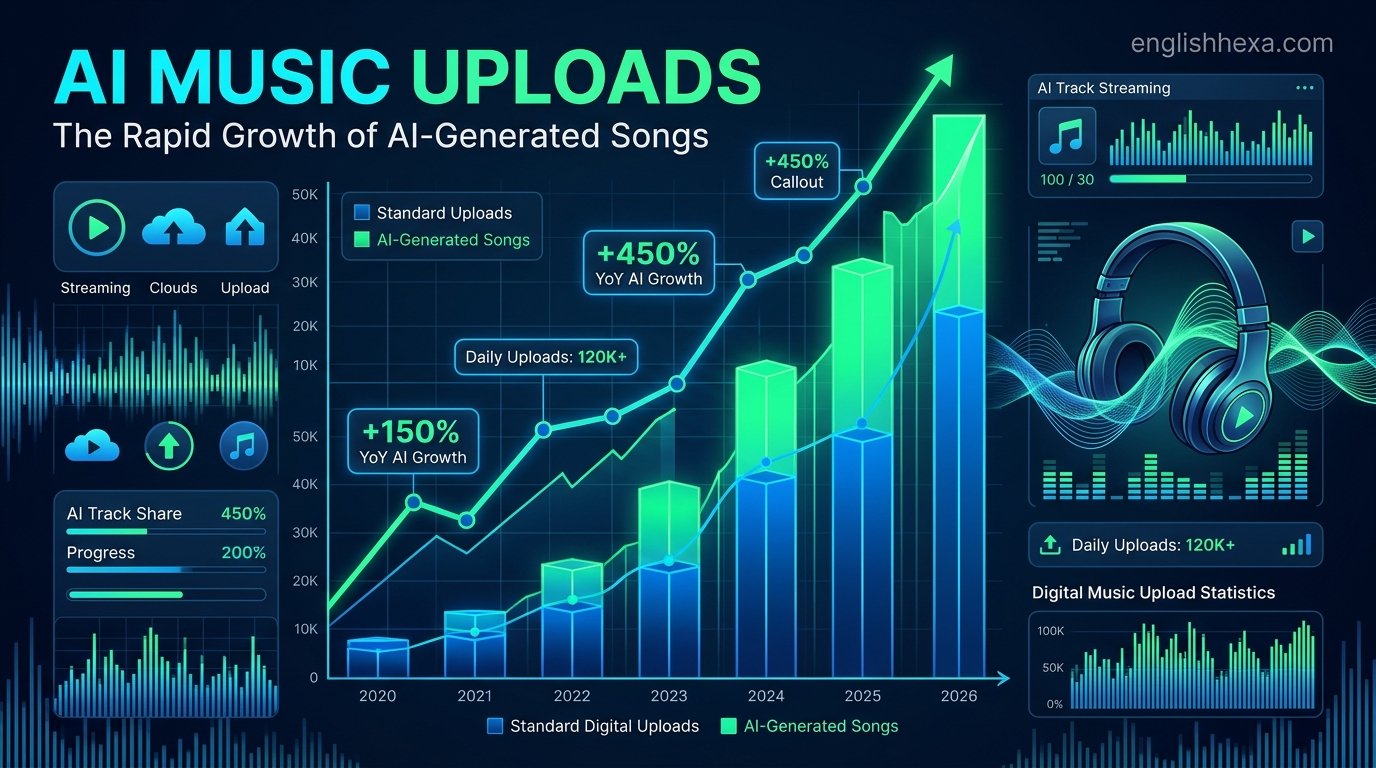
Detection matters because of volume. One platform’s disclosures, Deezer’s, give the clearest public timeline in the industry, and every figure below belongs to Deezer, on the date shown.
| When | Deezer’s disclosed figure | What it means |
|---|---|---|
| Early 2025 | About 10 percent of daily uploads fully AI generated | Detection tool launches; labelling begins that June |
| September 2025 | About 28 percent of uploads | The flood is structural, not a stunt |
| November 2025 | Roughly 50,000 fully AI tracks a day | More than 13 million AI tracks tagged during 2025 |
| April 2026 | About 75,000 a day, roughly 44 percent of uploads | AI is approaching half of all new supply |
| July 2026 | Nearly 90,000 a day, over 50 percent on peak days | AI is the majority of new deliveries on busy days |
| January 2025 to August 2026 | Over 42 million AI tracks detected in total | Excluded from algorithmic and editorial recommendations |
The listening numbers run the other way. Deezer reports fully AI tracks generate only 1 to 3 percent of streams, and that up to 85 percent of the streams those tracks did generate in 2025 were fraudulent.
That gap is the business case in one line: the uploads exist largely to farm royalty systems, and undetected they dilute the pool that human artists are paid from.
The figures are tracked in Music Business Worldwide’s Deezer reporting.
Listeners, meanwhile, cannot police this by ear. The Deezer and Ipsos survey of November 2025, 9,000 people in eight countries, found 97 percent failed a blind test between fully AI and human songs.
The same survey explains the labelling wave: 80 percent want fully AI music clearly labelled, 73 percent want to know when platforms recommend it, and 45 percent want to filter it out entirely.
Accuracy, Honestly: Claims, Conditions and the Real World Drop
Nearly every detector advertises 99 percent. The number is rarely invented; it is simply measured under conditions that flatter it, on clean audio from generators the tool already knows.
| The claim | Whose claim | The conditions attached |
|---|---|---|
| 99.8 percent accuracy | Deezer, for its own tool | Fully AI generated tracks from known generators such as Suno and Udio |
| 99 percent plus on known engines | Top detector marketing, as reported by methods guides | Studio quality, unprocessed, current model output |
| About 85 to 93 percent | Independent methods reporting | Professionally produced tracks with real finishing |
| About 65 to 70 percent | Trained human listeners, reported tests | Ears only, no tools |
| 97 percent failure | Deezer and Ipsos blind test | General listeners, fully AI vs human songs |
Four forces pull real world accuracy down. Hybrids send two signals at once. Post processing smooths the artifacts classifiers read. New models open a gap until retraining catches up. Compression and short clips starve the analysis of evidence.
The most honest sentence in the industry came from a generator’s own camp: reporting on ElevenLabs’ tool page notes its classifier does not reliably classify audio from its own current flagship voice model.
When the maker says the detector lags the generator, believe the maker.
False positives carry the human cost. Heavily autotuned and processed human vocals share surface traits with synthesis, and a small error rate applied to millions of uploads becomes thousands of wrongly flagged artists.
Independence needs checking too. An investigation of the detector market found a major tool site labelled as powered by another vendor’s engine, which means two agreeing scores can be one opinion repeated.
The wider market is mapped in this site’s look at GFXRobotection AI software by GFXMaker.
Read every result through its confidence level. A high score with high confidence on an exposed vocal is strong evidence.
A low confidence result, in either direction, means inconclusive, and treating it as a verdict is the reader’s error, not the tool’s.
How to Check a Song Yourself, Step by Step
No single check settles a song. The reliable method is layered, and each layer below is cheap or free. Stop when the layers agree; dig further when they conflict.
Step 1: Pick the right excerpt. Choose the most exposed vocal available: an intro, a breakdown, an a cappella passage. Dense mixes mask the voice and legitimately lower any tool’s confidence.
Step 2: Run a vocal focused checker. Start with a free verdict; Deezer’s public tool scans whole playlists from major services. Note the probability and the confidence, not just the headline word.
Step 3: Cross check on a genuinely different engine. Confirm the second tool is not the first tool relabelled. Two independent engines agreeing is real corroboration; the same engine twice is not.
Step 4: Read the credits and release history. Check the songwriter and label metadata, the artist’s live presence, and whether the catalogue appeared suddenly at volume. Impersonation releases cluster around shared labels and credits.
Step 5: Listen last, for cues not proof. Even pitch slides, missing breaths, flattened dynamics and a fizzy top end raise suspicion. They justify the checks above; they never replace them.
Step 6: Weigh the whole chain. A detector score plus no live history plus bulk upload patterns is a strong case. Any one element alone, including a 99 percent score, is a lead, not a conclusion.

Reading a Verdict: Three Illustrative Examples
Scores confuse people because the same number can mean different things in different contexts. The three examples below are illustrative composites, built to show how a careful reader interprets a result, not records of specific real tracks.
Example One: The Exposed Vocal at 0.97
A ballad’s opening verse, sung almost alone, returns a vocal score of 0.97 with high confidence and a named generator.
The credits show a label that appears on hundreds of recent uploads, and the artist has no live history.
Read: this is about as strong as detection gets. The excerpt was ideal, the engine is confident, and the metadata agrees.
A platform would label or hold the track; a journalist can report the finding with the method stated.
Example Two: The Hybrid at 0.55
A pop track returns a middling vocal score with low confidence, while its instrumental path reads strongly synthetic. Session chatter online suggests a human singer recorded over generated backing stems.
Read: the tools are probably both right. The vocal is likely human, the backing likely AI, and the correct label is the partly generated class, not a fraud headline. Hybrids punish binary thinking.
Example Three: The Human Flagged at 0.62
A heavily autotuned dance vocal is flagged as probably synthetic. The artist appeals with project files, dry stems and demo takes that show the performance being built by a person, take by take.
Read: the flag was a false positive, and the appeal archive settled it. The detector measured processing artifacts honestly; it simply could not see the session evidence that outranks any score.
The Cases That Taught the Industry
The Velvet Sundown: Flagged at 100 Percent
In July 2025 a psych rock band passed 850,000 Spotify listeners within weeks, with no performances, no social presence and promotional images that appeared fake. Skepticism arrived before any tool did.
Deezer’s detector then flagged the catalogue as 100 percent AI generated. Within days the artist biography was updated to describe a synthetic music project composed, voiced and visualized with AI support, and monthly listeners passed one million anyway.
The lesson cuts both ways: detection worked and was public, and a large audience kept listening regardless. Exposure informs listeners; it does not automatically remove the music.
Xania Monet: Openly AI, Genuinely Charting
Xania Monet is an AI voiced R and B persona with a human author. Mississippi songwriter Telisha Nikki Jones writes the lyrics herself and renders the performances with Suno; the voice is synthesized, the writing is hers.
The project signed a widely reported deal of about $3 million with Hallwood Media. Luminate counted roughly 117 million US on demand streams by February 2026, including the first AI voiced entry on a Billboard airplay chart.
Monet breaks the fraud frame. Nothing was hidden, no artist was imitated, and the debate is about competition and credit, not detection failure. Detection’s job here is simply the label, applied accurately.
The Impersonation Wave: Detection as Defence
In August 2025, AI releases appeared under the names of established Americana and folk artists, including one artist long deceased, credited to the same few labels. Spotify removed them under its impersonation policy.
The defence is industrial now.
Reporting in late September 2026 put Sony Music’s takedown requests for AI tracks imitating its artists at more than 260,000, a number that only makes sense with automated detection and identification feeding human review.
Platform Policies and the Law in 2026
| Platform or authority | Current approach, as reported |
|---|---|
| Deezer | Detects and tags AI tracks, excludes them from recommendations, licenses detection to others, announced a user toggle to exclude fully AI music in October 2026 |
| YouTube Music | Began rolling out AI labels in October 2026; partners classify uploads as Fully Gen AI, Partly Gen AI or No Gen AI |
| Spotify | Removed over 75 million spammy tracks in 2025; removes impersonation releases; reported to label AI persona artists and exclude them from recommendations by default |
| European Union | AI Act Article 50: synthetic audio must carry a machine readable mark, in force from 2 August 2026 |
| Industry framework | IFPI, RIAA, A2IM, the Recording Academy and SAG AFTRA backed a 2026 split between AI Generated and AI Assisted recordings |
The pattern matters more than any row. Platforms are converging on disclosure over prohibition: label the origin, filter the fraud, remove the impersonation. Fully AI music by an honest persona increasingly survives; hidden and imitative music does not.
For listeners the practical change is control. Deezer’s toggle and its survey numbers point the same way: audiences accept AI music exists and want the choice and the label, which detection quietly powers underneath.
Detection Across Formats, Genres and Languages
The same voice tests differently depending on what carries it. A studio WAV gives a classifier everything it needs; a voice note compressed twice by messaging apps gives it a fraction of the spectrum to judge.
Music video audio sits in between: the vocal is usually a finished master, but platform compression and loudness processing still smooth the fine detail detectors read. Expect lower confidence, not necessarily a different direction.
Genre changes the baseline. Lo fi and bedroom pop aesthetics deliberately bury vocals in noise and saturation, which blurs the human and synthetic signatures together.
Polished pop, by contrast, is so processed that human records drift toward the synthetic profile.
Rap tests well on the vocal path because the models are built for sung and spoken performance, but rapid delivery over dense beats still compresses the exposed vocal a checker needs. Hooks and intros remain the best excerpts.
Language matters less than newcomers expect.
Voice detection reads acoustics, not words, so a detector is not lost in an unfamiliar language; what varies is each vendor’s training coverage, which is a question worth asking before trusting a verdict on non English catalog.
Live recordings are the awkward case.
Room noise, crowd sound and microphone character add real world texture that can make a synthetic vocal read more human, one more reason a single live clip should never carry a conclusion alone.

For Artists: Monitoring, Takedowns and the False Positive Defence
If your voice is your living, treat detection as routine hygiene. Monitor your name and voice across platforms, because impersonation releases monetize your search traffic until they are removed.
When a fake appears, build the takedown as an evidence chain: the detector verdict, the release’s credits and uploader history, and your own catalog record. Platforms act fastest on complete files, not on outrage.
The mirror risk is being flagged yourself. Defend against it before it happens by keeping the artifacts only a human session produces:
- Project files and stems for every release, kept with dates intact
- Demo takes and voice memos showing the performance developing
- Writing notes and drafts that predate the finished track
- Session photos, bookings and engineer credits where they exist
That archive converts an appeal from an argument into a document review, and it costs nothing but the habit of not deleting your working files.
For Labels and Platforms: Detection at Ingestion
At catalog scale the workflow changes. Detection runs at ingestion, before monetization, playlisting or chart eligibility, with verdicts routed by confidence: clear passes through, clear synthetic is labelled or held, and the uncertain middle goes to human review.
The economics justify the spend.
Detection APIs price at cents per hour of audio (one leading service lists $0.07 per hour), while a single successful fraud network can drain meaningful royalty sums and chart positions that cannot be handed back.
Chart integrity is the newest customer.
Detection is now licensed beyond streaming, with 2026 reporting describing Billboard charts filtered through licensed detection, a claim this article keeps attributed because the chart industry has not published its own method note.

Mistakes and Myths
1. Treating a score as a verdict. A probability with a confidence level is evidence, and evidence gets weighed with credits, history and provenance, not worshipped alone.
2. Testing the loudest chorus. The densest mix gives the weakest read. Exposed vocals test best; choosing the wrong excerpt manufactures inconclusive results.
3. Believing a clean result proves human. It proves no known signature was found. New generators, heavy processing and short samples all produce clean results on synthetic audio.
4. Assuming rival tools are independent. Shared engines mean echoes, not corroboration. Check who actually built the detector before counting agreement as evidence.
5. Trusting your ears as the final court. The blind test number is 97 percent wrong for general listeners. Ears raise suspicions; instruments and records settle them.
6. Deleting your session files. For working artists, stems and demos are legal and reputational insurance. Storage is cheap; rebuilding proof after a false flag is not.
Frequently Asked Questions
What is AI singer detection?
AI singer detection decides whether a singing voice was performed by a person or generated or cloned by an AI model.
Detectors analyze the voice’s acoustic fingerprint and return a probability, a confidence level, and sometimes the generator’s name.
How does an AI music detector work?
Most detectors are classifiers. They read the spectral, prosodic and timing traces that synthesis leaves in a vocal, compare them with patterns from known generators and human recordings, and output a likelihood score.
A second method checks for watermarks embedded at creation.
Can a detector tell which AI model made a song?
Sometimes. Vocal detectors trained on specific generators can name the source model, for example Suno, when the synthesis signature is clear.
When it is not, honest tools report an unknown synthesis verdict instead of guessing, and dense mixes lower that attribution confidence.
How accurate are AI singer detectors?
Deezer states 99.8 percent for its own tool, a company figure for fully AI tracks from known generators.
Independent explainers report real world performance nearer 85 to 93 percent on professionally produced tracks, lower on hybrids, short clips and heavy processing.
Why can listeners not tell AI singers from human singers?
In the Deezer and Ipsos blind test of November 2025, 97 percent of 9,000 respondents in eight countries failed to identify the fully AI generated songs.
Modern generators reproduce tone, phrasing and emotion closely enough that unaided listening is no longer a reliable test.
Can I check whether a song is AI generated for free?
Yes, at a basic level. Deezer released a free public tool in June 2026 that scans playlists from services such as Spotify and Apple Music, and several detector sites offer a free first verdict.
Paid tiers add batch scanning, APIs and citable reports.
Which part of a song should I test for the best result?
The most exposed vocal you can find: an intro, a breakdown or an a cappella section. Vocal detectors read the singing, so a vocal forward clip gives the strongest verdict.
Dense instrumentation masks the voice and legitimately lowers the reported confidence.
Do AI detectors analyze the lyrics?
No. Voice detection is an acoustic problem, not a linguistic one. Detectors measure how the sound was produced, not what the words say.
A separate point follows: oddly generic lyrics are a human suspicion cue, but they are not detector evidence.
Can detectors catch AI vocals placed over human music?
Yes, that is a designed use case for vocal specific tools.
Some detection APIs run two independent paths, one for vocals and one for instrumentals, scoring short windows separately, so an AI vocal over an organic backing track can still be flagged on the vocal path.
Can detectors catch a human singer over an AI generated instrumental?
Only tools that also analyze the instrumental. A vocal only detector will correctly clear the human voice and say nothing about the backing track, which is why honest tools state their scope.
Fully AI generated classification and partly AI classification are different verdicts.
What is a hybrid track, and why is it the hardest case?
A hybrid mixes human and AI contributions: a person singing AI written material, AI stems under a human vocal, or AI arrangement and mixing on a human performance.
The two signals conflict, detectors disagree more often, and testing the layers separately gives the clearest picture.
Can post production fool an AI detector?
It degrades detection rather than defeating it outright. Running AI output through a digital audio workstation with EQ, compression, reverb and live layering smooths the spectral artifacts detectors look for.
Reported accuracy drops significantly on professionally finished tracks, which is one reason verdicts carry confidence levels.
What is audio watermarking, and does it solve detection?
Watermarking embeds an imperceptible machine readable signal in audio at the moment of creation, which a checker can later read.
It helps where present, but research reported in 2026 showed neural codec processing could strip a watermark to a 0 percent true positive rate, so watermarking complements classifiers rather than replacing them.
What is C2PA, and how is it different from detection?
C2PA is a provenance standard: it attaches tamper evident origin data to media when it is created. Provenance proves what a file is when the data is present and intact.
Detection works the other way, estimating origin from the audio itself when no trustworthy provenance exists.
What does the European Union require for AI generated audio?
From 2 August 2026, Article 50 of the EU AI Act requires providers of systems that generate synthetic audio to mark their output in a machine readable format.
The mark identifies the output as synthetic; it does not record what the model was trained on.
How does Deezer detect AI generated music?
Deezer uses a proprietary, patent pending detection system trained on output from major generators such as Suno and Udio.
It has tagged AI content since June 2025, excludes fully AI tracks from algorithmic and editorial recommendations, and began licensing the detection technology to other companies in 2026.
How many AI generated songs are uploaded every day?
By Deezer’s disclosures, about 10 percent of daily uploads in early 2025, roughly 75,000 tracks a day by April 2026, and nearly 90,000 a day by July 2026, over half of deliveries on peak days.
These are one platform’s company reported numbers.
Does Spotify detect and label AI music?
Spotify has acted on scale and impersonation: it reported removing over 75 million spammy tracks in 2025, removes releases that impersonate artists, and has been reported to label AI persona artists and exclude them from recommendations by default.
Its public detection detail is thinner than Deezer’s.
Does YouTube Music label AI generated songs?
Yes. YouTube Music began rolling out labels for songs created primarily with generative AI in October 2026, and music partners classify uploads as fully generative AI, partly generative AI, or no generative AI.
The three way split acknowledges hybrids instead of forcing a binary label.
What happened with The Velvet Sundown?
The Velvet Sundown gained over 850,000 Spotify listeners within weeks in July 2025 despite no performances, no social presence and apparently fake promotional images.
Deezer’s detector flagged the music as 100 percent AI generated, and the artist biography was later updated to describe a synthetic music project made with AI support.
Is Xania Monet a real singer?
Xania Monet is an AI voiced artist persona. Songwriter Telisha Nikki Jones writes the lyrics and renders performances with Suno.
The project signed a widely reported deal of about $3 million, and Luminate counted about 117 million US streams by February 2026, per the cited sources.
Can a detector identify whose voice is being imitated?
Most consumer checkers cannot; they judge whether a voice is synthetic, not whose it resembles.
Singer identification is separate technology: systems such as Pex Voice ID match a voice’s biometric traits across recordings, and 2025 research combined detection with identification in two stages.
What is the difference between singer detection and singer identification?
Detection answers a yes or no question: was this voice AI generated or cloned? Identification answers a who question: which singer does this voice match, human or synthetic?
Rights holders need both, first to flag a fake, then to prove whose likeness it uses.
Why do detectors sometimes flag autotuned human singers?
Heavily processed human vocals share surface traits with synthesis: evened pitch, smoothed dynamics and digital artifacts.
Detectors trained on those patterns can produce false positives, which is why a small stated false positive rate still matters at catalog scale, and why appeal routes with session evidence exist.
What does a low confidence detector result mean?
It means the audio did not give the detector enough clean signal, usually because the clip is short, compressed or densely mixed. Low confidence should be read as inconclusive, not as proof the song is human.
Honest tools report the drop instead of rounding it into a verdict.
How much audio does a detector need?
Detection models score short windows, one leading API analyzes four second windows, but a clip level verdict strengthens with more exposed vocal.
A full chorus or verse of clear singing is a far better test sample than a few seconds under a full mix.
Can AI detection prove that a song is human?
No. A clean result means no known synthesis signature was found, which is not proof of human origin, especially after processing or with a new generator.
Positive proof is shifting toward provenance and human authorship certification, which verify the creation process rather than guessing from the file.
Is a detector verdict enough evidence for a takedown?
It is one strong link in an evidence chain, not the whole chain. Platforms combine verdicts with credits, uploader history and rights records.
Reporting in late September 2026 put Sony Music’s takedown requests for imitations of its artists at more than 260,000.
What does vocal AI percentage mean in an API result?
Some detection APIs return separate percentages and confidence values for the vocal and the instrumental, plus per window scores that aggregate into a clip verdict.
A high vocal percentage with high confidence means the singing itself reads as synthetic across most windows, not just in one passage.
Do AI singer detectors work on rap vocals?
Yes. Vocal detection models are built for sung and rapped performances, and rights focused voice identification likewise covers singing, rapping and speech. Rapid delivery and heavy effects can lower confidence, as with any dense or processed vocal.
Do detectors work on singing in other languages?
Voice detection reads acoustics rather than words, so language matters less than for speech content tools, but training coverage still varies by vendor.
One speech detection API claims coverage of 48 languages; for singing, check the specific tool’s stated scope before relying on a verdict.
What is the difference between AI generated and AI assisted music?
A 2026 industry framework backed by organizations including IFPI, the RIAA and the Recording Academy separates fully AI generated recordings from AI assisted ones, where AI tools support a human led process.
Platforms increasingly mirror the split, YouTube Music with its fully, partly and no generative AI classes.
Will AI labelling of songs become standard?
The direction is clear: EU law now requires machine readable marking of synthetic audio, major platforms are adding labels, and in the Deezer and Ipsos survey 80 percent of respondents said fully AI generated music should be clearly labelled.
Expect labelling to be normal within a few release cycles.
How do record labels and distributors use AI detection?
They screen at ingestion, before monetization and playlisting, to keep impersonation and royalty fraud out of the catalog.
Detection is also licensed for chart integrity; 2026 reporting said Billboard charts would be filtered through Deezer’s detection, a claim kept attributed to its source here.
Can new AI generators outrun the detectors?
Temporarily, yes. Detectors are trained on known generators, so a new model or a major update opens a gap until retraining catches up.
One telling admission, reported from ElevenLabs’ own tool page, is that its classifier does not reliably classify audio from its current flagship voice model.
Is it legal to upload an AI song that imitates a famous singer?
Platforms treat impersonation as a policy violation and remove such releases, and voice likeness engages publicity and related rights that vary by jurisdiction.
This is general information, not legal advice; artists facing imitation should use platform reporting and rights holder channels promptly.
How can artists protect their voice from AI cloning?
Register and monitor: use voice identification monitoring where available, keep release metadata accurate, report impersonation quickly with evidence, and publish through channels that support provenance.
Detection lowers risk and speeds takedowns; it cannot prevent a public voice from being copied in the first place.
What are the ear based signs that a singer might be AI?
Reported tells include unnaturally even pitch slides, missing or oddly placed breaths, flattened dynamics, fizzy top end and arrangements that resolve too neatly.
They are suspicion cues, not proof: trained listeners in reported tests identified AI music only about 65 to 70 percent of the time.
Why do streaming platforms care so much about AI detection?
Money and trust. Deezer reports that fully AI tracks draw only 1 to 3 percent of streams, and that up to 85 percent of the streams those tracks generated in 2025 were fraudulent.
Undetected AI uploads dilute the royalty pool that human artists are paid from.
Do all AI detectors agree with each other?
No. Engines differ in training data and thresholds, and some supposedly independent tools share an engine; one investigation noted a major detector site labelled as powered by another vendor’s engine.
Cross checking two genuinely different tools, plus credits and release history, beats trusting any single score.
What should I do if a detector flags my own human song as AI?
Treat it as an appeal, not a verdict on you. Supply the evidence only a human session produces: project files, stems, demo takes, writing notes and release history.
Keep those files as routine practice; they are the strongest false positive defence an artist has.
How often do AI detectors need retraining?
Continuously. Every new generator release or major model update shifts the synthesis signature the classifiers learned, opening a detection gap until the tools retrain on the new output.
It is the structural reason no accuracy figure stays true for long, and why verdicts on very new sounding releases deserve extra caution.
Conclusion
AI singer detection works, within limits its vendors rarely volunteer: it reads vocals better than mixes, known generators better than new ones, and clean audio better than finished records.
Inside those limits it is already load bearing infrastructure for streaming.
Use it the layered way. Test the exposed vocal, cross check on an independent engine, read the credits, and let provenance speak where it exists.
That habit separates the Velvet Sundowns from the Xania Monets, which is the distinction that actually matters.
More plain language explainers live across English Hexa and its technology and AI coverage on the blog, including a look at digital technology trends from Aggr8Tech.
Start with one song you already suspect, and run the six steps on it today.

Dilawar Mughal is an SEO expert with 8 years of hands-on experience helping websites grow their organic traffic, rankings, and revenue. He specializes in content-driven SEO, local SEO, and Pinterest SEO, and builds practical, results-focused strategies for businesses and publishers.

2 thoughts on “AI Singer Detection”