


AI vs SaaS tools sounds like a contest between two kinds of software, and framed that way it produces confident nonsense in both directions.
AI is a capability. It is what software can now do: interpret, generate, decide and increasingly act. SaaS is a delivery and business model: software hosted in the cloud, opened in a browser, paid for by subscription.
That is why most AI tools are SaaS. Your AI writing assistant, support agent and image generator arrive exactly the way your accounting package does: a login and a monthly bill.
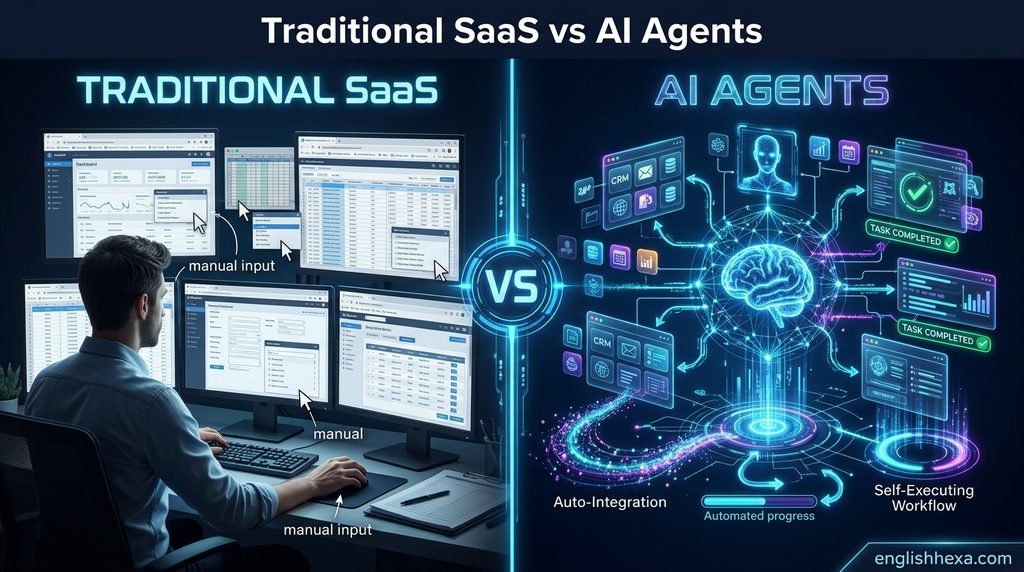
So the real contest is not between the two words. It is between software a human operates and software that completes work, and between charging for seats and charging for outcomes.
Those two fights are real, documented and worth your money decisions.
The Comparison Is Miscast: Three Layers, Not Two Camps
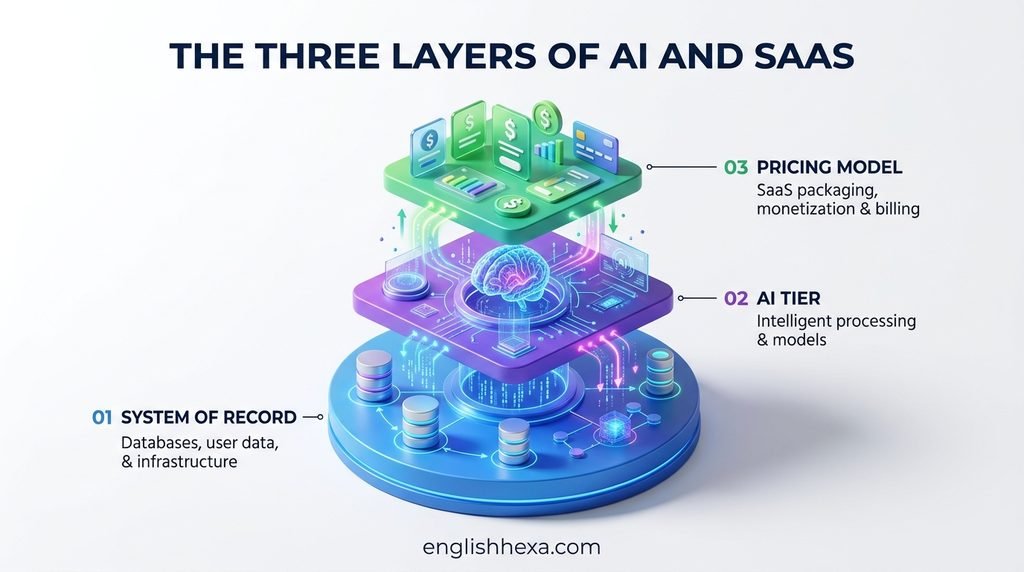
Nearly every argument in this debate dissolves once the stack is drawn in three layers. Each layer is changing at a different speed, and confusing them is how bad conclusions happen.
| Layer | What lives there | Who is winning |
|---|---|---|
| System of record | Your data, permissions, transactions, audit history: CRM records, ledgers, tickets, files | Incumbent SaaS, strongly. Agents need these systems and cannot responsibly replace most of them yet |
| AI tier | Reasoning and action across records: agents that read several systems, decide, and execute multi step work | New AI platforms and the model companies, with incumbents racing to build their own |
| Price model | How the work is charged for: per seat, per usage, per outcome | Outcomes and usage, gaining every year; seats shrinking as the AI component grows |
Read the debate through this table and the slogans sort themselves. When someone says SaaS is dead, they usually mean the second and third layers are moving.
When someone says SaaS has never been healthier, they mean the first layer and the spending totals.
Both can be true at once, and on current evidence, both are. The battlefield is the middle layer: who owns the logic that used to live inside each application.
The Four Things People Mean by AI and SaaS

Half the confusion in this topic is vocabulary. Four different products get called AI tools or SaaS interchangeably, and they behave very differently as purchases.
1. Traditional SaaS
A hosted application that stores your data and gives you screens to work in: the classic CRM, accounting package or project board. You operate it; it records the results.
Its value is reliability, structure and being the system of record.
2. SaaS With AI Features
The same application with AI assistance at the edges: a suggested reply, an auto summary, a smart search box. The workflow stays yours. Most incumbent products sit here today.
3. AI Native SaaS
Software whose core promise is produced by the model: an AI helpdesk that resolves most tickets, an AI documentation tool that writes the note from the visit. Remove the AI and the product has nothing to sell.
It is still delivered and billed as SaaS.
4. AI as a Service (AIaaS)
The engine layer sold to builders: APIs for language, vision, prediction and agents that developers embed in their own products. End users never open AIaaS directly. Much of category three is quietly built on category four.
Keep the four apart and vendor claims get easier to grade. A category two product wearing category three language is the mild, everyday form of the agent washing problem covered later.
AI Tools vs SaaS Tools, Head to Head
With the vocabulary fixed, the honest comparison is between a traditional SaaS tool and an AI agent tool doing the same job. This table is the one to argue with.
| Dimension | Traditional SaaS tool | AI agent tool |
|---|---|---|
| Who does the work | Your people, clicking through workflows | The agent, across tools, with people reviewing |
| Interface | Dashboards, forms, menus | Natural language goals, approvals, exception queues |
| Pricing | Per seat per month, predictable | Usage or outcome based, variable with success |
| Cost curve | Rises with headcount and seat creep | Falls per task as models cheapen, total can rise with usage |
| Data role | Is the system of record | Reads and writes records in other systems |
| Failure mode | Downtime, bad data entry | Confident wrong actions, needs audit trails and gates |
| Switching cost | High: data and process live inside | Lower for the agent, but the records underneath stay sticky |
| Best at | Structured, regulated, high trust processes | Repetitive, cross tool, language heavy work |
Two rows deserve emphasis. The failure mode row is why governance, not capability, decides most enterprise rollouts.
The Debate, Fact Checked
What Nadella Said, and What He Did Not
On the BG2 podcast in late 2024, Microsoft CEO Satya Nadella described business applications as essentially CRUD databases, create, read, update, delete, with a bunch of business logic on top.
His argument: the logic will migrate to AI agents, an AI tier that updates multiple back ends without discriminating between them, and business apps will probably collapse in the agent era as people start replacing the back ends.
Note what he did not say. He never used the slogan SaaS is dead, and his target was the application layer, not cloud delivery or subscriptions.
The quote is a structural prediction by the CEO of the largest incumbent.
The SaaSpocalypse: A Market Event, Not a Verdict
On 30 January 2026, Anthropic released 11 role specific plugins for Claude Cowork, bundling skills and connectors into assistants for whole job functions.
Software stocks sold off hard in the days that followed.
Reporting described a Goldman Sachs basket of US software stocks down 6 percent in a single session, nearly 285 billion dollars wiped across software and related stocks, and the S and P North American Software Index down about 15 percent in January, its steepest monthly fall since October 2008.
A Jefferies trader, Jeffrey Favuzza, named it the SaaSpocalypse.
A separate report described over 1 trillion dollars sold across a dramatic week in February 2026; the two figures cover different windows and baskets, and honest coverage keeps them separate, as this page does.
What the selloff priced was a fear about the seat model, not audited evidence that customers had stopped buying software. The spending data below is the necessary counterweight.
The Counter Evidence: Spending and Exposure
Start with Gartner’s cloud spending forecast: SaaS end user spending was forecast at 299.1 billion dollars for 2025, up 19.2 percent, the largest segment of a 723.4 billion dollar public cloud market.
Gartner’s 2026 software forecasts kept rising through the year: about 1.44 trillion dollars in April, revised toward 1.46 to 1.47 trillion in later releases, growth around 15 percent.
Forecasts are not results, but a dying category is not usually forecast to grow at double digits by its own undertakers.
The same firm also quantifies the threat properly.
In July 2026 Gartner estimated up to 234 billion dollars of enterprise application SaaS spending, roughly a fifth, could be exposed to agentic arbitrage by 2030: agents reducing how much humans interact with applications directly.
Exposure is not loss; it is the size of the contested ground, stated by the analyst rather than the slogans.
| Claim in the debate | What the evidence supports |
|---|---|
| SaaS is dead | False as stated. Spending and forecasts grow; the seat and interface model is what is contracting |
| AI agents will replace all business apps | Unsupported. Analysts put agents inside a third of enterprise software by 2028, not instead of the other two thirds |
| Nothing is changing | False. Pricing migration is already dated: outcome pricing at Zendesk since August 2024 |
| Seats are dead | Partly, and directionally. Seats persist for human operated tools; AI work is priced by usage and outcomes |
| Incumbents are safe | Unproven. Owning records and distribution helps; the logic layer is genuinely contested |
Pricing: From Seats to Usage to Outcomes
The most concrete change in this whole topic is on the pricing page. Three models now coexist, and the mix inside any contract tells you where that product sits in the transition.
| Model | You pay for | Fits | Watch out for |
|---|---|---|---|
| Per seat | Each human login | Tools people actively operate | Paying for shelfware: licenses nobody uses |
| Consumption / usage | Tokens, tasks, API calls, minutes | AI features and agent work at variable volume | Bill shock when usage succeeds; needs budgets and alerts |
| Outcome based | A result: resolved ticket, qualified lead, completed review | Agent delivered work with a definable done | Defining and auditing the outcome; disputes over quality |
The documented milestones: Zendesk moved its AI agents to outcome based pricing in August 2024, and its CEO told a HumanX audience, unequivocally, seats are dead, warning that companies still on seats in two or three years will struggle.
Bain’s Technology Report 2025 states the buyer’s side of the same logic: if an agent replaces a human task, customers will expect to pay based on outcomes, not log ons.
Gartner expects about 70 percent of top SaaS vendors to offer consumption pricing for part of their portfolio by 2027.
A worked example makes it tangible. A support team handling 10,000 tickets a month might pay per seat for 25 agents, or per resolution for an AI agent closing 60 percent of tickets with humans on the rest.
The second bill scales with results delivered; the first scales with payroll, whether the tickets get answered or not.
Expect blended contracts for years: a platform fee for the system of record, usage for AI features, outcomes where an agent owns a whole task.
If a vendor offers only seats for an AI product, ask what that tells you about their confidence in it.
Which SaaS Categories Are Actually at Risk
Exposure is not evenly spread. The pattern in the forecasts and the selloff is consistent: tools whose value is mostly a workflow over a database are exposed, and tools holding irreplaceable records, regulation or networks are defended.
| Category | Exposure | Why |
|---|---|---|
| Simple ticketing, form driven tools, basic reporting | High | The logic is exactly what agents replicate; the data is portable |
| Single purpose productivity apps | High | One workflow each, easily absorbed by a general agent |
| CRM and sales tools | Medium | Records and adoption are sticky, but data entry and follow up work is agent food |
| Helpdesk platforms | Medium | The platform survives as record and channel; the per seat agent count is what shrinks |
| Core finance, payments, industry systems of record | Low | Regulation, transaction integrity and audit weight punish confident automation |
| Platforms with proprietary data or networks | Low | Agents need the data and the network; they cannot route around either |
The mechanism has a name now. Gartner calls it agentic arbitrage: as agents mediate between people and applications, vendors whose value was the interface lose pricing power to whoever owns the agent layer and the data.
For buyers, the practical read is negotiating leverage. Categories in the high rows are where renewal discounts and outcome pilots are easiest to win this year, because the vendor knows the alternative is credible.
The Cost Curves Nobody Quotes Honestly
Every camp quotes the other side’s worst cost line. The honest comparison is two curves, not two prices.
SaaS starts near zero and climbs predictably: seats multiply, tiers inflate (benchmarks put SaaS price inflation in double digits recently), and sprawl accumulates.
Zylo’s 2026 index counts the average organization at about 305 applications and 55.7 million dollars a year, with roughly 36 percent of licenses unused: the waste line is not a rounding error, it is the budget.
Custom or agent heavy AI reverses the shape: real build and integration cost up front, then inference, maintenance, model upgrades and the salary of whoever owns it. Per task it can be far cheaper at scale.
Per invoice it can also surprise, because usage based bills grow with success.
Gartner has warned that inference costs per agentic workflow could rise several fold through 2028 even as unit prices fall, simply because agents do so much more work than a human session did.
Budget owners should model AI spend like cloud spend, with alerts, not like a subscription.
The discipline that survives both curves: price the workflow end to end (licenses or usage, plus the human time around it, plus error handling) and review quarterly.
Any comparison that omits the humans flatters whichever side the author sells.
Build, Buy or Hybrid: The Decision

Practitioner consensus across the current guides is unusually consistent, and it survives contact with the forecasts. Run the workflow through these steps in order.
1. Classify the workflow.
Is it common (support deflection, meeting summaries, knowledge search, invoice intake) or strategic (your underwriting logic, your quoting rules, your clinical or compliance judgment)? Common points to buy; strategic points to build or heavily customize.
2. Locate the record.
If a SaaS platform already holds the data and the audit trail, an agent on top of it usually beats a rebuild. Replacing a system of record is the most expensive sentence in enterprise software.
3. Price the outcome, not the demo.
Get the vendor to price the result at your volume, including the failure rate and the human review the failures need. A cheap pilot with unpriced exceptions is marketing, not a quote.
4. Pilot one measurable workflow.
Ninety days, one baseline metric, a human approval gate. The research consensus is blunt that pilots weighted over demos is how the successful adopters differ from the canceled projects below.
5. Default to hybrid.
SaaS platforms as records and controls, copilots inside them for the people, agents orchestrating the repetitive steps between them.
That is the stack most enterprises in the current data are actually building, because it buys agent value without betting operations on immature autonomy.
The Failure Half: Canceled Projects and Washed Agents
Any honest comparison carries the failure statistics on the same page as the forecasts. Gartner’s June 2025 agentic release is the anchor document.
It predicts over 40 percent of agentic AI projects will be canceled by the end of 2027, citing escalating costs, unclear business value and inadequate risk controls.
Read the causes carefully: all three are management failures, not model failures.
Do not merge it with Gartner’s second 40 percent. A separate May 2026 prediction says 40 percent of enterprises will demote or decommission agents already in production by 2027, after governance gaps surface in incidents.
One forecast counts projects that never ship; the other counts agents pulled back after shipping. Same firm, same number, different events.
The same June release estimates only about 130 of the thousands of vendors claiming agentic capability are genuinely agentic, the rebranding pattern Gartner calls agent washing.
Its analyst, Anushree Verma, adds that most agentic projects are early experiments driven by hype and often misapplied, and that many use cases sold as agentic do not need agents at all.
Even the release’s supporting poll deserves its label: it surveyed 3,412 webinar attendees in January 2025, a self selected audience, of whom 31 percent were still waiting to see. Useful as a mood reading, not a census.
Diligence questions that catch a washed agent:
- Show me the agent completing a multi step task in my environment, not a scripted demo.
- What does it do when it is unsure: stop, escalate, or guess?
- Where is the audit trail of its actions, and can I replay a bad one?
- What are its permissions, and can I scope them per system?
- Price it at ten times my current volume, in writing.
- Which of my use cases would you tell me not to agent? (A vendor with no answer is selling.)
What the Workforce Data Actually Says
Both camps quote workforce numbers selectively. The two best datasets complicate everyone equally, which is why they are worth trusting.
The Anthropic Economic Index, built from millions of real Claude conversations, found about 57 percent of usage was augmentation, people working with the model, against 43 percent automation.
The present tense of AI at work is mostly a person going faster, not a person removed.
Microsoft’s 2025 Work Trend Index (31,000 workers, 31 countries) found 82 percent of leaders expecting to use digital labor to expand capacity within 12 to 18 months.
Intention is not outcome, but it explains procurement better than any product launch.
Gartner’s forecasts thread the two: 15 percent of day to day decisions autonomous by 2028 means 85 percent still involve a person, increasingly as reviewer of agent output.
Plan roles around review, exception handling and data quality, not around disappearance.
The IDC projection of 1.3 billion AI agents by 2028, cited by Microsoft, counts software instances, not employees replaced; agents are cheap to spin up and mostly narrow.
Treat agent counts the way you treat app counts: a sprawl warning, not a headcount forecast.
AI Tools in Everyday Software: The View From the Ground
Step back from enterprise forecasts and the same pattern shows at consumer scale.
The AI image generator is the clearest example: a capability that once needed a design suite subscription is now a prompt box, billed by usage, delivered as SaaS.
Software guides increasingly document this hybrid reality.
The GFXRobotection AI software by GFXMaker coverage shows AI capability packaged inside specialist tools, and reporting on digital technology trends from Aggr8Tech tracks how quickly AI features move from novelty to default.
The English Hexa site follows this shift across its technology coverage, and its AI and technology coverage on the blog collects the explainers this comparison sits alongside.
The ground level lesson matches the enterprise one: categories blur, and the pricing and the work are what actually change.
Mistakes and Myths
1. Treating AI and SaaS as opposites.
The founding error. Most AI products are SaaS; the useful comparisons are operated versus agentic work, and seats versus outcomes.
2. Quoting a market size with no owner.
Vendor blogs cite AI SaaS forecasts from about 72 billion to over a trillion dollars with firms inconsistently named. A number without a firm, a date and a definition is decoration.
3. Merging the forecasts.
Gartner’s June and August 2025 agentic predictions are different claims, and its two 40 percents are different events. Articles that weld them together are telling you their standard of care.
4. Believing the agentic label.
With roughly 130 genuinely agentic vendors in Gartner’s estimate, the default assumption for any agent claim should be prove it in my environment, on my data, at my volume.
5. Replacing the system of record first.
The glamorous target and the worst first move. Agents earn trust on workflows between records long before they should own the records themselves.
6. Budgeting AI like a subscription.
Usage priced tools punish the old habit. Set spend alerts, review per outcome costs monthly, and expect success to raise the bill before it lowers the headcount line.
Frequently Asked Questions
What is the difference between AI tools and SaaS tools?
SaaS is a delivery and business model: cloud software, used through an interface, paid by subscription, traditionally per seat. AI is a capability: systems that interpret, generate and act.
Most AI products arrive as SaaS; the live contrast is software a human operates versus agents that complete work.
Will AI replace SaaS?
The evidence points to transformation, not disappearance. Gartner forecasts software spending growing about 15 percent in 2026 with SaaS the largest cloud segment, and agents embedded in a third of enterprise software by 2028.
What is being replaced is the pattern around SaaS: clicking through interfaces, priced in seats.
What did Satya Nadella actually say about SaaS?
On the BG2 podcast in late 2024, he called business apps essentially CRUD databases with business logic, argued the logic would migrate to AI agents in an AI tier working across back ends, and said apps would probably collapse in the agent era.
He never said the words SaaS is dead.
What is the AI tier?
Nadella’s term for a layer of AI agents that holds the business logic and works across many applications and databases at once, instead of logic living inside each separate app.
In that picture, applications become data stores the agents read and update, and people interact with the agents rather than with each interface.
What is AI SaaS?
AI SaaS is cloud software whose core value is AI: it does not merely store data or add a smart button, it uses the data to automate tasks, generate content, predict outcomes or complete steps of work.
An AI native helpdesk that triages and resolves most tickets is AI SaaS; a classic helpdesk with one AI suggested reply feature is SaaS with AI.
What is the difference between AI SaaS and SaaS with AI?
Foundation versus feature. In SaaS with AI, the product works as it always did and AI assists at the edges while the user performs the workflow.
In AI SaaS, remove the AI and the main promise disappears, because the outcome itself is produced by the model.
What is AIaaS?
AI as a Service sells the engine, not the application: cloud APIs for language, vision, prediction or agents that developers embed in their own products.
SaaS is the finished product users open; AIaaS is a building block other software is made from. Many AI SaaS products run on AIaaS underneath.
Is SaaS dead?
No, on the market’s own numbers. Gartner expects SaaS to remain the largest public cloud segment, forecast at about 299 billion dollars for 2025, with total software spending growing at double digit rates.
The slogan gets one thing right: seat pricing and interface bound workflows are under real pressure.
What was the SaaSpocalypse?
An early 2026 selloff.
After Anthropic released Claude Cowork plugins on 30 January 2026, software stocks fell sharply: reporting described a Goldman basket down 6 percent in a session, about 285 billion dollars wiped, and the North American software index down about 15 percent in January.
A Jefferies trader coined the name.
Why are seats said to be dead?
Seat pricing charges for people logging in, and agents reduce the people a workflow needs.
Zendesk moved its AI agents to outcome pricing in August 2024, and its CEO said seats are dead, warning firms still on seats would struggle. Bain’s 2025 report agrees: pay for outcomes, not log ons.
What is outcome based pricing?
Paying for a result instead of access: per resolved ticket, per qualified lead, per completed review.
It transfers performance risk to the vendor and fits agent delivered work, because the buyer no longer cares how many humans or seats touched the task.
It is harder to administer than a subscription, which is why hybrid models are common.
What does Gartner predict for AI agents in enterprise software?
Three distinct forecasts: about 40 percent of enterprise apps will feature task specific agents by end 2026 (August 2025); by 2028, 33 percent of enterprise software will include agentic AI and 15 percent of day to day decisions will be autonomous; and over 40 percent of agentic projects will be canceled by end 2027.
What is agent washing?
Gartner’s term for rebranding chatbots, assistants and automation as agentic without real autonomous capability. In June 2025 Gartner estimated only about 130 of thousands of vendors claiming agentic AI were genuinely agentic.
For buyers it is the central diligence problem: the label is cheap, the capability is not.
How many SaaS applications does the average company use?
Zylo’s 2026 index puts the average organization at about 305 applications and 55.7 million dollars of annual SaaS spend, with roughly 36 percent of licenses unused.
Other roundups vary by sample, so treat the exact count as benchmark dependent; the sprawl and waste direction is consistent everywhere.
Should my business build custom AI or buy SaaS?
Buy for common workflows where good enough is cheap: meeting summaries, knowledge search, standard support deflection. Build where the workflow is your operating advantage, needs deep integration, or runs on rules generic tools cannot express.
Hybrid stacks, SaaS platforms plus custom agent orchestration, are the common middle.
Is custom AI cheaper than SaaS in the long run?
Not automatically. SaaS is cheap at entry and expensive at scale, per seat across hundreds of users. Custom AI reverses the curve: high build cost, then inference, maintenance and an owning team.
Comparisons omitting maintenance and model upgrades flatter custom builds; omitting seat growth flatter SaaS.
Can AI agents work with my existing SaaS tools?
Yes, that is their main current mode. Agents connect through APIs, read and update records in your CRM, helpdesk and finance systems, and coordinate steps across them.
The platforms remain the systems of record; the agent becomes the worker moving between them, augmenting the stack before replacing any of it.
What happens to SaaS dashboards and interfaces?
They shrink in importance rather than vanish. As agents take instructions in natural language and complete tasks, fewer people open dashboards daily; interfaces remain for configuration, oversight, exception handling and audit.
Products designed only as pleasant interfaces, with shallow data and logic, are the exposed ones in this shift.
Which SaaS categories are most at risk from AI?
Tools whose value is mostly a workflow over a database: simple ticketing, form driven CRMs, basic reporting, scheduling, and single purpose productivity apps. Their logic is exactly what agents replicate.
Categories with deep proprietary data, regulatory weight, complex transactions or network effects, such as core finance, payments and industry systems of record, are far harder to displace.
What moat does a SaaS company have against AI?
Data, distribution and depth: proprietary data agents need, an installed base and integrations that take years to replicate, regulated high trust workflows, and transaction networks.
A pleasant interface and a feature list are not moats in the agent era, because agents bypass interfaces and features commoditize quickly.
Are AI tools cheaper than SaaS tools?
They can be, per task completed, and misleading per invoice. Agent pricing shifts cost from predictable subscriptions to usage: tokens, tasks and outcomes, which scales with success and can surprise budgets.
Gartner has warned that inference costs per agentic workflow could rise several fold through 2028 as usage explodes, even while unit prices fall.
What is SaaS sprawl and why does AI make it worse and better?
Sprawl is overlapping subscriptions, shadow purchases and unused licenses accumulated across a company. AI worsens it short term, as every team adopts its own AI tools on top of the stack.
It can improve it later, if agents consolidate work and let companies retire the point solutions they replace.
Do AI tools replace employees or augment them?
Both patterns are measured. Anthropic’s Economic Index, from millions of Claude conversations, found about 57 percent of usage was augmentation, working with a person, against 43 percent direct automation.
Microsoft’s 2025 Work Trend Index found 82 percent of leaders expecting to use digital labor to expand capacity within 12 to 18 months. The honest summary is task level change first, role level change unevenly.
How big is the SaaS market now?
It depends who counts, and the spread is the lesson.
Gartner forecast SaaS end user spending of about 299 billion dollars for 2025 inside its cloud forecast, while Statista puts global SaaS revenue near 489 billion for 2026 under a broader definition.
Both can be right; they measure different boundaries.
Why do AI SaaS market forecasts differ so wildly?
Because the category boundary is undefined: forecasts quoted in vendor blogs range from about 72 billion dollars in 2024 to over a trillion by the early 2030s, mixing AI software, AI services and AI enabled SaaS differently.
Quote a forecast with its firm, year and definition attached, or do not quote it.
What should I look for when evaluating an AI tool against a SaaS tool?
Ask what outcome it owns, what data it needs and keeps, how it handles errors and escalation, what it costs at ten times current usage, and whether its agentic claims survive diligence, remembering Gartner’s estimate that most agentic labels are washing.
Pilot one measurable workflow before any platform decision.
Are AI agents reliable enough to replace SaaS workflows?
For narrow, checkable tasks with human approval gates, increasingly yes.
For open ended, high stakes or regulated work, not yet: Gartner predicts over 40 percent of agentic projects canceled by end 2027, and its 2026 Hype Cycle notes most deployments remain narrowly scoped.
Reliability belongs to a task design, not to AI in general.
What is the hybrid approach to AI and SaaS?
Keep the SaaS platforms as systems of record, data, permissions and transactions, and put AI where it earns: copilots inside the tools people already use, plus agents orchestrating the repetitive steps between tools.
It is the approach most enterprises in the current data are actually taking, because it captures agent value without betting the operation on immature autonomy.
Will small businesses benefit more from AI tools or SaaS?
AI tools lower the expertise barrier: a small team can get analysis, drafting, support and automation that once required staff or enterprise software.
SaaS still wins where a mature, cheap product exactly fits a standard need, such as accounting or email. In practice small businesses are adopting AI layered on a lean SaaS core.
What is a vertical AI tool?
An AI product built for one industry’s workflow end to end: legal review, medical documentation, insurance underwriting, recruiting.
Vertical AI competes with horizontal SaaS by owning the outcome in a domain where generic tools need too much configuration, and it is where many of the strongest AI native companies are being built.
How does AI change software buying?
Buyers evaluate outcomes and agent behavior, not feature checklists alone, and procurement has grown more procedural: G2’s 2026 buyer research found security review the biggest delay after vendor selection.
Expect longer diligence on data handling and autonomy limits, and pilots weighted more than demos.
What happens to my data when agents work across SaaS tools?
Agents need broad access to be useful, which concentrates risk: one agent may read your CRM, email and files.
Governance follows the access: scoped permissions, audit trails of agent actions, approval gates for sensitive operations, and clear rules on what vendors may train on. Diligence this part hardest.
Can I build my own SaaS replacement with AI coding tools?
For narrow internal tools, increasingly yes: AI coding agents and vibe coding let teams generate small applications that once justified a subscription. The catch is everything after generation: security, maintenance, integrations, uptime and ownership when the builder leaves.
Businesses are doing this selectively for simple, low risk tools, not for systems of record.
What is the difference between a copilot and an AI agent?
A copilot assists a person inside a tool, suggesting, drafting and completing small steps while the human drives. An agent is given a goal and executes a multi step task across tools, reporting back for review.
Copilots keep the SaaS workflow and speed it up; agents move the workflow itself, which is why the pricing and governance questions differ.
Why are investors worried about SaaS stocks?
Because the agent thesis attacks the seat based growth model public SaaS valuations rest on: if customers need fewer seats and logic moves to an AI tier, revenue per customer can fall even as software usage rises.
The early 2026 selloff priced that fear quickly. The counter case is that incumbents own the data and distribution agents need, and software spending forecasts keep rising.
Should SaaS companies fear OpenAI and Anthropic?
They are becoming platform competitors: foundation model companies now ship agent products and workplace tools that overlap SaaS categories, as the Claude Cowork plugin launch showed.
At the same time most SaaS AI features run on those same models. The relationship is supplier and rival at once, and negotiating it is now a core strategy question for software executives.
What does AI mean for SaaS pricing pages?
Expect blended models: a platform subscription plus usage or outcome components for AI work. Gartner predicts about 70 percent of top SaaS vendors will offer consumption pricing for part of their portfolio by 2027.
Pure per seat AI pricing is under most pressure, charging for the humans AI augments or replaces.
Is AI just a feature every SaaS will add?
Partly. Basic AI assistance is becoming table stakes, like search or mobile apps did. But agents change the unit of work, and pricing, and who the user is, which is more than a feature cycle.
The safest reading: AI as features for most tools, AI as the product for a growing minority, and the boundary moving every year.
What skills do teams need in the AI plus SaaS era?
Fewer pure operators and more reviewers, designers and owners of workflows: people who can specify a task precisely, evaluate agent output, manage exceptions and own data quality.
Microsoft’s research describes leaders planning to expand capacity with digital labor; the human premium moves to judgment, context and accountability.
How fast will this transition happen?
Slower than the slogans, faster than previous platform shifts. Forecasts put meaningful autonomy in a minority of decisions by 2028 (Gartner’s 15 percent), most agent projects are still pilots, and large organizations move on procurement cycles.
Plan on a multi year hybrid period in which agents do more each year inside a stack that still looks recognizably like SaaS.
What is the one sentence answer to AI vs SaaS?
SaaS is how software is delivered and sold; AI is what the software can now do.
The fight is not between the two words but between charging for seats that operate tools and charging for outcomes that agents deliver, and for years most businesses will run both at once.
Where should a company start with AI tools today?
With one painful, measurable, low risk workflow: support deflection, document processing, meeting and knowledge work are the common entries.
Buy or pilot an AI tool against a baseline, keep a human approval gate, measure the outcome for a quarter, and expand only what proves itself.
That sequence, not a platform bet, is what the successful adopters in the current research share.
Conclusion
The honest answer to AI vs SaaS tools is that the versus is the least interesting part.
SaaS remains the delivery model and the record layer, growing on every serious forecast, while AI takes over growing shares of the work and the pricing logic on top of it.
What is actually ending is narrower and more useful to know: software that only organizes work for humans to do, billed by the seat, in categories where an agent can deliver the outcome instead.
What is not ending is the need for systems of record, audit trails and software somebody is accountable for.
So choose per workflow, not per slogan.
Keep your records where they are governed, put agents on the repetitive work between them, price outcomes where outcomes can be defined, and diligence every agentic claim as if Gartner’s 130 out of thousands estimate were written about your shortlist, because statistically it might as well be.
Start this quarter: pick one painful, measurable workflow, baseline it, pilot an agent against it with a human approval gate, and let one quarter of results, not a keynote, decide what happens to the rest of your stack.

Dilawar Mughal is an SEO expert with 8 years of hands-on experience helping websites grow their organic traffic, rankings, and revenue. He specializes in content-driven SEO, local SEO, and Pinterest SEO, and builds practical, results-focused strategies for businesses and publishers.

7 thoughts on “AI vs SaaS Tools: What Is Actually Different, and What Should You Choose”