

If you ever paused mid-sentence wondering whether to type combating or combatting you’re in good company. This single extra letter has puzzled students, bloggers, and even seasoned editors for years. The good news? Once you understand the simple rule behind it, you’ll never second-guess yourself again.
Quick Answer
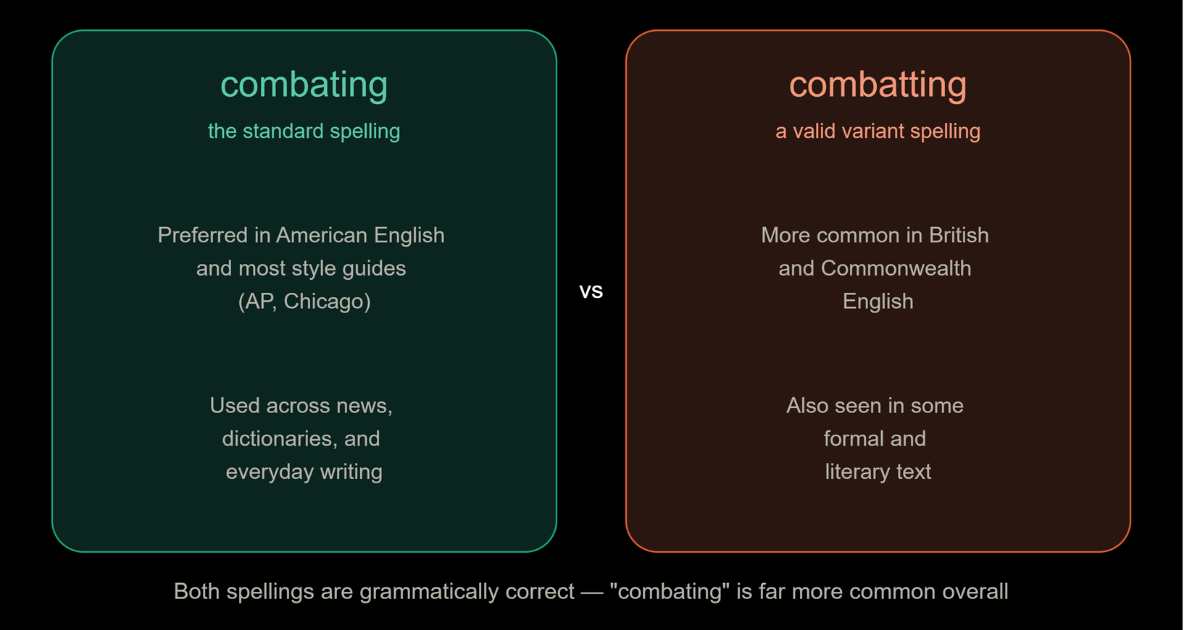
Combating (one “t”) is the standard spelling in American English and is widely accepted as correct across most global writing. Combatting (two t’s) shows up mainly in British English, though even UK style guides increasingly favor the single-“t” version. Both words mean exactly the same thing: to actively fight against or take action to stop something, whether that’s a disease, a social issue, or an actual physical conflict.
Why People Get Confused
The confusion isn’t really about meaning both spellings describe the same action. It comes from three overlapping issues:
- English has separate spelling traditions for American and British audiences.
- Writers assume every verb ending in a consonant doubles that consonant before “-ing” (think “running” or “getting”).
- Spell-checkers, browsers, and even some publishers use different regional dictionaries, so people see both forms online and assume either is “safe” everywhere.
Once you understand where each spelling comes from, the mystery disappears.
Related Post: What Happen or What Happened? The Complete Guide to Correct Usage in English
Understanding the Root Word “Combat”
Combat as a Noun
As a noun, “combat” refers to fighting or active conflict, usually in a military or physical sense. For example: Soldiers were sent into combat at dawn.
Combat as a Verb
As a verb, “combat” means to fight against, resist, or work to reduce something harmful. For example: The city is working to combat homelessness. This verb form is the root of both “combating” and “combatting,” and it’s the reason the spelling debate exists in the first place.
Why Both Spellings Exist
English Consonant Doubling Rules
In English, a verb typically doubles its final consonant before adding “-ing” when two conditions are met: the word ends in a single consonant preceded by a single vowel, and the stress falls on the final syllable. Think “stop” → “stopping” or “regret” → “regretting.”
The word “combat” is pronounced COM-bat, with the stress on the first syllable, not the last. By the standard rule, that means the final “t” should not be doubled which is exactly why “combating” is considered the more grammatically consistent spelling.
How Regional English Influences Spelling
British English has historically been more generous with consonant doubling, even in words where the stress rule doesn’t technically require it. This is the same pattern you see in “travelling” versus the American “traveling,” or “cancelled” versus “canceled.” “Combatting” grew out of that same British tendency, even though it doesn’t strictly follow the stress-based rule.
Combating in American English
✔️ Correct American English Spelling
In the United States, “combating” is the accepted and preferred spelling in virtually every context news writing, academic papers, business communication, and everyday use.
Why Americans Prefer “Combating”
American English spelling reform, dating back to the 19th century, favored simpler, more streamlined word forms wherever possible. Since “combat” doesn’t carry end-syllable stress, dropping the extra “t” fits naturally with that broader push for efficiency and consistency.
Examples of “Combating” in Sentences
- The organization is combating misinformation through fact-checking campaigns.
- Local police are combating rising crime rates with community outreach.
- New policies aim at combating inflation before it worsens.
Combatting in British English
✔️ Is “Combatting” Correct in the UK?
Yes, “combatting” is considered acceptable in British English, though it’s far from universal. Many UK publications, including government and academic sources, still use “combating” as well, so the two forms coexist in Britain more than most people realize.
Why British English Doubles the “T”
British spelling traditions lean toward doubling consonants in many “-ing” and “-ed” forms, regardless of strict stress rules, largely as a holdover from older printing and editorial conventions. “Combatting” simply followed that broader pattern rather than the stricter grammatical logic used elsewhere.
Examples of “Combatting” in Sentences
- The government announced new funding for combatting cybercrime.
- Volunteers are combatting food insecurity across rural communities.
- The report outlines strategies for combatting climate-related risks.
How Pronunciation Affects the Spelling
Stress Pattern of “Combat”
Say the word out loud: COM-bat. The emphasis clearly lands on the first syllable, not the second.
Why Stress Determines Consonant Doubling
English spelling conventions tie consonant doubling to where stress falls in a word. Because the stress in “combat” sits on the first syllable, the traditional rule says no doubling is needed which explains why “combating” aligns more closely with formal English grammar logic, even in regions that generally favor doubled consonants.
Combating and Combatting as Verb Forms
Present Participle
Both “combating” and “combatting” function as the present participle of “combat,” used in continuous verb tenses: She is combating the disease with a new treatment.
Gerund
Both forms can also act as gerunds, functioning like a noun: Combating poverty requires long-term investment.
Continuous Tense Examples
| Tense | American English | British English |
| Present Continuous | is combating | is combatting |
| Past Continuous | was combating | was combatting |
| Future Continuous | will be combating | will be combatting |
Real-World Usage Examples
American English Examples
- Combating obesity starts with better nutrition education.
- The startup focuses on combating plastic pollution.
British English Examples
- The NHS is combatting long waiting lists with new funding.
- Councils are combatting antisocial behaviour in city centres.
Academic and Professional Writing
Most academic journals and major style guides, including AP Style and the Chicago Manual of Style, recommend “combating” as the default choice, regardless of regional audience, because it’s more universally recognized and creates fewer inconsistencies in mixed international readerships.
Case Study: Combating Climate Change vs Combatting Climate Change
US Research Paper Example
American climate policy papers and journals consistently use “combating climate change” as the standard phrase, aligning with US style guide recommendations.
UK Government Report Example
Some UK government and environmental reports use “combatting climate change,” while others use “combating climate change” in the same body of work, reflecting how loosely the rule is applied even domestically.
Which Version Should You Use?
For global content, SEO writing, and mixed audiences, “combating climate change” is the safer, more widely searched, and more consistent phrase.
Historical Development of “Combating” and “Combatting”
Noah Webster and American Spelling Reform
Noah Webster’s 19th-century push to simplify American spelling dropping unnecessary letters from words like “colour” and “travelling” directly shaped how Americans handle words like “combat.” Streamlining spelling was part of building a distinct American linguistic identity, and “combating” fit right into that movement.
British Spelling Traditions
British English retained many older, more traditional spelling patterns, including generous consonant doubling. “Combatting” appeared more frequently in older British texts, particularly newspapers and government documents from the early 20th century, though its use has declined significantly since.
Common Consonant Doubling Rules in English
When to Double the Final Consonant
Double the final consonant when a one-syllable or stress-final word ends in a single vowel plus a single consonant. Examples: “stop” → “stopped,” “run” → “running,” “admit” → “admitted.”
When Not to Double the Final Consonant
Don’t double the consonant when the stress falls earlier in the word. Examples: “open” → “opening,” “visit” → “visiting,” “combat” → “combating.”
Comparison Table of Similar Words
| Base Word | Stress | American Form | British Form |
| Combat | First syllable | Combating | Combatting |
| Travel | First syllable | Traveling | Travelling |
| Cancel | First syllable | Canceling | Cancelling |
| Prefer | Last syllable | Preferring | Preferring |
| Occur | Last syllable | Occurring | Occurring |
Combating vs Combatting: How to Choose the Correct Spelling
Choose “Combating” If…
- You’re writing for a US-based or international audience.
- You’re following AP Style, Chicago Manual of Style, or most modern SEO content guidelines.
- You want the safest, most widely recognized option.
Choose “Combatting” If…
- You’re writing specifically for a British audience or publication.
- Your organization’s official UK style guide requires it.
- You’re quoting or referencing historical British texts.
Best Choice for International Readers
When your audience is mixed or global which is true for most websites and blogs “combating” is the smarter default. It reads naturally to American readers and remains fully understandable to British readers, minimizing confusion either way.
Frequently Asked Questions
Is Combating or Combatting Correct?
Both are correct. “Combating” is standard in American English and widely accepted globally, while “combatting” is a valid British English variant.
Is Combatting Wrong in American English?
It’s not technically wrong, but it looks unusual to American readers and isn’t recommended by major US style guides like AP or Chicago.
Which Spelling Is More Common Worldwide?
“Combating” is more common globally, appearing far more frequently in news, academic writing, and digital content across regions.
Why Do British and American English Spell Words Differently?
Regional spelling differences stem from historical spelling reforms, particularly Noah Webster’s 19th-century efforts to simplify American English, while British English retained older, more traditional conventions.
Conclusion
At the end of the day, combating and combatting mean exactly the same thing they simply reflect two branches of English that evolved slightly differently over time. American English trimmed the extra “t” in line with its broader push toward simpler spelling, while British English held onto the doubled consonant as part of its more traditional style. Neither version is truly “wrong,” but understanding the reasoning behind each one helps you write with more confidence and precision.
If you’re ever unsure which spelling to use, default to “combating.” It’s grammatically consistent with standard English stress rules, recommended by major style guides, and instantly recognizable to readers no matter where they’re from. Save “combatting” for cases where you’re specifically targeting a British audience or following a UK-specific style guide. Whichever you choose, the key is consistency pick one spelling and stick with it throughout your document to keep your writing clear, polished, and professional.

Benjamin Reed is a passionate writer who shares insightful and engaging content on lifestyle, trends, and everyday topics.
