
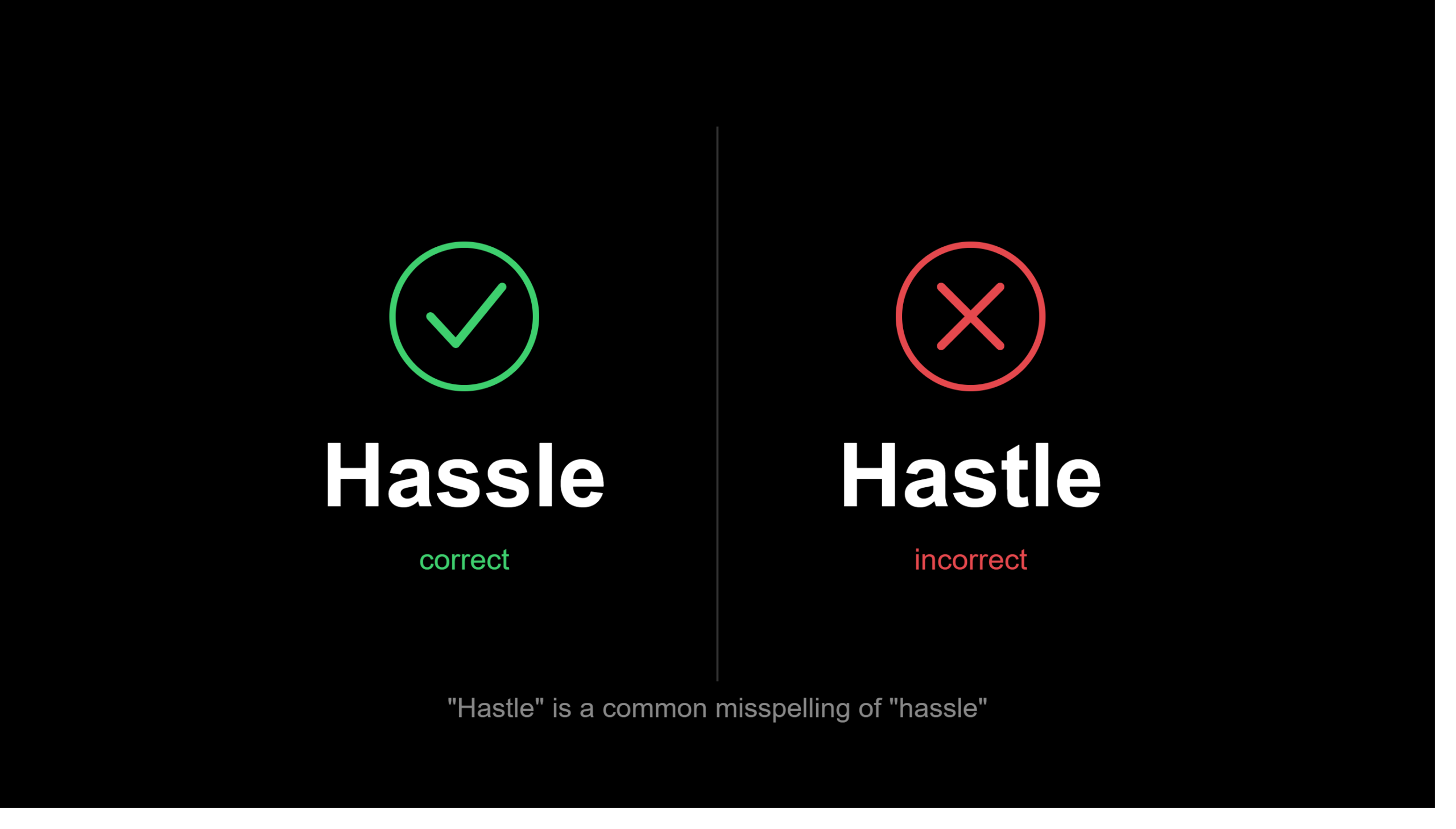

Ever typed “hastle” and paused, unsure if it was right? You’re not alone Hassle vs Hastle is one of the most common spelling mix-ups in English. It usually comes down to pronunciation and its resemblance to words like “castle” or “hustle.”
The truth is simple: only one spelling is real. This guide settles the Hassle vs Hastle debate for good, covering the correct spelling, true meaning, and simple tricks to remember it every time.
What Is the Correct Spelling: Hassle vs Hastle?
The correct spelling is hassle. “Hastle” is not a recognized English word — it doesn’t appear in Merriam-Webster, Oxford, Cambridge, or any other standard dictionary.
| Spelling | Status | Notes |
| Hassle | ✅ Correct | Real word, noun and verb |
| Hastle | ❌ Incorrect | Common misspelling, not in any dictionary |
Hassle means trouble, inconvenience, or bother. It can describe a frustrating situation (“What a hassle!”) or the act of pestering someone (“Stop hassling me”). Whenever you’re tempted to add a “t,” remember: there isn’t one.
Why People Mistype “Hassle” as “Hastle”
The mix-up isn’t random. It happens for a handful of predictable reasons.
1. Phonetic Confusion
When spoken quickly, the double “s” in hassle can sound like a soft “st,” making the ear (and then the fingers) assume there’s a hidden “t.”
2. Double-Letter Mistakes
English learners and fast typists often struggle with double consonants. Skipping or misplacing one letter in a double-letter word is a classic slip.
3. Typing Errors
On a keyboard, the letters feel close together, and muscle memory from typing similar-sounding words can lead fingers astray mid-sentence.
4. Auto-Correct Interference
Some older or poorly trained spellcheck tools fail to flag “hastle,” especially when the error has already been typed and searched by many other users online.
5. Bad Online Examples
Once a misspelling appears often enough in comments, ads, or social posts, readers start to assume it’s an accepted variant — even though it never was.
What the Word “Hassle” Actually Means
At its core, “hassle” describes something that takes extra effort, time, or patience than it should. It’s a mild, everyday word for friction — not a serious crisis, just an annoying obstacle.
It works two ways in English:
- As a noun, it names the annoying situation itself.
- As a verb, it describes the act of bothering or pressuring someone.
Hassle as a Noun: Meaning + Examples
Definition
As a noun, a “hassle” is a problem, inconvenience, or source of stress that disrupts an otherwise smooth process.
Examples
- Renewing a passport was a total hassle.
- Moving apartments always comes with a few unexpected hassles.
- Returning the package was surprisingly free of hassle.
Common Situations Where “Hassle” Works Well
- Long queues or waiting times
- Paperwork and bureaucratic processes
- Travel delays or rebooking
- Customer service back-and-forth
- Technical setup problems
Hassle as a Verb: Meaning + Examples
Definition
As a verb, “to hassle” means to repeatedly bother, pressure, or nag someone, usually about something relatively minor.
Examples
- Please don’t hassle me about the deadline — I’m on it.
- Debt collectors kept hassling him with daily calls.
- Her little brother hassled her until she agreed to play.
How “Hassle” Is Used in Daily Life
Common Daily Uses
People use “hassle” constantly in casual speech to describe small frustrations — a traffic jam, a forgotten password, or a slow checkout line.
Business & Professional Uses
Brands love the phrase “hassle-free,” using it in marketing to promise smooth, effortless experiences, such as “hassle-free returns” or “hassle-free setup.”
Casual Conversational Uses
In friendly chats, “hassle” softens a complaint. Saying “it’s a bit of a hassle” sounds far less dramatic than “it’s a huge problem.”
Etymology: Where the Word “Hassle” Comes From
Possible Origins
Linguists don’t agree on one single origin. Some trace it to a blend of “haggle” and “tussle,” while others link it to older dialect words describing shaking, pushing, or minor scuffling.
Meaning Evolution
The word gained popularity in American English around the mid-20th century, initially describing an argument or scuffle before softening into today’s broader meaning of everyday inconvenience.
Interesting Fact
“Hassle” started life as slang. It wasn’t considered “proper” English for decades, yet it’s now common in professional marketing copy, journalism, and everyday conversation worldwide.
Related post: Combating vs Combatting: Which One Should You Use?
Why the Confusion? Why People Think It’s Spelled “Hastle”
1. English Word Patterns Are Inconsistent
Words like “castle,” “whistle,” and “bristle” all end in “-stle” with a silent “t.” Since “hassle” sounds similar, people wrongly assume it follows the same rule.
2. Misheard in Conversation
In fast, casual speech, the “ss” sound blurs enough that listeners genuinely believe they hear a “t” between the vowels.
3. Memory Errors
Because “hassle” isn’t used in formal writing as often as “castle” or “hustle,” the brain has fewer chances to lock in the correct visual pattern.
How to Remember the Correct Spelling of “Hassle”
1. Think of “Less Hassle = Less Stress”
Both “hassle” and “stress” contain a double “s” — and a hassle is, quite literally, a small stressor.
2. Remember the Pair
Pair it with “hustle.” Neither word has a “t” hiding in the middle, even though both sound like they might.
3. Visual Trick
Picture the double “s” as two snakes hissing — a fitting image for something irritating, with zero room for a “t.”
4. Use a Quick Mnemonic
Try: “Hassle Always Sounds Simple, Less Effort” — the H-A-S-S pattern reinforces the correct start of the word.
5. Think of Customer Service Phrases
Brands never write “hastle-free returns” — because it looks unprofessional. Let marketing language be your spelling guide.
Hassle in Pop Culture & Media
Common Pop-Culture Uses
Movies, sitcoms, and song lyrics frequently use lines like “Why are you hassling me?” or “Don’t hassle me right now,” reinforcing the word’s casual, conversational tone.
Why It’s Popular
It’s short, expressive, and instantly relatable — everyone understands the mild frustration it conveys without sounding overly dramatic.
Case Studies: Real-Life Examples of When “Hassle” Applies
Case Study 1: Customer Service Hassle
A customer waited on hold for over 40 minutes to resolve a billing error. She later described the entire process as “one big hassle,” even though the issue was eventually fixed.
Case Study 2: Travel Hassle
A traveler’s flight was delayed twice, forcing a rebooking at the counter. The lost time and repeated line-waiting became the defining “hassle” of the trip.
Case Study 3: Workplace Hassle
An employee had to resubmit the same expense report three times due to a formatting error. Colleagues agreed it was an unnecessary hassle that better software could have prevented.
Sentence Examples Using “Hassle” Correctly
Noun Examples
- Parking downtown is always a hassle during rush hour.
- Switching phone carriers turned into a minor hassle.
- There’s no hassle involved in canceling your subscription.
Verb Examples
- The landlord kept hassling tenants about early payments.
- I won’t hassle you if you just send the file by Friday.
- Reporters hassled the celebrity for a comment outside the venue.
Common Mistakes People Make With “Hassle”
- Spelling it “hastle” instead of “hassle”
- Confusing it with “hustle” (which means to work hard or move quickly)
- Using it interchangeably with more serious words like “harassment” or “conflict,” when it should describe something mild
- Using “an hassle” instead of “a hassle” (it starts with a consonant sound)
- Overusing it in formal writing where “inconvenience” or “difficulty” fits better
Hassle: Quick Facts
| Fact | Detail |
| Correct spelling | Hassle |
| Incorrect spelling | Hastle |
| Part of speech | Noun and verb |
| Pronunciation | /ˈhæ.səl/ |
| Tone | Informal, conversational |
| Popular phrase | “Hassle-free” |
| Common confusion | Hustle vs Hassle |
| Best formal alternatives | Inconvenience, difficulty, complication |
Conclusion
Spelling confusion between hassle and hastle is one of those small English quirks that trips up even confident writers, and now you know exactly why it happens and how to avoid it for good. “Hassle” is the only correct form — it’s a flexible word that works as both a noun describing an annoying situation and a verb describing the act of pestering someone. “Hastle” simply isn’t a word, no matter how often it shows up in casual typing or unedited online content.
Remembering the double “s” and skipping the “t” entirely is the easiest way to lock this in permanently. Whether you’re writing a professional email, a marketing tagline, or a quick text to a friend, using the correct spelling shows attention to detail and keeps your writing polished. The next time you feel that flicker of doubt, trust this simple rule, and spelling “hassle” correctly will never be a hassle again.

Benjamin Reed is a passionate writer who shares insightful and engaging content on lifestyle, trends, and everyday topics.
