

Daily step count footwear is not one product, and that is why most guides on this topic feel incomplete. Some readers want a shoe that stays comfortable for 10,000 steps, some want to know whether their tracker counts steps correctly in different shoes, and some want a shoe that counts steps itself. Each of those readers needs a different answer, and this article gives all three in order.
The shoe you wear for a high step count matters because your feet absorb thousands of impacts every day. A shoe that feels soft in a shop can still fail at step 8,000, when your arch collapses, your heel slips, or your forefoot starts to burn. A shoe that fits your foot type, your surface, and your step level will let you walk more often, with less pain, and with fewer interruptions.
Your step target also matters, because 10,000 steps is not a scientific threshold. It began as a marketing name for a Japanese pedometer, and most of the benefit in large studies accrues well below that number. That does not make 10,000 steps a bad goal, but it does mean you should not judge a good walking day by whether you hit a round number.
Quick Answer: How Many Steps, What Shoes, and Does Footwear Change the Count?
Aim for about 7,000 to 8,000 steps a day for most adults, with an age split: about 6,000 to 8,000 for adults aged 60 and older, and about 8,000 to 10,000 for younger adults, according to a 2022 pooled analysis of 15 studies. The steepest gains come from moving from very low counts to moderate counts, so a walker who goes from 3,000 to 6,000 steps gains more than a walker who goes from 9,000 to 12,000.
Choose a cushioned, supportive shoe that fits your foot type. Flat feet and overpronation need a stability shoe with a firm medial post and a firm heel counter, while neutral feet on hard surfaces usually do better with maximal cushioning and a rocker sole. In both cases, the shoe must pass three shop tests: it must resist twisting through the midfoot, bend only at the toes, and have a removable insole.

Footwear did not change step counting in one peer-reviewed study, which tested four activity monitors in running shoes and hard-soled dress shoes across grass, gravel, tile, asphalt, and linoleum, plus stairs and ramps. That study did not test slippers, flip-flops, high heels, or hiking boots, and it did not test false steps during driving or cycling. Slow walking also reduces step-detection sensitivity in other studies cited by that paper, so a shoe-mounted sensor may count slow steps better than a wrist sensor.
How Many Steps a Day Do You Actually Need?
Where 10,000 Steps Came From
The 10,000-step goal began in 1965, when a Japanese company sold a pedometer called Manpo-kei, which translates as “10,000 steps meter.” The number stuck because it was round, memorable, and easy to market, not because a trial showed that 10,000 steps beat lower counts. That history matters, because it explains why so many people feel they have failed on a 7,500-step day that was actually a strong health day.
A 2019 study in JAMA Internal Medicine tested the number in 16,741 older women with an average age of 72. Women averaging about 4,400 steps a day had lower death rates than women averaging about 2,700 steps, and the benefit levelled off at around 7,500 steps. That study alone does not prove that steps cause longer life, because healthier people tend to walk more, but it does show that the benefit curve flattens well below 10,000.
A 2020 JAMA study of about 4,800 US adults aged 40 and older found a similar pattern. Compared with 4,000 steps a day, 8,000 steps was linked with a 51% lower risk of death, and 12,000 steps with a 65% lower risk, in that study’s analysis. Those percentages are associations from observational research, not guarantees, and they should never be presented as a promise that a shoe or a step goal will prevent disease.
The Age-Split Plateau
The 2022 Paluch pooled analysis of 15 studies and 47,471 adults gives the clearest age split in the step literature. For adults aged 60 and older, the risk of premature death levelled off at about 6,000 to 8,000 steps per day, meaning more steps than that provided no additional longevity benefit in that analysis. For adults younger than 60, the risk stabilised at about 8,000 to 10,000 steps per day.
That age split has a practical meaning for footwear. An older walker who aims for 7,000 steps needs a shoe that is comfortable, stable, and easy to put on, but does not need a shoe built for 15,000-step days. A younger walker who aims for 10,000 steps on concrete needs more cushioning, more durability, and a faster replacement cycle, because the shoe absorbs more total impact.
Walking speed did not add a separate benefit once total steps were accounted for in the Paluch analysis. That finding is useful, because it means a comfortable pace still counts, and you do not need to walk fast to get the step benefit. Brisk walking is time-efficient and good for fitness, but total step volume did most of the work in those studies.
Why the First Few Thousand Steps Matter Most
The steepest gains come from the lowest starting point. A person who moves from 2,000 to 5,000 steps a day gains more, in the observational studies, than a person who moves from 9,000 to 12,000 steps. That pattern repeats across the JAMA, Paluch, and 2025 Lancet Public Health summaries, and it is the most encouraging finding in the whole step literature.
That pattern also changes how you should choose footwear. A new walker does not need the most expensive maximal-cushion shoe on the market, because the first goal is consistency, not distance. A comfortable, supportive shoe that you actually wear every day will beat a technically perfect shoe that sits in a cupboard because it feels stiff, heavy, or hard to put on.
Set your step goal from your current average, not from a round number. If you average 3,000 steps, aim for 5,000 first, then 7,000, then 8,000 if that feels sustainable. If you already average 8,000 steps, holding that level consistently matters more than chasing 12,000 steps on one day and resting for three days after it.
Does Footwear Change Your Step Count?
What the PLOS Study Actually Tested
The PLOS ONE study from 2016 is the only peer-reviewed test in this SERP that directly asks whether footwear changes step counting. Fifteen participants wore four commercial activity monitors at the same time — Garmin Vivofit, New Lifestyles NL-2000 pedometer, Withings Pulse O2, and Fitbit One — during a prescribed walking route. That route reflected surfaces typically used to reach a daily step goal, and it included stairs and ramps as well as flat walking.
The surfaces tested were natural lawn grass, gravel, ceramic tile, tarmacadam or asphalt, and linoleum. The footwear tested was running shoes and hard-soled dress shoes, which the authors chose as the two types of footwear expected to be worn throughout the day when aiming for 10,000 steps. All four monitors were accurate in step detection across those surfaces, in both footwear types, and over a timeframe long enough to accumulate 10,000 steps.
The authors’ conclusion was clear and limited. They found no effect of footwear type on step-detection sensitivity for the two types tested, and they stated that all monitors tested were valid for physical activity quantification over flat surfaces, stairs, and ramps, in running shoes and hard-soled dress shoes. That conclusion does not extend to footwear types they did not test, and a good article must say so.
What the PLOS Study Did Not Test
Slippers, flip-flops, high-heeled shoes, and hiking boots were not tested, and the authors explicitly list them as future work. Those types differ from running shoes and dress shoes in sole type, degree of foot contact with the ground, and how tightly they fit on the foot. A loose slipper that slips off the heel, a flip-flop that requires toe grip, or a high heel that changes foot strike could all affect step detection in ways the study cannot answer.
Specificity was also not tested, which means the study did not measure false steps during activities that do not involve stepping, such as driving, cycling, or swimming. That limitation matters, because a tracker that counts steps correctly while walking can still count steps while driving over a bumpy road. Shoe-based sensors reduce one kind of false positive — arm swings counted as steps by wrist trackers — but they do not eliminate every kind of false step.
Attachment location was fixed to the manufacturer’s recommended location for each device, and only one location per device was tested. A wrist tracker worn loosely, a phone in a bag, or a shoe tracker clipped to a different part of the shoe could all behave differently. If your step count looks wrong, check attachment and fit before you blame the shoe.
Slow Walking, Attachment, and False Steps
Slow walking reduces step-detection sensitivity in some monitors, according to studies cited in the PLOS paper. A slow walker produces a smaller acceleration signal at each foot strike, which makes it harder for an algorithm to distinguish a real step from background movement. That effect matters for older walkers, rehabilitation walkers, and anyone who walks slowly indoors.
Shoe-mounted sensors have a theoretical advantage here, because they measure motion at the foot, where the step actually happens. A sophisticated algorithm can recognise the sharp spike of a foot strike, followed by a period of stability, then push-off, and filter out non-walking movements such as shaking a foot or sitting with restless legs. That direct measurement is why shoe-based systems are often described as more precise for walking-specific activities.
No consumer tracker is 100% accurate, and any article that claims otherwise is overstating the evidence. A tracker is a consistency tool, not a laboratory instrument, and its value lies in showing trends over weeks, not in proving that you took exactly 10,000 steps on a given Tuesday. If your tracker misses slow steps, walk at a comfortable pace and wear it consistently, rather than chasing a perfect count.
| Tracker type | How it counts | Strength | Weakness |
| Wrist tracker | Arm movement + accelerometer | Convenient, all-day wear, heart-rate and sleep features | Arm swings can be counted as steps; slow steps can be missed |
| Phone pedometer | Phone accelerometer | No extra device, free apps | Only counts when the phone is on your body |
| Shoe-mounted tracker | Foot strike accelerometer | Closest to the step, fewer arm false positives | Needs laces or a clip, only counts when that shoe is worn |
| Smart insole | Pressure + accelerometer in the shoe | Gait, pressure, and cadence data, movable between shoes | Battery, charging, and washability limits |
| Smart shoe (built-in) | Built-in sensors in the shoe | No clip to lose, integrated data | Cannot move the sensor to another shoe; limited buyable options |
Choosing Shoes for a High Daily Step Count
Foot-Type Chooser: Flat, Neutral, and High-Arch Feet
Foot type decides shoe category more than brand does. Flat feet, also called pes planus, cause overpronation, which is an inward rolling of the foot that strains the posterior tibial tendon, the plantar fascia, and the medial knee. A flat-footed walker needs a stability or motion-control shoe that interrupts that chain, not a soft neutral shoe that lets the arch collapse further.
Neutral feet need cushioning without heavy motion control. A neutral gait rolls through the foot in a balanced way, so a neutral cushioned shoe with good shock absorption and a flexible sole usually works well. A stability shoe on a neutral foot can feel stiff and constraining, and it adds weight without adding benefit.
High arches need cushioning and shock absorption, because a high-arched foot is often rigid and does not absorb impact well. A maximal-cushion shoe with a soft, responsive midsole can help, but it must still have a stable heel and a roomy toe box. A very soft shoe with no heel stability can feel unstable on uneven surfaces, so balance matters more than softness alone.

| Foot type | What happens when you walk | Choose | Avoid |
| Flat feet / overpronation | Arch collapses, foot rolls inward, fascia and knee strain | Stability shoe, firm medial post, firm heel counter, torsion-resistant shank | Soft neutral shoe, flat slip-on, shoe that twists easily |
| Neutral feet | Balanced roll-through, even wear | Neutral cushioned shoe, flexible sole, good shock absorption | Heavy motion-control shoe that feels stiff |
| High arches | Rigid foot, poor shock absorption, heel and forefoot pressure | Maximal cushion, soft responsive midsole, stable heel | Very firm, flat shoe with no cushioning |
| Plantar fasciitis | Fascia irritation, morning heel pain, arch strain | Thick cushioned sole, rocker sole, low-to-moderate drop, arch support | Flat sandal, high heel, shoe that folds in the middle |
Cushioning vs. Stability vs. Maximal Cushion
Cushioning absorbs impact at heel strike, and it matters most on hard surfaces such as concrete and asphalt. A cushioned midsole made from EVA foam, responsive foam, or gel reduces the shock that travels through the heel, knee, and back. A walker who covers 10,000 steps on concrete needs more cushioning than a walker who covers the same steps on grass or a treadmill.
Stability controls excess motion, and it matters most for flat feet and overpronation. A stability shoe uses a firmer medial post, GuideRails in Brooks models, or a similar structure to guide the foot through its natural motion path without aggressive correction. That guidance reduces arch collapse, but it adds weight and firmness that a neutral walker may not need.
Maximal cushioning is a different idea from stability. A maximal-cushion shoe such as the HOKA Bondi has a very thick midsole that absorbs a large amount of impact, and a rocker sole that helps the foot roll forward. That combination reduces heel-strike impact and plantar fascia stretch during push-off, according to podiatrist guides, but it does not provide overpronation control on its own.
The best shoe for a high step count is usually a combination, not a single feature. A flat-footed walker on concrete needs stability plus cushioning, while a neutral walker on concrete needs cushioning plus a stable heel. A walker with plantar fasciitis needs cushioning plus a rocker sole plus a low-to-moderate drop, and may still need an orthotic for arch control.
Fit Tests That Eliminate Bad Shoes in the Shop
Fit tests work better than brand names, because brands change models every year and the same model name can fit differently in a new version. Michigan Foot Doctors, a podiatrist practice, lists three tests that eliminate more shoes than any other, including many shoes marketed specifically for plantar fasciitis. Use those tests in the shop, before you pay.
Test 1: The twist test. Hold the heel in one hand and the forefoot in the other, and try to wring the shoe like a towel. A good walking shoe resists twisting through the midfoot, because that resistance is what stops the arch from collapsing with every step. A shoe that twists easily lets the arch collapse, which loads the plantar fascia and strains the knee.
Test 2: The bend test. A shoe should flex where your foot flexes, at the ball of the foot, and only at the ball. If the shoe folds in half across the middle, it offers no meaningful arch support, regardless of what the insole claims. That folding is a sign that the shank, the stiff piece between the heel and the forefoot, is too weak for daily walking.
Test 3: The removable insole test. The footbed must come out, because a removable insole means the shoe can accept an orthotic later if you need one. A glued-in footbed forecloses that option, and for a foot that is still changing, that matters more than the quality of the insole the shoe shipped with. Brand marketing, “podiatrist-designed” labels, and price deliberately do not count in that practice’s tests.
Test 4: The heel and toe-box check. The shoe should feel snug around the foot, have good arch support, and the heel should not slip around, according to Dr. Mark Mendeszoon, a board-certified podiatrist cited in walking-shoe guides. There should be adequate room in the toe box, because cramped toes cause blisters, bunions, and hammertoe pain over thousands of steps.
Test 5: The later-in-the-day fit. Measure both feet later in the day, when natural swelling is at its peak, and try shoes with the socks you actually plan to wear. Different brands use unique lasts, so a size in one brand may not match another, and women with wide feet should check wide-width listings by colourway and model revision, because width availability changes between versions.
Lace-Up vs. Slip-On: Comfort, Habit, and the Honest Story
Lace-up trainers give you a more secure, adjustable fit, because you can tighten the midfoot, loosen the forefoot, and lock the heel in place. That adjustability matters at high step counts, because feet swell during the day and a shoe that fit in the morning may feel tight by the afternoon. A lace-up shoe lets you adjust for that change without changing shoes.
Slip-on sneakers are easier to put on, and that ease matters for seniors, for workers who change shoes quickly, and for anyone who walks in short bursts throughout the day. A structured slip-on with arch support, a firm heel counter, and a secure fit can work well for daily walking. A flat, loose slip-on with no arch support cannot, because it lets the foot slide, the arch collapse, and the heel slip with every step.
One widely shared story about lace-up vs. slip-on shoes needs careful handling. A B2B product-insights page describes a remote worker, “Maya,” whose step count rose on lace-up days and stayed low on slip-on days over eight weeks. That story is a single-person anecdote, not a study, and it changed no other variables in a controlled way. It is useful as a habit idea — the pause required to lace up may prompt a pre-meeting walk — but it is not evidence that lace-up shoes increase steps.
Use the habit idea, not the numbers. If you work remotely, try a simple routine: put on a structured walking shoe before your first meeting, take audio-only calls as walks, and take a short loop after dinner. Those three habits, not the shoe brand, are what the anecdote actually describes, and they work in any supportive shoe that fits well.
Best Shoes by Step Count and Foot Type
Best Overall for 10,000 Steps
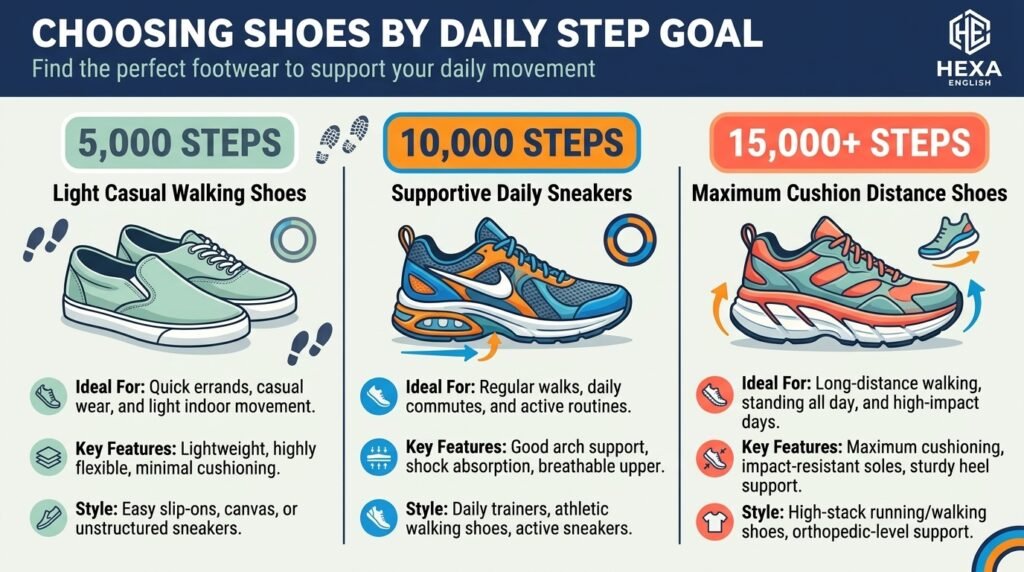
HOKA Clifton 10 is named as best overall in multiple expert roundups, including Men’s Health editors cited in walking-shoe guides, and it has earned the American Podiatric Medical Association’s Seal of Acceptance. It is known for plush cushioning and a lightweight design, without feeling bulky, which suits all-day walking, long distances, and everyday wear. It is a strong starting point for a neutral walker who wants cushioning without a heavy stability shoe.
Brooks Ghost 15 is a neutral cushioned running shoe that works well for walking, with a wider toe box and good shock absorption. Podiatrist guides name Ghost for active walkers who need cushioning without heavy motion control, and it pairs well with orthotics if arch support is needed later. Ghost is lighter than a maximal-cushion shoe, which suits walkers who find thick midsoles bulky.
Nike Pegasus 42 is Nike’s best shoe for running and walking in its own guide, with Zoom Air units at the forefoot and heel, a React foam midsole, and a breathable engineered mesh upper. Nike’s guide names it for walkers who switch between running and walking, walk on hard surfaces, or need arch support and joint cushioning. It is a good choice for a walk-run routine, rather than a pure walking shoe.
On Cloud 6 Waterproof is named as best overall in one 2026 men’s walking-shoe guide, with CloudTec cushioning, a lightweight breathable design, and a slip-on style for easy wear. Waterproofing matters for walkers who walk in rain or on wet paths, but it can reduce breathability in summer, so choose waterproof only if your walking conditions need it.
Best for Flat Feet and Overpronation
Brooks Adrenaline GTS 24 is named as best overall stability shoe by Michigan Foot Doctors, with GuideRails technology that guides the foot through its natural motion path without aggressive correction. Tanglewood Foot Specialists, a Houston podiatry practice, cites a 12 mm drop and GuideRails support for overpronators, and a competitor-reported US price range of $140 to $160 for Brooks models — verify the current US price and model at purchase time, because model years change.
ASICS Gel-Kayano 31 is named as maximum control for heavy overpronation by Michigan Foot Doctors, with gel cushioning in the heel and structured stability. Tanglewood cites a competitor-reported US price range of $160 to $180 for Gel-Kayano, and notes that it is heavier, so it is less ideal for running but excellent for standing jobs on hard floors. That trade-off matters: maximum control often means maximum weight.
New Balance Fresh Foam 860v14 and Saucony Guide 17 are also named as stability picks by Michigan Foot Doctors, and HOKA Arahi 7 is named as cushion plus stability. New Balance 928v3 and Brooks Addiction Walker 2 are named as everyday walking shoes for flat feet, which suits walkers who want stability without a running-shoe look. Pair any of those picks with a supportive insole such as PowerStep Pinnacle, as Michigan’s guide suggests, if arch support alone is not enough.
Best for Plantar Fasciitis and Heel Pain
HOKA Bondi 9 is named as the strongest all-around pick for plantar fasciitis in the Naples podiatry guide, because of its 4 mm drop and wide, stable midsole. Maximal midsole cushioning reduces heel-strike impact, and the rocker sole shape lowers the amount of stretch placed on the plantar fascia during push-off. Tanglewood cites a competitor-reported US price range of $165 to $185 for HOKA Bondi — verify the current model and price, because Bondi 8 and Bondi 9 are both named in different guides.
Brooks Adrenaline GTS is the better call if overpronation is also a factor, according to the Naples guide, because Bondi alone does not provide overpronation control. That distinction is important: a maximal-cushion shoe can feel wonderful on the heel while still letting a flat arch collapse, which keeps loading the fascia. A stability shoe plus cushioning, or a maximal shoe plus an orthotic, often works better than either alone.
Vionic Walker Classic is named as best overall for plantar fasciitis by Garage Gym Reviews, which claims to have researched or tested almost 70 pairs of sneakers for its guide. Saucony Cohesion 13 is named as best budget pick in the same guide, which matters because plantar fasciitis shoes do not need to be the most expensive shoes to pass the twist, bend, and removable-insole tests. New Balance 990 and 1080 are also named for plantar fasciitis, with multiple width options including 2E wide and 4E extra wide, which helps hard-to-fit feet.
A low-to-moderate heel-to-toe drop, generally 4 to 12 mm, tends to work best for plantar fasciitis, according to the Naples guide. Very low or zero-drop shoes shift more load onto the fascia than most feet with plantar fasciitis can tolerate comfortably, so a minimalist or barefoot shoe is not a good first choice for heel pain, even if it feels natural in the shop.
Best for Wide Feet, Seniors, and Standing-All-Day Work
Wide feet need genuine wide-width options, not just a larger size. New Balance 990 and 1080 offer 2E wide and 4E extra wide options, and Brooks offers wide 2E sizing across several core lines including Adrenaline GTS. Always check width availability by colourway and model revision, because a shoe that is available in wide in one colour may not be available in wide in another.
Seniors need stability, cushioning, and easy entry. Brooks Addiction Walker 2 is named as best for seniors for plantar fasciitis by Garage Gym Reviews, and New Balance 928v3 is named as an everyday walking shoe for flat feet by Michigan Foot Doctors. Both are stable, cushioned, and available in wide widths, which suits feet that change shape with age and need a secure heel without a tight toe box.
Standing-all-day workers need the same features as high-step walkers, plus slip resistance. Nurses, teachers, and retail workers stand on hard floors for entire shifts, and podiatrist guides name ASICS Gel-Kayano and New Balance 990 for those jobs. Check your workplace dress code and slip-resistance requirements before you buy, because a walking shoe that is perfect for a park path may not meet a hospital or kitchen safety rule.
Workers with bunions or hammertoes need a wide toe box more than an official width label, according to BuyAdvanced fit guidance. A roomy forefoot, a soft upper material, and a removable insole reduce pressure on the forefoot, which matters more over thousands of steps than the brand name on the tongue.
Best Budget Picks and What to Avoid
Saucony Cohesion 13 is a useful budget starting point for plantar fasciitis, and Skechers Go Walk Arch Fit 2.0 is named for arch support and a flexible sole for natural gait. Both show that a good walking shoe does not need to cost the most, as long as it passes the twist, bend, and removable-insole tests. A budget shoe that fails those tests is not a bargain, because it will cost you in pain and replacement time.
Avoid flat, unsupported sandals for a daily step goal, especially in summer, because they remove arch support and heel cushioning entirely. Podiatrist guides name prolonged unsupported sandal use as a common trigger for plantar fasciitis flare-ups. Avoid high heels for prolonged walking, because they shorten the Achilles tendon, increase stress on the ball of the foot, and can cause bursitis, synovitis, and nerve irritation, according to Dr. Ritchard Rosen, a podiatrist cited in walking-shoe advice.
Avoid a shoe that folds in the middle, twists easily, or has a glued-in footbed, even if it is marketed as “podiatrist-designed” or costs a premium price. Michigan Foot Doctors states that plenty of inexpensive shoes pass all four of its tests, and plenty of expensive shoes fail them. Price, brand marketing, and labels deliberately do not count in that practice’s evaluation.
| Shoe category | Best for | Example models | Watch out for |
| Neutral cushioned | Neutral feet, hard surfaces, walk-run | Brooks Ghost, Nike Pegasus, HOKA Clifton | Not enough control for flat feet |
| Stability | Flat feet, overpronation | Brooks Adrenaline GTS, ASICS Gel-Kayano, New Balance 860 | Heavier, can feel stiff for neutral feet |
| Maximal cushion | Heel pain, long hours, hard surfaces | HOKA Bondi, HOKA Clifton | No overpronation control alone; bulk |
| Everyday walking | Seniors, standing jobs, daily wear | New Balance 928v3, Brooks Addiction Walker 2, Vionic Walker | Check width and slip-resistance rules |
| Budget | First pair, backup pair, rotation | Saucony Cohesion, Skechers Go Walk Arch Fit | Must still pass twist, bend, and insole tests |
Smart Shoes, Smart Insoles, and Shoe-Mounted Trackers

What You Can Buy Now vs. What Is Still Research
You can buy a shoe-mounted tracker now, such as LaceClips, which clips to laces and tracks steps, jumps, calories, and pivots across 25 or more sports, with no subscription in its product description. That type of tracker converts any laced shoe into a step tracker, which means you do not need to buy a new shoe to get shoe-level step data. It is a useful bridge between a wrist tracker and a full smart shoe.
You can buy a smart insole now, such as NURVV, which is named in smart-footwear explainers for gait analysis, pressure distribution, and step count and cadence. A smart insole can be moved between shoes, which means you can keep your favourite walking shoe and add gait data to it. Battery life, charging, and washability are the practical limits to check before you buy.
You cannot buy the Rutgers smart shoe, because it is a research prototype, not a commercial product. Rutgers engineers built a shoe with an accelerometer, a tiny processor, and edge AI that classifies each 15-second segment as slow walking, fast walking, running, or climbing stairs. The original model examined 21 movement characteristics and reached 98.1% accuracy, but required more memory than the shoe’s processor could hold, while a smaller model reached 95.4% accuracy, ran about 15 times faster, and used about one-sixth as much current.
You should not treat non-US smart-shoe marketing claims as US facts. Impakto, an India smart-shoe brand, claims “99.9% accuracy” for its Navigator smart shoes, but that claim is unverified marketing, not a standardised test result, and the product is not a US recommendation in this SERP. A B2B sourcing guide for computerized shoes cites ISO 13485, CE, FCC, RoHS, and IP67 standards, but those are sourcing and compliance claims for manufacturers, not guarantees for a consumer shoe you buy online.
Shoe vs. Wrist vs. Phone Tracking: Accuracy Trade-Offs
Shoe tracking is closest to the step, because it measures foot strike directly and filters out arm swings that wrist trackers can mistake for steps. That advantage matters most for slow walking, for walking with hands in pockets, and for activities where arm movement does not match leg movement. It also matters for gait analysis, because only a foot-level sensor can measure pressure distribution and cadence accurately.
Wrist tracking is most convenient for all-day wear, because you wear a watch all day, while a shoe tracker only counts when you wear that shoe. A wrist tracker also gives heart-rate, sleep, and activity data that a shoe tracker does not, which makes it a better all-round health tracker. For most walkers, wearing a tracker consistently matters more than the small accuracy difference between wrist and shoe tracking.
Phone tracking is free but incomplete, because it only counts steps when the phone is on your body. A phone left on a desk, in a bag, or on a charger will miss steps that a wrist or shoe tracker would count. If your phone step count looks low, check whether you carried the phone for the whole walk before you conclude that your shoes or your fitness are the problem.
How to Walk More Without Hurting Your Feet
Step-Goal Ramp, Walking Breaks, and Walking-Pad Use
Start from your current average and add steps gradually, rather than jumping from 3,000 to 10,000 steps in one week. A gradual ramp lets your feet, knees, and shoes adapt, and it lets you notice pain early, before it becomes an injury. If you have a heart, joint, or foot condition, talk to a clinician before ramping up, and do not copy a clinical step-dosing protocol as a general prescription.
Walking breaks work better than one long walk for many people, especially remote workers and desk workers. A 12-minute walk before the first meeting, two 5-minute call-and-stroll sessions during audio-only calls, and a post-dinner loop are the kinds of breaks described in the lace-up anecdote, and they add up without requiring a single free hour. Those breaks also break up sedentary time, which matters even if your total step count does not reach 10,000.
A walking pad can help on days when outdoor walking is hard, because it lets you walk indoors while working, watching television, or waiting for a call. First-person walking-pad stories name comfortable walking shoes as a key factor in consistency, because a walking pad without a supportive shoe can still cause foot pain. Use the same shoe rules for a walking pad as for outdoor walking: cushioning, arch support, a roomy toe box, and a shoe that is not worn out.
Remote-Worker Movement and the Call-and-Stroll Idea
Remote workers face a specific step problem: the commute disappears, and steps cluster before noon. The Alibaba anecdote describes a remote worker whose steps plateaued at 3,200 to 3,800 per day, with 92% of steps before noon and almost no movement after 1 p.m. That pattern is plausible for many remote workers, even though the anecdote itself is not evidence, because the home office removes the walk to the train, the walk to lunch, and the walk to a meeting room.
The call-and-stroll idea is simple and worth trying. Take audio-only meetings as walks, either outdoors or on a walking pad, and keep video meetings seated. That rule alone can add two or three short walks to a workday without adding meeting time. A structured walking shoe, put on before the first call, can serve as a cue for that habit, in the same way that putting on work clothes cues a work mindset.
Do not let a step goal replace strength work. Walking is strong for heart health and mood, but it does little to build or protect muscle and bone, according to step-science summaries. Public health guidelines recommend muscle-strengthening activity on at least two days a week in addition to aerobic activity, and a shoe cannot replace that work.
When to Replace Walking Shoes
Steps to Miles to Months Calculator
Replacement is a maths problem, not a calendar problem. Most guides cite 300 to 500 miles as the replacement range for walking shoes, but that range means very different months for different walkers. A walker who covers 10,000 steps a day covers roughly 5 miles a day, so 300 to 500 miles lasts about 60 to 100 days, or roughly 2 to 3 months. A walker who covers 3,000 steps a day covers roughly 1.5 miles a day, so the same shoe lasts about 200 to 333 days, or roughly 6 to 11 months.
Use this table to estimate your replacement timing, then adjust for surface, weight, gait, and shoe type. A heavier walker on concrete will wear a shoe faster than a lighter walker on a treadmill, and a maximal-cushion shoe may compress faster than a firm stability shoe. The table is a starting estimate, not a rule, and wear signs always override mileage.
| Daily steps | Approx. miles per day | Months to 300 miles | Months to 500 miles |
| 3,000 steps | About 1.5 miles | About 6 to 7 months | About 11 months |
| 5,000 steps | About 2.5 miles | About 4 months | About 6 to 7 months |
| 7,000 steps | About 3.5 miles | About 3 months | About 4 to 5 months |
| 10,000 steps | About 5 miles | About 2 months | About 3 to 4 months |
| 12,000 steps | About 6 miles | About 1 to 2 months | About 3 months |
Rotating two pairs extends the life of both, because foam recovers between walks and each pair absorbs fewer total miles. Rotation also gives you a backup pair when one pair is wet, being broken in, or showing early wear signs. If you walk 10,000 steps a day, rotation is not a luxury — it is the simplest way to avoid walking in a dead shoe without buying shoes every month.
Wear Signs: Midsole, Outsole, Heel Counter, and Pain Returning
Midsole wear is the most important sign, and the hardest to see. The midsole is the layer between the outsole and the upper, and it provides cushioning and stability. When it wears out, you may see creasing or unevenness when you look at the shoe at eye level on a flat surface, or you may feel that the foam is noticeably firmer than when the shoe was new. That firmness means the shoe no longer absorbs impact, even if the outsole still looks fine.
Outsole wear is easier to see. If the tough outer sole has worn through to the midsole, or is worn down more on one side than the other, traction and stability are compromised. Smooth treads do not grip well, which increases the risk of a fall if you become unsteady. Check the heel area for significant flattening or slanting on one side, because uneven heel wear suggests that cushioning and support are compromised.
Heel-counter wear is a stability warning. The heel counter is a stiff piece of material at the back of the shoe above the midsole, and it provides foot and ankle support. If it feels flexible when pressed side to side, or leans to one side, it probably will not provide essential support anymore. That flex is a sign to replace the shoe, even if the upper still looks new.
Pain returning is the final sign, and it should not be ignored. If your feet feel sore when you walk in shoes that used to feel comfortable, if blisters return after the break-in period, or if knee or hip fatigue increases after walks that used to feel easy, the shoe has likely lost its support. If foot pain does not resolve in a couple of days, or has not eased after 6 to 8 weeks of supportive footwear, see a podiatrist rather than trying another pair.
Mistakes to Avoid
- Chasing 10,000 steps on day one. A sudden jump from a sedentary level to a high step goal causes fatigue, soreness, and injury, and it makes you less likely to walk the next day. Start from your current average and add steps gradually.
- Buying on softness alone. A shoe that feels soft in the shop can still fail at 10,000 steps if it twists easily, folds in the middle, or has a glued-in footbed. Use the twist, bend, and removable-insole tests before you pay.
- Wearing flat sandals for a step goal. Flat, unsupported sandals remove arch support and heel cushioning, and prolonged use is a common trigger for plantar fasciitis flare-ups, especially in summer.
- Wearing high heels for prolonged walking. High heels shorten the Achilles tendon and increase stress on the ball of the foot, which can cause bursitis, synovitis, and nerve irritation over time.
- Ignoring foot type. A neutral cushioned shoe on a flat, overpronating foot lets the arch collapse, while a heavy stability shoe on a neutral foot feels stiff and wasteful. Match the shoe category to your foot type first, then choose a brand.
- Keeping shoes until they fall apart. A shoe can look fine on the outside while the midsole is dead, the heel counter is flexible, and the outsole is smooth. Replace on mileage and wear signs, not on appearance alone.
- Trusting a tracker count without checking attachment. A wrist tracker worn loosely, a phone left on a desk, or a shoe tracker clipped to the wrong place will all give a wrong count. Check attachment and fit before you blame the shoe or your fitness.
- Copying a clinical protocol as a general plan. A diabetic-foot step-dosing protocol with temperature monitoring and redness checks is a clinical tool, not a general walking plan. Do not use its break-in schedule or step ramp as a prescription for healthy walkers.

Expert Tips
- Measure both feet later in the day, with your walking socks on. Feet swell during the day, and a shoe that fits in the morning may feel tight by the afternoon, when you are actually walking.
- Do the twist test before you leave the shop. A shoe that twists easily through the midfoot will let your arch collapse at step 5,000, no matter how soft the insole feels.
- Do the bend test at the ball of the foot, not the middle. A shoe that folds in half offers no arch support, and that failure will show up as heel pain long before the outsole wears out.
- Choose a shoe with a removable insole, even if you do not need an orthotic yet. That option costs nothing now and saves you from buying a new pair later if your foot changes.
- Match the shoe to your surface, not just your step count. Concrete needs more cushioning than grass or a treadmill, and a trail needs more traction and stability than a city path.
- Rotate two pairs if you walk 10,000 steps a day. Rotation extends the life of both pairs, lets foam recover, and gives you a backup when one pair is wet or worn.
- Track trends, not single days. A tracker that shows 7,000 steps on average over a month is more useful than a tracker that shows exactly 10,000 steps on one day and 2,000 steps for the next three days.
- Check attachment before you blame accuracy. A loose wrist tracker, a phone in a bag, or a shoe tracker clipped to the wrong place will all give a wrong count, regardless of the shoe you wear.
- Add walking breaks, not just longer walks. Two 5-minute call-and-stroll breaks and a short evening loop add up to thousands of steps without requiring a free hour.
- See a podiatrist if pain persists for 6 to 8 weeks in supportive shoes. A shoe change alone cannot fix every foot problem, and sharp pain, swelling, or a change in gait always deserves evaluation.
FAQs
How many steps a day do I need?
Most adults gain most of the step benefit by about 7,000 to 8,000 steps a day, with an age split of about 6,000 to 8,000 for adults aged 60 and older and about 8,000 to 10,000 for younger adults, according to a 2022 pooled analysis of 15 studies.
The steepest gains come from moving from very low counts to moderate counts. This is general information, not a prescription, and if you have a health condition, talk to a clinician before setting a step goal.
Do I really need 10000 steps a day?
No, you do not need exactly 10,000 steps a day to gain most of the benefit. The number began as a 1965 Japanese pedometer marketing name, Manpo-kei, meaning “10,000 steps meter,” and it was not derived from a trial showing that 10,000 steps beat lower counts. Ten thousand steps is a fine round goal if you enjoy chasing it, but a consistent 7,000-step day is a strong health day.
What shoes are best for walking 10000 steps a day?
A cushioned, supportive walking or running shoe that fits your foot type is best for 10,000 steps a day. Flat feet need a stability shoe with a firm medial post and heel counter, neutral feet on hard surfaces usually do better with maximal cushioning and a rocker sole, and every foot type needs a roomy toe box, a shoe that bends only at the toes, and a removable insole. Test those features in the shop before you buy.
Can shoes help me walk more steps?
Comfortable, supportive shoes can remove a barrier to walking, but there is no controlled evidence that a shoe brand alone increases steps.
A single-person anecdote about lace-up shoes and higher steps is sometimes cited, but it is not a study and should not be used as evidence. Habits such as walking breaks, call-and-stroll calls, and a short evening loop are more likely to increase steps than a brand change alone.
Does footwear affect step count accuracy?
In one peer-reviewed study, footwear did not affect step counting for running shoes vs. hard-soled dress shoes.
The PLOS ONE 2016 study tested four monitors across grass, gravel, tile, asphalt, and linoleum, plus stairs and ramps, and found no footwear effect for those two types. Slippers, flip-flops, high heels, and hiking boots were not tested, so that result does not extend to every shoe type.
Are smart shoes accurate for step counting?
Shoe-based sensors can be more precise for walking than wrist sensors, because they measure foot strike directly, but no consumer smart shoe in this SERP has a verified standardised accuracy claim. A Rutgers research prototype reached 95.4% accuracy with a small model and 98.1% with a larger model in lab conditions, but it is not a product to buy. Treat any “99.9% accuracy” marketing claim as unverified unless it cites a standardised test.
Shoe pedometer vs. wrist tracker — which is more accurate?
A shoe pedometer is generally closer to the step and less prone to arm-movement false positives, while a wrist tracker is more convenient for all-day wear. A shoe tracker only counts when you wear that shoe, while a wrist tracker counts all day and also tracks heart rate and sleep. For most walkers, wearing a tracker consistently matters more than the small accuracy difference between shoe and wrist tracking.
How often should I replace walking shoes?
Most guides cite 300 to 500 miles, which is about 6 to 12 months for a casual walker but only about 2 to 3 months for a daily 10,000-step walker. A 10,000-step walker covers roughly 5 miles a day, so 300 to 500 miles lasts about 60 to 100 days. Replace sooner if you see midsole creasing, smooth tread, heel slant, heel-counter flex, or returning pain, and rotate two pairs to extend the life of both.
What are the signs my walking shoes are worn out?
Midsole foam that feels firmer or shows creasing, outsole tread that is smooth or worn through to foam, a heel that is slanted or more than 4 mm uneven, and a heel counter that flexes side to side are all wear signs. Pain, blisters, or knee and hip fatigue returning after walks that used to feel comfortable are also signs that support has gone. Replace on mileage and wear signs together, not on appearance alone.
What shoes are best for flat feet?
Stability or motion-control shoes with a firm medial post, a firm heel counter, and a torsion-resistant shank are best for flat feet. Podiatrist picks in the SERP include Brooks Adrenaline GTS 24, ASICS Gel-Kayano 31, New Balance 860v14, Saucony Guide 17, and HOKA Arahi 7, with New Balance 928v3 and Brooks Addiction Walker 2 for everyday walking. Pair a stability shoe with a supportive insole if arch support alone is not enough.
What shoes are best for plantar fasciitis?
Shoes with thick, cushioned soles, good arch support, a rocker sole, and a low-to-moderate heel-to-toe drop of 4 to 12 mm are best for plantar fasciitis. HOKA Bondi 9 is the strongest all-around pick in the Naples podiatry guide, while Brooks Adrenaline GTS is better if overpronation is also a factor. If morning heel pain has not eased after 6 to 8 weeks of supportive footwear, see a podiatrist rather than trying another pair.
Should I wear running shoes for walking?
Yes, running shoes are often a good option for walking, especially for joint pain, hard surfaces, arch support needs, and walk-run training. Nike’s own guide states that running shoes are comfortable enough for long or short walking distances, and podiatrist guides name several running shoes as their top walking picks. The key is cushioning, support, and fit, not whether the box says “walking” or “running.”
Are slip-on shoes bad for walking all day?
Slip-on shoes are not automatically bad, but many lack arch support, heel hold, and a secure fit, which matters at high step counts. A structured slip-on with arch support and a firm heel counter can work well for daily walking, while a flat, loose slip-on lets the foot slide and the arch collapse. Test the twist and bend tests before you buy, and choose a lace-up shoe if you need an adjustable fit for swelling feet.
Do I need orthotics for daily walking?
Not everyone needs orthotics for daily walking, but they can help for moderate-to-severe or chronic plantar fasciitis, flat feet with pain, or arch collapse that shoes alone do not control. A properly fitted insert corrects arch collapse that shoes alone cannot fully control, and most recommended shoes accept a removable footbed swap. Choose a shoe with a removable insole so you can add an orthotic later without buying a new pair.
What is the twist test for walking shoes?
Hold the heel in one hand and the forefoot in the other, and try to wring the shoe like a towel. A good walking shoe resists twisting through the midfoot, because that resistance stops the arch from collapsing with every step. A shoe that twists easily lets the arch collapse, which loads the plantar fascia and strains the knee, and it should be eliminated in the shop.
What is the bend test for walking shoes?
A walking shoe should flex where your foot flexes, at the ball of the foot, and only at the ball. If the shoe folds in half across the middle, it offers no meaningful arch support, regardless of what the insole claims. That folding is a sign that the shank is too weak for daily walking, and the shoe should be eliminated even if it feels soft in the shop.
Why does a removable insole matter?
A removable footbed lets you swap in an orthotic later if you need one, while a glued-in footbed forecloses that option. For a foot that is still changing, or for a walker who may develop pain later, that option matters more than the quality of the insole the shoe shipped with. Check for a removable insole before you buy, even if you do not need an orthotic today.
How should walking shoes fit?
Walking shoes should feel snug around the foot, have good arch support, and the heel should not slip around, with adequate room in the toe box. Measure both feet later in the day, when swelling is at its peak, and try shoes with the socks you actually plan to wear. Different brands use unique lasts, so a size in one brand may not match another, and wide-width availability varies by colourway and model revision.
Are HOKA shoes good for plantar fasciitis?
Podiatrist guides say yes, because maximal midsole cushioning reduces heel-strike impact and the rocker sole lowers plantar fascia stretch during push-off. HOKA Bondi is the strongest all-around pick in the Naples guide, and HOKA Clifton is lighter with balanced cushioning. HOKA alone does not provide overpronation control, so flat-footed walkers may still need a stability shoe or an orthotic alongside maximal cushioning.
Brooks Ghost vs. Adrenaline — which for walking?
Choose Brooks Ghost if you have a neutral gait and want cushioning without motion control, and choose Brooks Adrenaline GTS if you overpronate or have flat feet. Ghost is lighter with a wider toe box, while Adrenaline uses GuideRails technology and a 12 mm drop to control excess motion. Both pair well with orthotics, and both are named by podiatrist guides for daily walking, so foot type, not brand loyalty, should decide between them.
Conclusion on Daily Step Count Footwear
Daily step count footwear works best when you start with your step level, match the shoe to your foot type, and check the shoe in the shop before you trust it for thousands of steps. Aim for a consistent 7,000 to 8,000 steps if that is sustainable for you, choose a stability shoe for flat feet and a maximal-cushion shoe for neutral feet on hard surfaces, and use the twist, bend, and removable-insole tests to eliminate bad shoes quickly.
Remember that running shoes and dress shoes did not change step counting in one peer-reviewed study, but slippers, heels, and boots were not tested, and that a smart shoe prototype is not yet a product you can buy.
Your next step is simple and practical. Measure both feet later today, try on two or three shoes from different categories — one stability, one maximal cushion, one neutral — and run the twist, bend, and heel-slip tests in the shop.
Choose the shoe that passes those tests and feels comfortable after a short walk, not the shoe with the best marketing or the highest price. Then set a step goal from your current average, rotate two pairs if you walk 10,000 steps a day, and replace your shoes when mileage and wear signs say so, not when they fall apart. If foot pain persists for 6 to 8 weeks in supportive shoes, see a podiatrist, and use the Related Topics links above to plan your next shoe, tracker, and step-goal decisions.

Dilawar Mughal is an SEO expert with 8 years of hands-on experience helping websites grow their organic traffic, rankings, and revenue. He specializes in content-driven SEO, local SEO, and Pinterest SEO, and builds practical, results-focused strategies for businesses and publishers.
