
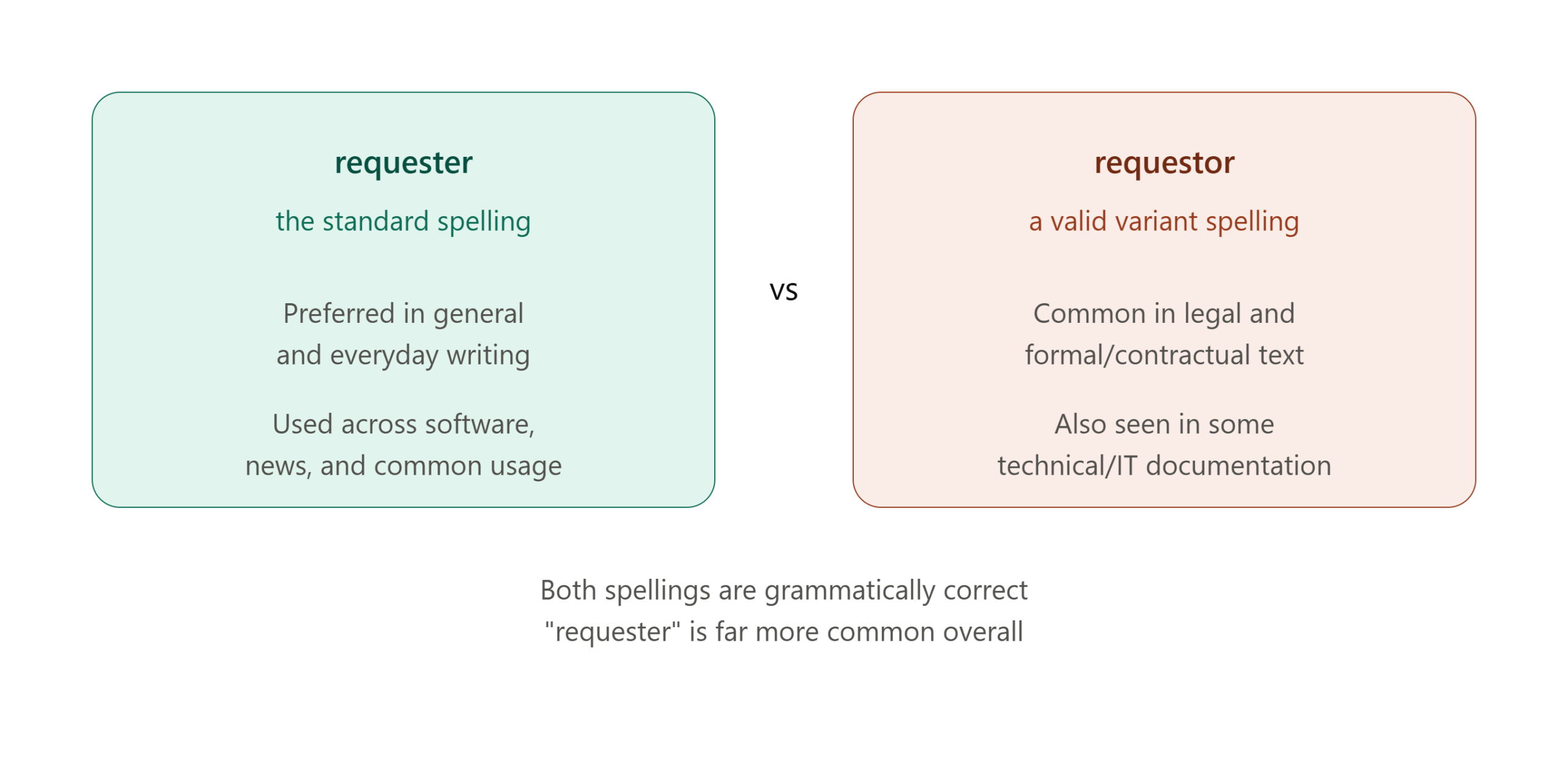

Ever paused mid-email, unsure whether to type requester or requestor? You’re not imagining things both spellings genuinely exist, both show up in real documents, and spellcheck doesn’t always help. The confusion isn’t your fault. It’s a quirk of how English absorbed this word over centuries.
This guide breaks down exactly when to use each spelling, why one dominates everyday writing, and why the other refuses to disappear from legal and technical fields.
Requester vs. Requestor Meaning, Usage, and Correct Contexts
At their core, both words describe the same thing: a person or entity asking for something information, access, approval, or a resource. The difference isn’t definition. It’s register, industry, and regional habit.
Get that distinction right, and you’ll never second-guess yourself in a contract, a support ticket, or a project brief again.
The Meaning and Usage of “Requester” and “Requestor”
Neither spelling is a typo. Both are recognized by major dictionaries. But they don’t carry equal weight in real-world writing one is the everyday default, and the other is a specialist holdout.
Requester
“Requester” is the standard, dominant spelling across modern English, and especially in American business and casual writing. You’ll spot it in:
- Workplace emails
- Customer support tickets
- HR forms and internal policies
- Government publications
- General-purpose writing of almost any kind
It reads naturally because it follows a pattern English speakers already know instinctively:
request → requester
Compare it to teach → teacher, or build → builder. The “-er” ending is the default agent-noun suffix in English, which is exactly why “requester” feels effortless to read and write.
Examples:
- “The requester submitted the form yesterday.”
- “Please notify the requester once the ticket is resolved.”
- “Every requester must confirm their identity before access is granted.”
Related Post: Become vs Became: The Ultimate Guide to Using These Verb Forms Correctly
Requestor
“Requestor” means exactly the same thing, but it’s the minority spelling. It shows up mainly in:
- IT systems and procurement platforms
- Legal drafting and contracts
- Some British institutional writing (though “requester” still wins even there)
- Formalized industry jargon
Organizations often lock in “requestor” as a system label rather than a casual word choice. Once a database field is called “Requestor ID,” changing the spelling mid-system risks breaking records, so the term sticks around by necessity.
Examples:
- “The requestor must digitally sign the agreement.”
- “In this workflow, the requestor and the approver are two different roles.”
Key Difference Between Requester and Requestor
| Feature | Requester | Requestor |
| Meaning | Person who makes a request | Same meaning |
| Commonness | Very common | Less common |
| Region | Dominant in US English | Occasional in UK; niche overall |
| Typical context | Everyday, business, government | Legal, IT, procurement |
| Tone | Natural, conversational | Formal, technical |
| Recommended for general use | ✔️ Yes | ❌ Not usually |
Bottom line: they’re interchangeable in meaning, but “requester” is the safer default for nearly all writing.
Exploring the Prevalence of “Requester” in American English
American English leans heavily toward “requester.” It appears in government forms, corporate memos, and virtually every style guide that addresses the word at all. A few reasons it took over:
- Most US dictionaries list “requester” as the primary entry
- It matches the standard “-er” agent-noun pattern used across thousands of English words
- Corporate style guides favor the simpler, more familiar spelling
- It reads as neutral and approachable rather than bureaucratic
Examples in American English
- “Send a confirmation email to the requester once the ticket closes.”
- “The requester asked for expedited processing on this order.”
- “We can’t release the file until the requester verifies their identity.”
Common Examples and Usage in Daily Language
“Requester” shows up across nearly every industry without sounding out of place:
- Customer service: “Please confirm the requester owns this account.”
- Education: “The requester asked for access to archived transcripts.”
- Healthcare: “We reached out to the requester for updated insurance details.”
- Human resources: “The requester filed an internal transfer request.”
No matter the field, “requester” reads as the neutral, expected choice.
Impact of Language Trends on Word Preference
Word preferences shift with how people actually communicate, not just with what dictionaries say. Three trends explain why “requester” pulled ahead.
1. Digital communication simplifies language
Online writing rewards short, familiar words. Emails, chat support, and app interfaces all favor terms that don’t make a reader pause and “requester” fits that mold better than its Latin-flavored cousin.
2. American English influences global usage
US-based software, media, and corporate content travel worldwide. As American spelling conventions spread through global platforms, “requester” rode along and became the informal international standard.
3. Style guides encourage consistency
Most editorial and corporate style guides recommend picking the more common, more recognizable variant when two spellings are equally valid. That default nearly always points to “requester.”
Requestor in British English and Specialized Contexts
British English occasionally favors “requestor,” but even in the UK, “requester” is now more frequently used. Where “requestor” survives, it’s usually because an institution adopted it early and never updated its terminology. You’ll still find it in:
- Government tenders and procurement contracts
- Legal definitions and statutes
- IT infrastructure documentation
- Regulatory filings
Examples of Requestor in Specialist Contexts
- Software development: “The requestor must authenticate before the API call proceeds.”
- Banking: “The requestor of the wire transfer must complete identity verification.”
- Law: “The requestor signed the affidavit under oath.”
- Procurement: “The requestor submitted a purchase order for approval.”
Legal Contexts
Legal writing sometimes retains “requestor” because:
- The spelling appears in older statutes and precedent
- Certain regulatory bodies maintain legacy terminology for consistency
- Contracts require a single, fixed spelling once a term is defined
Example: “The requestor acknowledges receipt of all required disclosures.”
Technical Contexts
In technology and systems design, “requestor” often functions as a defined role rather than a plain noun. Common examples include:
- Requestor permissions
- Requestor authorization workflow
- Requestor ID field
- Requestor access level
Development teams tend to leave these labels untouched, since altering an established field name can disrupt downstream systems, audits, or integrations.
Understanding Language Variations
Why do two spellings of the same word coexist at all? A mix of factors is at play:
- Morphology how suffixes evolve differently depending on a word’s origin
- Regional spelling habits
- Institutional tradition that resists updating fixed terminology
- Historical printing and translation choices
This isn’t unique to “requester” vs. “requestor.” English has plenty of parallel pairs: adviser/advisor, traveler/traveller, counselor/counsellor. Two correct spellings existing side by side is normal, not a sign either one is wrong.
Etymology and Evolution of the Term “Requester”
Historical Perspective of the Word “Request”
“Request” traces back to the Latin requaerere, meaning to ask or seek. It passed into Old French as requested a petition or formal ask before entering Middle English, where it settled in as both a noun and a verb.
The Emergence of “Requester” in Modern Usage
As English standardized its agent-noun patterns, the “-er” suffix became the go-to ending for words describing a person who performs an action maker, player, reader, and eventually requester.
“Requestor” persisted alongside it mainly because of the Latin “-or” agent suffix, which shows up in words like author and creditor. Legal drafting traditions and specialized institutions held onto that Latin-influenced form even as everyday English moved toward “-er.” Neither version is incorrect one simply became the general-purpose default while the other became a niche, industry-specific holdover.
Practical Examples: How to Use “Requester” in Sentences
- “The requester provided all required documents ahead of schedule.”
- “We’ll notify the requester within 24 hours of a decision.”
- “Only the original requester can cancel this submission.”
Quick reference:
| Context | Recommended Term |
| Everyday writing | Requester |
| Email communication | Requester |
| Business documents | Requester |
| Legal contracts | Depends on existing precedent |
| IT workflows | Often “Requestor” |
| Procurement systems | Often “Requestor” |
Common Mistakes and How to Avoid Them
Mixing spellings in the same document
Switching between “requester” and “requestor” within one piece of writing looks careless and undermines credibility, even though both words are technically correct.
Switching spellings inside a system definition
If a database, form, or contract has already defined “requestor” (or “requester”) as a fixed term, changing it mid-document can create confusion or even legal ambiguity.
Thinking one spelling is “wrong”
Neither spelling is a grammar mistake. The right choice depends entirely on context, audience, and existing precedent not on which one “sounds correct” to you.
Letting autocorrect decide for you
Spellcheck tools often default to “requester” regardless of context, silently overriding a term your industry or organization may specifically require. Always double-check before accepting a suggested correction.
Conclusion
Both “requester and requestor are grammatically valid, and both describe exactly the same thing: someone making a request. The real difference lies in where each word feels at home. “Requester” is the natural pick for everyday communication emails, customer service, HR forms, and general business writing because it mirrors familiar English patterns and reads effortlessly to any audience.
“Requestor,” on the other hand, has carved out a lasting niche in legal, procurement, and technical documentation, where formal precedent and system consistency matter more than conversational ease. When in doubt, default to “requester” for general use, but always match whatever spelling a contract, platform, or workflow has already established. Getting this small detail right signals precision and that’s exactly the kind of consistency that makes professional writing trustworthy.

Benjamin Reed is a passionate writer who shares insightful and engaging content on lifestyle, trends, and everyday topics.
