
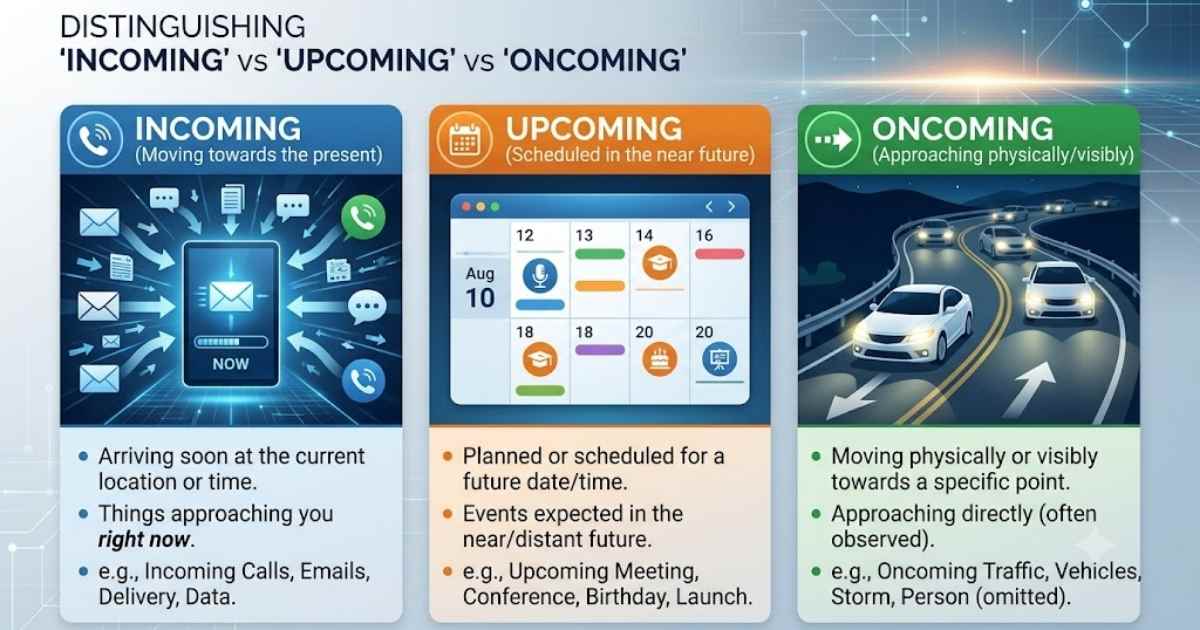

Incoming vs Upcoming vs Oncoming can feel confusing at first. These three words look almost the same. But they mean very different things. Many people mix them up every day. Even confident English speakers get this wrong sometimes. One word talks about arrival. Another talks about future timing. The last one talks about physical movement. Once you know these small differences, everything gets clearer.
This guide makes Incoming vs Upcoming vs Oncoming simple and easy to learn. We use short sentences here. We use real, everyday examples. We also use easy comparison tables. You will learn exactly when to use incoming. You will learn exactly when to use upcoming instead. You will also learn when oncoming fits best. By the end, you will pick the right word with full confidence, every single time.
Understanding “Incoming”, “Upcoming”, and “Oncoming”
Each word answers a different question:
- Incoming → Is something arriving at you or your system?
- Upcoming → Is something scheduled for later?
- Oncoming → Is something physically moving toward you right now?
Once you separate arrival, timing, and motion, the confusion disappears.
What “Incoming” Really Means
Definition of Incoming
Incoming describes something that is arriving, entering, or reaching a person, device, or place happening now or very soon. It centers on arrival, not scheduling.
When You Use “Incoming”
Use “incoming” when:
- Something is reaching your phone, inbox, or system
- A person, shipment, or object is about to arrive
- You’re describing entry or reception of something
Tech & Communication
- Incoming call
- Incoming message
- Incoming email
- Incoming server request
Deliveries & Logistics
- Incoming shipment
- Incoming package
- Incoming supplies
Weather & Natural Forces
- Incoming storm
- Incoming heatwave
- Incoming tide
Emergencies & Warnings
- Incoming danger
- Incoming fire
- Incoming missile (military usage)
Examples of Incoming
- “I missed the incoming call while driving.”
- “We’re expecting an incoming shipment by noon.”
- “The forecast shows an incoming storm tonight.”
Key Insight
Incoming = arriving at you, now or soon. It can be physical or digital, but it always involves reaching a destination.
Related Post: Myself vs My Self: The Complete Guide to Meaning, Grammar, Identity & Real-World Usage
What “Upcoming” Really Means
Definition of Upcoming
Upcoming refers to something planned or expected in the future. It has no physical motion attached only timing.
Practical Uses of “Upcoming”
“Upcoming” fits naturally with:
- Events and conferences
- Deadlines and appointments
- Product launches
- Holidays and announcements
Examples
- “I have an upcoming interview next Tuesday.”
- “Here’s a preview of the upcoming release.”
- “Don’t miss the upcoming deadline.”
Typical Daily Uses
You’ll spot “upcoming” in:
- Calendars and planners
- Newsletters and marketing emails
- Social media event pages
- Streaming platform previews
Key Insight
Upcoming = scheduled, not moving. If it sits on a calendar, “upcoming” is almost always correct.
What “Oncoming” Really Means
Definition of Oncoming
Oncoming describes something physically moving toward you, often quickly and sometimes dangerously. Unlike “incoming,” it’s almost always tied to observable, physical motion.
Common Uses of “Oncoming”
Traffic & Vehicles
- Oncoming car
- Oncoming train
- Oncoming bus
Danger & Physical Threats
- Oncoming wave
- Oncoming crowd
- Oncoming debris
Weather
- Oncoming hail
- Oncoming winds
Examples
- “She swerved to avoid the oncoming truck.”
- “Watch for oncoming traffic before crossing.”
- “The surfer was knocked over by an oncoming wave.”
Key Insight
Oncoming = physical motion directly toward you. It usually implies urgency, direction, and sometimes risk.
Side-by-Side Comparison
Meaning Differences Table
| Word | Focus | Involves Movement? | Typical Use | Example |
| Incoming | Arrival/reception | Yes (physical or digital) | Calls, emails, storms, shipments | “Incoming message” |
| Upcoming | Future timing | No | Events, deadlines, launches | “Upcoming concert” |
| Oncoming | Physical approach | Yes (usually physical) | Traffic, danger, weather | “Oncoming car” |
Best Word Choice by Scenario
| Scenario | Correct Word | Reason |
| A car driving toward you | Oncoming | Direct physical movement |
| A call alert on your phone | Incoming | Reaching your device |
| A meeting planned for next week | Upcoming | Scheduled future event |
| A storm approaching right now | Incoming | Arriving, though motion is involved |
| A movie releasing next month | Upcoming | Planned future release |
| A package about to arrive today | Incoming | Nearly at your location |
Why Context Matters
Ask yourself three quick questions:
1. Is it physically moving toward you?
If yes, lean toward oncoming.
2. Is it arriving to your device, system, or location?
If yes, use incoming.
3. Is it planned for the future?
If yes, use upcoming.
For example: “incoming exam” is wrong because an exam doesn’t move “upcoming exam” is correct. Meanwhile, “upcoming train” ignores the train’s motion, so “oncoming train” fits better in traffic contexts.
Examples from Everyday Life
Incoming
- “I got an incoming text from my sister.”
- “We have incoming orders to process this afternoon.”
Upcoming
- “I’m anxious about my upcoming surgery.”
- “The upcoming software update should fix the bug.”
Oncoming
- “He stepped into the path of oncoming traffic.”
- “Watch out the oncoming waves are strong today.”
Common Mistakes to Avoid
Using “oncoming” for events
❌ “The oncoming party is tomorrow.” ✔ “The upcoming party is tomorrow.”
Using “incoming” for scheduled things
❌ “I’m getting ready for the incoming festival.” ✔ “I’m getting ready for the upcoming festival.”
Using “upcoming” for something happening now
❌ “The upcoming storm is already here.” ✔ “The incoming storm is hitting us now.”
Using “oncoming” for digital stuff
❌ “Oncoming email” ✔ “Incoming email”
Using “incoming” for things that don’t move
❌ “Incoming exam” ✔ “Upcoming exam”
Easy Memory Tricks
1. Incoming = In-coming
It’s literally coming in toward you or your system.
2. Upcoming = Up next
If it’s on your schedule and hasn’t happened yet, it’s up next.
3. Oncoming = On the way toward you
Physical, direct, and often fast-moving.
4. The Car Rule
If “car” fits naturally after the word, it’s oncoming (oncoming car ✔, upcoming car ✘).
5. The Calendar Rule
If it belongs on a calendar, it’s upcoming.
Case Studies
Case Study 1: The Weather App
A weather alert reads: “Incoming storm expected in 45 minutes.” Not “upcoming,” because the storm is actively approaching, not merely scheduled.
Case Study 2: A Company Announcement
An email says: “Our upcoming webinar is scheduled for Friday.” Not “incoming,” since a webinar is a planned event with no physical motion.
Case Study 3: Traffic Incident
A news report states: “The cyclist collided with an oncoming car.” Not “incoming,” because the car was physically traveling toward the cyclist on the road.
Quotes to Help You Remember
- “Incoming tells you something is almost at your door.”
- “Upcoming gives you time to prepare.”
- “Oncoming makes you step back or move fast.”
FAQs
What is the difference between “incoming” and “upcoming”?
Incoming means something is arriving now or very soon, while upcoming means something is scheduled for a later date.
When should I use “oncoming” instead of “incoming”?
Use oncoming for physical movement toward you, like traffic; use incoming for arrivals that are digital or non-physical, like emails.
Can “upcoming” be used for things already happening?
No upcoming only applies to future events, not things currently in progress.
Why is “oncoming event” incorrect?
Events don’t physically move toward you, so “upcoming event” is the correct phrase instead.
Is “incoming message” the same as “oncoming message”?
No only “incoming message” is correct, since messages arrive digitally rather than through physical motion.
Conclusion
Incoming vs Upcoming vs Oncoming is easy once you know the small differences. Incoming means something is arriving now. Upcoming means something is planned for later. Oncoming means something is moving toward you. That is the full idea behind Incoming vs Upcoming vs Oncoming.
Keep these simple rules in mind. Think about time. Think about arrival. Think about movement. This makes Incoming vs Upcoming vs Oncoming simple to use every day. Practice with real sentences often. Soon, Incoming vs Upcoming vs Oncoming will feel natural to you. Your English will sound clearer and more confident right away.

Benjamin Reed is a passionate writer who shares insightful and engaging content on lifestyle, trends, and everyday topics.
