


The Countdown at a Glance
| Phase | Core work | Hard deadline inside it |
|---|---|---|
| 8 weeks out | Method, budget, dates, landlord notice | Lease notice, often 60 days |
| 6 weeks out | Book mover or truck, declutter, inventory | Mover booking window, 6 to 8 weeks |
| 4 weeks out | Address change, utilities, records, providers | Forwarding start date you choose |
| 2 weeks out | Pack by room, service car, confirm all | Utility shutoff and start dates |
| Final week | Essentials box, walkthrough, documents | Nothing new can be booked cheaply |
| Moving day | Loading, bill of lading, meter photos | Sign nothing unread |
| Delivery day | Inventory check, damage notes | Notes before you sign delivery papers |
| First 30 days | License, registration, doctors, claims | State deadlines, 30 to 90 days |
The Nexus cross country moving checklist runs the same eight week skeleton in quick list form. Print a one page version for the fridge and keep the working detail digital.
Eight Weeks Out: Three Decisions First
Decision one is the method. Full service movers, a container, a rental truck, or a hybrid sets every later task, from packing pace to who lifts what on moving day.
Decision two is the budget. Build it from layers, not one number: the move itself, packing, vehicle, travel, lodging, gap housing, deposits, and a contingency for access fees.
Budget layering is a transferable skill. The Small business cash flow plan uses the same discipline for a business: money mapped by timing, not totals, which is exactly how a move goes wrong or right.
Decision three is dates. Fix the load date and the delivery window before anything else, because movers, landlords, and utilities all key their deadlines off those two anchors.
Give the landlord notice now if you rent. Most leases require 60 days, and Angi’s checklist flags the notice inside the eight week block for that reason.
Read your own lease before assuming the number. Notice periods, forwarding address duties, and cleaning standards are lease terms, not customs, and the document you signed governs all three.
Start the moving folder this week, paper or digital. Estimates, confirmations, inventories, photos, and receipts live in one place from day one, because claims and deposits later run on this file.
Vet the Mover Before You Price the Move

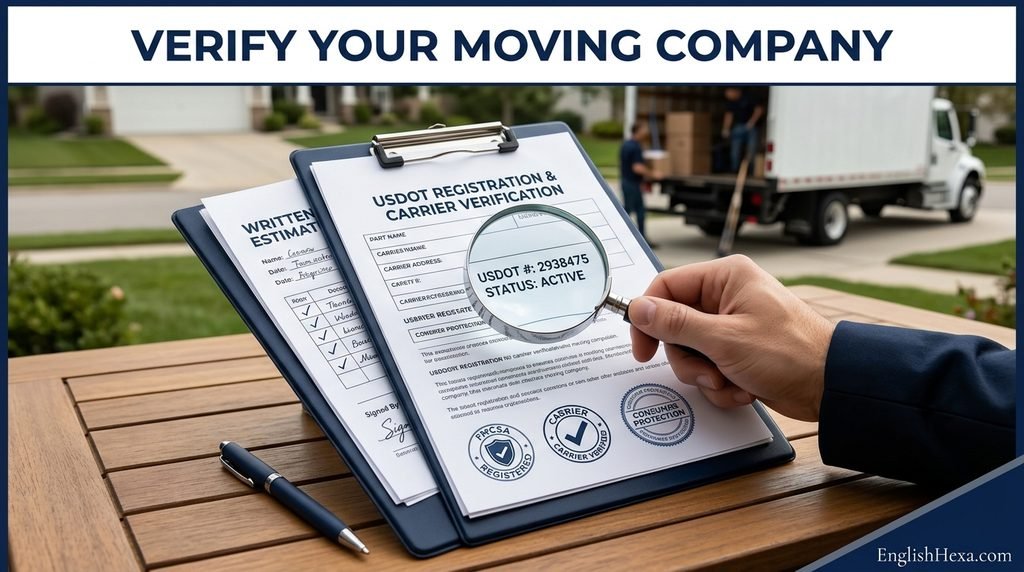
Interstate movers must register with the Federal Motor Carrier Safety Administration and carry a USDOT number. Look the number up in the FMCSA Protect Your Move database before any deposit changes hands.
The lookup shows registration status and complaint history. A mover with no USDOT number is not a bargain at any price; it is an unregistered operator asking for your deposit.
Know whether you are hiring a carrier or a broker. A broker sells your move to a carrier it may not name; get the actual carrier’s name and USDOT number in writing and verify that company.
Get at least three written estimates, each after an in home or video survey of your actual rooms. Phone quotes without a survey are how lowball numbers are manufactured.
Learn the three estimate types before comparing totals. A binding estimate locks the price for the described shipment; binding not to exceed caps it while letting it fall with lower weight.
A non binding estimate is a projection, and the final bill follows the real weight. Comparing a non binding quote against a binding one is comparing a guess against a promise.
Red flags end conversations early. Large cash deposits, no written estimate, no rights booklet, and pressure to sign blank or incomplete documents are the pattern the federal warnings describe.
What It Costs: Attributed Ranges, Not One Average
Published averages for this move disagree by thousands of dollars. They measure different data with different methods, so they are printed here as an attributed set, never blended.
The Angi long distance moving cost guide, from 6,434 verified projects updated in October 2026, puts the average at 4,566 dollars, with most moves between 2,388 and 6,868 dollars.
An Allied and ConsumerAffairs compilation lands higher, near 7,780 dollars on average, with a range of 4,400 to 17,000. That set skews toward full service moves, which explains most of the gap.
Marketplace data tells the third version. The moveBuddha cross country moving tips averages moving out of state at about 4,300 dollars from its own pricing data, collected monthly.
One carrier’s own blog quotes 3,000 to 5,000 dollars for an average long distance move. Carrier marketing ranges sit at the optimistic end, and this set shows why sourcing matters.
| Method | Published range | Best for |
|---|---|---|
| Full service movers | 1,100 to 13,700 dollars | Larger homes, tight timelines, hands off |
| Moving containers | 2,000 to 7,600 dollars | Flexible loading, gap between homes |
| Rental truck | 600 to 4,900 dollars | Small loads, lowest price, your labor |
Those method ranges come from moveBuddha’s pricing data for moves of roughly 1,000 to 2,500 miles. Your route and weight move you inside the range; the range does not quote your move.
Price mechanics explain the spread. Long distance moves bill by weight and distance, not by the hour, and transport often works out near 0.50 to 1.00 dollars per pound with mileage factored in.
Per pound rates rise with distance. One cost calculator’s model runs from roughly 0.42 to 0.62 dollars per pound at short distance toward 1.00 to 1.30 at 3,000 miles.
Season moves the number as much as weight does. Peak months, May to September, carry premiums reported at 20 to 30 percent by one industry summary and 15 to 25 percent by another calculator.
Both ranges are printed because both circulate. The direction is unanimous even where the percentages differ: off season, mid month, mid week is the cheapest calendar position you control.
Vehicle shipping is its own line if the car does not drive. Guides put cross country car transport around 800 to 2,000 dollars as a range, set by vehicle, route, and open versus enclosed transport.
Six Weeks Out: Book, Declutter, Inventory

Book inside the window. Professional movers book best at 6 to 8 weeks out; rental trucks and containers at 4 to 6 weeks, per the Long Distance moving checklist timeline.
Summer and month end dates tighten first. If your dates sit there, treat the early edge of the window as the real deadline and book before the declutter finishes.
Declutter before final quotes, not after. Pounds are the price, so every discarded piece lowers the survey weight that your binding estimate is built on.
Run the furniture decision with replacement math. Bulky low value pieces often cost more to ship 2,000 miles than their used replacement cost near the new home.
Downsizing can also change the home you are moving into. Flexible pieces earn their passage in small spaces; the Wall bed benefits makes that case for one category in detail.
Build the inventory now. Room by room list, with photos of condition for anything valuable or fragile, because this file becomes your delivery checklist and your claims evidence.
Measure the pieces that stay against the new home’s doors, stairs, and rooms. ShipSmart’s small load guide insists on count, measure, photograph before choosing a method, and the order matters.
Gather records in parallel. Medical, dental, school, and vet records, plus insurance policies and ID documents, requested at six weeks because offices move slower than your countdown.
Four Weeks Out: The Address and Utility Choreography
File the USPS change of address to start forwarding on your move date. Forwarding moves most first class mail for 12 months, which sets the deadline for your own sender by sender sweep.
Work the sweep in one pass: banks, cards, subscriptions, insurance, employer, pharmacy, and tax authorities. Forwarding is a safety net with an expiry date, not a change of address by itself.
Schedule utilities at both ends. Shutoff at the old home the day after you leave; start service at the new home the day before you arrive, so no night sits dark on your account.
Book internet installation in the same pass. Install windows at a new address are the utility appointment most likely to slip, and remote work makes the slip expensive.
Check the old home for handover risks. Slow leaks and drainage issues found now are repairs; found by the buyer or landlord later, they are deposit and liability arguments, the territory of Basement water problems.
Confirm access at the new address. Elevator reservations, loading dock rules, parking permits, and any building certificate of insurance requirement belong to this phase, not moving week.
Find the new providers. A doctor, dentist, and vet chosen from your insurer’s in network directory now beats searching during the first sick week in a new state.
Transfer prescriptions with a bridge supply in hand. Pharmacies transfer most maintenance medications easily, but the request belongs in this phase, not the final week.
Two Weeks Out: Pack by Room, Confirm Everything

Pack least used rooms first: storage, guest rooms, decor, books, seasonal gear. Daily rooms go last, and the kitchen splits into a packed half and a working half until the final days.
Label by destination room and priority, not just contents. Delivery day runs on labels; a box marked open second tier kitchen beats a box marked misc in every way that matters.
Service the car if it drives the move. Angi’s checklist puts car servicing in the two week block: tires, fluids, brakes, and the spare, checked before a 2,000 mile week, not during it.
Reconfirm every booking in writing. Mover arrival window, truck or container reservation, travel, lodging, utility dates, and elevator slots, all re-verified while changes are still free.
Photograph the current home’s condition as rooms empty. These photos pair with your move in photos to defend the deposit, and they take ten minutes while the rooms are bare.
Plan the delivery spread. Your goods may arrive across a window of days; hold flexible lodging and keep the essentials system self sufficient until the truck’s date firms up.
The Final Week: Essentials, Walkthrough, Paper Trail
Pack the essentials box last and keep it with you. Documents, medications, chargers, toiletries, clothes, basic tools, cleaning basics, coffee, pet supplies, and bedding for the first night.
Call it the open first system: one box or bag per person plus one household box. If the truck runs late, this system is your whole quality of life for two days.
Assemble the document folder. IDs, passports, birth certificates, vehicle titles, lease or closing papers, insurance, and the mover’s paperwork travel in your vehicle, never on the truck.
Do the cleaning and the walkthrough. Clean to the lease or sale standard, photograph every empty room and meter reading, and hand over keys only against the agreed process.
Confirm the mover’s day of contacts. Driver’s name and phone, your phone on the paperwork, and the delivery window restated, all saved in your phone before loading starts.
Moving Day and Delivery Day
Be present and be the traffic controller. Clear paths, doors propped safely, and a closed room or off site care for kids and pets while doors stand open, per the step guides.
Read the bill of lading before signing. It is the contract and the receipt for your goods: services, dates, and valuation coverage on it must match your estimate, or the mismatch gets fixed before the truck loads.
Keep your copy of the bill of lading and the inventory until delivery and any claim resolve. These two documents are the spine of every later dispute, refund, or claim.
Note the driver’s contact and the expected delivery window in your phone. Then photograph the empty home one last time, meters included, as you close the door.
Delivery day runs on the inventory. Check items off as they enter, direct boxes by label, and note damage or missing pieces on the delivery paperwork before you sign it.
Note first, sign second, photograph everything. A damage note written after signing is an argument; written before, it is evidence.
Set up in priority order: beds, bathroom, a basic kitchen, then work essentials. ShipSmart’s delivery guidance and the step guides agree on that order, and tired people should not improvise it.
The First 30 Days in the New State
Handle the state admin stack early. Driver license and vehicle registration carry deadlines, commonly 30 to 90 days depending on the state; check your new state’s exact window in week one.
Register to vote and update the address everywhere the sweep missed. The forwarding clock started on moving day, and month one is when the stragglers surface.
Move your insurance to the new garaging address. Auto policies must be written for the new state, minimums differ, and a coverage gap between policies is the risk to engineer out.
Establish care. First appointments with the new doctor and dentist, school enrollment confirmed, and the nearest urgent care and pharmacy located before anyone needs them at midnight.
Close the old home’s loops. Deposit return tracked against your state’s deadline, final utility bills confirmed at zero, and the mover’s claim filed promptly if anything arrived damaged.
Federal rules give you nine months from delivery to file a claim with an interstate mover. File early anyway: photos fade, paperwork scatters, and early filers document better.
Settle one room completely before optimizing the rest. A finished bedroom and working kitchen change how the whole first month feels, which is a logistics outcome, not a decorating one.
The wider reading habit helps here too. The EnglishHexa blog collects the site’s practical guides in one place, and a move month is when checklists earn their keep across topics.
Everything else can wait for month two. The countdown’s job ends when the admin is done and the home runs; the archive of guides at EnglishHexa stays available when the next project starts.
Mistakes That Cost Money and Rights
Booking on price without the USDOT check is the expensive classic. The cheapest quote from an unregistered operator is not a quote; it is exposure.
Accepting a non binding phone quote manufactures moving day surprises. Survey first, written estimate second, deposit third, in that order, every time.
Decluttering after quotes locks yesterday’s weight into today’s price. The six week sequence exists because the survey should weigh the home you are actually moving.
Loading the essentials box onto the truck converts a late delivery into a crisis. The open first system travels with you, without exception.
Planning travel to the earliest delivery date strands people in empty houses. The window is the plan; the earliest day is a hope.
Letting first month admin drift past a state deadline turns a form into a fine. License, registration, insurance, and voter tasks belong on the same checklist as the boxes.
Frequently Asked Questions
How far in advance should I start planning a cross country move?
Eight weeks is the standard planning horizon across the major checklists (Nexus, National Van Lines, Angi), and 8 to 12 weeks is better when a house sale, visa, or school calendar is involved.
One six month variant exists for couples closing distance with job and visa work. You can compress to four to six weeks, but longdistance.net’s warning is the consensus: you will pay more and have fewer housing and mover options.
When should I book movers for a cross country move?
Book professional movers about 6 to 8 weeks ahead, and rental trucks or containers about 4 to 6 weeks ahead (longdistance.net), earlier for summer and month end dates when capacity tightens.
Peak season runs May to September, when prices rise roughly 20 to 30 percent (AmeriSave’s summary of industry data).
How much does it cost to move across the country?
Published averages conflict because they measure different things, so read them as an attributed set: Angi’s 2026 analysis of 6,434 verified projects puts the average at 4,566 dollars with most moves between 2,388 and 6,868.
An Allied and ConsumerAffairs compilation puts the average nearer 7,780 dollars with a 4,400 to 17,000 range, skewed to full service. moveBuddha’s data averages about 4,300 for moving out of state. Your real drivers are distance and shipment weight.
What is the cheapest way to move across the country?
A rental truck is usually the cheapest full household method: moveBuddha’s table puts rental trucks at 600 to 4,900 dollars against 1,100 to 13,700 for full service movers and 2,000 to 7,600 for containers
With DIY running about 30 percent less than full service on its data. The cheapest move of all is a smaller one: decluttering before quotes cuts the weight every method prices.
How are cross country moving costs calculated?
By weight and distance, not by the hour and not by a flat per mile rate. The transportation component often works out around 0.50 to 1.00 dollars per pound with mileage factored in (moving-hub’s guide)
And per pound rates rise with distance (101planners gives roughly 0.42 to 0.62 dollars per pound at short distance rising toward 1.00 to 1.30 at 3,000 miles). Packing, storage, shuttle service, and specialty items price separately.
What is a binding vs non binding estimate?
A binding estimate locks the price for the described shipment; a binding not to exceed estimate caps it while allowing it to drop if the shipment weighs less.
A non binding estimate is the mover’s projection, and the final charge follows the actual weight, which is how lowball quotes grow on moving day.
Get estimates in writing after an in home or video survey, and get at least three (the standard advice across longdistance.net and 101planners).
How do I check if a cross country mover is legitimate?
Interstate movers must register with the Federal Motor Carrier Safety Administration and carry a USDOT number. Look the number up in the FMCSA Protect Your Move database and check complaint history before paying any deposit.
Red flags: no USDOT number, quotes by phone without a survey, large cash deposits, and a company that will not provide a written estimate or the federal rights booklet movers must offer.
What is a bill of lading and why does it matter?
It is the contract for your move and the receipt for your goods, issued by the mover at loading.
Read it before signing, check that the services, dates, and valuation match your estimate, and keep your copy until delivery and any claim are settled.
Longdistance.net’s timeline puts keep the bill of lading on the moving day checklist for exactly this reason.
What moving insurance do I actually get?
By law the mover’s basic liability is Released Value coverage: 60 cents per pound per item, which pays about 30 dollars for a ruined 50 pound television stand regardless of its worth.
Full Value Protection, priced by the mover, obliges repair, replacement, or current value settlement. Third party moving insurance exists for high value shipments. Amerifreight’s guide states the 60 cent floor plainly; price Full Value Protection into any quote comparison.
How long does a cross country move take?
The checklist horizon is 8 weeks of preparation; the transit itself for coast to coast household goods typically runs one to three weeks depending on route, consolidation, and the delivery window in your contract.
Your travel should be planned against the delivery spread, not the earliest date: arrive before the window opens and hold flexible lodging until the truck’s date firms up.
What should go in an essentials box?
What you need if the truck is late: documents, medications, chargers, toiletries, a change of clothes per person, basic tools, paper towels and cleaner, snacks and coffee, pet supplies, and bedding for the first night.
Nexus and National Van Lines both put pack the essentials in the final week, and Anne Arundel’s step guide calls them Open First kits. This box travels with you, never on the truck.
How do I change my address when moving states?
File the USPS change of address to start mail forwarding on your move date, then work the account sweep: banks, cards, subscriptions, insurance, employer, tax authorities, and voter registration.
USPS forwarding buys time (standard forwarding runs 12 months for most mail classes) but does not replace updating each sender. Nexus and Angi both place change your address around four to six weeks out, with the sweep continuing after arrival.
When do I transfer utilities for a cross country move?
Schedule shutoff at the old home for the day after you leave and start service at the new home for the day before you arrive, so neither home sits dark while you are responsible for it.
ShipSmart’s timeline places utility and internet scheduling at four weeks out. Confirm elevator, parking, and internet install windows at the new address in the same pass.
How do I move across the country with a car?
Three options: drive it (cheapest if you are driving anyway, and it doubles as your essentials transport), ship it (about 800 to 1,800 dollars per Amerifreight’s guide, or 1,000 to 2,000 per 101planners
Priced as a range because vehicle and route decide), or sell and replace. If you drive, service the car two weeks out; Angi’s checklist puts car servicing in the two week block for a reason.
How do I move across the country with pets?
Book the travel method early (cabin space and hotel pet policies are limited), get a vet visit and health certificate if your destination or carrier requires one, and keep food, medication, and familiar bedding in your essentials kit.
Anne Arundel’s step guide adds a move day rule: create a safe closed room or off site care for pets while doors stand open for loading.
What items will movers not take?
Hazardous materials (fuel, paint, aerosols, chemicals), perishables on long hauls, and high value personal items they will advise you to carry yourself: jewelry, cash, documents, medications, and hard drives.
Plants face state agricultural rules and days of darkness in a truck; many households gift or ship plants separately. Ask your mover for its prohibited list during quoting, not on packing day.
Should I sell my furniture or ship it?
Run the weight math: furniture is most of a shipment’s pounds, and pounds are the price. Bulky low value pieces (particleboard shelves, worn sofas) often cost more to move 2,000 miles than their replacement cost at the destination’s used market.
ShipSmart’s small load guide starts with exactly this decision: define the load, photograph condition, and decide what must arrive versus what can be sold, donated, or replaced.
How much notice do I give my landlord when moving out of state?
Most leases require 60 days notice (Angi flags this in its eight week block), but the lease itself governs: read the fine print at eight weeks out, not four.
Breaking a lease for a job move rarely has a statutory escape; negotiation, subletting where allowed, and documented early notice are the realistic tools.
Are moving expenses tax deductible in 2026?
For most households, no. The federal moving expense deduction remains suspended for civilian moves under the Tax Cuts and Jobs Act framework; active duty military moving under orders keep their benefit, and a few states kept their own deductions.
Employer relocation help is generally taxable income to you. This is general information, not tax advice; a two state move year also usually means filing part year returns in both states.
What do I need to do in the first month in a new state?
The admin stack: driver license and vehicle registration within your new state’s deadline (commonly 30 to 90 days, state specific), voter registration, new doctors and dentist, school enrollment confirmation, insurance address updates
And your deposit and claims follow ups from the old home. longdistance.net’s summary table reserves the whole first month for this list, which is the part most checklists underweight.
How do moving claims work if something arrives damaged?
Note damage on the delivery paperwork before signing, photograph everything, and file the claim with the mover in writing.
Federal rules give you nine months from delivery to file a claim with an interstate mover, and the mover must acknowledge and act within set windows.
Your photo inventory from packing day and the bill of lading are the evidence; this is why the paper trail is a checklist phase of its own.
Full service movers vs containers vs rental truck: which is best?
Full service (moveBuddha range 1,100 to 13,700 dollars) buys labor and one accountable carrier, best for larger homes and tight timelines. Containers (2,000 to 7,600) buy flexible loading time and built in short storage, best for gap housing.
Rental trucks (600 to 4,900) buy the lowest price with your labor and driving, best for small loads and confident drivers. The right answer is set by load size, gap between homes, and who is doing the lifting.
What is a moving broker and should I use one?
A broker arranges the move and sells it to a carrier; it does not own trucks.
Brokers are legal and must also register, but the handoff is where deposits vanish and the carrier who arrives may not match the quote you accepted.
If you use one, get the actual carrier’s name and USDOT number in writing and verify that carrier, not just the broker.
How much should I budget beyond the mover’s quote?
Plan for the layers around the linehaul: packing materials or packing service, vehicle shipping if applicable, travel and lodging for your own trip, gap housing or storage, utility deposits
And a contingency for accessorial fees like shuttle service at a tight destination street. AmeriSave’s guide puts plausible all in totals for larger full service homes well above the headline averages, which is the honest shape of a real budget.
When is the cheapest time to move across the country?
Outside peak season: October through April, mid month and mid week where your dates allow.
AmeriSave reports peak season (May to September) costing 20 to 30 percent more; 101planners puts peak pricing at 15 to 25 percent higher between mid May and mid September.
Both ranges circulate, and the direction is unanimous even where the percentages differ.
How do I downsize before a cross country move?
Room by room, earliest phase, with three exits: sell, donate, discard. Weigh the decision literally for furniture: if replacement at destination costs less than its share of shipment weight, it does not travel.
Every checklist in the set puts declutter in the first two weeks of the timeline because quotes taken after decluttering are cheaper and more accurate.
What records and documents should I gather before moving?
Medical and dental records or transfer requests, school records, vet records, insurance policies, lease or closing papers, and the personal documents folder (IDs, passports, birth certificates, vehicle titles) that travels with you.
Nexus puts gather personal records at four weeks; schools and practices need lead time, so request early.
How do I find doctors and providers in a new state?
Start from your insurer’s in network directory for the new ZIP code, confirm your coverage itself works in the new state (marketplace and Medicaid plans are state specific), and transfer prescriptions with a bridge supply before you leave.
ShipSmart’s after delivery list adds locating pharmacies, urgent care, and emergency services in the first days, not the first month.
Can I pack and move plants across state lines?
Some states restrict plant imports for agricultural pests, and movers often refuse plants on long hauls because trucks sit dark and hot or cold for days.
Options: move hardy plants in your car, ship small plants by mail where allowed, or rehome and replace. Check the destination state’s agriculture department rules for houseplants if you are set on bringing them.
What is storage in transit and when do I need it?
The carrier holds your shipment in a warehouse for a set period when the new home is not ready, priced by weight and days.
Container services build a version of this into their model (load once, store, deliver), which is why gap moves favor them.
Confirm the storage clock and the delivery scheduling rules in the contract, because storage that expires converts timing problems into fees.
How do I handle a gap between leaving and the new home?
Decide early which of three shapes you are in: overlap (keep both homes briefly, priciest and easiest), storage plus short stay (container or storage in transit plus hotel or short rental), or a direct handoff timed to the delivery window.
The gap decision drives the method decision, which is why it belongs at eight weeks, not two.
What should I do on moving day itself?
Be present for loading, keep valuables and documents with you, maintain clear paths and a closed room for pets and kids, photograph meter readings and the empty rooms, and read the bill of lading before signing anything.
Note the driver’s contact and the expected delivery window in your phone before the truck leaves.
What should I do on delivery day?
Check items against your inventory as they come off, note damage or missing pieces on the delivery paperwork before signing, direct boxes by label to rooms, and set up beds, bathroom, and a basic kitchen first.
Anne Arundel’s final steps and ShipSmart’s priority order agree: bedroom, bathroom, kitchen, work essentials, then everything else.
How do I get my security deposit back after moving out of state?
Photograph the cleaned, empty home against your move in photos, do a walkthrough with the landlord if possible, and leave a forwarding address in writing.
State law sets the landlord’s return deadline and itemization duties; keep the lease, photos, and your notice letter until the deposit resolves, which can trail your move by a month or more.
Do I need to update my car insurance when I move states?
Yes: your garaging address is a rating factor, policies must be written for the new state, and minimum coverage rules differ by state.
Update insurance alongside registration, and confirm there is no coverage gap between the old policy’s end and the new one’s start. The same pass covers renters or homeowners insurance for the new address.
How does mail forwarding work and how long does it last?
USPS change of address forwarding moves most first class mail to the new address for 12 months, with shorter periods for some classes and packages handled differently.
File it to start on your move date, and treat the year as the deadline for completing your own account by account address sweep, because forwarding ends and senders are never notified automatically.
What is the weight of an average household shipment?
MovingPlace’s cost guide tabulates estimated weight and volume by home size, the inputs quotes are priced on.
Industry rules of thumb run roughly 1,000 to 1,500 pounds per furnished room, which is why a decluttered two bedroom can price below an untouched one bedroom. Your survey based inventory is the only weight that matters for your quote.
Should I tip cross country movers and how much?
Tipping is customary for good service, commonly handled as a per mover amount per day of loading and delivery work rather than a percentage of a long distance bill.
Budget it as cash on both ends, since different crews load and unload. Amounts in guides vary; treat any specific figure as custom, not a rule, and let service quality decide.
Can I move across the country in less than a month?
Yes, with trade offs: mover and truck availability shrinks, prices firm up, and the declutter and packing phases compress into evenings. The four to six week compression works best for small loads and flexible dates.
Prioritize in this order: booking, notice, address change, essentials, then pack by room from least used to most.
How do I move for a new job across the country?
Ask what the employer covers before you spend: lump sum, direct billed movers, house hunting trip, and temporary housing are the standard components, and relocation help is generally taxable unless the offer grosses it up.
Get the policy in writing, keep every receipt (you will need them for the employer’s process either way), and negotiate the start date against a realistic 8 week runway where you can.
What are the biggest cross country moving mistakes?
Booking on price without a USDOT check, accepting a non binding phone quote, decluttering after quotes instead of before, packing the essentials box onto the truck, planning your travel to the earliest delivery date
And letting the first month admin (license, registration, insurance) drift past state deadlines. Every one of these is a phase failure in the countdown, which is why the checklist exists.
Is a printable checklist or an app better for a cross country move?
The format matters less than the phases: a printable one page summary for the fridge (longdistance.net’s at a glance table is the model) plus a working digital folder for documents, photos, and receipts.
National Van Lines suggests keeping the checklist in print, digital, and notes app forms simultaneously, which is overkill for most households but right about one thing: redundancy beats hunting for a lost list.
Conclusion
A moving across the country checklist works when it is a countdown with hard deadlines, not a pile of tips. Notice, booking, utilities, forwarding, and the delivery window are the dates that govern everything else.
Run the paper trail like it matters, because it does: USDOT check, written estimates, photo inventory, bill of lading, and a claim filed inside its window if the move goes sideways.
Start the folder and the three decisions this week, even if your date feels far away. Eight weeks shrink fast, and the households that move calmly are the ones that started the countdown early.

Dilawar Mughal is an SEO expert with 8 years of hands-on experience helping websites grow their organic traffic, rankings, and revenue. He specializes in content-driven SEO, local SEO, and Pinterest SEO, and builds practical, results-focused strategies for businesses and publishers.
