


Hybrid generator limits are the reason a machine advertised at 9,500 watts can leave a Denver homeowner short on a hot night. Nothing is broken. The generator is behaving exactly as its design says it should.
The problem is the box number. That figure is measured on gasoline, at sea level, in mild weather, for a machine running at its short term best. Change the fuel, the altitude, or the temperature, and the number falls.
What follows is the full stack of caps, each with its size, its mechanism, and its workaround. It is the same discipline our guide to error 0x8007016a and its fixes teaches: read the real rating for your conditions, never the headline.
Hybrid Generator Limits at a Glance
Every limit below subtracts from the one above it. They do not take turns; they accumulate, which is why owners who allowed for one derate still run short.
| Limit | What It Caps | Typical Size |
|---|---|---|
| Fuel derate | Output on propane or natural gas | About 10% on propane, about 20% on natural gas |
| Altitude derate | Output as air thins | About 3.5% per 1,000 feet |
| Heat derate | Output on hot days | About 1% per 10 degrees F above the mid 70s |
| Continuous load ceiling | Load you may sustain | Plan at 50 to 80% of running watts |
| Surge ceiling | Motor starting power | Seconds only, never a planning figure |
| Outlet ceiling | Power through one connection | 2,400 to 12,000 watts by outlet size |
| Power quality | Safety for electronics | Conventional high THD, inverter under 3 to 5% |
| Fuel supply | Runtime and cold weather output | Set by your tank, line, or meter |
| Duty and rules | Hours, noise, placement | Standby duty, 20 foot outdoor placement |
First, Name the Machine: Two Kinds of Hybrid

In portable generator retail, hybrid means dual fuel or tri fuel: one engine that runs on gasoline plus propane, and on larger models natural gas as well. That is the machine this article mostly covers.
In solar retail, hybrid means a fuel generator combined with panels and a battery bank, or a battery power station with solar input. Its ceilings are different, and they get their own section near the end.
The two meanings share one lesson. Flexibility is bought with ceilings, and the ceilings, not the flexibility, decide whether the machine covers your load on your worst day.
Limit One: The Fuel Derate
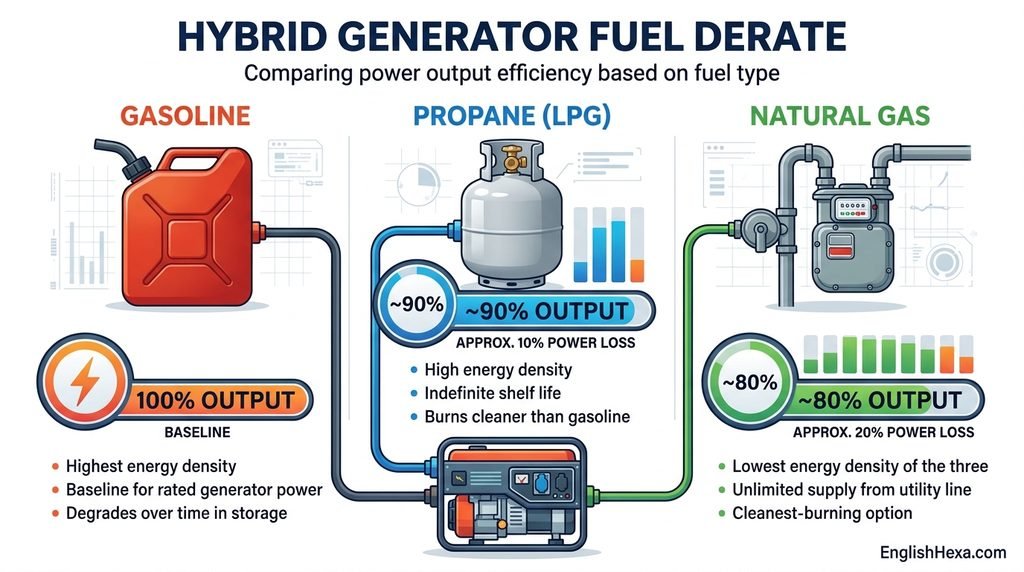
A dual fuel generator makes its headline watts on gasoline. Switch to propane and output falls by about 10 percent; switch a tri fuel model to natural gas and it falls by about 20 percent.
The cause is energy density. Engines burn volume, and a gallon of propane carries about 91,500 BTU against roughly 114,000 BTU in a gallon of gasoline. Natural gas carries about 1,030 BTU per cubic foot, leaner still.
| Fuel | Energy Content | Planning Output vs Gasoline |
|---|---|---|
| Gasoline | About 114,000 BTU per gallon | 100%, the rating on the box |
| Propane (LPG) | About 91,500 BTU per gallon | About 90%, a roughly 10% derate |
| Natural gas | About 1,030 BTU per cubic foot | About 80%, a roughly 20% derate |
Manufacturers print the honest numbers in their specification tables. Westinghouse rates its WGen7500DF at 7,500 running watts on gasoline and 6,750 on propane, a drop of exactly 10 percent, and the pattern repeats across brands.
Practitioner sizing guides put the propane range at roughly 5 to 15 percent, about 10 typical, which is why this article plans with 10 and checks the specific model’s table.
A planning tool like a dual fuel derate calculator formalizes the same math with 0.90 and 0.80 multipliers.
The rule that follows is absolute: size against the fuel you will actually burn. A household planning to ride out outages on stored propane must shop by the propane column, not the gasoline headline.
What the Fuel Derate Breaks First
The derate rarely stops lights or a refrigerator. It breaks motor starts: the well pump, the furnace blower, the air conditioner compressor, each asking for a surge the derated machine no longer has.
It also breaks load plans written at home from the box number. A plan totaling 8,800 watts looks safe against 9,500 and overloads the same machine the day it runs on propane.
Limit Two: Altitude and Heat
Engines breathe. Above sea level the air carries less oxygen per lungful, and output falls in proportion: about 3.5 percent for every 1,000 feet of elevation.
That figure is not folklore. Generac’s own high elevation guidance states the same 3.5 percent per 1,000 feet for its standby machines, and portable makers publish matching tables in their manuals.
WEN’s high altitude guide for its own generators adds the honest nuance: with a high altitude kit fitted, expect roughly 2 to 3.5 percent loss per 1,000 feet. At 5,000 feet the total is 10 to 17.5 percent, kit or no kit.
What an Altitude Kit Fixes, and What It Cannot
The kit rejets the carburetor for thin air, restoring the correct fuel air mixture. Starting improves, running cleans up, plug fouling and soot fall away.
What it cannot do is replace the missing oxygen. The power loss is physics, and the kit only stops a badly tuned engine from losing even more. Kits are sold in bands, roughly 3,000 to 6,000 and 6,000 to 8,000 feet.
The Heat Derate Nobody Mentions
Heat thins air too. Manufacturer guidance puts the loss near 1 percent of output per 10 degrees Fahrenheit above the mid 70s, with some makers quoting up to 2 percent.
A 95 degree outage day therefore costs roughly 2 to 4 percent before any other cap applies. Outages, heat, and peak load arrive together, which is exactly when the missing watts hurt.
Limit Three: Surge Is Seconds, Continuous Is a Ceiling
Running watts are the continuous promise. Starting watts are a brief overload allowance, measured in seconds, that exists for one job: starting electric motors.
Motor loads draw 3 to 5 times their running watts in the first moments. A well pump or compressor that cruises at 1,500 watts may demand 5,000 or more to get turning, as the sizing guides for pump backup spell out.
Plan the other direction. Add up the running watts of everything that will run together, confirm the biggest motor’s surge fits the remaining headroom, and keep the sustained total inside 50 to 80 percent of the running rating.
That band is not timidity. Running at the redline overheats the engine, wears it quickly, and leaves zero surge headroom, so the next motor start trips the breaker and takes the whole load down.
The sump pump is the classic trap: a modest running draw, a sharp surge, and a flooded basement if the start fails, which is why surge planning matters as much as the prevention habits in our guide to basement water problems.
The Soft Starter Workaround
A soft starter on an air conditioner or pump ramps the motor up gently, cutting its starting surge dramatically. It is the one accessory that genuinely raises a generator’s practical ceiling.
With a soft starter fitted, a machine one size smaller often starts a load it otherwise could not. It does nothing for running watts, runtime, or any other cap in the stack.
Limit Four: The Outlet Ceiling
The engine’s watts are not all reachable through one plug. Every outlet has an amp rating, and amps times volts is a hard ceiling no engine can argue with.
| Connection | Rating | Maximum Watts |
|---|---|---|
| Household duplex outlet | 20 amps, 120 volts | 2,400 watts |
| RV outlet | 30 amps, 120 volts | 3,600 watts |
| Transfer switch outlet | 30 amps, 240 volts | 7,200 watts |
| Transfer switch outlet | 50 amps, 240 volts | 12,000 watts |
The consequence surprises buyers every season. A 12,000 watt generator feeding a house through a 30 amp inlet delivers at most 7,200 watts to that house, whatever the engine could make.
Cords tighten the ceiling further. A long, thin extension cord drops voltage along its run, and motors at the far end see less than the nameplate promises. Short, heavy gauge cords are part of the rating in practice.
Limit Five: Power Quality, the THD Limit
Conventional open frame hybrids generate rough electricity. Their total harmonic distortion, THD, is high, commonly quoted in the 10 to 25 percent region depending on load and model, against utility power at roughly 5 percent or cleaner.
Sensitive loads care. Modern furnace control boards, variable speed motors, medical devices, and some electronics can misbehave, run hot, or refuse dirty power, and manufacturers of those devices say so in their manuals.
Inverter hybrids are the exception inside the category. Their output is specified under 3 to 5 percent THD, safe for laptops, televisions, and CPAP machines, which is why the inverter premium exists.
Read the THD line in the specification before buying for electronics. If the maker does not publish it, that silence is itself information about the class of machine you are looking at.
Limit Six: Runtime and Fuel Supply
Headline runtimes are measured at light loads, a quarter or half of rating. Double the load and the hours fall hard, because fuel burn tracks the work done, not the tank’s optimism.
On gasoline, the ceiling is the tank on the machine: a few gallons, sized for portability. On propane and natural gas, the generator’s ceiling moves outside the machine, to your supply.
| Supply | What Limits It | Practical Consequence |
|---|---|---|
| Gasoline tank | Tank size and fuel freshness | Hours per fill; stale fuel is the top no start cause |
| 20 lb propane cylinder | About 4.6 gallons, and vaporization rate in cold | Roughly 5 hours at half load on a large model; far longer on a small inverter |
| Large propane tank | Vaporization still applies, far less | The cold weather fix for big loads |
| Natural gas line | Meter and pipe capacity | Pressure can sag at full load on undersized services |
| Battery bank (solar hybrid) | Kilowatt hours stored | The whole runtime, until sun or engine refills it |
The Cold Weather Propane Trap
Propane leaves its tank as vapor boiled off the liquid surface. Cold slows that boiling sharply, and a big engine at high load drinks vapor faster than a small cold tank can make it.
Pressure falls, output sags, and frost creeps up the cylinder. Owners misread it as a faulty generator; it is a supply limit, fixed with a larger tank, manifolded cylinders, or a smaller load.
Gasoline’s Own Limit: Time
Gasoline degrades in months, not years. Ethanol blends stored in a tank and carburetor gum the small passages, and stale fuel is the most common reason a stored generator will not start on the day it is needed.
Propane’s storage life is effectively unlimited in a sealed cylinder. That single contrast, readiness against peak watts, is the honest core of the hybrid trade, and both sides of it are limits.
Limit Seven: Switching and Blending Rules

Most portable dual fuel models ask you to shut down, or at least unload, before changing fuels. The gasoline and propane paths feed differently, and the manuals write the sequence carefully for a reason.
A minority of product lines switch on the fly as a named feature. It is a genuine convenience in a long outage, and it is the exception that proves the default rule.
Blending does not exist in this class. A portable dual fuel engine burns one fuel at a time, never a mixture. Simultaneous blending belongs to industrial bi fuel systems, usually diesel with natural gas, at industrial prices.
Plan refueling and fuel changes as short planned outages inside the bigger outage. Anything plugged in that hates interruption, a computer or medical device, wants its own small battery backup for those minutes.
Limit Eight: Noise, Placement, and Rules
Open frame dual fuel machines are loud: commonly rated around 68 to 74 dBA at 23 feet under load. Enclosed inverter models run nearer 52 to 64 dBA, conversation territory, and the difference decides where each may legally and politely run.
Campgrounds enforce quiet hours, many neighborhoods enforce noise ordinances, and landlords and HOAs add their own rules. A generator that breaches them has a limit no specification sheet prints.
Placement is the hard rule above all of them. Carbon monoxide from a portable generator can kill in minutes, and the CDC states the rule plainly: outdoors only, at least 20 feet from the home, with exhaust pointed away from doors, windows, and vents.
Garages, carports, and enclosed balconies are never acceptable, doors open or not. Rain protection means an open sided canopy or generator tent that preserves airflow, never a closed box around a running engine.
California adds a purchase limit: models that are not CARB compliant cannot legally be sold for use there, whatever a listing claims.
CO shutoff sensors, now standard on most new portables, add a protective limit of their own: the machine stops itself when carbon monoxide accumulates around it.
Limit Nine: Duty, Maintenance, and Lifespan
A portable hybrid is a standby duty machine. It is built for outage hours with rests and service, not for the continuous weeks that prime power equipment is rated to deliver.
The service clock runs in hours: a first oil change early, commonly around 25 hours, then oil every 50 to 100 hours by model, with air filter, spark plug, and valve checks behind it. A three day outage can consume an entire service interval.
Two fuel systems double the readiness checks: gasoline freshness and carburetor care on one side, hose, regulator, and leak checks on the other. Skipped intervals are the fastest route to a voided warranty.
Businesses feel this limit as continuity planning, the same thinking that shapes service business systems: the machine only counts if it starts.
Ownership cost planning belongs with the budgeting discipline of a small business cash flow plan, because fuel, oil, and a size up all cost real money.
Conversion Kits and the Warranty Limit
Aftermarket kits convert gasoline generators to propane or natural gas, and many work. The limits are legal: fitting one usually voids the manufacturer’s warranty and may void the machine’s safety certification.
A factory dual fuel model keeps both intact. For a machine bought as insurance, that difference is worth more than the kit’s savings.
The Solar Hybrid Ceilings

Solar hybrid systems swap the fuel caps for four electrical ceilings, and they bind just as hard.
1. Battery capacity. Stored kilowatt hours are the entire runtime. A 5 kWh bank running a 1,000 watt load is a five hour machine, whatever the panels promise.
2. Inverter continuous rating. The inverter caps simultaneous load exactly as an outlet does. Surge allowances exist, in seconds, on the same terms as engine machines.
3. Maximum solar input. Panels can only refill at the input ceiling, in watts and within a voltage window. A depleted bank after a cloudy evening may need most of a sunny day to recover.
4. Battery chemistry limits. Lithium banks restrict charging at or below freezing and lose capacity across their cycle life. Winter, the season of outages, is when all four ceilings sit lowest.
The Worked Example: One Generator, Every Cap
Take a real, popular class of machine: 9,500 running watts on gasoline, the size many households buy for whole house backup. Reviewer testing of one such model measured it at rating on gasoline.
Now move it to a Denver home, on propane, during a 95 degree outage.
1. Fuel derate. On propane the same model is rated and measured near 8,500 watts. The first thousand watts were never yours on this fuel.
2. Altitude derate. Denver sits near 5,280 feet. At 3.5 percent per 1,000 feet, output falls about 18 percent: 8,500 becomes roughly 6,900 watts.
3. Heat derate. At 95 degrees, allow roughly 3 percent from the heat ranges makers publish: about 6,700 watts remain, the true ceiling right now.
4. Continuous band. Plan sustained load at 80 percent of that ceiling: roughly 5,400 watts of honest, all evening load.
5. The verdict. From 9,500 on the box to about 5,400 planned watts: over 40 percent of the headline was conditions, not capacity. WEN’s worked Denver example walks the same arithmetic for altitude and heat and lands in the same territory.
Nothing about that outcome is a defect. The same machine at sea level, on gasoline, in mild weather is a genuinely strong unit. The limit was never the generator; it was the unexamined stack.
Limit to Workaround Matrix
| Limit | Workaround | What It Costs |
|---|---|---|
| Propane derate | Size against the propane rating, or buy one size up | A larger machine |
| Natural gas derate | Size against the gas rating; verify meter capacity | Possibly a meter upgrade |
| Altitude loss | High altitude jet kit for your band | A small kit and fitting time |
| Heat loss | Shade with airflow, plan the derate | Nothing but honesty |
| Motor surge | Soft starter on the AC or pump | One accessory per motor |
| Continuous ceiling | Load management and staggered starts | Attention during outages |
| Outlet ceiling | 50 amp inlet and transfer connection | Electrician installation |
| Dirty power | Choose an inverter hybrid model | The inverter premium |
| Tank freeze up | 40 or 100 lb tank, or manifolded cylinders | A bigger fuel setup |
| Stale gasoline | Propane as the stored fuel, stabilizer for gasoline | Fuel rotation discipline |
| Noise rules | Inverter model, distance, lawful hours | Placement planning |
| Duty limits | Standby whole house unit for frequent long outages | A different product class |
Pre Purchase Limits Checklist
Run these checks the way EnglishHexa runs every buying guide on this site: against your own numbers, not the brochure’s.
1. Name your real fuel. If outages mean propane or natural gas, shop only by that column of the specification table.
2. Derate for your address. Apply roughly 3.5 percent per 1,000 feet of elevation, plus a few percent if your outage season is hot.
3. List loads by running watts. Add the surge of the single biggest motor. Keep the sustained total inside 80 percent of the derated figure.
4. Check the connection. Confirm the outlet and inlet sizes can actually deliver your planned watts to the house.
5. Check power quality. If furnace boards, medical devices, or work electronics are on the list, require a published THD under 5 percent.
6. Size the fuel supply. Match tank or line to your longest plausible outage, and solve cold weather vaporization before winter does it for you.
7. Read your rules. HOA, lease, campground, and city noise and placement rules are limits with legal force, not suggestions.
A Note on Numbers You Will See Elsewhere
Derate percentages online range wider than the honest sources do, and at least one ranking explainer states the propane and natural gas relationship backwards.
Treat unsourced precision the way our AI vs SaaS tools comparison teaches readers to treat tool claims: as marketing until a method is shown.
Every figure in this article carries its class: manufacturer rating, manufacturer guidance, practitioner range, or reviewer measurement. Where the classes disagree, the range is printed and the disagreement is named, never averaged away.
Frequently Asked Questions
What are the main limits of a hybrid generator?
A hybrid generator is capped by a stack: less power on propane or natural gas than on gasoline, less again at altitude and in heat, surge watts that last seconds, and outlets that cap delivery.
Its runtime is set by the fuel supply you connect. The usable figure is the nameplate minus every cap that applies.
How much power does a dual fuel generator lose on propane?
About 10 percent of running watts is typical, with manufacturer ratings and practitioner guides putting the range at roughly 5 to 15 percent.
Westinghouse rates one popular model at 7,500 running watts on gasoline and 6,750 on propane. Size against the propane rating if propane is your real fuel.
How much power does a tri fuel generator lose on natural gas?
About 20 percent against the gasoline rating is the standard planning figure, using an 0.80 multiplier and a range near 18 to 22 percent.
Natural gas carries far less energy per unit volume, about 1,030 BTU per cubic foot. The same engine simply produces less power on it.
Why does propane produce fewer watts than gasoline?
Energy density. A gallon of gasoline holds roughly 114,000 BTU; a gallon of liquid propane holds about 91,500 BTU.
The engine burns a similar volume per hour either way, so the lower energy fuel delivers less power. Gaseous fuel also displaces intake air.
How much power does a generator lose at altitude?
About 3.5 percent of rated power per 1,000 feet above sea level, per Generac’s official guidance.
WEN gives roughly 2 to 3.5 percent per 1,000 feet with a high altitude kit fitted. At 5,000 feet, plan on 10 to 17.5 percent less before any other derate.
What does a high altitude kit do, and what can it not do?
The kit rejets the carburetor for thinner air, restoring the fuel air mixture, easier starting, and cleaner running.
It limits the power loss; it cannot remove it, because the missing oxygen is physics, not tuning. Kits are sold in elevation bands, roughly 3,000 to 6,000 and 6,000 to 8,000 feet.
Does hot weather reduce generator output?
Yes. Manufacturer guidance puts the loss at roughly 1 percent per 10 degrees Fahrenheit above the mid 70s, with a 1 to 2 percent range.
A 95 degree day can cost 2 to 4 percent alone. It stacks with altitude and fuel derates on exactly the days outages peak.
What is the difference between starting watts and running watts?
Running watts are what the generator supplies continuously. Starting watts are a brief surge allowance, lasting seconds, for motor loads.
Pumps and air conditioners can draw 3 to 5 times their running watts at startup. A load plan built on starting watts trips the breaker within moments.
How much load should you put on a generator continuously?
Plan sustained loads in the 50 to 80 percent band of the running watts for the fuel you are using.
Running at 100 percent continuously overheats the engine, wears it fast, and leaves no surge headroom. Very light loads for long periods are inefficient too.
Can a hybrid generator run a whole house?
A large dual fuel model, roughly 9,000 running watts and up on gasoline, can carry most essential and many comfort loads through a transfer switch.
On propane at altitude the same machine may deliver a quarter less than its box number. That gap decides whether central air runs.
Can a dual fuel generator run on both fuels at the same time?
No, not in portable models. Dual fuel means one fuel at a time, chosen by the fuel selector.
Simultaneous blending exists only in industrial bi fuel systems, typically diesel with natural gas. That is a different product class entirely.
Can you switch fuels while the generator is running?
On most portable models, plan to shut down or unload before switching, and follow the manual for your machine.
A minority of lines offer on the fly switching as a named feature. Treat running switches as the exception, not the category default.
How long will a 20 lb propane tank run a dual fuel generator?
A 20 lb cylinder holds about 4.6 gallons of propane, and runtime depends entirely on load.
Reviewer testing of a large dual fuel model measured about 5 hours at half load from one cylinder. Small inverter models stretch a cylinder past 20 hours at light loads.
Why does my generator lose power on propane in cold weather?
Propane must vaporize inside the tank before the engine can use it, and cold slows vaporization sharply.
A small tank feeding a large engine cannot boil off gas fast enough, pressure falls, and output sags: the classic tank freeze up. Fixes: a larger tank, manifolded tanks, lower load.
Is a dual fuel generator safe for sensitive electronics?
It depends on the class. Conventional open frame models produce high THD power that sensitive electronics and some furnace controls may dislike.
Inverter dual fuel models produce clean power under 3 to 5 percent THD. Check the THD specification, not the marketing.
What THD is safe for electronics?
Utility grade power sits at or under about 5 percent total harmonic distortion, and inverter generators are typically specified under 3 percent.
That under 5 percent zone is the practical safety line for laptops, televisions, furnace boards, and CPAP machines.
How loud is a hybrid generator?
Class decides it. Open frame conventional dual fuel models are commonly rated around 68 to 74 dBA at 23 feet under load.
Enclosed inverter models run roughly 52 to 64 dBA. Compare ratings at the same distance and load, and expect night time levels to feel louder.
Can you run a hybrid generator in a garage or on a balcony?
Never in a garage, indoors, or on an enclosed balcony. Generator carbon monoxide can kill in minutes.
CDC guidance: run generators outdoors, at least 20 feet from the home, exhaust pointed away from openings. Apartment rules and fire codes often ban balcony generators outright.
What is CARB compliance, and why does it limit my choices?
CARB is the California Air Resources Board. Generators sold for use in California must meet its emission rules.
Some dual fuel models are 49 state only and cannot legally be shipped to or used in California. Check the compliance line before ordering across state lines.
How long can a portable hybrid generator run continuously?
Portables are standby duty machines, built for outage hours, not prime power.
Long runs need fuel stops, oil checks (intervals commonly 50 to 100 hours), and rest across multi day events. For true 24/7 power, the correct product is a prime rated or standby unit.
Does running on propane extend generator life?
Propane burns cleaner, leaves fewer deposits, and cannot gum a carburetor in storage, removing the top cause of generator failure.
That supports longer service life and easier readiness. Mechanical wear from running hours is unchanged, and oil service stays on schedule.
How long does gasoline last in a generator?
Ethanol blend gasoline degrades within months; guidance puts usable storage at roughly 6 to 12 months with stabilizer, far less without.
Stale fuel gumming is the top reason stored generators fail to start. Propane stores indefinitely in a sealed cylinder.
What size hybrid generator do I need for a well pump?
Well pumps are among the hardest loads: usually 240 volt, with starting surges of 3 to 5 times running watts.
Size against the surge using your actual fuel’s rating, keep headroom, and consider a soft starter. A 120 volt only model cannot run the pump at all.
Why does my generator trip its breaker on propane but not gasoline?
Because the ceiling moved. On propane the machine makes about 10 percent fewer watts, so a plan built on the gasoline rating overloads it.
Rebuild the load plan on the propane running watts, apply the continuous band, and stagger motor starts.
What does the outlet limit mean on a big generator?
The engine’s watts are not all reachable through one plug. A 20 amp outlet caps at 2,400 watts, a 30 amp 240 volt outlet at 7,200.
A 12,000 watt generator feeding a house through a 30 amp connection delivers at most 7,200 of them.
Can two hybrid generators be paralleled for more power?
Only inverter models with a parallel port and kit, usually with a matching unit. Paralleling roughly doubles usable watts.
Conventional open frame dual fuel generators cannot be paralleled at all. That is a real limit for buyers planning to grow into bigger loads.
Do dual fuel conversion kits work, and are they safe?
Aftermarket kits exist and many work mechanically. The limits are legal and practical: fitting one usually voids the warranty and may void the safety certification.
A factory dual fuel model keeps its warranty and certification intact. The installer owns the regulator sizing and ventilation decisions.
What maintenance limits come with a hybrid generator?
Two fuel systems mean two sets of checks: gasoline freshness and carburetor care, plus hose, regulator, and leak checks on the gas side.
Shared engine service stays: oil (first change early, then every 50 to 100 hours), air filter, spark plug. Skipping intervals is the fastest way to void a warranty.
Are hybrid generators more expensive to own?
The purchase premium over a comparable single fuel model is real but modest, and running costs depend on local fuel prices per delivered kilowatt hour.
Propane often costs more per unit of energy. The ownership case rests on readiness and flexibility, not fuel savings.
What are the limits of a solar hybrid generator?
Four ceilings: battery capacity in kilowatt hours, the inverter’s continuous rating, maximum solar input watts, and lithium charging limits in the cold.
A depleted bank may need most of a sunny day to refill. Cloudy stretches push the deficit to the fuel engine or the grid.
How much solar input can a hybrid power station take?
It is model specific, printed as maximum solar input watts and a voltage range. Exceeding the voltage ceiling can damage the unit.
Size the array to the input ceiling, not the roof. Expect real harvest well below panel nameplate on winter and cloudy days.
Can a hybrid generator power medical equipment like a CPAP?
A CPAP draws modest watts, roughly 30 to 90 depending on the humidifier, so capacity is rarely the issue. Power quality and runtime are.
Use an inverter model with clean output and plan overnight runtime. Anyone dependent on powered medical equipment should also keep a battery backup layer. General information, not medical advice.
Does a hybrid generator need a transfer switch?
For powering house circuits, yes: a transfer switch or a listed interlock kit with an inlet box is the safe, code compliant route.
Backfeeding through a dryer outlet is illegal and can kill utility workers. Extension cords to individual appliances are the switch free option.
Why is my dual fuel generator louder on one fuel?
Owners report small differences in exhaust note between fuels, but load and engine speed dominate perceived noise far more than fuel choice.
The structural limit is the frame: open frame machines have no enclosure on any fuel. Compare dBA ratings at the same distance and load.
What is wet stacking, and does it apply here?
Wet stacking is a diesel phenomenon: unburned fuel and carbon build up during long, light load running.
It applies to industrial diesel and bi fuel machines, not gasoline propane portables. The portable analogue is fouled plugs from chronic light loading; exercise the machine under real load.
Can a hybrid generator run in the rain?
Portables are not weatherproof. Manufacturers direct users to keep them dry, typically under an open sided canopy or a generator tent that preserves ventilation.
Never run one in a closed enclosure. Wet outlets and cords raise shock risk; GFCI protection is part of the operating limits.
How does natural gas supply limit a tri fuel generator?
The generator can only burn what the line delivers. Home gas meters and pipe runs are sized for existing appliances.
A large tri fuel unit at full load can demand more flow than an old meter supplies, causing pressure sag at peak load. A plumber or the gas utility verifies capacity.
What happens if you overload a hybrid generator?
In sequence: voltage and frequency sag, motors overheat, electronics misbehave, then the breaker trips or the engine stalls.
Inverter models shut output down electronically. Repeated overloads shorten engine and alternator life. The fix is load shedding: drop the biggest discretionary load and restart.
Is a hybrid generator worth it over a single fuel model?
For outage readiness, usually yes: the second fuel insures against gasoline being unavailable in a disaster or stale in storage.
The price is about 10 percent fewer watts on propane and a modest premium. A user with fresh gasoline who needs every advertised watt may prefer single fuel, sized up.
What should I check before buying a hybrid generator for high altitude use?
Four things: the derated watts at your elevation on your planned fuel, altitude kit availability for your band, and whether critical motor loads still start.
Add cold weather propane supply if winters are severe. If the math fails, the fix is a larger model, not optimism.
Hybrid generator vs standby generator: which limits matter?
The portable hybrid’s limits are duty, fuel logistics, noise, and manual operation: you place it, connect it, and service it during the event.
A standby unit removes those with automatic start and a permanent fuel line, at far higher cost. Choose by outage frequency and who is home to run the machine.
What is the single most misunderstood hybrid generator limit?
That the limits stack. Buyers apply one derate, usually the propane figure, and stop.
The disappointing machines are correctly built and correctly rated. The plan ignored altitude, heat, the outlet ceiling, or the surge, and the stack quietly removed a quarter of the box number.
Conclusion
Hybrid generator limits are not a flaw in the category; they are the category, priced in.
The fuel flexibility is real, and so is the stack of caps that separates the box number from your evening load: fuel, altitude, heat, surge, outlets, power quality, supply, noise, and duty.
Run the stack before you buy, size against the fuel and the address you actually have, and the machine you choose will do on its worst night what the brochure promised on its best one.
Keep reading the EnglishHexa blog for the next sizing and backup power breakdown.

Dilawar Mughal is an SEO expert with 8 years of hands-on experience helping websites grow their organic traffic, rankings, and revenue. He specializes in content-driven SEO, local SEO, and Pinterest SEO, and builds practical, results-focused strategies for businesses and publishers.
