
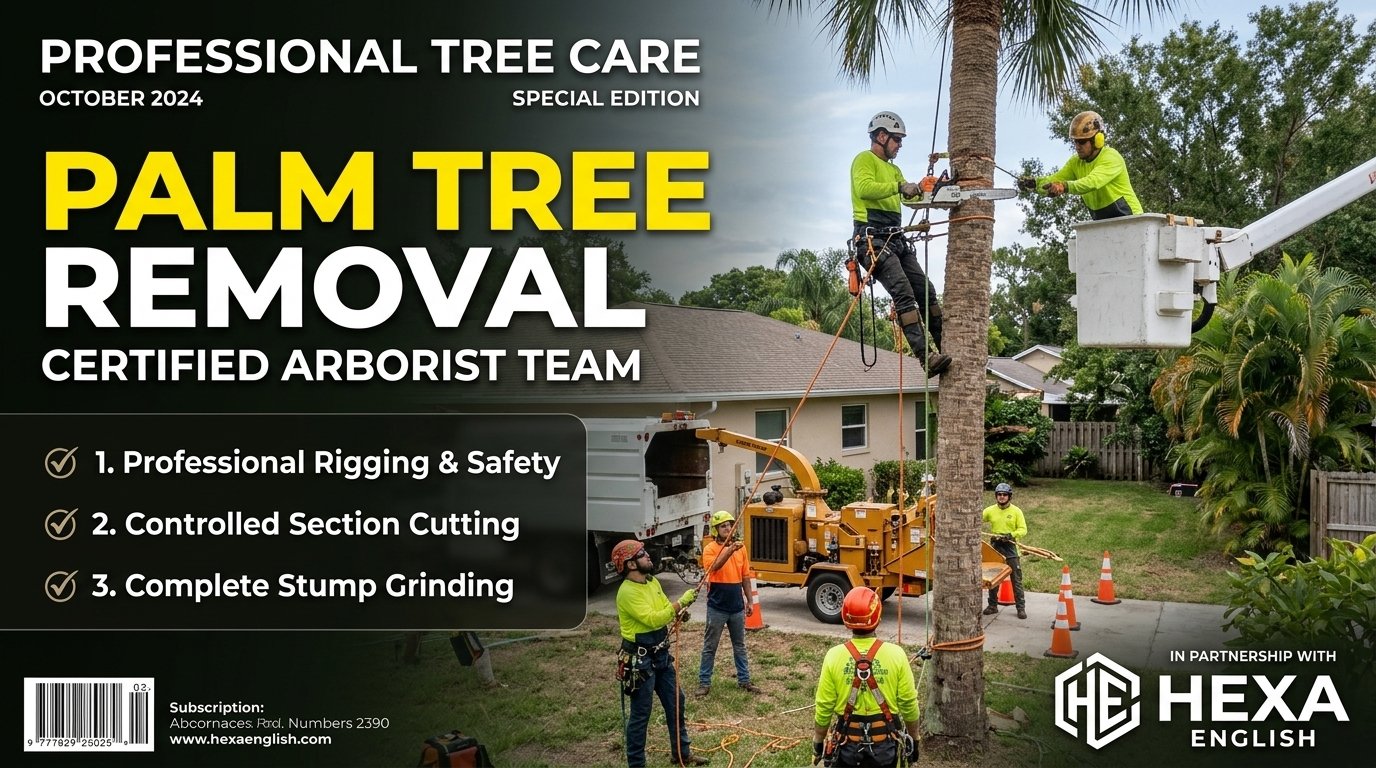

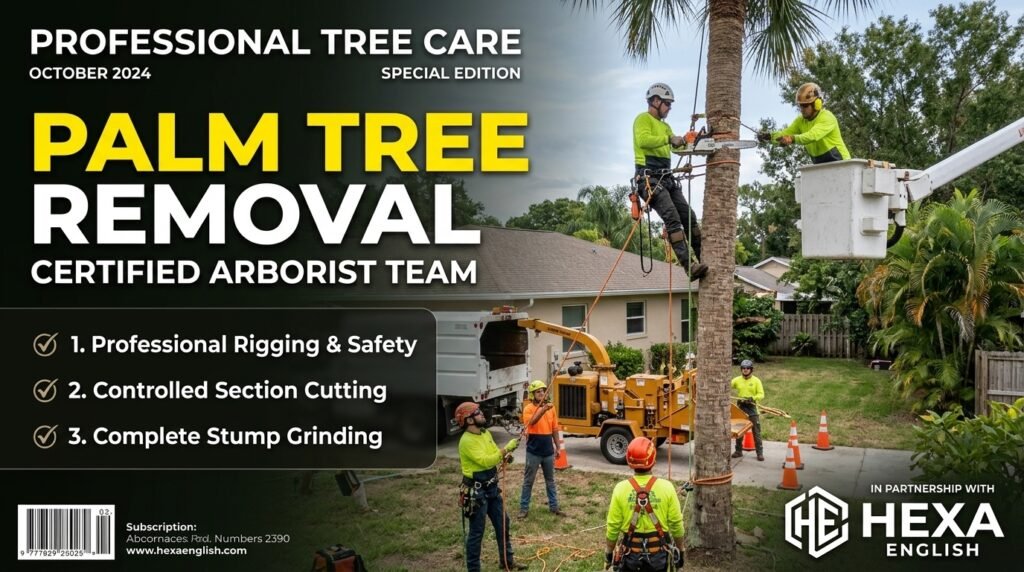
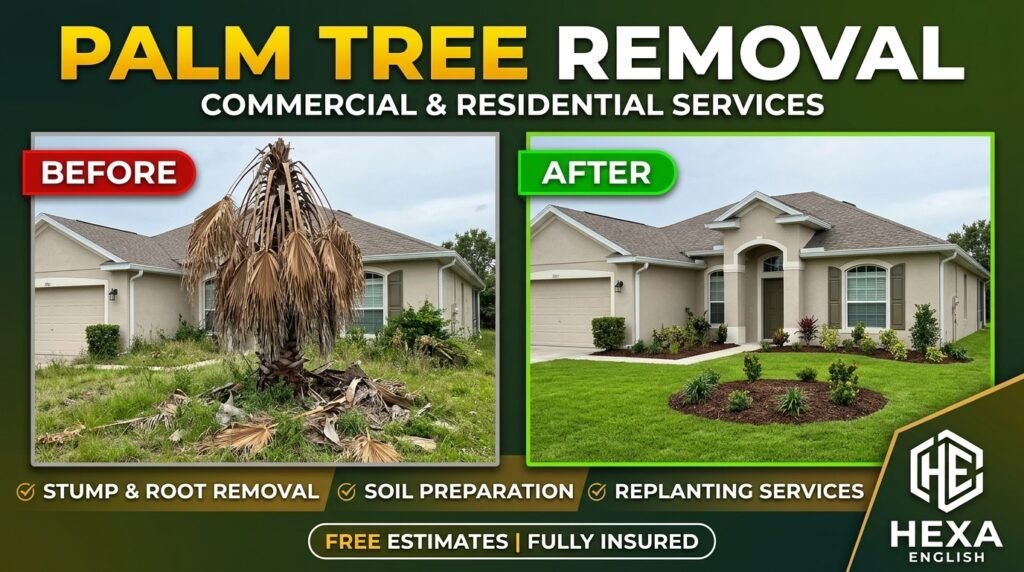
Palm tree removal is a controlled, sectional job, not a simple cut and drop. Palms have a heavy top crown, a dense fibrous trunk, and no spreading canopy to dismantle, so crews usually remove the crown first, then cut the trunk in sections.
Height drives cost most, access drives method second, and condition drives risk third. Get those three facts clear before calling for quotes, and most price differences will make sense.
Angi, updated October 5, 2026, reports a national average of $525 for palm tree removal, with most homeowners paying $150 to $1,500. HomeGuide reports the same $525 average, with a range of $150 to $900 for trees up to 60 feet, so treat both figures as competitor reported ranges, not as a guaranteed quote.
Palm Tree Removal in One Line
Remove a dead, diseased, or hazardous palm, trim a healthy palm with dead fronds only, and check permits before either job in many Florida, California, and Texas cities.
A palm that looks yellow is not always dead, because potassium and magnesium deficiency can look severe but are reversible with correct fertilising, per Bovees. That save versus remove check should come before any removal decision.
| Decision | Action | Next step |
|---|---|---|
| Dead, leaning, cracked, or storm damaged | Remove, urgently if hazardous | Call a licensed, insured crew, do not climb |
| Ganoderma conk on trunk | Remove promptly, do not replant a palm there | Bag conk for landfill, not landscape mulch |
| Lethal bronzing, lab confirmed | Remove immediately | Test first, then remove, per UGA Extension |
| Yellowing fronds, no conk, no lean | Test and fertilise first | Arborist assessment, nutrient check |
| Healthy palm, dead fronds only | Trim, do not remove | Remove dead fronds, keep green fronds |
| Palm too close to house or pool | Assess, then remove or transplant | Quote with access, crane, and stump scope |
When to Remove a Palm Tree, and When to Trim Instead
Removal and trimming are different jobs, with different prices, permits, and risks. That distinction matters, because trimming a diseased palm does not cure disease, while removing a healthy palm wastes a valuable tree.
Dead, Diseased, and Hazardous Palms
A dead palm should be removed, because dead fronds drop, the crown becomes top heavy, and the trunk can fail in wind. That failure risk rises in hurricane and monsoon season, when dead palms are often the first to fall.
A leaning palm after a storm should be assessed urgently, because lean can signal root damage, trunk cracking, or soil movement. That assessment should come from a crew, not from a homeowner pulling on the trunk.
A palm with a Ganoderma conk, a hard shelf like fungus on the lower trunk, should be removed promptly, per University of Florida IFAS Extension. That conk signals significant internal decay, even when the crown still looks green.
Palms Too Close to House, Pool, and Power Lines
A palm too close to a house, pool, fence, or roof creates a drop risk, a debris risk, and a maintenance burden. That proximity risk rises with height, because a taller palm has a heavier crown and a longer fall zone.
A palm near power lines should never be handled by a homeowner, because power line clearance, utility rules, and electrocution risk require a qualified crew and often utility coordination. That power line rule is a hard stop, not a DIY challenge.
A palm near a pool drops fronds, flowers, and fruit into water, clogs filters, and creates a slip hazard on decks. That pool mess alone does not always justify removal, but combined with lean, disease, or height, it often does.
Palms That Can Recover With Care
A palm with yellowing fronds, reduced new growth, and crown thinning may have potassium or magnesium deficiency, not a lethal disease. That nutrient problem, per Bovees, can look severe but is reversible with correct fertilising.
A palm with a few dead fronds, but a healthy spear leaf, or newest frond, in the centre, usually needs trimming, not removal. That spear leaf check is a fast health signal: a green, growing spear suggests life, while a dead spear suggests serious decline.
A palm with irregular boot shedding, or leaf base shedding, or a large root initiation zone above the soil line, may look alarming but can be normal, per UGA Extension. That normal variation should be checked by an arborist before removal, to avoid removing a healthy palm.
Palm Tree Removal Cost by Height, Species, and Location
Cost ranges conflict across sources, so Step 2 must show ranges by source, not one merged price. That reconciliation builds trust, because homeowners who get three quotes will see three different prices anyway.
Cost Reconciliation: Angi, HomeGuide, and Other Sources
Angi, updated October 5, 2026, reports $150 to $1,500 overall, with a $525 national average, and stump removal at $175 to $550 extra. HomeGuide reports $150 to $900 for trees up to 60 feet, $700 to $1,500 for trees over 80 feet, and stump removal at $80 to $250 extra.
Modernize reports palm removal at $200 to $500 for small trees, $500 to $800 for medium trees, and $800 to $1,000 for large trees. Stump and Limb reports palm removal at $250 to $1,200, with a note that height is the main variable, which is oversimplified, because access and condition also matter.
Omar Tree Service reports $250 to $1,200 overall, with small palms at $250 to $400, medium palms at $400 to $800, and large palms at $900 to $1,200 plus. VisionaryEcho reports complete removal at $300 to $1,500, with stump grinding at $100 to $400, but that source is low authority, so treat it as a secondary range only.
That spread shows why a single price cannot be trusted: scope differs, with stump, haul away, permits, and crane work sometimes included and sometimes separate. A written quote with scope is the only reliable price for a specific palm.
| Height band | Angi range, Oct 2026 | HomeGuide range | Notes |
|---|---|---|---|
| Up to 15 feet | $100 to $200 | $100 to $200 | Smallest palms, open access, no crane |
| 15 to 30 feet | $150 to $450 | $150 to $450 | Medium palms, climbing or bucket truck |
| 30 to 60 feet | $200 to $950 | $200 to $900 | Large palms, sectional work, rigging |
| 60 to 80 feet | $300 to $1,200 | $300 to $1,200 | Very tall palms, crane or sectional work |
| Over 80 feet | $1,100 to $1,500 | $700 to $1,500 | Tallest palms, crane, restricted access premium |
That table uses Angi and HomeGuide height bands, which match closely, and it labels both sources. That labelling matters, because a reader who checks either source will find the same bands, not a new invented band.
Cost Factors: Height, Diameter, Access, Condition, and Location
Height drives cost most, because taller palms need more time, more rigging, and often a crane or bucket truck. That height premium rises sharply above 60 feet, where sectional work and crane work become standard.
Trunk diameter drives cutting time, because wider trunks need more cuts, more processing, and more haul away volume. That diameter factor matters for Date and Royal palms, which have wider trunks than slender Fan palms.
Access drives method, because a palm in an open front yard can be dropped in sections, while a palm in a courtyard, behind a pool, or beside a house needs piece by piece removal and often a crane. That access premium can exceed the height premium on tight sites.
Condition drives risk and time, because dead, diseased, tangled, or storm damaged palms need slower, more careful work. That condition premium, per Angi, includes tangled fronds from neglected palms and diseased trees needing safe disposal.
Location drives labour, insurance, and disposal rates, with HomeGuide state ranges showing Florida at $130 to $900, California at $150 to $1,150, Texas at $130 to $1,250, and Arizona at $140 to $925. That state spread shows why a national average cannot replace a local quote.
Number of trees, emergency timing, permits, and cleanup also affect price, with emergency and after hours work costing more than scheduled work. That emergency premium should be confirmed in writing before work starts, not discovered on the invoice.
Stump Grinding Cost, Separate or Included
Stump grinding is often priced separately from trunk removal, so a quote must state whether stump work is included. That separate scope is the most common quote dispute in palm removal, because homeowners assume stump work is included when it is not.
Angi reports stump removal at $175 to $550, while HomeGuide reports stump removal at $80 to $250, with grinding at $100 to $250 and root removal at $75 to $150 per hour for 1 to 2 hours. That stump range conflict shows why scope matters more than a single number.
A stump quote should state grinding depth, backfill, and cleanup, because a shallow grind leaves a stump that can trip, sink, or block replanting. That depth and backfill detail, covered in the stump section, should be in writing.
Cost by State: Florida, California, Texas, Arizona, and More
HomeGuide state ranges, competitor reported, show Arizona $140 to $925, California $150 to $1,150, Florida $130 to $900, Georgia $135 to $1,000, Hawaii $180 to $1,100, Louisiana $140 to $1,000, Nevada $145 to $980, North and South Carolina $135 to $975, and Texas $130 to $1,250. That state table should be re-verified at publishing time, because labour and disposal rates change.
Florida costs reflect hurricane season demand, palm density, and permit rules, while California costs reflect labour, access, and disposal rules. That state context helps a homeowner understand why a quote in Phoenix differs from a quote in Miami for a similar palm.
For city level pricing, Phoenix, Las Vegas, San Diego, Miami, and Tampa each have local service pages, but no public city price table was verified in Step 1 research. That city gap means Step 2 should direct readers to local quotes, not to an invented city price.
Palm Species Guide: Queen, Date, Fan, Royal, and Cabbage
Species changes height, trunk width, crown weight, and removal difficulty, so a species table helps a homeowner describe their palm accurately to a crew. That accurate description improves quote accuracy, because a crew can estimate method better from species and height than from height alone.
| Species | Typical mature height | Trunk and crown | Removal notes |
|---|---|---|---|
| Queen palm, Syagrus romanzoffiana | Medium to tall, often 30 to 50 feet | Slender trunk, feathery crown, heavy fruit | Common in Florida and California, fruit mess, moderate difficulty |
| Canary Island date palm, Phoenix canariensis | Tall, often 40 to 60 feet | Wide trunk, dense crown, heavy fronds | Wide trunk, more cutting time, crane often needed at height |
| Date palm, Phoenix dactylifera | Tall, often 40 to 80 feet | Wide trunk, dense crown, fruit clusters | Tall and heavy, sectional work, disposal volume high |
| Mexican fan palm, Washingtonia robusta | Very tall, often 60 to 100 feet | Slender trunk, fan crown, tall and top heavy | Very tall, top heavy, crane or sectional work, wind risk |
| California fan palm, Washingtonia filifera | Tall, often 40 to 60 feet | Stout trunk, fan crown, native to desert | Stout trunk, more cutting time than Mexican fan |
| Royal palm, Roystonea regia | Very tall, often 50 to 80 feet | Smooth trunk, large crown, heavy fronds | Tall and heavy, sectional work, Ganoderma risk noted in UF IFAS examples |
| Cabbage palm, Sabal palmetto | Medium to tall, often 30 to 60 feet | Slender trunk, fan crown, Florida state tree | Protected in many Florida jurisdictions, check permits, resilient native |
| Pygmy date palm, Phoenix roebelenii | Small, often 6 to 12 feet | Small trunk, compact crown, often multi stem | Smallest palms, often DIY or low cost pro job, if clear fall zone |
| Coconut palm, Cocos nucifera | Medium to tall, often 30 to 60 feet | Slender trunk, large nuts, coastal | Nut drop hazard, coastal rules, HOA and city rules vary |
That species table uses common names and scientific names, so a homeowner can match their palm to a crew description. That matching improves quote accuracy, because a crew can plan rigging and disposal better from species than from a photo alone.
For invasive and nuisance palms, some jurisdictions encourage removal, per Pinellas County tree code notes, while protected native palms, such as Cabbage palm in Florida, may need a permit even at smaller sizes. That protected versus invasive split shows why species matters for permits, not just for price.
Disease Guide: Ganoderma, Lethal Bronzing, and Fusarium
Disease diagnosis should come before removal, because some declines are reversible, while others are lethal and require prompt removal. That diagnosis first rule prevents removing a palm that could recover, and prevents delaying removal of a palm that will fail.
Ganoderma Butt Rot
Ganoderma butt rot, caused by Ganoderma zonatum, is a lethal palm disease with no cure, per UF IFAS and UGA Extension. That no cure rule means fertilising, trimming, or fungicide will not restore a Ganoderma palm, and any product sold as a Ganoderma cure should be treated with scepticism.
Symptoms include wilting, general decline, and a hard shelf like conk on the lower trunk, but not all Ganoderma palms produce a conk before they die, per UF IFAS. That no conk does not clear a palm, so decline alone should be assessed, not dismissed.
Once a conk appears, UF IFAS says the palm should be removed, primarily for safety, because a significant portion of the trunk is already decayed. That safety reason matters in hurricane season, when decayed palms are often the first to fall.
After removal, do not replant a palm in the same location, because Ganoderma survives in soil and roots, per UF IFAS and UGA Extension. That replanting ban applies to all palm species, not just the species that died, so choose a non palm replacement for that spot.
Conks should be removed as soon as they form, placed in trash for landfill or incineration, and never placed in yard waste for landscape recycling, per UF IFAS. That landfill rule prevents spores from spreading through recycled mulch, which is a common disposal mistake.
Lethal Bronzing
Lethal bronzing is a phytoplasma disease that requires laboratory testing for confirmation, per UGA Extension. That lab test rule means visual symptoms alone cannot confirm lethal bronzing, because nutrient deficiency and other diseases can look similar.
Once a palm tests positive for lethal bronzing, UGA Extension says it should be removed immediately. That immediate removal rule prevents spread to nearby palms, especially in Florida where lethal bronzing is a serious concern.
Symptoms can include bronzing, decline, and spear death, but those symptoms overlap with other problems, so testing matters. That testing step should be done by an arborist or extension service, not by guessing from a photo.
Fusarium Wilt and Other Declines
Fusarium wilt, caused by Fusarium oxysporum, is another lethal palm disease, with decline and frond death that can look like Ganoderma or nutrient deficiency. That overlap means accurate identification matters before deciding that a declining palm needs removal, per Treasure Coast Tree guidance.
Nutrient deficiency, especially potassium and magnesium, can cause yellowing, reduced new growth, and crown thinning, but those symptoms are reversible with correct fertilising, per Bovees. That reversible rule is the main reason to test and assess before removing a yellowing palm.
General decline alone does not confirm Ganoderma, lethal bronzing, or Fusarium, because root problems, water problems, and other conditions can cause similar canopy symptoms. That general decline warning, per Treasure Coast Tree, should be in every disease section, to prevent misdiagnosis.
Permits, HOA Rules, and Insurance
Permits are local, vary sharply by city and county, and can block a removal even when a homeowner and a crew agree it is needed. That local variation means Step 2 must direct readers to official city and county sites, not to a single national permit rule.
Permits by City and County
Pinellas County, Florida, updated January 23, 2026, requires a permit for palms more than 6 feet in height on non homesteaded property, while homesteaded single family properties only protect trees greater than 24 inches DBH. That Pinellas rule, from pinellas.gov, shows how homestead status changes protection.
Boynton Beach, Florida, requires a landscape permit for tree and palm removal, with a $50 application fee plus $25 per tree or palm, plus mitigation in some cases at $600 per palm. That Boynton Beach fee and mitigation, from boynton-beach.org, should be verified on the official site at publishing time, because fees change.
O’Neils Tree Service, Tampa Bay, notes permit fees from roughly $25 to $300 for standard residential removals, with review timelines from a few days for simple cases to several weeks for protected or specimen trees. That O’Neils range is a company guide, not an official fee schedule, so it should be labelled as such.
Tampa protected species lists include most native palms, and Cabbage palms, the Florida state tree, are protected in many jurisdictions even at smaller sizes, per O’Neils. That protected native rule means a small Cabbage palm may still need a permit, while an invasive palm may be exempt.
Florida Statute 163.045 hazard tree documentation can sometimes bypass the standard permit process, per O’Neils, but that bypass requires documentation, not just a claim of hazard. That documentation rule should be checked with the city before relying on it.
Shuncy permit claims for California, Florida, and Texas, including a California County Agricultural Commissioner permit and a Florida Department of Agriculture permit, are unverified general claims from a low authority site. That Shuncy warning means Step 2 should not copy those claims without checking the official county site for the specific service area.
HOA Approval Versus City Permit
HOA rules apply in addition to municipal rules, not instead of them, per O’Neils. That addition rule means a homeowner who needs both HOA architectural review approval and a city permit must get both, not just one.
If an HOA requires approval and a city requires a permit, a crew can often produce documentation that satisfies both processes in one site visit, per O’Neils. That single visit documentation saves time, but it still requires two approvals, not one.
If a permit is denied, options include appeal, variance, or alternatives such as pruning to reduce hazard while preserving the trunk, per Shuncy HOA guidance, but that guidance is low authority, so it should be framed as options to discuss with the city, not as guaranteed outcomes.
Ignoring local ordinances can lead to stop work orders, daily fines, and liability if removal causes damage, per Shuncy HOA guidance. That penalty warning, while from a low authority source, matches the general principle that permits should be checked first, and it should be verified on the official city site.
Insurance and Liability
A licensed, insured crew should provide a certificate of insurance on request, per Sonoran Tree Care and B and C Tree Service examples. That certificate check protects a homeowner from liability if a worker is injured or property is damaged during removal.
Most homeowner insurance policies do not cover injury or property damage from DIY tree work, per O’Neils, and ANSI Z133 is the safety standard the industry follows. That DIY insurance gap is a strong reason to hire a pro for any palm above small ornamental size.
For storm damage, insurance coverage depends on policy, cause, and documentation, with photos before removal helping a claim. That photo documentation, per O’Neils permit guidance, should be done before removal, not after, because a removed tree cannot be photographed for a claim.
The Removal Process, Step by Step
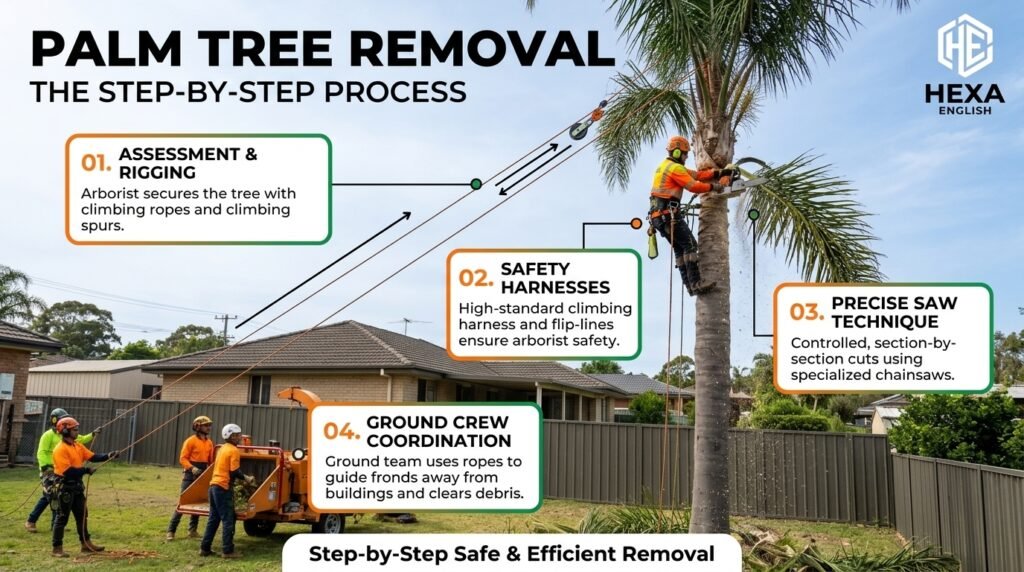
A professional palm removal follows a predictable sequence, with assessment first, then crown work, then trunk work, then stump work, then cleanup. That sequence matters, because each step controls a different risk: fall, drop, power line, property, and disposal.
Assessment and Utility Locate
Assessment starts with species, height, trunk diameter, lean, disease, and proximity to structures, pools, fences, roofs, and power lines. That assessment determines method: open drop in sections, sectional dismantling, bucket truck, or crane.
Utility locate comes next, with a call to 811 in the US before any digging, to map underground water, gas, and electrical lines. That 811 call is free, required in many areas, and prevents costly and dangerous utility strikes during stump work.
Permit and HOA checks come next, with documentation, photos, and a site plan where required. That permit check should be done before scheduling, not on the day of work, because a missing permit can stop a job.
Crown and Frond Removal
Crown removal starts with dead, dying, and overhanging fronds, plus flower and fruit stalks to reduce weight, mess, and pest risk. That frond removal, per Green Man Tree Service, should be clean and balanced, without over lifting the crown, which stresses the tree if it were to stay.
For removal, the crown is usually removed first, in sections, to reduce top weight before trunk work. That crown first sequence prevents a top heavy trunk from falling uncontrolled, which is the main palm specific risk, per Omar Tree Service.
Frond disposal is a palm specific problem, because palm fronds are stringy, heavy, and full of moisture, and they clog grinders, per Omar Tree Service. That disposal problem means haul away and dump fees can be higher for palms than for hardwood branches.
Sectional Trunk Cutting and Crane Work
Trunk cutting for palms is usually sectional, from the top down, especially where there is no room to drop the whole trunk. That sectional method, per Omar Tree Service and EngineerFix, takes more time, gear, and labour, but it controls fall and drop risk.
A crane is used for tall palms, restricted access palms, and palms near structures, pools, or power lines, where sectional climbing alone cannot control the load. That crane decision should be made by the crew, based on height, weight, access, and proximity, not by price alone.
Bucket trucks are used where access allows, for crown work and sectional cutting, while climbing is used where a bucket truck cannot reach. That bucket versus climbing choice depends on access, height, and site layout, and it affects price and time.
Stump Grinding and Root Handling
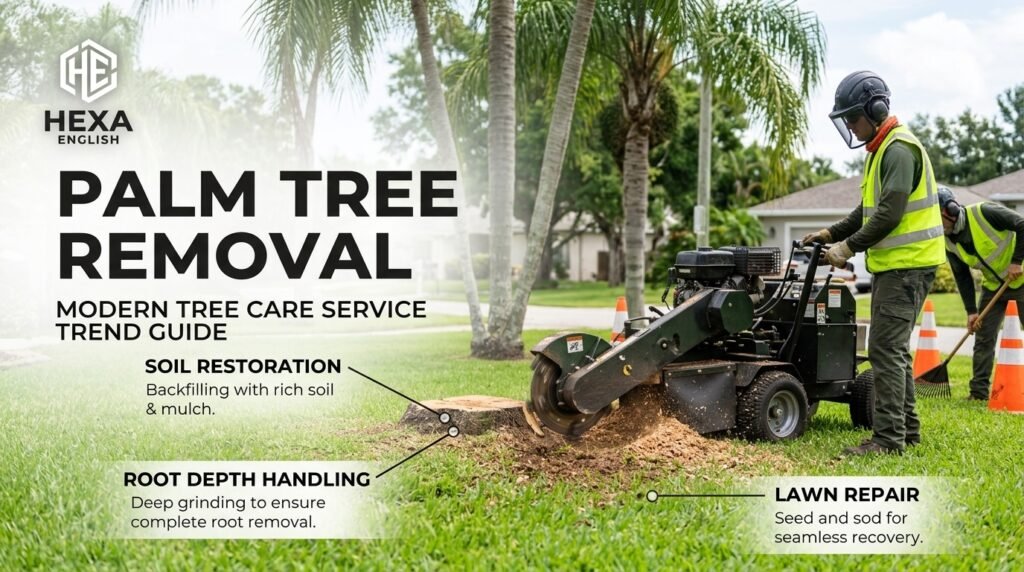
Stump grinding after trunk removal uses a stump grinder to shred the stump below grade, typically 4 to 6 inches below grade per EngineerFix, or at least 15 cm below grade per Shuncy, or at least 300 mm below grade per an Australian guide, which should not be presented as a US standard. That depth variation shows why a quote should state grinding depth in writing.
Palm roots are a dense, shallow, fibrous mat, concentrated in the top 18 to 36 inches of soil, with no deep taproot, per EngineerFix and GardenGuides. That shallow mat means palm stumps are often easier to grind than hardwood stumps, but they still need a grinder that can handle fibrous material, not just a cutting wheel.
Palm roots generally do not resprout after trunk removal, per GardenGuides, because palms grow roots only from a root initiation zone just under the soil line. That no resprout rule means full root excavation is rarely needed, and grinding plus backfill is usually sufficient for replanting.
Cleanup, Haul Away, and Restoration
Cleanup should leave the yard clean, with fronds, trunk sections, and wood chips hauled away or left only if agreed in writing. That cleanup standard, per Green Man and B and C examples, includes pool and spa cleaning where debris falls in water, which should be confirmed before work starts.
Backfill should use native soil, compacted to prevent sinkholes over time, per Shuncy backfill warnings. That compaction step matters, because uncompacted backfill settles and creates a depression, which can trip, collect water, or block replanting.
Restoration after removal can include levelling, sod, or a new planting, with a waiting period for backfill settling where needed. That restoration plan should be agreed before work, not after, because a crew that leaves a hole is not the same as a crew that leaves a level, plantable bed.
Stump and Root Options: Grinding, Excavation, Chemical, and Decay
Stump options differ in depth, time, cost, and replanting readiness, so a table helps a homeowner choose without guessing. That table should be presented as options to discuss with a crew, not as DIY instructions for large stumps.
| Option | How it works, in general | Depth and time | Replanting readiness | Risks and notes |
|---|---|---|---|---|
| Stump grinding | Machine shreds stump below grade | 4 to 6 inches below grade, same day, per EngineerFix | Ready for landscaping, after backfill and levelling | Fastest, most common, needs access for grinder |
| Stump excavation | Machine or hand digging lifts stump and roots | Full stump, same day for small palms, longer for large | Ready for replanting, after backfill and compaction | More soil disturbance, more haul away, higher cost for large stumps |
| Chemical decomposition | Product applied per label to speed decay | Weeks to months, per EngineerFix and Conroe Arborist | Delayed, until stump softens and is removed | Slow, label and safety rules apply, pro advice recommended, never use kerosene or gasoline methods |
| Natural decay | Stump left to decay naturally | Months to years, slowest | Delayed, until stump breaks down | Slowest, trip hazard, pest and fungus risk, not for Ganoderma sites |
That stump table avoids step by step chemical instructions, because chemical products vary by label, and large stumps should be handled by a pro. That general framing keeps Step 2 safe, while still giving a homeowner a decision table.
For Ganoderma sites, grinding is preferred over leaving a stump, because grinding breaks up infected material and limits conk formation, per UF IFAS. That Ganoderma grinding rule is an exception to natural decay, which should never be used for a Ganoderma stump.
For small palms, hand digging with a shovel, mattock, and saw can work, per Arborist Tomball guidance, but only where the stump is small, access is clear, and no utilities are nearby. That small palm limit should be stated clearly, to prevent a homeowner from attempting a large stump by hand.
DIY Limits: What Homeowners Can and Cannot Do Safely
DIY palm work should be limited to small palms under 10 to 12 feet with a clear fall zone, per Bovees and VisionaryEcho, and even then only with proper safety gear, a sharp chain, and a clear plan. That small palm limit is the main DIY rule in Step 2, and it should not be stretched to taller palms.
Homeowners can safely maintain palms under 10 feet using standard ladders and hand tools, per VisionaryEcho, for tasks such as removing dead fronds, applying fertiliser, and monitoring for pests. That maintenance limit is different from removal, because trimming a small palm is not the same as felling a tall palm.
Professional services become advisable for palms exceeding ladder reach, requiring specialised climbing equipment and training, per VisionaryEcho. That ladder reach rule is a practical DIY limit: if a ladder cannot reach the crown safely, a pro should do the job.
DIY work for tall palms, leaning palms, diseased palms, palms near power lines, palms near structures, and palms near pools should be avoided, because those jobs need rigging, crane work, and insurance. That tall and hazard rule should be stated as a hard stop, not as a suggestion.
Equipment costs for occasional palm maintenance often exceed hiring a pro when safety gear, specialised tools, and disposal fees are factored in, per VisionaryEcho. That cost comparison helps a homeowner see why a pro quote can be cheaper than a DIY rental, once gear and disposal are counted.
Emergency Palm Tree Removal: Storm, Lean, and Power Lines
Emergency removal follows a triage sequence: safety first, then documentation, then crew, then cleanup. That triage order prevents a homeowner from making a dangerous situation worse by climbing, cutting, or touching power lines.
Storm and Lean Triage
If a palm is leaning after a storm, cracked, or hanging over a house, roof, or driveway, stay clear, keep people and pets away, and call a licensed, insured emergency crew. That stay clear rule is the first emergency step, because a leaning palm can fall without warning.
If a palm has contacted power lines, do not touch the tree, the lines, or anything touching them, and call the utility and emergency services first. That power line rule is a hard stop, because electrocution risk is immediate and invisible.
Document damage with photos before removal, where safe, because photos help insurance claims and permit documentation, per O’Neils. That photo step should be done from a safe distance, not by climbing or approaching a leaning palm.
Emergency Crew and Timing
Emergency crews, such as B and C Tree Service Phoenix with 24/7 emergency crews, offer after hours response for storm damage. That emergency availability varies by company and city, so Step 2 should direct readers to call local emergency crews, not to a single national number.
Emergency pricing is higher than scheduled pricing, because after hours, weekend, and storm demand increase labour and equipment costs. That emergency premium should be confirmed in writing before work starts, where possible, even in urgent cases.
After emergency removal, stump, cleanup, and replanting can be scheduled separately, because emergency work focuses on hazard removal first. That emergency versus restoration split helps a homeowner understand why an emergency quote may not include stump grinding or replanting.
Disposal, Replanting, and What to Plant Next
Disposal and replanting are part of removal, not afterthoughts, because palm debris, Ganoderma material, and soil settling all affect the next planting. That disposal and replanting section closes the removal loop, from hazard to new landscape.
Disposal Rules
Palm fronds should be hauled away and chipped where facilities accept them, with a note that fronds clog grinders and cost more to dispose of than hardwood branches, per Omar Tree Service. That disposal cost should be included in a quote, not added later as a surprise.
Ganoderma conks and infected trunk material should go to landfill or incineration, not to landscape mulch, per UF IFAS. That landfill rule prevents spores from spreading through recycled mulch, which is a common and dangerous disposal mistake.
Healthy palm trunk and frond material can be chipped or composted where local facilities accept it, but local green waste rules vary, so check the city or county waste site. That local waste check prevents a homeowner from assuming all palm debris can be mulched.
Replanting After Removal
After a non disease removal, replanting can start once backfill settles and levels, with a new palm or a non palm tree chosen for spacing from structures, pools, utilities, and fences. That spacing rule prevents the next palm from becoming the next removal in 10 years.
After Ganoderma removal, do not replant a palm in the same location, per UF IFAS and UGA Extension, because the fungus survives in soil and roots. That Ganoderma ban means choose a non palm tree, shrub, or lawn for that spot, not another palm species.
After lethal bronzing removal, replanting should follow extension guidance for the area, because disease pressure and species susceptibility vary by region. That extension guidance check prevents replanting a susceptible palm in a high disease area.
Native palms, such as Cabbage palm and palmettos, are the most resilient and least susceptible to fatal pests and diseases in coastal Georgia and Florida, per UGA Extension. That native resilience makes native palms a strong replanting choice where they are appropriate, but they still need permit checks in protected areas.
How to Choose a Palm Tree Removal Company
Choosing a company should follow a checklist, not a single price, because scope, insurance, and method matter more than a low bid. That checklist system prevents a low bid that excludes stump, haul away, permits, or cleanup.
Quote Checklist
A written quote should include species and height, method, crane or climbing, stump included or separate, haul away included or separate, permit responsibility, cleanup standard, damage responsibility, and payment terms. That written scope, per Bovees 2 to 3 quotes advice, allows a homeowner to compare bids accurately.
Licence, insurance certificate, and ISA certification should be verified before work, with certificates available on request, per Sonoran Tree Care and B and C examples. That verification step protects a homeowner from liability and from unqualified crews.
Reviews, years in business, and local service area should be checked, with a preference for companies that specialise in palms, not just general tree work. That palm specialisation matters, because palm crown weight, fibrous trunk, and frond disposal differ from hardwood work.
Red flags include a quote without scope, no insurance certificate, no permit discussion, a demand for full payment upfront, and a promise to cure Ganoderma with a product. That red flag list helps a homeowner walk away from a risky bid, even when the price looks low.
Mistakes to Avoid
- Removing a palm without checking permits. A missing permit can stop work, trigger fines, and require mitigation, so check city and HOA rules first.
- Removing a yellowing palm without testing. Potassium and magnesium deficiency are reversible, so test and assess before removing a palm that could recover.
- DIY a tall, leaning, or power line palm. Tall and hazard palms need rigging, crane work, and insurance, so hire a licensed, insured crew for those jobs.
- Assuming stump grinding is included. Stump work is often separate, so confirm grinding depth, backfill, and cleanup in writing before work starts.
- Using a merged national price as a quote. Angi, HomeGuide, and other sources conflict, so get 2 to 3 written local quotes with scope.
- Putting Ganoderma conks in landscape mulch. Conks should go to landfill or incineration, not to yard waste for recycling, per UF IFAS.
- Replanting a palm where Ganoderma died. Ganoderma survives in soil, so choose a non palm replacement for that spot.
- Skipping a utility locate before stump work. Call 811 before digging, to map water, gas, and electrical lines and prevent strikes.
- Leaving backfill uncompacted. Uncompacted backfill settles into a sinkhole, so confirm compaction and levelling in the quote.
- Choosing by lowest price alone. A low bid that excludes stump, haul away, permits, or cleanup can cost more than a higher bid with full scope.
Tips for Palm Tree Removal
- Get 2 to 3 written quotes. Compare scope, not just price, with stump, haul away, permits, and cleanup listed separately.
- Verify licence, insurance, and ISA certification. Ask for a certificate of insurance before work starts, not after.
- Check permits and HOA rules first. Get city and HOA approvals before scheduling, to avoid stop work orders.
- Call 811 before stump work. Map utilities before grinding or digging, to prevent strikes and damage.
- Confirm stump depth and backfill. Get grinding depth, backfill, compaction, and levelling in writing.
- Photograph before removal. Photos help insurance claims and permit documentation, especially for storm and hazard cases.
- Ask about crane versus climbing. Confirm method, access, and property protection before work, especially for tall and tight sites.
- Confirm cleanup standard. Agree on haul away, pool cleaning, and yard condition before work, not after.
- Plan replanting after removal. Choose a species and spacing that will not become the next removal, and avoid palms after Ganoderma.
- Keep all documents. Keep quotes, permits, insurance certificates, and photos for insurance, HOA, and future sale records.
FAQs
How much does palm tree removal cost?
Palm tree removal costs $150 to $1,500 in Angi and HomeGuide ranges, with a $525 national average reported by both sources in 2026. That range depends on height, access, condition, and location, so get a written local quote for a specific palm.
How much does it cost to remove a small palm tree?
Small palms up to 15 feet cost $100 to $200 in Angi and HomeGuide height tables. That small palm range assumes open access and no crane, so tight access or disease can increase the price.
How much does it cost to remove a 30 foot palm tree?
A 30 foot palm falls in the 15 to 30 foot band at $150 to $450, or in the 30 to 60 foot band at $200 to $900, depending on the source band and exact height. That band overlap shows why a quote should state height and scope, not just a single price.
How much does it cost to remove a 60 foot palm tree?
A 60 foot palm falls in the 30 to 60 foot band at $200 to $900, or in the 60 to 80 foot band at $300 to $1,200, depending on source and exact height. That tall palm range reflects sectional work, rigging, and often crane work.
How much does palm tree stump removal cost?
Palm tree stump removal costs $175 to $550 in Angi, $80 to $250 in HomeGuide, and $100 to $400 in VisionaryEcho, so treat those figures as competitor reported ranges, not as one price. That range conflict shows why a quote must state stump scope and depth.
How much does palm tree stump grinding cost?
Palm tree stump grinding costs $100 to $250 in HomeGuide, with root removal at $75 to $150 per hour for 1 to 2 hours where needed. That grinding range assumes access for a grinder and a standard depth, so tight access can increase the price.
Is stump grinding included in palm tree removal?
Stump grinding is often priced separately from trunk removal, so a quote must state whether stump work is included. That separate scope is the most common quote dispute, so confirm grinding depth, backfill, and cleanup in writing.
Do I need a permit to remove a palm tree in Florida?
Permit rules in Florida vary by city and county, with Pinellas County requiring a permit for palms over 6 feet on non homesteaded property, and Boynton Beach requiring a landscape permit with fees. That local variation means check the official city or county site for the specific property before removal.
Do I need a permit to remove a palm tree in California?
Permit rules in California vary by city and county, with some counties requiring permits for taller palms and some cities requiring replacement trees. That local variation means check the official city or county planning site for the specific property, and do not rely on a general national rule.
Do I need a permit to remove a palm tree in Texas?
Permit rules in Texas vary by city and zoning district, with some areas requiring a land clearing permit for certain zones. That local variation means check the official city planning site for the specific property, and confirm HOA rules separately.
Do I need a permit to remove a palm tree in Arizona?
Permit rules in Arizona vary by city, with Phoenix and Mesa having local tree service and permit guidance, but no single statewide palm permit rule was verified in Step 1 research. That gap means check the official city site for the specific property before removal.
Does my HOA need to approve palm tree removal?
Yes, an HOA may require architectural review approval for palm tree removal, in addition to a city permit, not instead of it. That addition rule, per O’Neils, means get both approvals where both are required, not just one.
What happens if I remove a palm tree without a permit?
Removing a palm without a required permit can lead to stop work orders, fines, and mitigation requirements, such as replanting or paying into a tree fund. That penalty risk varies by city, so check the official city site before removal.
Can I remove a palm tree myself?
Homeowners can remove small palms under 10 to 12 feet with a clear fall zone, proper safety gear, and no nearby power lines, structures, or pools, per Bovees and VisionaryEcho. That small palm limit should not be stretched to taller, leaning, diseased, or power line palms, which need a pro crew.
How tall a palm tree can I remove myself?
A homeowner should limit DIY removal to palms under 10 to 12 feet with a clear fall zone, per Bovees, and to maintenance tasks under 10 feet with standard ladders, per VisionaryEcho. That height limit is a practical safety rule, not a legal limit, and it should be combined with a power line and structure check.
Is it safe to cut down a palm tree near my house?
No, cutting down a palm near a house is not safe for a homeowner, because fall zone, crown weight, and sectional control require rigging, crane work, or climbing experience. That near house job should be done by a licensed, insured crew with a written plan for property protection.
Who removes palm trees near power lines?
Palm trees near power lines should be removed by a qualified crew, often with utility coordination, because power line clearance and electrocution risk require specialised training and equipment. That power line job should never be attempted by a homeowner, even for a small palm.
What should I do if a palm tree is leaning after a storm?
Stay clear, keep people and pets away, photograph from a safe distance, and call a licensed, insured emergency crew, and the utility if power lines are involved. That stay clear and call rule prevents a leaning palm from falling on a person who tries to assess it up close.
How long does palm tree removal take?
Palm tree removal time depends on height, access, method, and stump scope, with small palms taking less than an hour and tall, restricted palms taking a full day or more. That time range should be confirmed in a written quote, with crane, stump, and cleanup included in the time estimate.
Do palm tree roots grow back after removal?
No, palm tree roots generally do not resprout after trunk removal, because palms grow roots only from a root initiation zone just under the soil line, per GardenGuides. That no resprout rule means grinding plus backfill is usually sufficient, without full root excavation.
How deep are palm tree roots?
Palm tree roots form a dense, shallow, fibrous mat concentrated in the top 18 to 36 inches of soil, with no deep taproot, per EngineerFix. That shallow mat means palm roots are less likely to damage deep foundations, but they can still lift shallow concrete, pavers, and pool decks.
Are palm tree roots invasive?
Palm tree roots are generally less invasive than hardwood roots, because they form a fibrous mat rather than a spreading woody root system, per GardenGuides. That mat can still lift pavers, crack shallow concrete, and interfere with pool plumbing where palms are planted too close.
Can palm tree roots damage a pool?
Yes, palm tree roots can damage a pool where palms are planted too close, by lifting decks, cracking coping, and interfering with plumbing. That pool risk should be assessed by a crew before removal, with a plan for root handling and backfill.
Can palm tree roots damage a driveway or foundation?
Yes, palm tree roots can lift driveways, sidewalks, and shallow concrete, but they are less likely to damage deep foundations than hardwood roots, because they lack a deep taproot. That shallow versus deep split helps a homeowner understand why a palm near a driveway is a bigger risk than a palm near a deep foundation.
Do palm trees regrow after being cut down?
No, a palm tree generally does not regrow after the trunk is cut down, because palms grow from a single growing point at the crown, not from multiple buds like hardwood trees. That single growing point rule means a cut palm will not sprout a new trunk from the stump.
Conclusion
Palm tree removal becomes clear once height, access, condition, and permits are checked in order. Dead, diseased, and hazardous palms should be removed promptly, yellowing palms should be tested first, and healthy palms should be trimmed, not removed.
Keep three rules close: check permits and HOA rules first, call 811 before stump work, and get a written quote with stump, haul away, and cleanup scope. Add a licensed, insured, ISA certified crew for tall, leaning, and power line palms, and most palm removals will be safe, clean, and ready for replanting.
Get 2 to 3 written local quotes for your specific palm, confirm stump depth and backfill in writing, and keep all permits, photos, and insurance documents for your records.

Dilawar Mughal is an SEO expert with 8 years of hands-on experience helping websites grow their organic traffic, rankings, and revenue. He specializes in content-driven SEO, local SEO, and Pinterest SEO, and builds practical, results-focused strategies for businesses and publishers.
