

You’re scrolling through Instagram or Reddit and see “TW” sitting at the top of a post. Is it a typo, a username, or some new slang you missed? You’re not alone in wondering. TW is one of the most common abbreviations in online communities, and understanding it helps you communicate with more care and read digital spaces more accurately.
This guide covers the TW meaning in text, where it came from, how it differs from a content warning, and exactly how to use it the right way. By the end, you’ll know what TW means in every context, from a heartfelt caption to a casual work email, and you’ll be able to use it correctly yourself.
What Does TW Mean in Text?
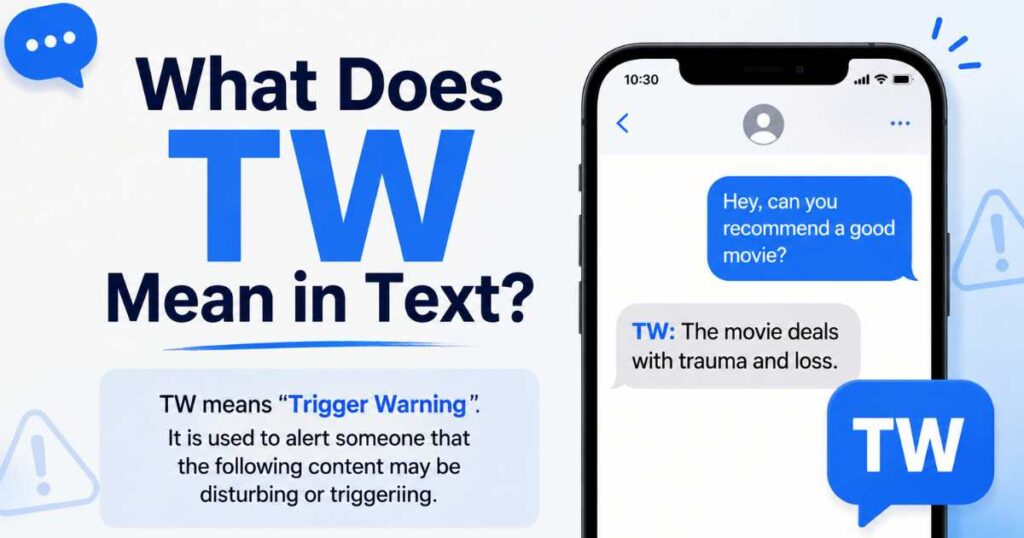
TW stands for Trigger Warning.
It’s a short notice placed before a message, post, or video to let readers know the content ahead might be emotionally difficult, disturbing, or upsetting for some people. It isn’t meant to hide information or discourage people from reading it simply gives them a choice before they engage.
Example: “TW: mention of anxiety and panic attacks” before a personal essay on Instagram.
That’s it. Short, respectful, and easy to spot at a glance. Once you know the TW abbreviation meaning, you’ll start noticing it everywhere from TikTok captions to Discord chats.
Where Did TW Come From? A Quick Origin Story
Trigger warnings didn’t start online. The idea has roots in trauma psychology, where clinicians noticed that certain words, images, or descriptions could trigger a strong emotional or physical reaction in people living with PTSD or anxiety disorders.
From there, the practice moved into feminist and mental-health-focused online forums in the early 2000s. Members would warn one another before posting about topics like sexual assault, self-harm, or eating disorders. It functioned as an act of community care long before it became a hashtag.
As platforms like Tumblr, Reddit, and later Twitter grew through the 2010s, “Trigger Warning” got shortened to the two-letter version we recognize today. Now TW shows up across Instagram, TikTok, Discord, and even in some workplace and academic settings.
TW vs. CW: What Is the Difference?
People often use TW and CW interchangeably, but they’re not quite the same thing.
| Term | Full Form | Purpose | Typical Use |
| TW | Trigger Warning | Flags content that may trigger a trauma response | Abuse, self-harm, assault, PTSD-related topics |
| CW | Content Warning | Flags content that’s sensitive but not necessarily traumatic | Death of a public figure, political rants, mature themes |
Think of CW as a yellow light and TW as a red one. A CW says, “heads up, this might be uncomfortable.” A TW says, “this could genuinely affect someone with lived trauma.”
In casual use, plenty of people treat the two as synonyms. If you want to be precise, reserve TW for trauma-related topics and use CW for anything sensitive but milder.
Related post: Indigo vs Violet: What the Real Difference? (2026)
Common Topics That Get a TW Label
Not every awkward or unpleasant topic needs a trigger warning. The practice is generally reserved for subjects that can genuinely distress someone with a history of trauma. The most common ones include:
- Mental health struggles (depression, anxiety, suicidal ideation)
- Eating disorders (weight, food restriction, body image)
- Sexual assault or abuse
- Domestic violence
- Graphic descriptions of illness, injury, or death
- Racism, homophobia, or discrimination
- Addiction and substance abuse
You’ll also occasionally see “TW: flashing lights” before videos, added as a courtesy for people with photosensitive epilepsy. That’s a reminder that trigger warnings have expanded beyond purely emotional topics to cover physical health risks too.
Does TW Have Other Meanings in Text?
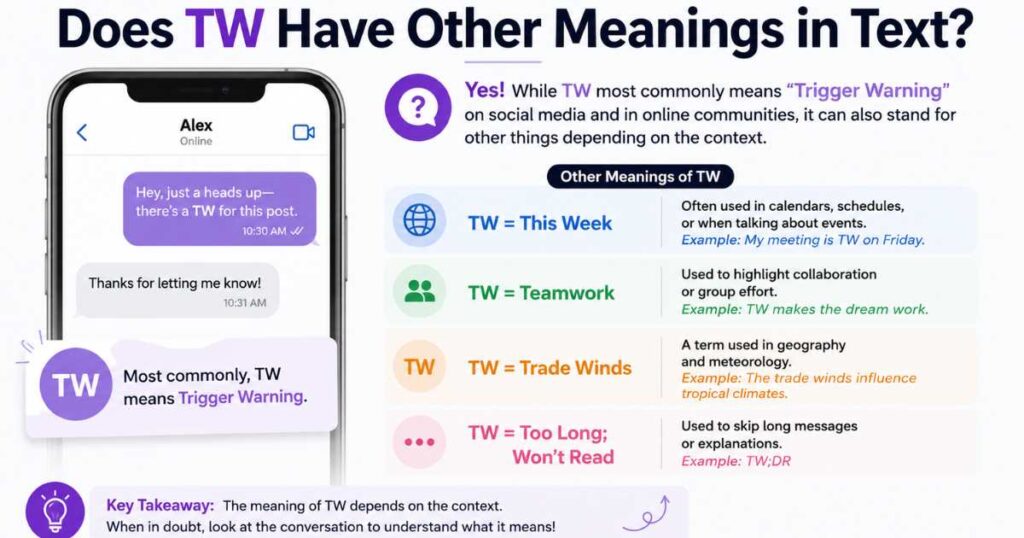
Yes and context decides which one applies.
| Context | Likely TW Meaning |
| Social media captions and posts | Trigger Warning |
| Mental health forums and support groups | Trigger Warning |
| Gaming or streaming chat | Trigger Warning, or informally “Teamwork” |
| Business emails and meeting notes | “This Week” |
| Older Twitter-era references | Twitter (the platform) |
| Sports commentary | Occasionally “Two-Way” (a player position) |
| Aviation | Tailwind |
| Physics | Terawatt |
If a friend texts “TW, this is heavy,” they almost certainly mean Trigger Warning. If a coworker writes “Recap from TW’s meeting,” they mean This Week. The surrounding sentence nearly always makes the meaning obvious.
Real-Life Examples of TW in Text and Social Media
Seeing TW in context makes the concept click faster than any definition. Here are a few realistic examples:
- Instagram caption: “TW: eating disorder recovery. Sharing my three-year journey and what actually helped me heal.”
- Reddit post: “TW: grief and loss. My dad passed away last month and I’m struggling to function some days.”
- TikTok video description: “TW: anxiety and panic attacks. This is my story, and you’re not alone.”
- Text between friends: “Hey, I need to vent TW, it’s about something bad that happened at work.”
- Discord venting channel: “TW: self-harm mentions. Feel free to skip this one if it’s not a safe read for you right now.”
Notice that in every example, TW appears at the very start, never buried halfway through. That placement is the entire point of the warning.
How to Use TW Correctly (And What to Avoid)
Using TW well takes a little intention. Here’s what good practice looks like.
Do this:
- Place TW at the very beginning of the post or message, before any sensitive content
- Be specific “TW: sexual violence” tells people far more than a bare “TW”
- Add a line break, ellipsis, or a few dots afterward so readers can choose to stop scrolling
- Use it sincerely, not as a joke
Avoid this:
- Using TW as a punchline or meme, which weakens it for people who genuinely need it
- Burying the warning halfway through a post that’s like putting up a wet floor sign after someone has already slipped
- Slapping TW on every mildly uncomfortable topic, which dilutes its meaning over time
- Skipping it altogether when posting about genuinely heavy subjects
The goal is care, not performance. Adding a TW is essentially telling your audience, “I don’t know what you’ve been through, but I want you to have a choice.”
Common Mistakes People Make With TW
Even well-meaning people slip up sometimes. Watch out for these:
Placing it too late. Writing three paragraphs about a traumatic experience and adding “TW btw” at the bottom helps no one lead with it instead.
Being too vague. A bare “TW” with no description leaves readers guessing whether the content applies to them. Specificity matters.
Using TW ironically. Captions like “TW: opinions incoming” as a joke chip away at the seriousness of the tool for people who rely on it.
Confusing TW with a spoiler warning. A spoiler warning protects a plot twist. A trigger warning protects someone’s mental health. They’re not interchangeable.
Should You Always Use TW or Is It Optional?
Nobody can force you to add a trigger warning it’s a social norm, not a rule.
That said, using it costs you almost nothing and can matter a great deal to someone else. Posting a raw account of abuse or self-harm without a warning could catch a survivor off guard in a space they didn’t expect. Two letters at the top of a post prevent that.
It’s a bit like holding a door open. You don’t have to, but it says something about how you treat other people when you do. If you’re writing personal stories, opinion pieces, or heavy social posts, adding a TW is almost always the more thoughtful choice.
TW in Text vs. TW in Formal Writing
You’ll rarely see “TW” used in a published article, academic paper, or professional report. In those spaces, writers spell things out fully: “Content Warning” or “Note: This piece discusses sexual assault.”
TW belongs to informal, conversational internet culture. It’s fast and instantly recognizable within the communities that use it social captions, forum threads, chat messages, and short-form video descriptions.
If you’re writing something formal or long-form, spell the warning out. If you’re posting on Reddit at midnight about something heavy, TW works perfectly well.
Which Should You Use: TW, CW, or Something Else?
A quick decision guide:
- Use TW when the content could trigger a trauma response abuse, violence, self-harm, assault
- Use CW when the content is sensitive or mature but not necessarily traumatic political topics, a public figure’s death, a heated rant
- Use “Spoiler Warning” or “SW” for plot reveals in shows, movies, or games
- Use a fully written-out warning in professional, academic, or published writing
When you’re unsure which to use, lean toward TW. Nobody has ever complained that a warning showed too much consideration.
FAQ’s
Is TW the same as a content warning?
Not exactly TW (Trigger Warning) targets content that may trigger trauma responses, while CW (Content Warning) is a broader label for anything sensitive or uncomfortable.
Do I have to use TW on every sensitive post?
No, it isn’t mandatory, but it’s a widely respected practice on platforms like Reddit, TikTok, and Tumblr that shows consideration for your audience.
Can TW mean something other than Trigger Warning?
Yes depending on context, TW can mean Twitter, “This Week,” “Teamwork,” Tailwind (aviation), or Terawatt (physics), though Trigger Warning is by far the most common meaning online.
Conclusion
TW is a small abbreviation that carries real weight. At its core, it’s empathy in shorthand a way of saying, “I don’t know what you’ve been through, but I want to give you the choice before we go there.” Whether you’ve seen it on Instagram, Reddit, or in a text from a friend, you now know exactly what it means, where it came from, and how to use it thoughtfully.
The next time you see “TW” at the top of a post, take it as an invitation rather than an obstacle: pause, decide if you’re in the right headspace, and read on if you choose to. And the next time you’re the one sharing something heavy, a quick TW at the top costs you nothing but it might mean everything to someone reading on the other end.

