
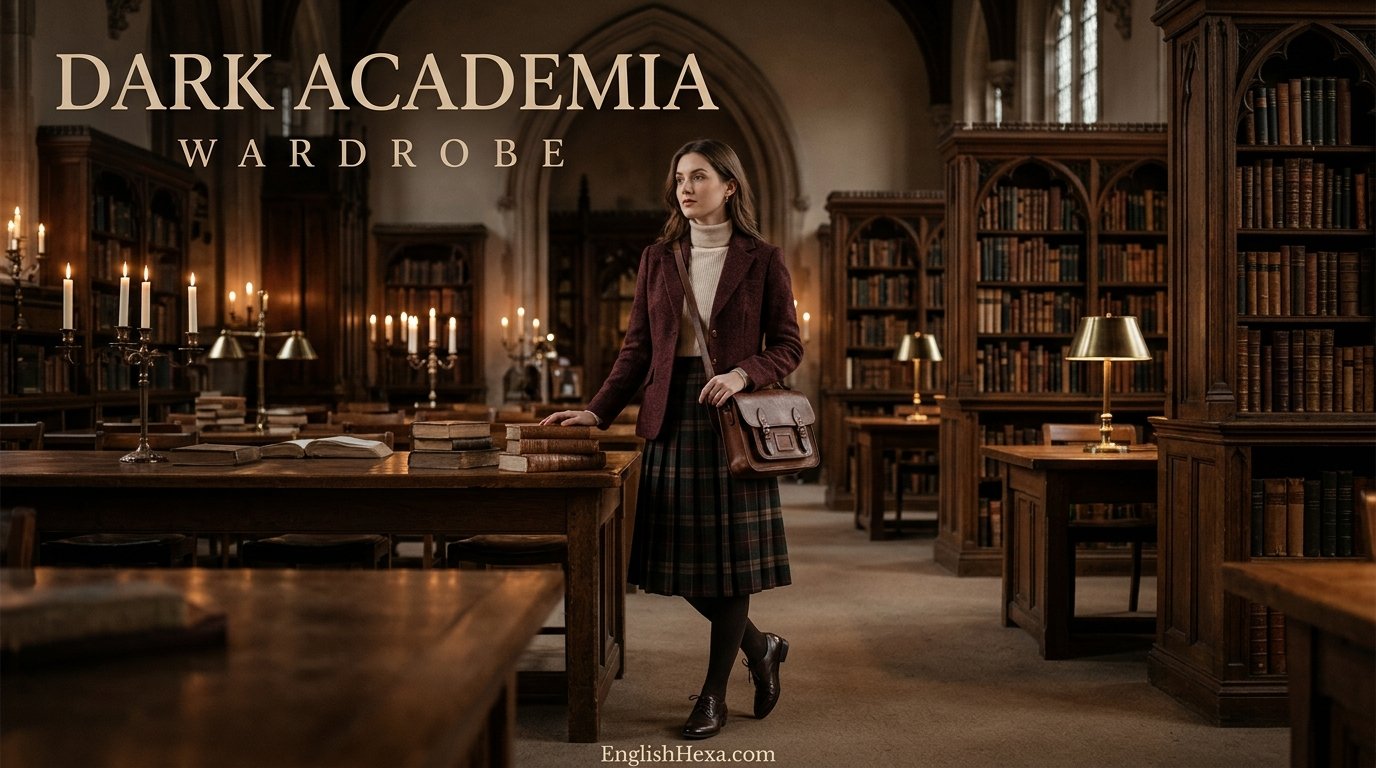

A dark academia wardrobe is built palette first, texture second, one scholarly anchor per outfit, and those three rules turn a pile of vintage looking clothes into a system that dresses you. Everything else in this page is those rules applied.
Most guides hand you a list of pieces and leave you to improvise. The pieces are the easy part; the rules are what make twenty pieces behave like a hundred outfits across a full year of real weather, real workplaces, and real budgets.
The English Hexa library collects guides built this way, system before shopping. Start here with the rules, then buy or thrift only what the system is missing.
What Dark Academia Is, and Is Not
Dark academia is an aesthetic and subculture built on higher education, classic literature, and Gothic romance: old universities, candlelit libraries, poetry, and the traditional academic clothing those worlds wore.
Its wardrobe translates the culture into cloth: tailored blazers, pleated skirts, Oxford shirts, knitwear, and leather shoes, all in dark, muted, earthy colors. Donna Tartt’s novel The Secret History is the style text the culture cites most.
It is not a costume, a Halloween register, or a uniform to copy whole. It is a classic wardrobe with a mood, which is why its pieces predate the label by generations.
The Culture Under the Clothes
The aesthetic grew out of online book culture and spread through social platforms in the early 2020s, carrying its reading lists with it. The satchel, the fountain pen, and the glasses are equipment in this culture, not props.
That is also why the style rewards depth: a wardrobe built around a genuine interest in the literature and the history reads authentic in a way a copied shopping list never does.
The smarter entertainment experiences guide makes the broader point about curated experiences: the people who build the world around an interest get more from it. Dark academia is that principle worn.
The Costume Line: Style Versus Character
Here is the rule the whole wardrobe hangs on: one or two signature pieces per outfit. The signature pieces are the tweed blazer, the plaid pleated skirt, the sweater vest, and the Oxford shoes.
Wear all of them at once and the outfit crosses the costume line into school uniform territory. Wear one or two, grounded in modern basics like dark denim or a plain knit, and it reads as personal style.
Every formula in this article respects the line. When an outfit of yours feels fancy dress, count its signature pieces; the count, not the clothes, is the problem.
The line also explains the aesthetic’s everyday durability. Because most outfits run one anchor with quiet support, the wardrobe works on ordinary Tuesdays, in ordinary workplaces, without announcing itself.
Costume is a special occasion register; style is what survives the weekly rotation. Build for the rotation, and the special occasions take care of themselves.
The Closed Palette System
The palette is a closed system: a fixed set of colors where everything coordinates with everything, by construction. Buy inside it and outfits assemble themselves; buy outside it and each new piece orphans the rest.
| Palette Group | Colors | Job in the Wardrobe |
|---|---|---|
| The darks | Black, charcoal, espresso brown, navy | The base: coats, trousers, skirts, shoes |
| The accents | Burgundy and oxblood, forest and olive green, camel, mustard | The interest: knits, blazers, skirts, one per outfit |
| The lights | Cream, ivory | The relief: shirts, turtlenecks, the layer that keeps darks from going flat |
The lights matter more than beginners expect. A dark academia wardrobe without cream and ivory collapses into a black blur; the light layer is what lets the darks read as colors.
Black Base Versus Brown Base
Choose your base family first. A black base (black, charcoal, navy, burgundy) reads cooler, more Gothic, more urban. A brown base (espresso, camel, olive, cream) reads warmer, more vintage, more autumnal.
Pieces can cross later, but the starter capsule should pick one family and commit. Commitment is the capsule’s engine: ten pieces in one family outdress twenty split across two.
The Texture Rule: Fabrics That Read Scholarly
If palette is the wardrobe’s grammar, texture is its accent. Dark academia fabrics are matte, heavy, and tactile: tweed and herringbone, wool, corduroy, velvet, cable knit, leather, and crisp cotton shirting.
The rule for judging any garment in any store: if it is shiny, thin, or plasticky, it breaks the register. If it has weight, grain, or weave you can feel, it probably belongs.
Texture is also the quality gate that makes the budget logic work. A wool blazer worn for a decade of autumns is cheaper per wear than three synthetic blazers worn for a season each.
The Capsule Rail: Twenty Pieces, Dozens of Outfits
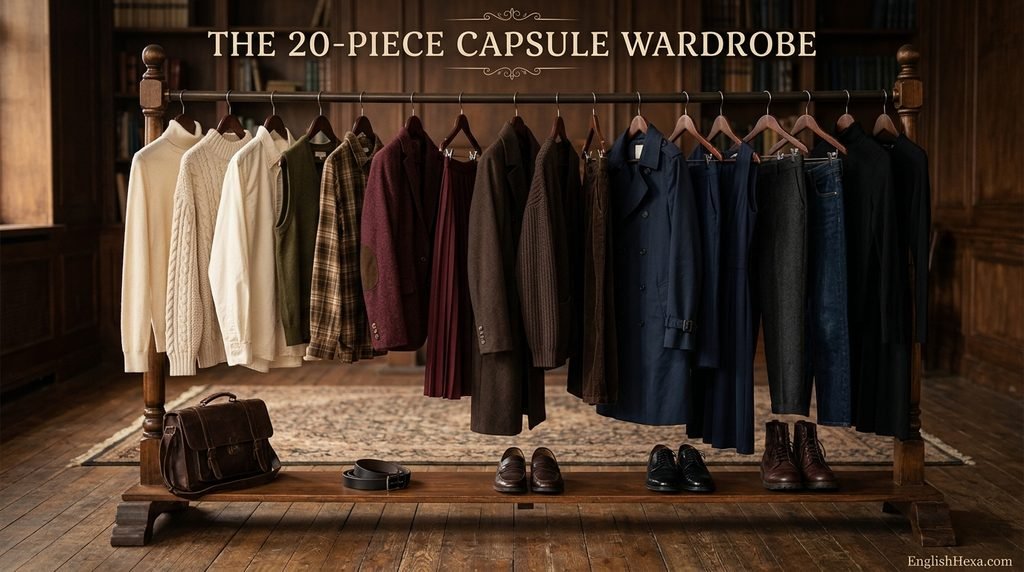
The rail below is the wardrobe at full size. The Elegance Edit’s dark academia capsule wardrobe organizes the same rail by category, and the category discipline is worth copying: every piece below has a job and a season.
| Category | Pieces | Notes |
|---|---|---|
| Outerwear | Tweed or plaid blazer, long wool coat, trench coat | The blazer anchors; the coats own their seasons |
| Knitwear | Black turtleneck, cream turtleneck, cable knit sweater, sweater vest, chunky cardigan | The layering engine of the whole wardrobe |
| Shirts and tops | White or cream Oxford shirt, tie neck or puff sleeve blouse | The lights of the palette, worn daily |
| Bottoms | Wool trousers, plaid trousers or corduroy, pleated skirt, second skirt or dark denim | Trousers and skirts share the anchor role |
| Dress | One high neck or wrap dress in the palette | The one piece outfit for evenings |
| Shoes | Loafers, Oxford shoes or brogues, boots | Leather, polished, black or brown |
| Accessories | Leather satchel, leather belt, knit scarf, frill socks and tights | The romance lives here |
The Ten Piece Starter
Starting from zero, buy half the rail: one blazer, two turtlenecks (black and cream), one Oxford shirt, wool trousers, a pleated skirt or second trouser, a chunky cardigan, loafers, boots, a belt, and a coat.
That starter is credited in the capsule guides with over twenty outfit combinations, and the claim is plausible because the palette makes every top fit every bottom. Live in the starter for a season before expanding it.
The Outfit Math
Capsule math is multiplication, not addition. Eight tops, four bottoms, three outer layers, and three shoe pairs do not make eighteen outfits; they make hundreds of combinations, filtered by weather and occasion.
This is why the palette discipline pays: every piece inside the system multiplies the whole wardrobe, while every piece outside it adds only itself. Judge purchases by multiplication.
Planning visually helps some builders: sketching or generating outfit boards with an AI image generator turns the abstract math into combinations you can see before you spend.
Fit and Tailoring: The Scholarly Silhouette
Dark academia silhouettes are structured but not tight: blazers with a defined shoulder worn slightly relaxed, trousers high waisted and straight or gently pleated, skirts at midi or knee length with movement.
The fit rules are three. First, shoulders decide the blazer: seams at the shoulder bone, everything else can be tailored or worn loose. A blazer that fits the shoulders reads bespoke at any price.
Second, hems are deliberate: trousers break once or crop cleanly, skirt lengths are chosen rather than defaulted, coat sleeves show a sliver of the layer beneath. Unconsidered length is where the scholarly silhouette quietly dies.
Third, knitwear skims rather than clings: turtlenecks and sweaters follow the body without compressing it, because the aesthetic’s ease is part of its authority. Oversized is welcome in cardigans and coats, where structure elsewhere compensates.
Tailoring money follows the same priority as buying money: blazer first, trousers second, everything else as needed. Twenty minutes with a tailor converts a thrifted blazer into the best fitting garment you own, which is the whole thrift strategy in miniature.
Petite frames keep one volume source (the coat or the skirt, not both) and hems precise. Taller frames can stack the long coat over wide trousers freely.
Curvier frames use the high waist and the structured blazer to set the silhouette’s terms, exactly as the register intends.
One Scholarly Anchor: Building Outfits
Outfits in this wardrobe are built around one scholarly anchor: the piece that declares the aesthetic (blazer, pleated skirt, vest, Oxford shoes, satchel). Everything else supports quietly inside the palette.
Everyday and School Formulas
The working uniform: turtleneck or Oxford shirt, blazer or cardigan, wool trousers or a pleated skirt, loafers, satchel. Rotate the knit and the layer, and the outfit renews itself daily.
School settings suit the wardrobe naturally, since its pieces descend from uniforms. Keep skirt lengths and logos inside your institution’s rules; the aesthetic’s formality does the rest.
Work and Professional Formulas
Work takes the tailored rail and drops the theatrical notes: blazer, Oxford shirt or turtleneck, wool trousers, polished loafers, satchel as the work bag.
Keep one signature texture per outfit (tweed, corduroy, a cable knit) and skip vest plus plaid combinations that read student. The palette itself is office native, the aesthetic’s quiet career advantage.
Evening and Occasion Formulas
Evening runs on velvet and contrast: a burgundy velvet blazer over a lace or silk blouse, a high neck dress with a long coat, the lights traded for candlelight tones.
Museums, dinners, and dates are the aesthetic’s home occasions. One anchor, richer texture, and jewelry from the old soul set (pearls, a brooch, a coin necklace) finish it.
The Year Round Wardrobe

Autumn owns this aesthetic in the public imagination, but the wardrobe runs twelve months on fabric swaps. The palette and the anchors never change; weights and layers do.
Autumn: The Home Season
Everything deploys at once: tweed, corduroy, cable knits, boots, the long coat over all of it. Autumn is when the wardrobe’s full texture range is wearable in a single outfit.
Winter: Velvet and the Long Coat
Winter deepens the system: the wool overcoat as the visible outfit, velvet for evenings, knit tights and scarves as working layers, boots with tread. Keep the palette tight so the bulk reads as architecture.
Spring: The Trench Transition
Spring lightens the insulation, not the colors: the trench replaces the wool coat, blazers go unlined, skirts trade knits for blouses, loafers drop the heavy socks. A little more cream lifts the palette toward the season.
Summer: The Palette Without the Layers
Summer is the aesthetic’s hardest season, because layering is its main tool. Carry the register by color and anchor instead: short sleeve knits, linen blend trousers, pleated skirts with blouses, loafers, one scholarly piece per outfit.
Heat honesty matters here. A summer dark academia outfit that you actually wear beats a faithful one that lives in the closet until October.
The Registers: Feminine, Masculine, Romantic
The same wardrobe speaks three dialects. Tailored pieces (blazers, trousers, Oxford shoes) carry the masculine leaning register; skirts, dresses, and Mary Janes carry the classic feminine one.
Romantic academia softens everything: flowing skirts, lace details, puff sleeves, velvet, a dreamier hand with the same palette. Most real wardrobes blend registers by section, tailored outside and romantic underneath.
Old family photographs are a genuine reference library for all three, which is why readers use the animate old family photos guide on inherited photos: grandparents’ tailoring is this aesthetic’s primary source material.
Building It: Thrift First, Buy Once
Dark academia is the rare aesthetic where thrifting is the authentic route, not the budget compromise. Its pieces are classic menswear and uniform staples, which thrift stores stock permanently.
ThredUp’s dark academia fashion guide builds outfits entirely from resale for the same reason. Vintage wear is welcomed by the culture, and a pre loved wool coat carries the character the aesthetic prizes.
The Closet Audit
Before buying anything, audit what you own: pull everything in the palette, then your most tailored pieces, then your leather shoes and bags. Most people find a third of the wardrobe already hanging in the closet.
The audit converts the build from a shopping project into a gap list. Buy the anchor you lack (usually the blazer or the loafers) and one texture, and the register appears.
The Thrift Priority List
Thrift in this order, where second hand quality is highest and stock is deepest:
1. Wool blazers. Check shoulders, lining, and buttons; tailoring forgives the rest.
2. Pleated and wool skirts. Abundant, durable, and cheap relative to quality.
3. Leather loafers and Oxfords. Check soles and uppers; resoleable leather is a decade of wear.
4. Satchels and messenger bags. Leather ages into the aesthetic instead of out of it.
5. Cable knits in wool. Check for moth damage and pilling; natural fibers only.
Stage the spending across months if the budget needs it. The discipline is the same one a small business cash flow plan applies to a business: sequence the outflows, and the plan funds itself without a crisis.
Care That Makes Classics Last
The buy once math only works if the pieces last, and these fabrics repay simple care: rest wool between wears, brush tweed instead of washing it, store knits with cedar against moths, and dry clean sparingly.
Leather needs conditioning and shoe trees, and loafers need polish, because in this aesthetic condition is part of the look. Scuffed shoes break an outfit faster than a wrong piece does.
Common Mistakes
1. Crossing the costume line. Four signature pieces at once reads as uniform cosplay. One or two, grounded in basics, reads as style.
2. Buying outside the palette. One bright or pastel piece orphans itself instantly. The closed palette is the system; respect it especially while the wardrobe is small.
3. Chasing the look in synthetics. Shiny, thin fabrics fail the texture rule at arm’s length. Fewer pieces in real wool and leather beat a closet of imitations.
4. Skipping the lights. All dark, all the time collapses into a blur. Cream and ivory layers are structural, not optional.
5. Ignoring shoe condition. This aesthetic reads footwear first. Polish is a styling step here, not a chore.
6. Building for autumn only. A wardrobe that works three months a year is a costume with a calendar. Plan the summer and spring swaps from the start.
7. Copying outfits instead of learning the system. Copied looks expire with their photos. The palette, texture, and anchor rules generate outfits forever, including ones nobody has photographed yet.
Five Complete Outfits, Piece by Piece

Rules become outfits here. Each build names its anchor, its palette path, and its costume line count, so you can copy the logic with whatever your rail holds.
Outfit one, the library standard. Cream turtleneck, charcoal tweed blazer, black wool trousers, polished loafers, brown satchel. Anchor: the blazer. Signature count: one. This is the outfit the whole system is calibrated on, wearable to class, work, and dinner.
Outfit two, the skirt register. Black turtleneck, burgundy pleated skirt, sheer black tights, Mary Janes, one coin necklace. Anchor: the skirt. The palette path runs dark to accent to light at the neck, and the knit keeps the accent piece company without competing.
Outfit three, the vest day. White Oxford shirt, cream cable knit vest, brown corduroy trousers, brogues, leather belt. Anchor: the vest. Signature count stays at one because the trousers are solid and the shirt is plain, exactly the restraint the costume line demands.
Outfit four, the evening build. Burgundy velvet blazer, black silk blouse, black midi skirt, heeled loafers or Mary Janes, pearl earrings. Anchor: the blazer, upgraded by fabric. Evening dark academia changes textures before it changes shapes.
Outfit five, the summer answer. Short sleeve cream knit, olive linen blend trousers, tan loafers, canvas tote, tortoiseshell glasses. Anchor: the palette itself, carried by color when layers cannot carry it. Proof the system survives its hardest season.
Read together, the five builds share a skeleton: one anchor, one light layer or light relief, darks below or above, texture doing the talking. Change any single element and the outfit renews; change the skeleton and you are building a different aesthetic.
Building Your Dark Academia Wardrobe: Six Steps
The order matters more than the budget. Followed in sequence, each step makes the next one cheaper, because the system starts coordinating your purchases immediately.
1. Audit the closet you have. Palette pieces out first, tailored pieces second, leather third. Your starter rail is probably a third built already, and the audit names the real gaps.
2. Choose the base family. Black base or brown base, decided by what the audit found most of. Every later purchase gets judged against this family first.
3. Buy or thrift the anchor. The blazer, in tweed, plaid, or solid wool. It converts more existing clothes than any other single purchase in this wardrobe.
4. Complete the ten piece starter. Turtlenecks in black and cream, the Oxford shirt, wool trousers, the skirt or second trouser, the cardigan, loafers, boots, belt, coat. Stop here for a full season.
5. Add texture before adding pieces. A cable knit, a corduroy, a velvet for evenings. Texture expands the wardrobe’s range faster than new categories do, because it changes how existing outfits read.
6. Expand by multiplication only. Every later piece must pair with at least three outfits you already wear. A piece that multiplies enters; a piece that merely adds waits, however beautiful it is alone.
Frequently Asked Questions
What is a dark academia wardrobe?
A wardrobe built on the dark academia aesthetic: traditional academic clothing (blazers, pleated skirts, Oxford shirts, loafers) in a closed palette of dark, muted, earthy colors.
Its fabrics are textured (tweed, wool, corduroy, velvet), and it works as a capsule because the palette coordinates everything by construction.
What are the essential pieces of a dark academia wardrobe?
The core rail: a tweed or plaid blazer, black and cream turtlenecks, a white or cream Oxford shirt, cable knit sweaters and a sweater vest, high waisted wool or plaid trousers, and a pleated skirt.
Add a long wool coat or trench, loafers and Oxford shoes or boots, and a leather satchel. Fifteen to twenty pieces produce dozens of outfits.
What colors are in the dark academia palette?
The darks: black, charcoal, deep brown, navy. The earth accents: burgundy and oxblood, forest and olive green, camel and mustard. The lights: cream and ivory, which keep the darks from going flat.
The palette is the system. Pieces bought inside it coordinate automatically, which is why the aesthetic suits a capsule wardrobe so well.
What fabrics define dark academia?
Texture carries the mood: tweed and herringbone, wool, corduroy, velvet, cable knit wool and cashmere, leather, and crisp cotton shirting as the smooth counterpoint.
Heavy, matte, tactile fabrics read scholarly; shiny synthetics break the register. Fabric quality is where the aesthetic is actually decided.
How many pieces do I need for a dark academia capsule wardrobe?
Fifteen to twenty well chosen pieces cover the full rotation: two blazers or one blazer and a coat, three knits, two shirts, two trousers, one or two skirts, one dress, two to three shoe pairs, and the satchel.
A ten piece starter is credited in the capsule guides with over twenty combinations. The count grows fast as pieces are added inside the palette.
How do I avoid looking like I am wearing a costume?
Respect the costume line: the signature pieces (tweed blazer, plaid pleated skirt, sweater vest, Oxford shoes) worn all at once read as a school uniform costume.
Wear one or two signature pieces per outfit, grounded with modern basics like dark denim or a plain knit. The aesthetic should read as your style, not as a character.
Is dark academia only for autumn?
Autumn is its home season, when coats, knits, and boots deploy at once, but the wardrobe runs year round with fabric swaps: linen blends in summer, the trench as the spring coat, velvet and the long wool coat in winter.
The palette and the anchors do not change; only weights and layers do.
What shoes belong in a dark academia wardrobe?
Loafers first (polished leather, lug sole for winter), lace up Oxfords and brogues, Mary Janes, and boots for cold weather, all in black or brown leather.
Keep them polished: footwear condition is read instantly in this aesthetic, and scuffed shoes break it faster than a wrong piece does.
What is the difference between dark academia and light academia?
The same academic codes in opposite palettes and moods. Dark academia: black, brown, burgundy, Gothic romance, autumn weight fabrics, evening library energy.
Light academia: cream, beige, white, soft knits, spring light and gentler romanticism. Pieces cross over; the palette and the mood decide the register.
How do I build a dark academia wardrobe on a budget?
Thrift first: the aesthetic’s pieces (wool blazers, pleated skirts, leather loafers, satchels) are thrift store staples, and vintage is native to the style, not a compromise.
Buy inside the palette only, check wool content and shoe condition, and spend new money on turtlenecks and tights, which thrift poorly.
What is the difference between dark academia and old money style?
Overlapping pieces, different stories. Old money style is quiet luxury: impeccable classics and wealth coded restraint. Dark academia is literary and moody: darker palette, Gothic references, vintage welcomed.
The library rather than the estate. A tweed blazer serves both; burgundy velvet and worn leather belong to dark academia.
Can men wear dark academia?
Yes, the aesthetic’s roots are substantially menswear: Oxford shirts, tweed and corduroy blazers, knit vests, pleated or straight trousers, loafers and brogues, long coats.
The men’s version swaps the skirt rail for trousers and adds ties, scarves, and flat caps. The palette system and the costume line apply identically.
What bags suit dark academia?
Structured leather in black or brown: the satchel is the signature, messenger and portfolio bags follow, canvas totes as the casual option.
The bag should look like it carries books, because in this aesthetic it usually does. Hardware stays minimal; logos and novelty shapes break the register.
How do I wear dark academia to work or an office?
Use the tailored rail and drop the theatrical notes: blazer, Oxford shirt or turtleneck, wool trousers, loafers, the satchel as your work bag.
Keep one signature texture per outfit and skip vest plus plaid combinations that read student rather than professional. The palette itself is office native.
What patterns are dark academia?
Houndstooth, glen plaid and tartan, herringbone, argyle, and fine stripes on shirting. Patterns live on the scholarly pieces and are worn one per outfit inside the palette.
A plaid blazer over solid everything is the standard deployment. Two competing plaids cross into costume.
What jewelry and accessories fit dark academia?
Small, old soul pieces: coin necklaces, pearl earrings, a vintage brooch, signet style rings, simple glasses, leather belts, frill socks with loafers, knit scarves.
Accessories are where the romance lives, so they can be more expressive than the clothes, in gold, brass, pearl, and leather tones.
How do I style a sweater vest in dark academia?
Over a collared shirt with collar and cuffs showing, with trousers or a pleated skirt, and a blazer over it in cold weather.
The vest is a strong signature piece, so the costume line applies: vest day is not also plaid skirt and tie day. Cream cable knit is the classic.
Can dark academia work in summer?
Yes, with weight and coverage swaps: short sleeve knits in the palette, linen blend trousers, pleated skirts with blouses instead of knits, loafers without heavy socks.
Summer is the aesthetic’s hardest season because layering is its main tool; the closed palette and one anchor piece do the work instead.
What books and culture sit behind dark academia?
The aesthetic grew from online book culture: Donna Tartt’s The Secret History is its most cited style text, alongside classic and Gothic literature, poetry, and the Dead Poets Society visual register.
The wardrobe is the visible half of a reading centered lifestyle, which is why the accessories function as genuine equipment rather than props.
How do I layer dark academia outfits?
In scholarly order: shirt or turtleneck base, knit or vest mid, blazer structure, coat as the weather layer. Show each layer at one point (collar, cuff, hem) so the stack reads deliberate.
Two to three visible layers is the working range. More belongs to deep winter and needs the palette kept tight.
What is romantic academia versus dark academia?
Romantic academia is the softer sub register: flowing skirts, lace details, puff sleeve and tie neck blouses, velvet, a dreamier femininity, still in the dark palette.
Dark academia proper leans tailored and androgynous. Most real wardrobes blend them by section: tailored outerwear, romantic tops.
How do I start a dark academia wardrobe from scratch?
Palette first, anchor second. Choose your base (black or brown family) and buy the ten piece starter inside it: one blazer, two turtlenecks, one Oxford shirt, wool trousers, a pleated skirt or second trouser, a cardigan, loafers, boots, a belt, a coat.
Live in it for a season before expanding; the capsule math rewards patience.
Are pleated skirts required for dark academia?
No piece is required; the pleated skirt is simply the most recognizable signature. Trousers carry the same register (wool, plaid, corduroy, high waisted), and many wardrobes are trouser only.
What is required is the system: palette, texture, and one scholarly anchor per outfit.
How do I care for wool, tweed, and leather pieces?
Wool and tweed: rest garments between wears, brush rather than wash, spot clean, store with cedar against moths, dry clean sparingly.
Leather: condition periodically, use shoe trees, keep loafers polished. These fabrics repay care with decades of wear, the aesthetic’s slow fashion core.
What hairstyles and makeup complete dark academia?
Understated and classic: loose waves, low ponytails and buns, braids, and natural or softly vintage makeup with berry and oxblood lip tones or strong brows.
The grooming register is scholarly rather than glamorous. This is presentation guidance only; the wardrobe works without it.
Can I wear dark academia if I do not like skirts?
Completely. The trouser rail (high waisted wool, plaid, corduroy, pleated trousers) plus blazers, knits, and Oxford shoes delivers the full aesthetic.
The menswear leaning version is one of its classic forms. Skirts are one dialect; tailoring is the language.
What is chaotic academia?
A scruffier cousin aesthetic: the same library culture with deliberately undone styling, wrinkled shirts, loosened ties, and maximal layering.
It relaxes dark academia’s polish rules while keeping the palette and pieces. The base wardrobe is identical, styled down.
How does dark academia work for plus sizes?
By the same system: palette, texture, anchor. Structured blazers and high waisted trousers in quality wool blends carry the register at every size.
The costume line matters more than any fit rule. Buy the best fabric your budget reaches, tailor the blazer if needed, and let the palette coordinate.
What should I thrift first for dark academia?
In order: wool blazers (shoulders and lining), pleated and wool skirts, leather loafers and Oxfords (soles and uppers), satchels and messenger bags, cable knits, long coats.
These categories are abundant second hand because the aesthetic recycles classic menswear and uniform pieces that thrift stores always stock.
Is dark academia a trend or a lasting style?
Its pieces are a century of classics; only its name and online community are recent. Blazers, pleated skirts, turtlenecks, and loafers predate the label by generations and will outlast it.
Treat the wardrobe as a classic wardrobe with a mood, and the trend question dissolves.
What is the one piece to buy first?
The blazer, in tweed, plaid, or solid wool, matched to your base family. It is the scholarly anchor that converts the most existing clothes into dark academia outfits on day one.
Shoes second (loafers), because the blazer and loafers together frame everything between them.
How do I wear dark academia without all black?
Build on the brown family instead: espresso and camel knits, cream shirts, burgundy and olive accents, tan loafers, a brown satchel.
Black is the palette’s most famous member, not its requirement. A brown based wardrobe reads warmer and more vintage.
What tights and socks work with dark academia skirts?
Sheer or opaque black tights are the standard, charcoal and deep brown as variations, cable knit tights in winter. Frill or lace trim socks with loafers and Mary Janes are the repeated detail.
The leg layer is part of the palette: bright or novelty hosiery breaks the register instantly.
Can dark academia work for school dress codes?
It is one of the most dress code friendly aesthetics, since its pieces derive from uniforms: collared shirts, blazers, pleated skirts at code length, trousers, loafers.
Check your rules on skirt length and logos (the aesthetic has no logos to worry about). The wardrobe’s formality does the compliance work.
How do I add dark academia touches to a wardrobe I already have?
Run the audit: pull everything already in the palette (black, brown, burgundy, cream), then your most tailored pieces, then your leather shoes and bags.
Most people find a third of the wardrobe hiding in their closet. Add one anchor and one texture, and the register appears without a rebuild.
What is the difference between dark academia and preppy style?
Shared ancestors, different weather. Preppy is bright, clean, and coastal: navy, white, pastels, tennis and sailing codes, polished optimism.
Dark academia is the same tailoring after dark: muted palette, Gothic romance, autumn weight, literature over sport. The blazer is common ground.
What outerwear matters most in dark academia?
Two coats cover the year: a long wool overcoat for winter (the aesthetic’s calling card, worn open with a scarf) and a trench for spring and rain. The blazer functions as indoor outerwear.
Buy outerwear first among equals when building; in cold months the coat is the outfit everyone sees.
How do I photograph or document dark academia outfits?
The community conventions: library, cafe, and old building settings, warm or moody natural light, books and bags as genuine props because they are genuinely carried.
Full length framing shows the tailoring. This is presentation culture rather than styling law, but it explains the aesthetic’s visual consistency online.
What gifts suit someone building a dark academia wardrobe?
The accessories and tools of the lifestyle: a leather satchel or belt, a coin necklace, a fountain pen, classic literature editions, a wool scarf in the palette, shoe care supplies.
Gifts inside the closed palette always land, because the system guarantees they coordinate with what the person owns.
Does dark academia have to include vintage clothing?
No. Vintage is welcomed and thrifting is economical, but new pieces in the classic cuts and fabrics serve identically; heritage and prep retailers sell the entire rail new.
What the aesthetic requires is the cut, fabric, and palette discipline, not a garment’s age. Worn in is a bonus.
How do I transition a dark academia wardrobe into spring?
Lighten weights, keep colors close: the trench replaces the wool coat, blazers go unlined, skirts pair with blouses instead of knits, loafers drop the heavy socks.
A slight palette lift (more cream, olive and burgundy kept) signals spring without leaving the system. The anchors stay; only insulation leaves.
What is a dark academia outfit formula I can repeat daily?
The working uniform: turtleneck or Oxford shirt, blazer or cardigan, wool trousers or pleated skirt, loafers, satchel.
Rotate the knit color and the blazer, and the outfit renews itself inside the palette. The decision is made once; the variations are automatic.
Conclusion
A dark academia wardrobe succeeds when the system outranks the shopping: a closed palette that coordinates everything, a texture rule that gates quality, one scholarly anchor per outfit, and the costume line respected. Build those four habits and the wardrobe assembles itself, season after season.
Start with the closet audit this week, then the ten piece starter inside your palette. More system first guides live across the English Hexa blog, ready when the next build begins.

Dilawar Mughal is an SEO expert with 8 years of hands-on experience helping websites grow their organic traffic, rankings, and revenue. He specializes in content-driven SEO, local SEO, and Pinterest SEO, and builds practical, results-focused strategies for businesses and publishers.
