


Prevent cockroaches and you never fight an infestation, and the way to do it is a system, not a spray can: the same integrated pest management order that universities and the EPA teach.
The system has five working steps: keep them out, starve them, dry them out, remove their shelter, and monitor so a single wanderer gets caught before it becomes a colony.
Under those steps sits one decision most guides skip: which species you are preventing. Indoor breeders and outdoor wanderers need different prevention, and mixing them up wastes money.
EnglishHexa publishes practical home, business, and tech guides; this page is the cockroach prevention reference inside that library, built from university IPM programs and extension services.
The Short Answer
To prevent cockroaches: seal cracks and gaps, screen drains, and sweep doors; starve them with sealed food and a grease free kitchen; dry the home by fixing leaks and moisture.
Remove shelter by clearing cardboard and clutter, then monitor with sticky traps against walls so any arrival is detected while numbers are tiny.
Reach for chemicals last, and then use bait in cracks, never foggers or room sprays. The UC IPM cockroach Pest Notes states the doctrine plainly: pesticides alone will not solve cockroach problems.
First, Identify the Species: Settlers vs Wanderers

Prevention fails when it treats every roach as the same roach. Two families live two different lives, and each needs its own plan.
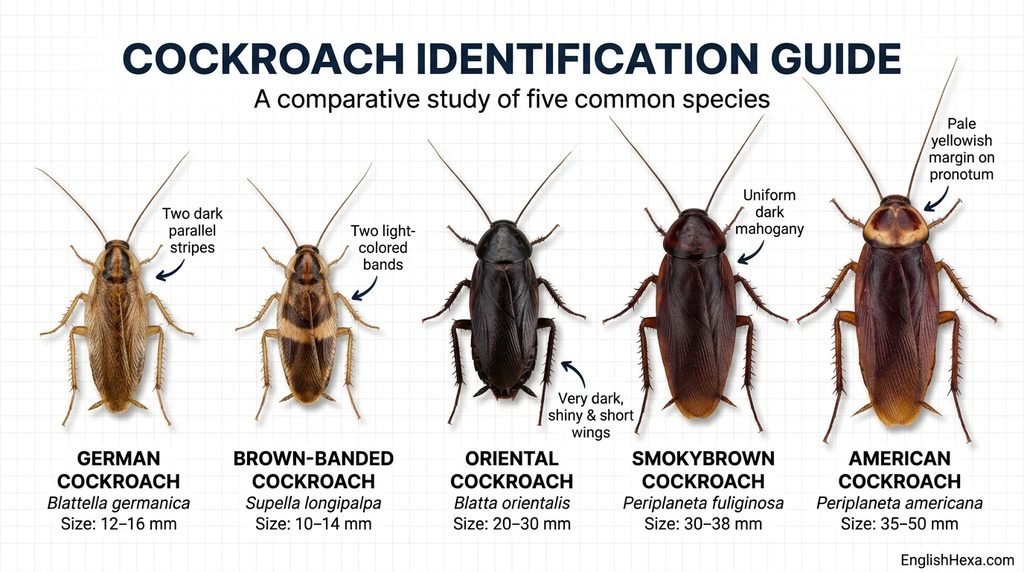
| Species | Where it lives | How it gets in | The prevention that matters |
|---|---|---|---|
| German cockroach | Indoors, kitchens and bathrooms | Hitchhikes in boxes, groceries, furniture | Inspection, harborage removal, bait discipline |
| Brown banded cockroach | Indoors, warm dry furniture zones | Hitchhikes, spreads room to room | Whole home inspection, furniture checks |
| American cockroach | Outdoors, sewers, basements | Wanders in, up drains, under doors | Exclusion, drain screens, moisture control |
| Oriental cockroach | Cool damp areas, crawl spaces | Wanders in at ground level | Drainage, ground level sealing |
| Smokybrown cockroach | Outdoors, trees and mulch in the South | Flies or wanders toward lights | Yard pressure reduction, threshold sealing |
The German cockroach is the serious one: about half an inch long, light brown, with two dark stripes behind its head. It breeds indoors and almost never lives outside.
If your roaches are German, your problem is already inside, and prevention means stopping the next generation, not guarding the door.
The big outdoor species are a different story. A two inch American cockroach in the tub is usually a wanderer from a drain, a basement, or the yard, and exclusion is its answer.
The UC IPM cockroach Pest Notes builds its whole guidance on this point: identify the species before taking action, because effective management varies by species.
Step One, Exclusion: Seal the Ways In
Roaches are crack sized. A German cockroach can hide in a crack about 1/16 inch wide, roughly 1.6 millimeters, and its young use even smaller gaps.
The Texas A&M cockroach prevention page gives homeowners a workable threshold: seal cracks of 1/8 inch or more in the foundation and exterior walls, then work inward from there.
Work the list in order:
- Foundation and wall cracks at 1/8 inch or more, with silicone or acrylic latex caulk.
- Plumbing penetrations under every sink, plus gaps around furnace flues and pipes.
- Electrical outlets, baseboards, and ceiling moldings, the indoor travel network.
- Doors and windows: weather stripping replaced, thresholds tight, door sweeps that touch the floor.
- Weep holes in brick and stone: fill with copper mesh, never sealed shut, because they must still breathe.
- Floor drains, vents, and ducts: fine screens fitted. North Carolina’s agriculture department calls these routes cockroach highways, and it is right.
Keep drain traps wet as well: the water in the trap is itself a seal, and a dried out trap is an open door from the sewer side.
Step Two, Starve Them: Food, Grease, and the Nightly Reset
Roaches eat almost anything organic, but a kitchen runs on three fuels: crumbs and spills, grease films, and food left accessible overnight. Cut all three.
The nightly reset is the core habit: dishes washed, counters wiped, stovetop degreased, floors swept or vacuumed, and nothing edible left out, including the pet bowl.
Store dry food and pet food in sealed hard containers, not the bags they came in. The Texas A&M cockroach prevention page is specific: tight containers for pet food, and no uneaten pet food left in the bowl overnight.
Grease deserves its own sentence, because it is the fuel people forget: the film on the stovetop, the drip pan, and the wall behind the stove can feed roaches that never touch your pantry.
Weekly, clean behind and under the refrigerator and stove. Quarterly, pull appliances out and clean the floor and wall junction where warmth, moisture, and grease meet.
Trash goes in a can with a lid that fits, emptied regularly, and recycling gets rinsed before storage, because a sugary can is a feeding station.
Step Three, Dry Them Out: Water Is the Leash

Water outranks food in roach survival, and the figures are stark enough to reorder your whole plan.
University of Florida guidance puts a German cockroach at about 12 days with food but no water, against about 42 days with water but no food. A leak is life support; a crumb is a snack.
So fix dripping faucets, sweating pipes, and running toilets as prevention work, not plumbing trivia. Wipe sinks and tubs dry at night in problem buildings.
Attack condensation too: insulate cold pipes, ventilate bathrooms and kitchens, and run a dehumidifier where basements stay damp.
For the basement specifically, standing water and chronic damp are the twin invitations; Basement water problems walks through diagnosing and fixing basement water problems at the source.
Outdoors, fix drainage that pools against the foundation, and move mulch, leaf litter, and firewood away from the walls where outdoor species stage before wandering in.
Step Four, Remove Shelter: Cardboard, Clutter, and Harborages
A harborage is a warm, dark, tight, undisturbed place near food and water. Roaches spend their days pressed into cracks, which entomologists call their crack hugging habit.
Cardboard is the worst material in the house: its corrugation is a ready made harborage in exactly the dimensions roaches seek, and boxes are the main vehicle for egg cases entering a home.
Swap cardboard storage for sealed plastic bins, and clear stacks of newspapers, paper bags, and rags, especially in kitchens and bathrooms, as extension guidance directs.
Then work the harborage map: cabinet hinges and drawer tracks, the voids behind dishwashers, refrigerator motor compartments, under sink cabinets, and the gaps behind stoves.
Vacuum cracks and crevices as part of cleaning. A vacuum with a HEPA filter physically removes roaches, egg cases, and the droppings and shed skins that carry allergens.
Clean up droppings (frass) wherever you find them. Frass carries an aggregation scent that tells other roaches the spot is safe; leaving it recruits the next arrivals.
Step Five, Monitor: Traps Tell the Truth
Prevention without monitoring is guesswork. Sticky traps convert worry into counts, and counts tell you whether the system is working.
Place traps against walls and in corners, along travel routes: under the sink, beside and behind the refrigerator, near floor drains, along shared walls in apartments.
Two to four traps cover most kitchens. Check them weekly and write the counts down; the trend across weeks is the report card that matters.
Texas A&M’s field practice is worth copying exactly: if a trap catches nothing after two or three nights, move it. An empty trap in the wrong place proves nothing.
A trap that starts catching nymphs (the small wingless young) tells a specific story: breeding is happening nearby, and the response is harborage hunting plus bait, not more spraying.
Stop Them at the Door: The Hitchhiker Problem
For the indoor breeding species, the front door is a cargo inspection problem. Egg cases and hiding roaches ride in on corrugated cardboard, grocery bags, delivery boxes, and secondhand goods.
Unpack boxes outside or in the garage where you can, inspect seams and corrugation, and break boxes down immediately rather than storing them.
Secondhand furniture and appliances are the highest risk cargo: inspect drawer tracks, undersides, and motor compartments before they cross the threshold, and vacuum them thoroughly.
Travel counts too: keep luggage off hotel floors where possible, inspect on return, and wash travel laundry promptly. Roaches that ride home in a suitcase start colonies in closets.
Moving day is the peak risk event of all. The protocol appears in the FAQs below: clean and seal the new place first, set traps on day one, and inspect every box as it enters.
If They Get In Anyway: Bait, Do Not Blast
Arrivals happen. The correct response is the one extension services repeat everywhere: bait, placed where roaches hide, in many small placements the size of a pea.
Bait works by recruitment: a slow acting ingredient lets the roach return to the harborage, where the poison spreads through the colony, including roaches you never see.
The extension guide to German cockroach control adds the discipline that keeps bait working over time: rotate the active ingredient class, because German cockroach populations adapt to what they meet repeatedly.
Keep bait placements away from children and pets, in cracks and stations, and follow the product label exactly. The label is not advice; under US pesticide law, the label is the law.
Add an insect growth regulator in persistent German roach situations: IGRs stop nymphs maturing and breeding. They do not kill adults, so they partner with bait rather than replacing it.
Boric acid dust has a narrow, respected role: a thin layer inside wall voids and under appliances, dry and undisturbed, where The UC IPM cockroach Pest Notes notes it keeps working as long as it stays dry.
What never enters this step is the spray can used near bait. Sprays repel roaches away from placements and contaminate them, a warning repeated by state agriculture guidance and The Mississippi State extension cockroach guide alike.
What Does Not Work, With the Evidence
Prevention money is wasted in predictable places. Three products fail on evidence, not opinion.
| Method | Who tested or ruled | What they found |
|---|---|---|
| Ultrasonic plug in repellers | Cornell University NY State IPM program | Scientific evaluations found no effect on German cockroaches |
| Ultrasonic devices, general | University of Arizona extension review | Not shown effective in scientific studies; use not advised |
| Ultrasonic device claims | US Federal Trade Commission, 2001 | Warning letters to 60 plus sellers: claims need scientific proof |
| Foggers and bug bombs | UC IPM and Rutgers guidance | Do not reach harborages; repel and disperse roaches to new areas |
| Room sprays near bait | State agriculture and extension guidance | Repel roaches and contaminate bait placements |
The ultrasonic story deserves one more fact: in a 1986 test of nine commercial devices, German cockroaches showed no behavioral response at all. Equal numbers entered rooms with the sound on or off.
Foggers fail mechanically: the mist cannot penetrate the cracks where roaches live, so it flushes them deeper into walls and, in apartments, into the neighbors.
Essential oils and scent remedies sit a tier above nothing: brief repellency at a treated spot in lab conditions, no field evidence as a prevention system, and no effect on egg cases or harborages.
Apartments and Attached Homes: The Building Problem
In multifamily housing, the building is the ecosystem. Roaches travel wall voids and plumbing chases between units, which caps what any single tenant’s routine can achieve.
So run your unit perfectly and document: dated trap counts and photos are the evidence that moves landlords and property managers, because they convert a complaint into data.
Seal your side of the shared system: plumbing penetrations, outlets, and baseboard gaps on shared walls, plus drain screens and a door sweep on the hallway door.
General US habitability patterns put building level treatment on the owner in most jurisdictions, with tenants responsible for sanitation and prompt reporting. That is general information, not legal advice; local codes govern.
The buildings that solve this run building wide IPM: coordinated baiting, monitoring in common areas, and maintenance sealing, rather than unit by unit spraying that just moves roaches around.
For businesses renting space, the same logic becomes a systems question: Service business systems makes the general case that recurring problems get solved by documented systems with owners, and pest prevention in a commercial unit is exactly that.
Health: Allergens, Asthma, and Safe Cleanup
Cockroaches are a documented health exposure, not just a disgusting one. Their feces, saliva, shed skins, and body fragments carry allergen proteins, including Bla g 1 and Bla g 2.
The National Institute of Environmental Health Sciences identifies cockroaches as an indoor allergen source, and CDC guidance connects exposure with asthma control, particularly for children.
Cleanup method matters: dry sweeping stirs allergen dust into the air. Use a HEPA filtered vacuum, then wet clean surfaces where droppings accumulated, with soap and water.
The health case also argues against sprays and foggers in asthma homes, since health guidance notes they can trigger attacks themselves. Bait and exclusion protect lungs twice over.
If asthma is part of your household, treat prevention as part of the care plan and raise it with your clinician. This page gives general information, not medical advice.
DIY vs Professional: What a Good Service Actually Does
A competent IPM professional sells a process: inspection and species identification, monitoring traps with counts, targeted bait and possibly IGR application, exclusion advice, and scheduled reassessment.
Judge any service against that list. A visit that consists of a baseboard spray and a door hanger is selling the method this page just graded as failing.
Prices for prevention services vary widely by market, home size, and problem level, so be skeptical of any single national figure. Get written quotes that specify the method, not just the visit count.
For a business deciding between service contracts, the budgeting frame in Small business cash flow plan applies cleanly: recurring services belong in the plan as a named line, reviewed against the results they produce, which here means trap counts trending to zero.
Keep up with new guides in the library through The EnglishHexa blog, where home and business topics get the same sourced, system first treatment as this page.
The Seasonal Prevention Calendar
Prevention pressure follows the calendar, and planning with it beats reacting to it.
Spring is sealing season: caulk, sweeps, screens, and drain work done before breeding peaks, plus a yard pass that clears mulch and vegetation off the foundation.
Summer is monitoring season: outdoor species breed at full speed, trap counts get checked weekly, and deliveries and luggage get inspected like the hitchhiker routes they are.
Autumn is threshold season: cooling weather pushes outdoor roaches toward warmth and water, so door sweeps, drain screens, and basement traps carry the load as the fall invasion arrives.
Winter is the quiet audit: indoor breeders do not take the season off, so use the slow months for the deep harborage clean, appliance pull outs, and the frass cleanup that resets the kitchen to zero.
In the South, treat the calendar as a rhythm rather than a schedule: outdoor pressure never fully stops, and the system runs all year with seasonal emphasis.
Frequently Asked Questions
1. How do you prevent cockroaches in the first place?
Run the IPM order: seal cracks and gaps, screen drains, and sweep doors; starve them with sealed food and a grease free kitchen; fix leaks and dry sinks; clear cardboard and clutter; and monitor with sticky traps.
Chemicals come last, as bait in cracks.
UC IPM states plainly that pesticides alone will not solve cockroach problems.
2. Can a clean house still get cockroaches?
Yes, and extension services say so directly.
Texas A&M notes cleanliness will not always prevent invasions from outside sources: outdoor species wander in through gaps, and German cockroaches arrive as hitchhikers in boxes and used furniture regardless of cleanliness.
A clean home stops them settling and breeding; it cannot seal every arrival route alone.
3. What attracts cockroaches to a home?
Water first, then food, then shelter, in warm dark undisturbed places.
University of Florida guidance puts German cockroach survival at about 12 days with food but no water, versus about 42 days with water but no food.
Grease films, crumbs, pet food, leaks, condensation, cardboard, and clutter complete the invitation.
4. How small a crack can a cockroach fit through?
Smaller than intuition suggests.
A German cockroach can hide in a crack about 1/16 inch wide, roughly 1.6 millimeters, and nymphs use even smaller gaps.
Texas A&M’s working rule is to seal foundation and wall cracks of 1/8 inch or more, then work down to plumbing penetrations, outlets, and baseboards.
5. Why is water more important than food for roach prevention?
The survival math says so.
With food but no water a German cockroach lasts about 12 days on University of Florida figures; with water but no food, about 42 days.
A dripping faucet or sweating pipe is life support, while a crumb is a snack.
Fix plumbing first, then the pantry.
6. Which cockroach species should I worry about indoors?
Two breed indoors: the German cockroach, about half an inch with two dark stripes behind the head, and the brown banded cockroach, which prefers warm dry spots like furniture and electronics.
American, oriental, and smokybrown cockroaches live mostly outdoors and wander in, signaling exclusion and moisture problems.
Identify the species before acting; the prevention differs completely.
7. How do cockroaches get into apartments?
Four routes dominate: shared wall voids and plumbing chases from neighboring units, drains and utility penetrations, deliveries and luggage, and gaps under hallway doors.
In multifamily buildings the building is the ecosystem, which is why unit only efforts plateau and building level IPM programs exist.
8. Can cockroaches come up through drains?
Yes.
Floor drains and the pipes behind them are a documented route, especially for American cockroaches from sewer systems.
North Carolina’s agriculture department recommends screens over floor drains, vents, and ducts, calling them cockroach highways.
Keep drain traps wet so the water seal holds, and screen basement and laundry floor drains.
9. What is integrated pest management (IPM) for cockroaches?
The EPA backed framework every extension service teaches: inspect and identify first, prevent entry, remove food, water, and shelter, monitor with traps, clean up pests and residue physically, and use targeted bait in cracks only when needed, exactly per label.
It replaces calendar spraying with measurement and thresholds.
10. Why do experts say bait works better than spray for prevention?
Mechanism.
A slow acting bait is eaten, carried back to the harborage, and shared, killing roaches you never see.
Sprays kill on contact, repel survivors deeper into walls, and contaminate bait placements; extension guidance is explicit: do not spray where you bait.
Foggers disperse roaches without reaching harborages, and UC IPM advises avoiding them.
11. Do bug bombs and foggers prevent cockroaches?
No.
They do not penetrate harborages, they repel and disperse cockroaches into new areas including neighboring units, and health agencies note they can trigger asthma attacks.
UC IPM and Rutgers both advise against them for cockroaches.
Money spent on foggers is better spent on caulk, drain screens, and traps.
12. Do ultrasonic pest repellers work on cockroaches?
No controlled evidence supports them.
Cornell University’s New York State IPM program reports scientific evaluations found no effect on German cockroaches.
The University of Arizona extension review concluded sonic devices have not been shown effective and their use is not advised.
The FTC warned more than 60 sellers in 2001 that such claims need scientific proof, and the EPA does not test these devices for efficacy.
13. Do essential oils or home remedies prevent cockroaches?
Treat them as short lived repellents at best, not prevention.
Some oils repel roaches from a treated spot briefly in lab settings, but they evaporate, never touch harborages or egg cases, and carry no controlled field evidence as a system.
The verified system stays exclusion, sanitation, moisture control, and monitoring.
14. How do you prevent cockroaches in the kitchen?
Run the nightly reset: dishes washed, counters and stovetop degreased, crumbs vacuumed including under appliances, food and pet food sealed, trash out or lidded.
Weekly, clean behind and under the refrigerator and stove.
Seal under sink plumbing penetrations, and keep two monitoring traps in place: under the sink and beside the refrigerator.
15. How do you prevent cockroaches in the bathroom?
Bathrooms are water stations: fix drips and running toilets, dry the tub and sink at night, ventilate after showers, and seal around pipe penetrations and the tub access panel.
Keep drains screened and traps wet.
German cockroaches cluster where bathroom plumbing meets kitchen walls, so check the warm side of shared walls with a trap.
16. How do I keep roaches out of my apartment when neighbors have them?
Control your perimeter and your evidence.
Seal your side of shared walls, screen drains, sweep the door, inspect every delivery, and run traps along shared walls.
Document counts and dates for the landlord; in most states habitability rules put building level treatment on the owner, and trap data is the leverage that moves it.
17. What should I check before signing a lease to avoid roaches?
Inspect like an entomologist: look under sink cabinets for droppings, shed skins, and egg cases; check cabinet hinges, drawer backs, and the space behind the refrigerator.
Ask directly about the building’s pest program and recent treatments in adjacent units.
Visit after dark if possible.
A landlord running a documented IPM program is a genuine amenity.
18. How do you prevent cockroaches when moving into a new home?
Before furniture arrives: deep clean inside cabinets and behind appliances, vacuum cracks with a HEPA vacuum to remove egg cases and allergen residue, seal plumbing penetrations, and set monitoring traps in kitchen and bathrooms for the first month.
Inspect every box and secondhand item as it crosses the threshold; moving day is the top hitchhiking event.
19. How do roaches hitchhike, and how do I stop it?
Egg cases and hiding roaches ride in corrugated cardboard, grocery bags, delivery boxes, used furniture, and secondhand appliances, especially refrigerators and microwaves.
Stop it at the door: unpack boxes outside or in the garage, inspect seams and corrugation, inspect used furniture before it enters, and swap cardboard storage for sealed plastic bins.
20. Is cardboard really that bad for roach prevention?
Yes, for two reasons: corrugation is a ready made harborage in exactly the dimensions roaches seek, and boxes are the main vehicle for egg cases entering a home.
Extension guidance lists removing stacks of newspapers, paper bags, rags, and cardboard, especially in kitchens and bathrooms, as a core step.
Store in sealed plastic bins instead.
21. What are the signs roaches are starting to move in?
Droppings like black pepper or coffee grounds near cabinets and appliances, smear marks along wall junctions, shed skins, a musty oily odor in enclosed spaces, and egg cases in cabinet hinges and appliance voids.
One live roach in daylight often signals crowding in the harborage.
Monitoring traps turn suspicion into counts.
22. What do cockroach egg cases look like and where do they hide?
The egg case, or ootheca, is a small brown capsule carried by the German cockroach female until just before hatching, which is why sprays miss the next generation entirely.
Look in cabinet hinges, drawer tracks, appliance motors, box corrugation, and behind furniture for the brown banded species.
Vacuuming physically removes them, which chemicals often cannot.
23. How do monitoring traps help prevention?
They convert worry into data.
Placed against walls and in corners near warmth, food, and water, sticky traps show which species is present, where activity concentrates, and whether your measures are working week over week.
Texas A&M’s practice: move a trap to a new spot if it catches nothing after two or three nights.
24. Where exactly should I place sticky traps?
Along travel routes, not in open floor: under the sink against the back wall, beside and behind the refrigerator, inside the cabinet on the stove side, near floor drains, and along the shared wall in apartments.
Two to four traps cover most kitchens.
Check weekly and write the counts down; the trend is the report card.
25. Should I use gel bait if I only want prevention?
Bait is a control tool for activity, not a perimeter treatment.
In a home with zero trap counts, exclusion, sanitation, and monitoring are the prevention.
Bait enters when traps show activity, placed in cracks and harborages in many small placements, following label directions exactly and kept away from children and pets.
Never spray near bait.
26. What is an insect growth regulator and does it help?
An IGR, such as hydroprene or pyriproxyfen, mimics insect hormones and prevents nymphs from maturing and reproducing; it does not kill adults on contact.
In professional IPM it pairs with bait to break the German cockroach breeding cycle.
For prevention focused homeowners it is a second line tool for known problem buildings, used strictly per label.
27. Is boric acid a good preventive for roaches?
Boric acid dust has a real role in the extension playbook: applied thinly inside wall voids, under refrigerators, and in other dry undisturbed hiding places, it keeps working while it stays dry, per UC IPM.
It is not a room treatment: keep it out of living areas, away from children and pets, and off food surfaces, and follow the label.
28. Why did the bait stop working on my German cockroaches?
Probably resistance or aversion, both documented by extension entomologists.
Resistance means the active ingredient no longer kills; resistance has been reported to more than 40 active ingredients historically.
Glucose aversion means the population tastes the bait sugar as bitter and refuses it, a heritable trait found in 37 percent of field populations in one survey.
The fix is rotating to a different insecticide class.
29. How often should baits be rotated?
When repeat applications are needed, extension guidance for German cockroaches is to rotate to a different active ingredient class at least monthly, cycling at least three baits from different IRAC classes until trap counts reach zero.
Never run two baits at once; sublethal mixing undermines both.
Monitoring counts judge whether the current class still works.
30. Are cockroaches a health risk, or just disgusting?
A documented health risk, chiefly through allergens.
Cockroach feces, saliva, shed skins, and body fragments carry proteins including Bla g 1 and Bla g 2 that trigger allergic reactions and worsen asthma.
The National Institute of Environmental Health Sciences identifies cockroaches as an indoor allergen source, and CDC guidance connects exposure with asthma control.
They also move bacteria across food surfaces.
31. How do I clean up cockroach allergens safely?
Wet methods, not dry ones.
Sweeping and dry vacuuming stir allergen dust into the air.
Guidance for asthma homes is to vacuum with a HEPA filtered machine, then wet clean surfaces where droppings accumulated with soap and water, removing the frass itself since its aggregation scent also attracts other roaches.
Wash bedding and soft furnishings in hot water where exposure was heavy.
32. Can cockroaches make asthma worse?
Yes; this is one of the best documented indoor health links in pest science.
Cockroach allergen exposure is associated with asthma symptoms and attacks, and CDC guidance warns that pesticide sprays and foggers can themselves trigger attacks, another argument for bait and exclusion in asthma homes.
Families managing asthma should treat prevention as part of the care plan and coordinate with their clinician.
33. When should I stop DIY and call a professional?
When trap counts rise despite four to six weeks of the full system, when roaches appear in multiple rooms or in daylight, when the species is German and counts stay high, or when the source is outside your control.
Like a neighbor unit or a building system.
Ask the pro about IPM specifically: inspection, species ID, a bait and IGR plan, and monitoring, not a spray subscription.
34. What does professional roach prevention include, and what does it cost?
A proper IPM service includes inspection and species identification, monitoring traps, targeted bait and possibly IGR application, exclusion recommendations, and scheduled reassessment with counts.
Prices vary widely by market, home size, and infestation level, so any single national figure would be invented; get two or three written quotes that specify the method.
Judge by the plan and the counts.
35. What are a landlord’s responsibilities for cockroach prevention?
It varies by state and city, but the general pattern in US habitability law is that landlords must keep rental housing free of infestations and fund building level treatment, while tenants keep units sanitary and report activity promptly.
This is general information, not legal advice: check your local housing code.
A tenant’s strongest tool is documentation: dated photos and trap counts submitted in writing.
36. How do you prevent roaches in a house that sits empty?
Vacant homes remove food but keep water and shelter.
Shut off or drain what you can, keep drain traps from drying out, remove every scrap of food and cardboard, seal obvious entries, and place monitoring traps that someone checks monthly.
A single leak in an empty house can sustain a colony undisturbed for months.
37. What time of year do cockroaches try to get inside?
Pressure is seasonal.
Summer is breeding season and peak activity.
Autumn cool downs push outdoor roaches toward warmth and water indoors, the classic fall invasion.
Heavy rain drives American and smokybrown roaches up from drains and mulch; winter cold snaps send them to heated structures.
Seal in spring, monitor hard in summer, guard thresholds in fall.
38. How do I prevent roaches in the basement, garage, and crawl space?
These are the outdoor species’ staging areas.
Fix moisture first: leaks, condensation, and drainage.
Remove cardboard storage in favor of plastic bins, clear vegetation and mulch contact against the foundation, screen vents, and monitor with traps near doors and drains so indoor migration is caught at the border.
39. Does keeping pet food out really matter?
Yes.
Dry pet food left in an open bowl overnight is a reliable, undefended food source at floor level, exactly where roaches forage.
Texas A&M advises storing dry pet food in tight containers and not leaving uneaten food out overnight; pick up bowls, wash them, and store the bag sealed.
Dry water bowls at night in problem buildings.
40. How do you prevent cockroaches in a restaurant or commercial kitchen?
Commercial kitchens run the same IPM system on a compliance footing: documented monitoring with trap counts, grease management, drain maintenance, sealed dry storage off the floor, delivery inspection at the dock, crack sealing around equipment.
And a licensed IPM program whose records satisfy health inspections.
Fogging a commercial kitchen is ineffective and a contamination risk; baits and exclusion carry the program.
41. What should I do in the first two weeks after a treatment so roaches do not return?
Protect the bait and finish the system: do not spray anything, do not clean bait placements away, remove competing food and water so bait wins, vacuum dead roaches and frass since their scent recruits others, keep traps counting.
And complete sealing and moisture repairs while the population is suppressed.
Most rebounds are system gaps, not product failures.
42. Can I completely guarantee a roach free home?
No honest source promises that, and extension guidance explicitly warns that outdoor invasions cannot always be prevented.
What the system guarantees is different: roaches that arrive find no food, water, or shelter, do not breed, and are detected by traps while numbers are tiny.
Prevention means never hosting a population, not never seeing a wanderer.
Conclusion
To prevent cockroaches for good, run the system in order: identify the species, seal the ways in, starve the kitchen, cut the water, clear the shelter, and let traps tell you the truth.
None of it is exotic. Caulk, containers, a wrench for the dripping tap, plastic bins, and four sticky traps outperform every gadget this topic sells, because they remove what roaches need instead of chasing what you see.
Start this week with the three highest leverage moves: seal the under sink gaps, fix the drips, and set two traps where the counts will warn you first.
A home that offers no food, no water, and no shelter cannot host a colony. Arrivals will still happen; settlements will not, and that is what prevention actually promises.

Dilawar Mughal is an SEO expert with 8 years of hands-on experience helping websites grow their organic traffic, rankings, and revenue. He specializes in content-driven SEO, local SEO, and Pinterest SEO, and builds practical, results-focused strategies for businesses and publishers.
