

DC drive parts buying starts with a stopped machine. The drive is old, the OEM may have discontinued it, and the wrong part wastes the one thing you cannot spare: downtime.
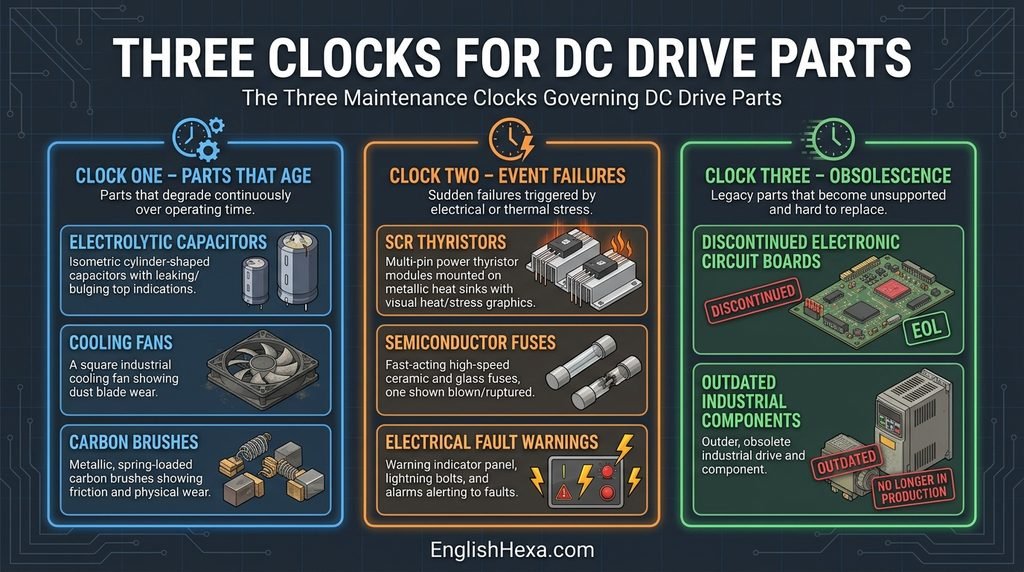
This guide from EnglishHexa organizes the whole problem around three clocks. Every DC drive part in your cabinet is governed by one of them.
Some parts age on a schedule. Some parts fail in an event. And some parts have vanished from the catalogs, which is a different problem entirely.
A note before the details: this is general information for qualified personnel. Drive work follows your site’s lockout and tagout program and the drive manufacturer’s manual, always.
The Parts Map: What Is Inside a DC Drive
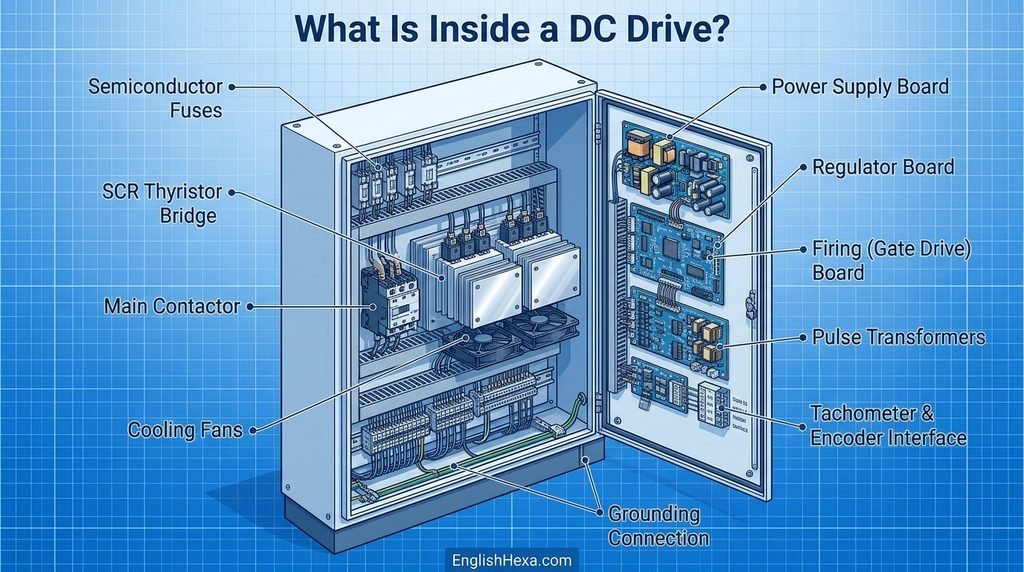
A DC drive is the controller for a DC motor. It rectifies AC power into controlled DC and regulates it so the motor holds the speed and torque the process demands.
The power stage does the heavy work. SCRs (thyristors) in a six pulse bridge convert the power, guarded by fast semiconductor fuses.
The control layer does the thinking. Regulator boards, firing boards, and power supplies decide when each SCR fires and how the drive responds.
The feedback loop closes the system. A tachometer or encoder reports real speed, and the control corrects itself against that signal continuously.
| Part Group | Key Parts | What Governs Them |
|---|---|---|
| Power stage | SCRs and thyristors, diode packs, semiconductor fuses, snubber networks, heatsinks | Event failures (Clock Two) |
| Control | Regulator and control boards, firing boards, pulse transformers, power supply boards | Age and obsolescence (Clocks One and Three) |
| Feedback | Tachometer generators, encoders, feedback boards | Wear and obsolescence |
| Cooling | Fans, filters, heatsink assemblies | Age (Clock One) |
| Switching | Main contactors, coils, contact kits | Wear (Clock One) |
| Motor side | Carbon brushes, commutator, field supply parts | Wear and inspection (Clock One) |
Read the map before ordering. Misorders happen when one group’s symptom gets another group’s part.
Clock One: Parts That Age
Age parts do not wait for a dramatic failure. They degrade on a schedule set by heat and hours, and the professional move is to replace them before they take the drive down.
Electrolytic Capacitors
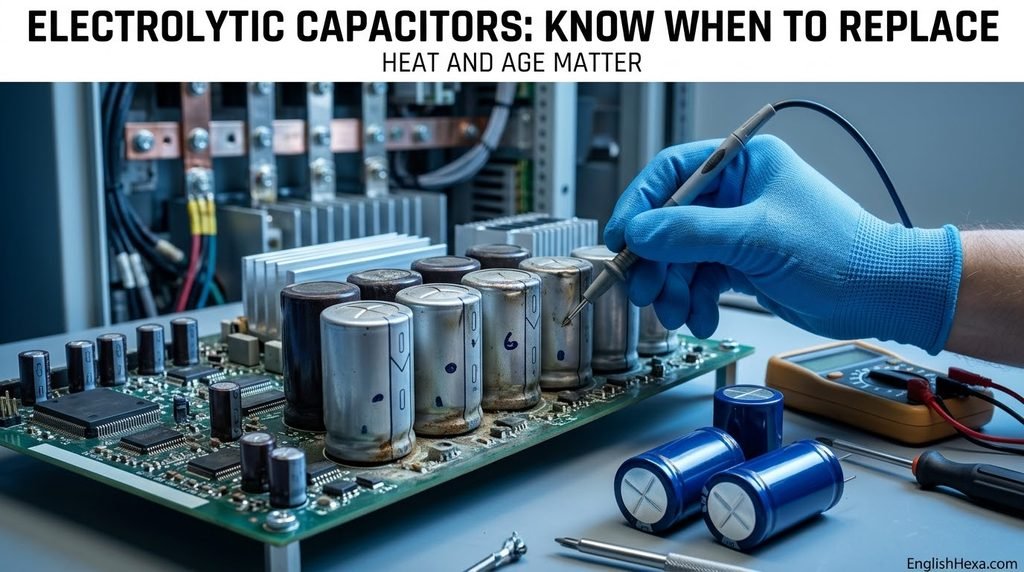
Capacitors are the drive’s main wear item. Repair shop experience puts useful life at about 8 to 12 years; maintenance guidance, including Wistex’s DC drive guide, allows 10 to 15 years.
Heat decides where in that range a drive lands. A hot, dusty panel can halve the life, which is why the same drive model ages differently in different plants.
Aging shows as rising nuisance trips, misfiring, and bus voltage faults. A drive that behaves cold and faults warm is describing its capacitors until proven otherwise.
Cooling Fans
Fans are the second age part, and the cheapest insurance in the cabinet. A failed fan announces itself as a thermal trip, usually under load, usually at the worst moment.
Serious maintenance programs replace fans preventively, alongside capacitors. The cost asymmetry is the entire argument: a fan costs a fraction of the power stage it protects.
An OEM training document for a large SCR system lists the fan unit at about 90 minutes to replace, against 30 for cards and modules. Cooling is a real assembly, not an afterthought.
Carbon Brushes and the Commutator
Brushes live on the motor, and they are the classic consumable. They are replaced on inspection, when length and spring pressure say so, not on a calendar.
The grade matters as much as the length. A wrong brush grade, or a worn brush left in service, scores the commutator and turns a cheap part into a motor repair.
Inspection rhythm follows duty. Heavily used motors get checked more often, and the commutator’s condition is read at the same visit.
Contactors
Main contactors switch the drive’s power and erode a little with every operation. Tips pit, coils weaken, and sellers stock contact kits for exactly this reason.
A chattering or dropping contactor mimics drive faults convincingly. It belongs early in every diagnostic sequence, before any board is condemned.
Clock Two: Parts That Fail by Event
Event parts die from something that happens: a surge, an overcurrent, a stalled motor, a decade of thermal cycles arriving at once. Diagnosis here is symptom first, meter second, order last.
SCRs and Thyristors
The SCR is the drive’s muscle. Six of them form the bridge in a non regenerative (2 quadrant) drive; twelve, in two anti parallel bridges, form a regenerative 4 quadrant drive.
SCRs fail shorted as a rule. A shorted device conducts when it should block, and the bridge delivers power the control never asked for.
The causes repeat across repair literature: voltage transients, overcurrent, commutation problems, thermal cycling, and misfires driven by a sick firing circuit, the cause Flexa Systems’ Parker drives guide emphasizes on large drives.
Semiconductor Fuses
A semiconductor fuse is not a household fuse. It is an ultra fast device whose let through energy is matched to the SCR, clearing in microseconds to die in the SCR’s place.
That is why OEM spares lists specify them exactly. One elevator drive maker’s list names a 250 amp semiconductor fuse beside SCR packs rated 162 amps at 1600 volts and 330 amps at 1200 volts.
The Symptom Table
| Symptom | First Suspects | First Test |
|---|---|---|
| Motor runs full speed, no control | Shorted SCR or power module | Meter test the SCRs and diodes, power isolated |
| Fuse blows instantly on power up | Shorted SCR, diode, or motor/cable short | Find the short before replacing the fuse |
| Nuisance trips, worse when hot | Aging capacitors, weak fan | Inspect capacitors; verify fan and airflow |
| Rough running, torque pulsation | Firing board, pulse transformer, one dead SCR channel | Check gate pulses channel by channel |
| Thermal trips under load | Fan failure, clogged heatsink, overload | Cooling path first, load second |
| Speed hunts or drifts | Tachometer wear, feedback wiring | Measure feedback signal quality |
| Dead control, healthy power stage | Control board power supply, board failure | Check low voltage rails before condemning the board |
The fuse rule governs this whole clock. A blown fuse is a messenger, and replacing it before finding the short usually produces one more blown fuse, sometimes in seconds.
Testing Before Ordering
Run the sequence before any part is ordered:
1. Isolate and lock out
All power off, absence of voltage verified, bus capacitors given time to discharge. The DC motor can sit at line voltage even when stopped, per OEM manual warnings.
2. Read the fuses
Which fuse blew is information. An armature fuse, a line fuse, and a field fuse each point at a different neighborhood of the drive.
3. Meter the power stage
Diode mode across each SCR and diode, per the manual. A near zero reading names the short; neighboring devices get checked for the domino damage shorts leave behind.
4. Inspect the motor side
Brushes, commutator, and cabling before the drive is condemned. A large share of supposed drive failures live in the motor or its leads.
5. Verify the feedback
A tachometer signal that is noisy or absent explains runaways and hunting without any power stage fault at all.
Boards come last in the sequence. Control electronics are condemned after power, cooling, motor, and feedback have all been cleared.
Clock Three: Parts That Vanish
Vanishing parts are the legacy problem. The drive still works, the motor is sound, and the control board that failed was discontinued a decade ago.
Four routes exist, in rising order of disruption. The right one depends on the platform, the budget, and how much downtime the plant can schedule.
| Route | What Changes | Best When |
|---|---|---|
| Component-level repair | Only the failed components on the existing board | The board is obsolete but repairable, and a skilled shop is available |
| Board swap (surplus or refurbished) | The whole board, for a tested spare | An exact spare exists and provenance is trustworthy |
| Retrofit controller | New digital control on the existing SCR stack | The power stage and motor are healthy; diagnostics and support are wanted |
| Full replacement or AC conversion | Drive, and for conversion the motor and wiring too | Repeat failures, end of life platform, or process needs have changed |
Component-level repair is the route Motion Tronic’s component-level repair explainer defines most clearly. A technician finds and replaces the failed components on the board itself, which works even when no spare board exists anywhere.
The retrofit route is a real product category now. the Bardac PLXD stack controller page describes a fully digital controller built to replace older SCR stack controllers, driving existing thyristor gates through a pulse transformer unit.
A retrofit keeps the stack, motor, and wiring. It replaces the thinking, keeps the muscle, and restores diagnostics and vendor support to a platform that had neither.
Replacement wins on its own evidence. Repeated failures, parts priced near a new drive, or a platform past roughly 20 years with compounding age faults, the criteria Wistex’s DC drive guide lists, all argue for it.
Identification: Nameplate, Part Number, Cross Reference
Identification discipline is where orders succeed or fail. Sellers of industrial parts, ATEL Elevator’s parts and components page among them, work from a photo of the nameplate and the part number, and cross from there.
The order of information matters:
1. The drive’s identity
Manufacturer, model, and rating from the nameplate, photographed. A drive family spans decades of revisions, and the model alone does not pin the variant.
2. The part’s own number
The OEM part number from the board or device, or from the manual’s spares list. Board revisions change layouts and connectors while keeping the same function.
3. The ratings that must match
For SCRs: current, voltage class, package, and gate characteristics. For fuses: the exact semiconductor type and rating. For tachometers: volts per 1000 RPM. Generic descriptions misorder parts daily.
Parameter backup belongs to identification too. Before any board comes out, the drive’s parameter settings are documented, because the replacement board arrives programmed for nobody’s motor.
Spares Strategy for Critical Drives
Stocking converts a breakdown from a week into a shift. Wistex’s DC drive guide recommends keeping fuses, SCRs, control boards, and feedback devices on hand for critical applications.
| Spare | Why It Earns the Shelf |
|---|---|
| Semiconductor fuses (exact type) | They die protecting the drive; the line waits on a fuse nowhere else stocks |
| SCR set or power module | The most common event failure in the power stage |
| Control board (or a repair route) | The vanishing part; a tested spare or a known shop beats a search at midnight |
| Cooling fan | Cheap, age limited, and its failure can cascade |
| Tachometer or encoder | Feedback failure stops the drive as surely as a power fault |
| Motor brushes (correct grade) | The consumable that protects the commutator |
| Parameter documentation | Not a part, and worth more than several that are |
Scale the shelf to criticality. A drive whose stoppage idles a plant justifies a full set; a drive with a twin on the next line may justify only fuses and a fan.
Businesses that sell uptime live on this logic. The operational framing in our service business systems is the service industry version of the same spares and systems thinking.
Lead times are part of the strategy. Obsolete parts move through surplus channels at unpredictable speed, which is precisely why the critical ones sit on your shelf instead.
Safety Boundaries for Drive Work
Everything in this guide is general information. Hands on drive work belongs to qualified personnel working under their site’s electrical safety program.
Isolate and lock out every source before opening the cabinet. Verify absence of voltage, and let DC bus capacitors discharge before touching the power stage.
Respect the stopped motor. OEM manuals warn that a DC motor may be at line voltage even when it is not running, and brushes are serviced only with power proven off.
Handle boards as ESD sensitive, because they are. OEM replacement kits warn about electrostatic discharge explicitly, and a careless hand can write off the board you just bought.
Torque and compound matter on power devices. OEM SCR kits specify mounting torque and include thermal compound or silicone oil, because a loosely mounted SCR overheats at a fraction of its rating.
The remaining explainers on our blog follow the same rule this guide does. Documents and discipline first, and the hardware decisions get easier in that order.
Frequently Asked Questions
What are DC drive parts?
The replaceable components inside and around a DC drive, the controller for a DC motor.
The groups: the power stage (SCRs or thyristors, diode packs, semiconductor fuses), the control electronics (regulator and control boards, firing boards, power supply boards), and the feedback devices (tachometer generators, encoders).
Add the supporting parts (contactors, cooling fans, capacitors, snubber networks, pulse transformers, braking resistors) and the motor side consumables, above all carbon brushes. Parts buying starts with identifying which group the failure lives in.
What is an SCR in a DC drive?
A silicon controlled rectifier, also called a thyristor: the power semiconductor that rectifies AC into controlled DC for the motor armature.
A typical industrial DC drive arranges SCRs in a six pulse bridge (six thyristors for a non regenerative, 2 quadrant drive; two bridges, twelve thyristors, for a regenerative 4 quadrant drive).
The drive’s control board fires the SCRs at precise angles to set the output voltage, which sets motor speed.
What parts fail most often in a DC drive?
Failure patterns split by cause. Age parts wear out on a schedule: electrolytic capacitors, cooling fans, and (on the motor) carbon brushes. Event parts die from stress: SCRs from voltage transients, overcurrent, and thermal cycling, and the semiconductor fuses that sacrifice themselves protecting them.
Control boards fail from a mix of age, heat, and surges. Maintenance guides converge on this list, which is why symptom first diagnosis works: the symptom usually names the group.
Why does my DC drive keep blowing fuses?
Because a fuse is a messenger, not a root cause. A semiconductor fuse blows to protect the SCRs, most often because an SCR has shorted downstream, or because of a short in the motor, cables, or a failed diode.
Replacing the fuse without finding the short usually produces another blown fuse, sometimes within seconds (a pattern repair forums document repeatedly on small drives). The correct sequence is power off, test the SCRs and diodes, inspect the motor and cabling, then fuse last.
What happens when an SCR shorts?
A shorted SCR conducts when it should be blocking, so the drive loses control of its output for part of each cycle.
The classic symptom is the motor running at full speed with no speed control, because the bridge delivers near maximum voltage regardless of the control signal.
Power semiconductors typically fail shorted, which is why loss of control plus a blown fuse is treated as an SCR short until testing proves otherwise.
How do you test an SCR?
With power isolated and locked out, an ohmmeter or a multimeter’s diode mode across the device: a healthy SCR shows high resistance between anode and cathode in both directions (until the gate is triggered), while a shorted one reads near zero.
Experienced technicians also check the gate to cathode junction and the surrounding diodes, because failures cascade (the domino effect): a shorted SCR often damages its fuse, its snubber, or a neighboring diode.
Exact procedures vary by device and drive; the drive’s manual and device datasheet govern.
What is a semiconductor fuse, and why not a regular fuse?
A semiconductor fuse is an ultra fast fuse designed to clear in the microseconds before an SCR is destroyed by a short circuit (its let through energy, I2t, is matched to the SCR’s rating).
A standard fuse is far too slow: by the time it opens, the SCR it was protecting is already shorted.
This is why DC drive spare lists specify semiconductor fuses by exact type and rating (one elevator drive list specifies a 250 amp semiconductor fuse, for example), and why substituting a hardware store fuse is false economy.
How long do DC drive capacitors last?
Electrolytic capacitors are the drive’s main wear item.
Field guidance puts useful life around 8 to 12 years in repair shop experience, and up to about 10 to 15 years in maintenance guides, depending heavily on temperature and load: heat is the multiplier, and a hot panel shortens life dramatically.
Because failure is gradual (capacitance falls, ripple rises), many plants replace capacitors preventively on age rather than waiting for the trips to start.
What are the signs of failing drive capacitors?
Rising nuisance trips, especially under load or on hot days; misfiring and erratic speed; DC bus undervoltage or overvoltage faults; visible bulging, leaking, or a domed top on the capacitors themselves; and a drive that behaves when cold and faults when warm.
Capacitor aging is the first suspect class on any drive over ten years old with diffuse, intermittent symptoms, because the same aging also stresses the SCRs and firing circuits around them.
How often should DC motor brushes be replaced?
On inspection, not on a calendar: brush length, spring pressure, and commutator condition decide.
Maintenance manuals direct regular inspection of brushes and commutator, replacement when brushes approach their wear limit, and use of the correct brush grade, because a wrong grade or a worn brush left too long scores the commutator, which turns a cheap consumable into an expensive motor repair.
Heavily used motors are inspected more often; the interval follows duty, environment, and brush wear rate.
What does a firing board do?
The firing board (gate drive board) generates the precisely timed pulses that trigger each SCR’s gate, in the sequence the six pulse bridge requires.
It takes its orders from the regulator or control board and delivers them, usually through pulse transformers that isolate the low voltage control from the power stage.
A faulty firing board causes misfires: rough running, torque pulsation, blown fuses, or a bridge that damages its own SCRs, which is why firing faults and SCR failures are diagnosed together.
Control board or power stage: which failed?
Symptoms split them. A dark or unresponsive control, lost parameters, or logic faults with a healthy power section points at the control side (control board, its power supply).
Blown semiconductor fuses, full speed runaway, or a trip the instant power is applied points at the power stage (SCRs, diodes, snubbers).
Repair guides for major drive families note the control board is often fine and the failure sits in the power stage or the internal power supply, but intermittent, diffuse faults can belong to either, which is why bench diagnosis exists.
Can a DC drive control board be repaired, or must it be replaced?
Both routes exist. Board level repair swaps the whole board (fast, if a spare or the OEM still stocks it).
Component level repair diagnoses the board itself and replaces only the failed components (capacitors, regulators, ICs, relays), which works even when the board is obsolete and no spare exists anywhere.
For legacy drives, component level repair is often the only route short of a retrofit, and repaired boards should be load tested, not just powered up.
What is component-level repair?
Repairing an electronic unit by finding and replacing the individual failed components on its boards, rather than replacing the board or the whole drive.
Repair shops describe it as the fastest and most cost effective route back into production for industrial electronics, and the only route that works on obsolete equipment whose boards are no longer manufactured.
Its requirements are diagnostic skill, the right components, and testing under realistic load afterward.
What is a tachometer, and when does it need replacing?
A tachometer generator is a small DC generator coupled to the motor shaft that outputs a voltage proportional to speed, giving the drive its speed feedback signal.
It wears like a miniature motor (brushes, bearings, commutator) and its signal degrades: symptoms include speed instability, hunting, and drift that calibration cannot cure. Replacement must match the original’s voltage per thousand RPM rating, or the drive’s scaling will be wrong.
Tachometer vs encoder feedback: what is the difference?
A tachometer gives an analog voltage proportional to speed: simple, robust, and standard on analog era drives. An encoder gives digital pulses: more precise, no brushes to wear, and standard on digital drives. Many drives accept either with configuration.
Feedback choice affects low speed stability and accuracy; a failing tachometer on an old drive is sometimes the trigger for a control retrofit that moves the system to encoder feedback.
What does the field regulator do?
It supplies controlled DC to the motor’s field winding. Field current sets the motor’s torque and, above base speed, its maximum speed (field weakening).
Field supplies are their own subassembly (a field regulator board or field rectifier, with its own fuses) and their failures look distinctive: loss of field can cause overspeed or a drive trip, weak field causes low torque and overheating.
Field parts are smaller than armature parts but just as specific to the drive model.
Why does my drive trip on overtemperature?
Because its cooling path has failed or been overwhelmed: a failed or slowing cooling fan is the first suspect, followed by clogged heatsink fins and filters, a blocked panel vent, or an overloaded drive.
Fans are age parts and are replaced preventively in serious maintenance programs.
An OEM training document for a large SCR system lists fan replacement at about 90 minutes against about 30 minutes for cards and modules, a reminder that cooling is a real assembly, not an afterthought.
What is a snubber network?
A resistor capacitor network connected across each SCR (or the bridge) that absorbs voltage spikes and slows the rate of voltage rise, protecting the thyristors from false triggering and transient damage.
Snubber components (film or ceramic capacitors and power resistors) age and fail, and a failed snubber often takes its SCR with it, or is taken out by it. On SCR replacement, the snubber belongs on the inspection list before the drive is re-energized.
What is a pulse transformer in a DC drive?
A small isolation transformer that carries the firing pulse from the low voltage firing board to an SCR’s gate, while keeping the gate circuit electrically isolated from the control electronics at line potential. Larger drives use one per SCR or per pair.
They rarely fail, but when a single SCR never fires (or fires late) with a healthy gate signal at the board, the pulse transformer and its wiring are on the suspect list.
Modern digital retrofit controllers ship with a separate pulse transformer unit for exactly this interface.
2 quadrant vs 4 quadrant drives: do parts differ?
Yes, mainly in the power stage count. A 2 quadrant (non regenerative) drive has one six thyristor bridge and controls speed in one direction with no regenerative braking.
A 4 quadrant (regenerative) drive has two bridges in anti parallel (twelve thyristors) and can brake and reverse by regenerating into the supply. More thyristors, more fuses, more firing channels, and a more complex control.
When ordering parts, the quadrant configuration is part of the drive’s identity, along with model and rating.
My drive is obsolete and parts are discontinued. What are my options?
Four, in rising order of disruption. Component level repair of the existing boards (keeps everything else untouched). Surplus and refurbished parts (workable, with testing and counterfeit awareness).
A modern digital controller retrofit onto the existing SCR power stack, a product category that exists precisely for this (new control, old thyristors, same motor).
Or full replacement of the drive, or a DC to AC conversion, when the motor and mechanics are also at end of life.
Can a modern controller run my old SCR stack?
Yes; that is the retrofit controller category. Digital stack controllers are built to interface directly to existing SCR bridges through a pulse transformer unit, in 2 or 4 quadrant configurations, with built in field control and tachometer, encoder, or armature voltage feedback.
The power stage (thyristors, fuses, heatsinks, contactors) is reused if healthy. This route modernizes diagnostics and controls without replacing the motor, the stack, or the machine wiring.
Repair vs replace a DC drive: how to decide?
Maintenance guidance converges on a pattern. Repair suits single, identified component failures (fuses, fans, brushes, an SCR set, a board) on a drive whose platform is still supported or repairable.
Replacement gains the case when failures repeat, when parts are unavailable or priced near a new drive, when the drive is past roughly 20 years with compounding age failures, or when a new system brings operational benefits the old one cannot.
Downtime cost usually outweighs the parts bill in the calculation.
When is a DC to AC conversion worth it?
When more than the drive is tired: a worn motor needing rewind or replacement, chronic brush and commutator maintenance, or a process that needs the control features of modern AC systems.
Conversion means a new motor, new drive, rewiring, and often mechanical redesign, with the downtime to match, which is why plants with sound DC motors and mechanics usually keep them and invest in the drive side instead.
The decision is a capital comparison, not a fashion statement.
How do I identify the right replacement part?
By the drive’s nameplate and the part’s own number, in that order: drive manufacturer, model, serial or rating, then the OEM part number from the board or device itself (or the manual’s spare parts list).
Sellers of industrial parts routinely ask for a photo of the nameplate and the part number to cross to the correct replacement. Generic descriptions (a 40 amp SCR) are not enough: package style, gate characteristics, voltage class, and mounting all vary.
What spare parts should I stock for a critical DC drive?
Maintenance guides recommend keeping the high failure, line stopping parts on hand: semiconductor fuses (the exact type), a set of SCRs or the SCR module, and the control board or a repair route for it.
Add feedback devices and cooling fans, scaled to how long the line can wait for a delivery.
Add the motor’s brushes. The stocking list is cheap insurance next to a stopped line, and it should be paired with documented parameter settings for the drive.
Do I need to back up parameters before changing a board?
Yes. A replacement control board arrives unprogrammed (or programmed for someone else’s motor), and repair guidance is explicit: document parameter settings before making changes so they can be restored.
Scaling settings tie the drive to its specific motor and feedback device; a board swapped without them can leave a drive that runs wrongly or not at all.
The backup habit (a written or saved parameter list per drive) belongs in the maintenance file, not in someone’s memory.
What safety precautions apply when replacing DC drive parts?
This work is for qualified personnel, under the site’s electrical safety program.
Core points from OEM manuals: isolate and lock out all power (the DC motor can sit at line voltage even when not running), verify absence of voltage, and allow DC bus capacitors to discharge.
Observe ESD precautions for boards (OEM replacement kits warn of ESD sensitive assemblies), and use the correct PPE and procedures for the voltage class.
This summary is general information, never a substitute for the drive’s manual and your site’s rules.
Can I replace an SCR with a higher rated one?
Sometimes, and only with the datasheet open.
Current and voltage ratings at or above the original are necessary but not sufficient: gate trigger requirements, package and mounting, thermal characteristics, and surge (I2t) coordination with the semiconductor fuse all matter, and a mismatched gate can cause misfiring worse than the original fault.
The safe default is the OEM part or a documented cross reference; uprating is an engineering decision, not a shopping shortcut.
What causes SCRs to fail?
Voltage transients (line surges, lightning, switching spikes), overcurrent from motor or load faults, thermal cycling over years of service loosening thermal interfaces, cooling failures, commutation problems, and misfires driven by a sick firing circuit, the cause repair shops emphasize on large DC drives.
Age alone features in post mortems: decades of heat cycles degrade even an unstressed device. A failed SCR is evidence; the cause decides whether its replacement survives.
Why does the motor run at full speed with no control?
The classic SCR short symptom: a shorted thyristor (or a failed power module) passes the supply through regardless of the control signal, so the motor sees near full voltage from the line.
Forum documented cases on small drives show the same pattern (and often a fuse that blows immediately on power up).
A lost feedback signal can also cause a drive to run away to a limit, which is why diagnosis separates the power stage from the feedback loop before parts are ordered.
What does a contactor do in a DC drive?
The main contactor connects and disconnects the drive’s power (and in many designs is part of the safety and sequencing chain, with an auxiliary role in precharge or braking circuits).
Contactors are wear parts: tips erode, coils fail, and sellers stock replacement contact kits (tips and coils) for exactly this reason.
A contactor that chatters, welds, or drops out under load produces faults that mimic drive failures, so it is checked early in the sequence.
How do I know if the problem is the drive or the motor?
Separate them methodically: the drive’s output can be tested against a known load or measured for balance and waveform per the manual, and the motor can be inspected and tested independently (brushes and commutator first, then insulation and armature tests by qualified shops).
Field experience: brush and commutator condition, blown drive fuses, and feedback faults account for a large share of supposed drive failures. Ordering drive parts before this separation is how good boards get replaced on healthy drives.
What does a dynamic braking resistor do?
It gives the motor’s stored energy somewhere to go during stopping: the drive connects the braking resistor across the armature, and the motor’s rotation is converted to heat in the resistor bank until the shaft stops.
Resistor banks are sized to the drive and duty; open circuited or shorted sections show up as long stops or trips during deceleration.
On regenerative (4 quadrant) drives, braking energy returns to the supply instead, which is one of the parts count differences between the two designs.
How long do drive cooling fans last, and should I replace them preventively?
Fans are age parts with finite bearing life, shortened by heat and dust.
Serious maintenance programs replace them preventively on age alongside capacitors, because a fan failure rarely announces itself before the thermal trip, and a thermal trip under load can take SCRs with it.
The cost asymmetry (a fan versus a power stage) is the whole argument.
What information do I need when ordering parts?
The drive’s manufacturer, model, and rating from the nameplate (a photo is standard practice), the OEM part number from the failed part or the manual’s spares list, and the machine context for feedback and motor parts (tachometer rating, brush grade and dimensions).
For elevator and other vertical drives, the OEM spares lists are published by system (semiconductor fuse ratings, SCR pack ratings, board part numbers), which is why the nameplate photo gets you a crossed replacement quickly.
Are refurbished and surplus parts a good idea?
They are a legitimate channel for obsolete equipment, with conditions: buy from sellers who test and warrant, verify the exact part number and revision, and be alert to counterfeits, which are a documented problem in power semiconductors.
For a critical line, a tested surplus board can beat a six week repair queue; for a safety related function, provenance matters more than price. Load test after installation, whichever channel supplied the part.
What is a current transformer doing in a DC drive?
Current transformers (CTs) sit on the AC input or the bridge and give the control board an isolated measurement of the current the drive is delivering. That signal drives current limiting, overload protection, and the current regulator.
A failed or miswired CT corrupts everything downstream of it: false overcurrent trips, poor current control, or no protection at all. CTs are small, cheap, and diagnostic blind spots, which is why they are checked when current behavior makes no sense.
How are parts different in small DC drives (KB, Dart class) vs industrial drives?
Scale and serviceability.
Small chassis drives (the fractional to a few horsepower class from KB Electronics, Dart Controls, Minarik, and similar) integrate most functions on one board with a handful of power devices.
Some models use plug in horsepower resistors for current scaling. These drives are often replaced whole because the board costs approach the drive’s price.
Industrial drives separate power stage, firing, and control into field replaceable assemblies. The failure physics is the same; the parts granularity is not.
What does load testing after repair prove?
That the drive works under the conditions that failed it. Repair shops distinguish powering up from testing under realistic load (their phrase for it), because many faults (weak capacitors, marginal SCRs, a sick firing channel) only appear at current.
A repaired drive returned without load testing is a hypothesis. For the buyer, asking what test a repair includes is as important as asking its price.
DC drive parts: what should I check first when a drive fails?
In order: the fuses (and what their condition implies), the incoming supply and contactor, the cooling fan and for overheating evidence, the SCRs and diodes by meter test, the motor’s brushes and commutator, and the feedback device and its wiring.
Then the control electronics, with parameters verified before boards are condemned. That sequence follows how the parts actually fail: protection and power first, consumables and feedback next, logic last. —
Conclusion
DC drive parts stop being a mystery once the three clocks are separated. Age parts get replaced on schedule, event parts get diagnosed by symptom and meter, and vanishing parts get a route, not a panic.
Identify before ordering: nameplate, part number, ratings, configuration. That discipline, plus a parameter backup on file, prevents most of the expensive mistakes in this niche.
Stock the parts whose absence stops your line: fuses, SCRs, a board route, a fan, feedback, and brushes. The shelf is cheap; the downtime is not.
Choose the route your platform earns: repair the board, swap the board, retrofit the control, or replace the drive. Each is right somewhere, and the evidence in the cabinet tells you where.
Start with the nameplate photo. It is the first step of every correct order in this field, and it takes thirty seconds.

Dilawar Mughal is an SEO expert with 8 years of hands-on experience helping websites grow their organic traffic, rankings, and revenue. He specializes in content-driven SEO, local SEO, and Pinterest SEO, and builds practical, results-focused strategies for businesses and publishers.
