


Water slide party success is decided before the slide inflates.
The hosts who relax on the day are the ones who measured the yard, matched the slide to the age group, and staffed the ladder and the exit.
They also read the weather policy before they paid the deposit, a pattern the team at English Hexa sees across every well run event.
A water slide party looks like pure improvisation, kids, water, noise, joy. Underneath, it is a small operation with real requirements: continuous power, hundreds of gallons of water, anchoring, supervision ratios, and a wind limit.
This guide runs the whole operation in order: the rent or buy decision, the size ladder, and your yard’s five requirements.
It continues with honest prices and their sources named, the questions that vet a rental company, the safety system, a party day run sheet, and the theme, food, and recovery layers that turn a rental into a party.
What a Water Slide Party Is

A water slide party is a party built around one anchor attraction: an inflatable water slide, rented for the day or owned, set up on grass or pavement, with food, shade, and dry seating arranged around it.
The slide does the entertaining; the host’s job is everything around the slide.
There are three ways to have one. Rent a commercial unit (the default, and the subject of most of this guide).
Buy a consumer inflatable for repeated home use. Or book a venue or event operator who brings slides to parks, schools, and fields. Each path has a different cost shape and a different share of the work, compared honestly in the decision section below.
Know what the keyword is not: a water park visit and a pool party are cousins, not the same event.
The slide party’s quiet advantage is that nobody needs to swim. Guests who cannot swim ride, splash, and belong, which is why hosts choose it for mixed groups.
Size by Age: The Height Ladder
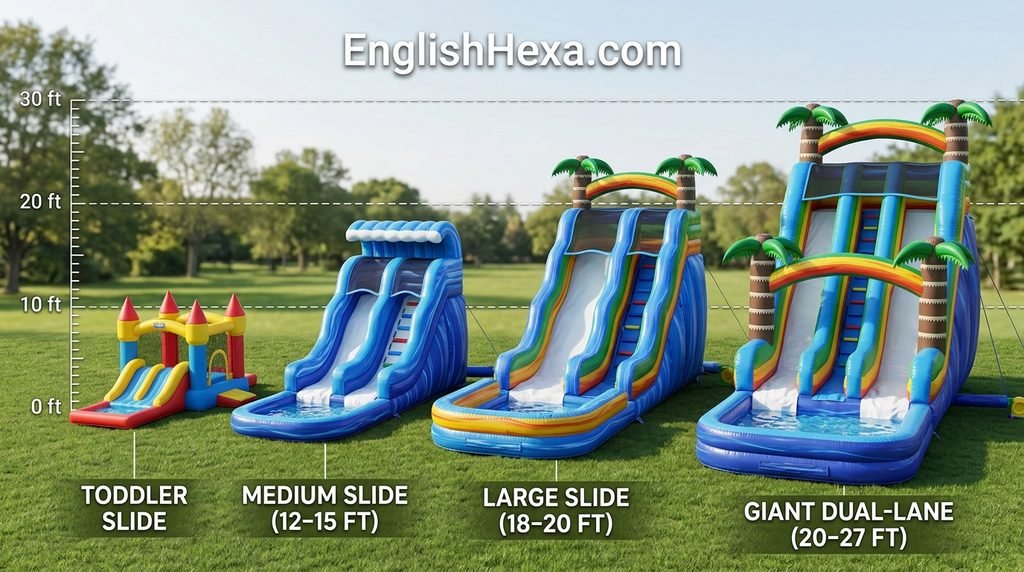
Height is the first decision because it decides who the party is for. Planning guides converge on the same ladder.
| Slide class | Typical height | Best ages | Typical footprint |
|---|---|---|---|
| Toddler and combo units | Under 12 ft slide in a combo | 2 to 5 | Combo footprint, one unit |
| Small to mid single lane | 12 to 15 ft | About 4 to 10 | About 25 to 30 ft long, 10 to 12 ft wide |
| Large single lane | 18 to 20 ft | Preteens, teens, adults | About 35 ft by 15 ft, sometimes more |
| Dual lane and giants | 20 to 27 ft | 7 to adult, big events | 40 ft plus; extensions can run 70 ft plus |
Read the ladder with your guest list, not your ambitions. A 15 foot slide thrills a seven year old and bores a fifteen year old.
A 22 foot slide delights the teen and excludes the kindergartner entirely. Mixed lists are handled with scheduling (age windows, covered in the run sheet), not with a compromise slide nobody loves.
Lanes are the second sizing decision.
Dual lanes double throughput and add racing, which is what keeps lines short at camps, schools, and block parties. For a backyard birthday with a dozen kids, a single lane cycles fast enough, costs less, and drinks less water.
Combos deserve their own sentence: a bounce house with a slide, hoop, and climb spreads young children across four activities in one footprint, which is why they anchor under seven parties better than a tall slide does.
The Five Site Requirements
Your yard must supply five things. Check all five before booking, because a failure in any one of them is discovered on delivery day, at delivery prices.
1. Space, the real kind. The setup area is always bigger than the unit. One Texas operator’s 18 foot slide measures 15 by 35 feet and requires a 20 by 40 foot setup area.
Manufacturer guidance asks about 3 feet of clear space on all sides. Measure length, width, and overhead clearance (branches, eaves, wires) and write the numbers down.
2. Access. Units arrive on dollies at 200 to 400 lb. A 36 inch gate is the safe minimum, and the largest units demand 48 inches and a clear 4 foot path.
Steps, terraces, and tight side yard turns can stop a delivery cold. Send the operator photos if access is anything but obvious.
3. Level ground. Slides need near level ground, within about two degrees by planning guidance. Riders accelerate downhill and splash pools fill unevenly on a slope. Put the slide on the flattest terrace or pad you have, and route children around steps with cones or flags.
4. Power. The blower runs continuously while the slide is up: typically 1 to 1.5 horsepower drawing roughly 8 to 12 amps.
It needs a dedicated 15 to 20 amp GFCI protected outlet within about 50 to 75 feet. Dual lane giants take two blowers on separate circuits. Park sites usually substitute a rented generator.
Keep cords and blowers dry. Water and electricity share this party by design, so the separation is managed, not assumed.
5. Water. A standard garden hose with decent pressure feeds the misting system. Hoses flow 6 to 10 gallons per minute, so a 3 to 4 hour party uses roughly 1,000 to 2,400 gallons.
The dollar cost is usually modest at residential rates. The mud cost is not, and the recovery section handles it.
Rent, Buy, or Venue: The Honest Comparison
| Path | What you get | What it costs you | Best for |
|---|---|---|---|
| Rent commercial | Big unit, delivery, setup, insurance, cleaning handled | Per event price, deposit, your site prep and supervision | Most parties, all big slides |
| Buy consumer | Smaller slide, yours forever, replays all summer | Purchase, storage, repairs, your liability, thinner material | Frequent hosts with storage and small kids |
| Venue or event operator | Slides brought to a park, school, or field, staff included options | Higher price, permits and COI paperwork | Schools, churches, companies, big crowds |
Renting wins most comparisons because the expensive parts of the day, insurance, inspection, a commercial grade unit, and a crew, arrive inside one price.
Buying only wins on repetition: many parties, young children, modest heights. The venue path wins when the guest count outgrows any backyard.
What It Costs, With Every Figure Labelled
Rental prices vary by region, season, and size more than almost any party purchase, so treat every number here as labelled evidence, not a quote.
Published planning guides put a day’s rental at roughly $150 to $275 for small single lane slides, $250 to $400 for mid size, and $350 to $650 or more for tall and dual lane models.
Named operators’ list prices show the same ladder from the other side: one Texas company lists a themed combo at $345, an 18 foot slide with pool at $375 for up to 8 hours, and a 22 foot dual lane giant at $685.
The spread is real, not an error: a Dallas operator prices a 20 foot slide from $925 for 4 hours, a metro premium that proves why national averages mislead. Your written quotes are the only prices that describe your party.
Budget the edges too. Deposits commonly run $50 to $150 at booking. Extra hours price as a percentage (one operator charges 7 percent per hour), and overnight adds a fee (plus $75 at that operator, with the second day at half price).
A generator adds $50 to $150 where the site has no power. Delivery beyond a core radius, cleaning fees for excessive mud, and late pickup fees all live in contracts; read yours before the day, not during it.
Vetting the Rental Company
The slide’s color is the least important thing about your rental. The company is the product.
Ask, and expect easy answers: Are you insured, and can you show it? Venues and parks will demand a certificate of insurance naming them.
Is the fleet state inspected where your state runs an inspection program, as Texas does annually through its insurance department? How are units cleaned between rentals? Reputable operators say so plainly; one Florida company names its sanitizing product on its FAQ page.
Then the operating questions: anchoring method for your surface, exact setup area and gate needs, who supplies hose and cords, the weather and rescheduling policy in writing, deposit and cancellation terms, and what the price window actually includes.
A good operator answers all of it without blinking. Hesitation on insurance or inspection is not a detail; it is the review.
The Safety System: Standards Plus Supervision
Start with the honest context. The CPSC study of inflatable amusement injuries estimated 113,272 emergency department treated injuries and 12 reported deaths associated with inflatable amusements from 2003 to 2013, with about 66 percent of injuries to arms and legs.
It also found over 90 percent of the injuries involved moon bounces, bounce houses, not water slides. The data argues for respect and good operation, not for fear or complacency.
The standards layer: commercially rented units should align with ASTM F2374, the standard for design, manufacture, operation, and inspection of inflatable amusement devices.
They should be built from lead free, fire retardant commercial vinyl, carry capacity and weight labels (a common per rider ceiling is 200 lb, per the manufacturer’s rating), and sit under state inspection where your state provides it.
The supervision layer is where parties are actually won.
The CPSC’s amusement ride safety bulletin for inflatables sets the staffing floor: a minimum of two operators for slides over 15 feet tall, and one for smaller slides and bounces. Experienced hosts turn that floor into a system with named positions.
The ladder monitor controls the queue and sends each rider only when the landing is clear.
The exit monitor clears the splash zone, helps riders up, and keeps the base from becoming a wrestling pit. For a dozen kids, those two sharp adults keep everything orderly; add a third roving adult when the list skews under six.
The rules themselves fit on one sign, and they are the same at every reputable operation: one rider per lane at a time, feet first and seated, no flips or roughhousing, riders grouped by similar size, clear the landing immediately, glasses and jewelry off.
Brief them out loud before the first ride, enforce them kindly, and sit a breaker out for one turn. Rules announced once and enforced always are what supervision means in practice.
Weather is part of the safety system, and the next sections give it its own law.
The preview: wind and lightning, not rain, stop play, and the operator’s wind rating governs, with manufacturers’ recommended maximums in the 15 to 25 mph range and deflation above 25.
The Party Day Run Sheet
A water slide party runs on a simple rhythm. Build the day backwards from the pickup window.
Before guests: the crew sets up, anchors, inflates, and fills. You check the unit’s condition and walk the rules with your monitors.
Stage towels, sunscreen, and the hydration station in the shade. Set the dry zone (food, gifts, seating) upwind and uphill of the splash pool if the yard allows.
Arrival and briefing: guests change, and the whole group hears the rules briefing at the slide before the first ride. Thirty seconds of briefing prevents a day of correcting.
First session: free sliding, with age windows if the list is mixed: youngest riders first while supervision is freshest, then older groups, then mixed time near the end if the crowd allows it.
The food break: schedule a real one. It empties the slide, rests the monitors, feeds children who would never voluntarily stop, and lets the grass and the splash zone recover. Cake lives in the dry zone, always.
Final session and close: last rides before the crew’s window, then towels, dry clothes, favors, and photos while the unit deflates. The invitation earns its keep here: guests who brought a change of dry clothes leave happy, and your car bound guests stay dry.
Themes, Food, and the Dry Zone
Themes work when they match the fleet. Tropical and luau is the classic pairing because rental fleets are full of palm tree slides.
Add leis, tiki touches, and pineapple drinks and the slide becomes the decor. Surf and beach, under the sea, pirate, shark, farm, and patriotic summer themes all exist as actual units, so pick the theme after you see your local fleet, not before.
Food follows physics: serve in the dry zone, favor food that tolerates heat and wet hands (grills, fruit, popsicles), and pour drinks in cans or pouches, never glass anywhere near bare wet feet.
A hydration station is not decor; on a hot day it is equipment.
The spectator layer decides whether adults remember the day fondly: shade, real seating, and a sightline to the slide from the dry zone.
Parents supervise better from comfort, and the party’s second shift, the grown ups’ own good time, happens in that shade.
More party planning patterns like these live across the English Hexa blog, because the dry zone principle, serve people where they are comfortable, generalizes to every event.
Weather Law: When Play Stops
Two rules govern, and neither is negotiable at the party.
Lightning: National Weather Service lightning safety guidance states it in one line worth memorizing: when thunder roars, go indoors, and stay there until 30 minutes after the last clap of thunder.
Lightning can strike miles ahead of rain, so the rule triggers on thunder, not on getting wet. The slide empties, the blower plan follows the operator’s storm procedure, and the party moves to its dry plan B without debate.
Wind: inflatables are sails with children on them, which is why anchoring and wind limits sit at the center of every safety bulletin. Manufacturers recommend maximum operating winds in the 15 to 25 mph range by unit; above 25 mph, unload and deflate.
If gusts are pushing the unit or worrying the crew, the decision is already made. A reputable company’s reschedule policy exists for exactly this morning; use it without guilt.
Rain alone, by contrast, usually changes nothing for a wet slide beyond moving the cake under cover. Know which of the three you are actually facing.
Yard Recovery and Pickup
The day after is part of the party, and it is mercifully small.
Tarps at the entry, exit, and queue, which several operators provide or recommend, keep the worst wear off the grass. Position splash drainage away from paths where you can, and expect one honest worn patch where the pool sat.
Rake the patch level, overseed it, and water it with the same hose that filled the slide; ten minutes of work, a few weeks of patience.
Inside, the recovery is towels: run the wet load the same evening and the party is fully closed before the photos are even sorted.
The Booking Timeline: When Each Decision Happens

Four to six weeks out (peak season): measure the yard and gate, choose the size class, and get two written quotes. Peak summer Saturdays book first, and the slide you want is a fleet of a few units, not a warehouse.
At booking: deposit paid, contract read, and the weather, reschedule, and cancellation terms confirmed in writing. Send the operator your yard photos and measurements now, not on delivery morning.
The week before: reconfirm the arrival window, clear the setup area and the delivery path, check the outlet and hose reach, and recruit your monitors by name. Brief them before the day, not during it.
The day before: watch the forecast like it is your job. If lightning or high wind is coming, the reschedule conversation happens now, while it is still a conversation.
Mistakes and Fixes
Mistake: booking by photo. The prettiest slide fails a 34 inch gate or a 30 foot yard. Fix: measure yard, gate, and overhead first, and book the slide that fits the numbers.
Mistake: one circuit for everything. Blower, bounce house, and the fridge’s circuit trip together mid party. Fix: a dedicated circuit for the blower, and a generator plan for parks.
Mistake: supervision by crowd. Ten parents watching means nobody is watching. Fix: named monitors at ladder and exit, in shifts, briefed before the first ride.
Mistake: mixed ages, no windows. Toddlers and teens sharing lanes is the classic incident shape. Fix: age windows and similar sizes per run, littlest first.
Mistake: no weather terms in writing. The forecast turns and the deposit becomes an argument. Fix: wind, lightning, and reschedule policy confirmed in the contract, plus a dry plan B.
Mistake: glass and chaos in the splash zone. Bare feet, bottles, and food at the pool edge. Fix: a dry zone with cans and pouches only, and food that waits for the break.

Frequently Asked Questions
What is a water slide party?
A party built around a rented or owned inflatable water slide as the main attraction, usually in a backyard, park, or school field in summer. The slide anchors the event; food, shade, dry seating, and water games fill the time around it.
How much does it cost to rent a water slide?
Published guide ranges put small single lane slides around $150 to $275 a day, mid size slides around $250 to $400, and tall or dual lane slides around $350 to $650 or more, varying by region, season, and height.
Individual companies list their own prices by unit; one Texas operator lists an 18 foot slide with pool at $375 for up to 8 hours. Treat every figure as company or guide stated and quote your own event.
What size water slide do I need for a birthday party?
Match height to age.
Planning guides put small to mid slides at 12 to 15 feet for ages about 4 to 10, with footprints around 25 to 30 feet long and 10 to 12 wide. Large slides of 18 to 20 plus feet serve preteens, teens, and adults.
How much space does an inflatable water slide need?
More than the unit size: setup areas run several feet larger in every direction.
One operator’s 18 foot slide measures 15 by 35 feet but needs a 20 by 40 foot setup area, and manufacturer guidance asks about 3 feet of clear space on all sides, plus a clear delivery path and gate.
What do I need to provide for a water slide rental?
Level ground, a standard garden hose with decent pressure reaching the setup spot, and a dedicated 15 to 20 amp GFCI protected outlet within roughly 50 to 75 feet for the blower.
Park sites often need a rented generator instead, and the rental company handles anchoring, setup, and takedown.
How much water does a water slide party use?
A typical garden hose flows about 6 to 10 gallons per minute; over 3 to 4 hours of sliding that is roughly 1,000 to 2,400 gallons.
At common residential rates that often works out to a modest sum in dollars, but check your local rate and expect the area around the pool to get muddy; tarps at entry and exit help.
How much power does an inflatable water slide use?
Most slides run one 1 to 1.5 horsepower blower drawing roughly 8 to 12 amps at 120 volts, and it must run continuously while the slide is in use.
Large dual lane units may use two blowers on separate circuits. Keep cords and blowers dry, guides stress, because water and electricity share the site.
How long is a typical water slide rental?
Most companies price a standard window, often up to 8 hours, with extra hours at a percentage, overnight options for a fee, and second day discounts.
The displayed price usually covers a set window, not unlimited time, so confirm hours, late fees, and pickup times in the contract.
Are inflatable water slides safe?
Rented commercially, they operate as regulated amusement devices: look for ASTM F2374 alignment, state inspection where required, liability insurance, and lead free, fire retardant commercial vinyl.
Context from the CPSC study of inflatable amusement injuries matters: most inflatable injuries in its data involved bounce houses, and outcomes track operation, anchoring, supervision, and one rider per lane.
What safety rules should a water slide party have?
The consistent set across operators: one rider per lane at a time, feet first and seated, no flips or roughhousing, group riders by similar size, clear the landing zone immediately, no glasses or jewelry, and continuous adult supervision.
Post the rules where riders queue, and enforce them kindly and constantly.
How many adults should supervise a water slide party?
At minimum, one designated adult monitor per slide.
The CPSC’s amusement ride safety bulletin for inflatables sets the floor: two operators for slides over 15 feet tall, one for smaller slides and bounces. Experienced hosts assign them by position: one at the ladder, one at the exit.
Can adults use rental water slides?
Yes, on units rated for them: many 18 foot and taller slides list ages 5 to adult or 7 to adult with per rider weight limits (one large unit lists 200 lb max per person).
Check the specific unit’s age and weight ratings; toddler and small slides are not built for adult riders.
What age is a water slide party best for?
Slides exist for nearly every age: toddler and combo units for under 5s, 12 to 15 foot slides for the 4 to 10 core birthday range, and 18 to 22 foot slides for teens and adults.
The planning mistake is one slide for a wide age spread without age windows; schedule younger kids first, then open it up.
What is the difference between renting and buying a water slide?
Renting buys a commercial grade unit, delivery, setup, insurance, and no storage or repair burden, priced per event.
Buying a consumer inflatable costs less per use across many parties but is smaller, thinner material, your maintenance, and your liability. Frequent hosts with storage sometimes buy; most party hosts rent.
What is a water slide combo unit?
A bounce house and slide combination, often usable wet or dry, with extras like a basketball hoop or climbing wall inside one footprint.
Combos anchor parties for younger kids and mixed ages because they spread children across activities instead of one queue; one farm themed combo lists a double slide, bounce area, hoop, and climb for $345 a day at its operator.
Should I get a single lane or dual lane slide?
Dual lanes double throughput and add racing, which keeps lines short at big events; campus, camp, and block parties benefit most.
Single lanes cost less, need less space and water, and suit typical backyard birthdays. Match lanes to your peak queue, not your guest total.
What happens if it rains on my water slide party?
Light rain rarely stops a wet slide; lightning and high wind do.
National Weather Service lightning safety guidance gives the rule: when thunder roars, go indoors, and stay there until 30 minutes after the last clap of thunder. Get the rain and reschedule terms in writing, and keep a dry plan B.
What wind is too much for an inflatable water slide?
Follow the unit manual and the operator’s policy.
The CPSC’s amusement ride safety bulletin for inflatables summarizes the practice: manufacturers recommend maximum winds in the 15 to 25 mph range by unit, and inflatables should be unloaded and deflated when wind exceeds 25 mph. If the crew says shut it down, shut it down.
Can a water slide go on concrete or a driveway?
Often yes, with ballast anchoring (sandbags or water barrels) instead of stakes, and padding considerations at the landing. Grass is preferred for staking and comfort. Tell the company your surface when booking; anchor method, price, and even unit eligibility can change with the surface.
Can I have a water slide party at a park?
Usually, with conditions: many parks require permits, an approved vendor list, and a certificate of insurance naming the venue or city, plus generator power since outlets may not be available.
Confirm all of it before booking; guides warn that unpermitted park inflatables get shut down.
How far in advance should I book a water slide?
Peak summer Saturdays book out first, so reserve as soon as your date is set, especially for large or themed units. Booking involves a deposit (guides cite $50 to $150 commonly) with the balance and contract details confirmed before delivery day.
What should I ask a water slide rental company before booking?
Insurance and state inspection status, cleaning between rentals, anchoring method for your surface, exact setup area and gate needs, power and water responsibilities, weather and reschedule policy, deposit and cancellation terms, and what the price window includes.
Good operators answer all of these easily; hesitation is information.
Are rental water slides cleaned between parties?
Reputable operators clean and sanitize units between rentals and say so on their pages; one Florida operator names its on site sanitizing product. Ask the question directly anyway, and check the unit’s condition at setup before the crew leaves.
What food works best at a water slide party?
Food that tolerates heat and wet hands: grilled items served in the dry zone, fruit, popsicles and ice based treats, and drinks in cans or pouches rather than glass.
Schedule a real food break that empties the slide, because kids will not voluntarily stop sliding to eat.
What else do I need besides the slide?
Shade for spectators, a towel and dry off station, sunscreen, a hydration station, seating in a dry zone, a first aid kit, and a plan for wet guests at bathroom trips.
Add simple water games, balloons, sprinklers, a bubble machine, for the youngest guests and for rotation breaks.
What themes work for a water slide party?
Tropical and luau is the classic pairing (tiki decor, leis, pineapple drinks) because slide fleets are full of palm tree units.
Surf and beach, under the sea, pirate, shark, farm, and patriotic summer themes all recur in rental fleets, so the decor can match the exact slide you rent.
How do I keep the yard from turning to mud?
Tarps at the entry, exit, and queue areas, which several operators provide; position the splash pool drainage away from walkways; rotate a sprinkler break so the slide rests; and accept a worn patch of grass as the price of the day.
Seeding the worn spot after the party is a ten minute fix.
Do water slides need a permit for a home party?
A private backyard party typically needs no permit, but HOA rules, noise ordinances, and water use restrictions can apply, and public venues are stricter. Check your HOA documents and city rules if you are unsure; the rental company usually knows the local landscape.
What is a slip n slide party add on?
A long, low slide strip, sometimes attached to a tall slide as an extension or rented separately, that turns the landing into a second ride.
Extensions lengthen the footprint dramatically (one 22 foot unit runs 73 feet long with its slip n slide), so measure for the full system, not the slide alone.
How do I handle mixed ages at a water slide party?
Use age windows: littlest riders first while energy is fresh and supervision is sharpest, then older groups, then mixed free time near the end if the crowd allows.
Group riders by similar size per run, and give toddlers their own small water play away from the big slide’s exit.
What should the party timeline look like?
A workable flow: guests arrive and change, rules briefing at the slide, free sliding, a food break that rests the slide and the monitors, cake in the dry zone, final sliding session, then towels, favors, and pickup while the crew deflates.
Build the rental window backwards from your pickup deadline.
Can I rent a water slide overnight or for a weekend?
Many operators offer overnight for a set fee and second day discounts; one lists overnight at plus $75 and the second day at 50 percent off.
Overnight means the blower and security are your responsibility in the gap, so confirm what stays running and what gets deflated.
What is the biggest inflatable water slide I can rent?
Residential rental fleets commonly top out around 22 to 27 feet tall; larger event slides exist for festivals and camps.
Beyond a point the limit is your site: footprint, gate width, and delivery access decide what is rentable at your address more than the catalog does.
Do I need insurance for a water slide party?
The rental company should carry liability insurance and be able to prove it; venues often require a certificate of insurance naming them.
Your own homeowners policy is the backstop for a home event. If a company cannot produce insurance paperwork, that is your answer about the company.
What does ASTM F2374 mean for my rental?
ASTM F2374 is the standard practice for the design, manufacture, operation, and inspection of inflatable amusement devices (cited in its 2022 revision by manufacturer guidance).
It is the document behind capacity labels, anchoring requirements, and operating rules; asking whether a fleet follows it separates professional operators from casual ones.
How are water slides anchored?
On grass, with stakes at the unit’s tie down points; on hard surfaces, with ballast such as sandbags or water barrels.
Anchoring is the crew’s job at setup and the host’s job to protect: keep guests from untying straps, keep the blower running, and shut down if anchors loosen or wind rises.
What if my yard is sloped?
Slides need near level ground, within a couple of degrees by planning guidance, because riders accelerate downhill and pools fill unevenly on a slope.
The flattest terrace or pad hosts the slide; a sloped yard may need a different unit position, a smaller slide, or a park venue instead.
Can toddlers join a water slide party?
Yes, with their own water world: small combo units, splash pads, sprinklers, and shallow water tables near the seating, supervised separately. Keep toddlers off big slides entirely, and schedule their time on any shared small slide before the big kids’ sessions.
What should guests bring to a water slide party?
Swimsuits, towels, sunscreen, a change of dry clothes, and water shoes or sandals for hot pavement. Say it on the invitation, including whether suits go on at arrival, because half the party’s logistics is wet kids and dry cars at the end.
How do I choose between a water slide and a pool party?
A rented slide brings the attraction to your yard, works for guests who cannot swim, and scales from toddlers to adults by unit choice.
A pool party needs a pool, lifeguard level vigilance, and strong swimmers. Many hosts pick the slide for mixed swimming abilities and the pool for small, confident groups.
What are common water slide party mistakes?
Booking by photo without measuring the yard or gate, putting the slide on the only circuit with everything else, no designated monitors, mixed ages with no windows, no shade or water for spectators, and no weather policy in writing.
Every one of these is preventable at booking time, which is the article’s core argument.
Is a water slide party worth it?
For a summer birthday in a warm climate, it is the highest certainty entertainment most hosts can buy: one rental occupies every guest for hours, needs no program directing, and photographs like a water park.
The value depends on doing the host’s half well: right size, right site prep, real supervision.
Conclusion
A great water slide party is not luck or budget. It is a short sequence done in order.
Size the slide to the ages, prove the yard can host it, vet the company like it matters, staff the ladder and the exit, brief the rules once, and let the weather law be the weather law.
Do those things and the day delivers what the keyword promises: a backyard that behaves like a water park, a host who actually watches some of it from the shade, and children who talk about it until next summer.
Book early for peak Saturdays, keep the run sheet on the fridge, and start with the five site requirements today. The slide is the easy part to rent; the party is the part you build, and now you have the whole plan.

Dilawar Mughal is an SEO expert with 8 years of hands-on experience helping websites grow their organic traffic, rankings, and revenue. He specializes in content-driven SEO, local SEO, and Pinterest SEO, and builds practical, results-focused strategies for businesses and publishers.
