
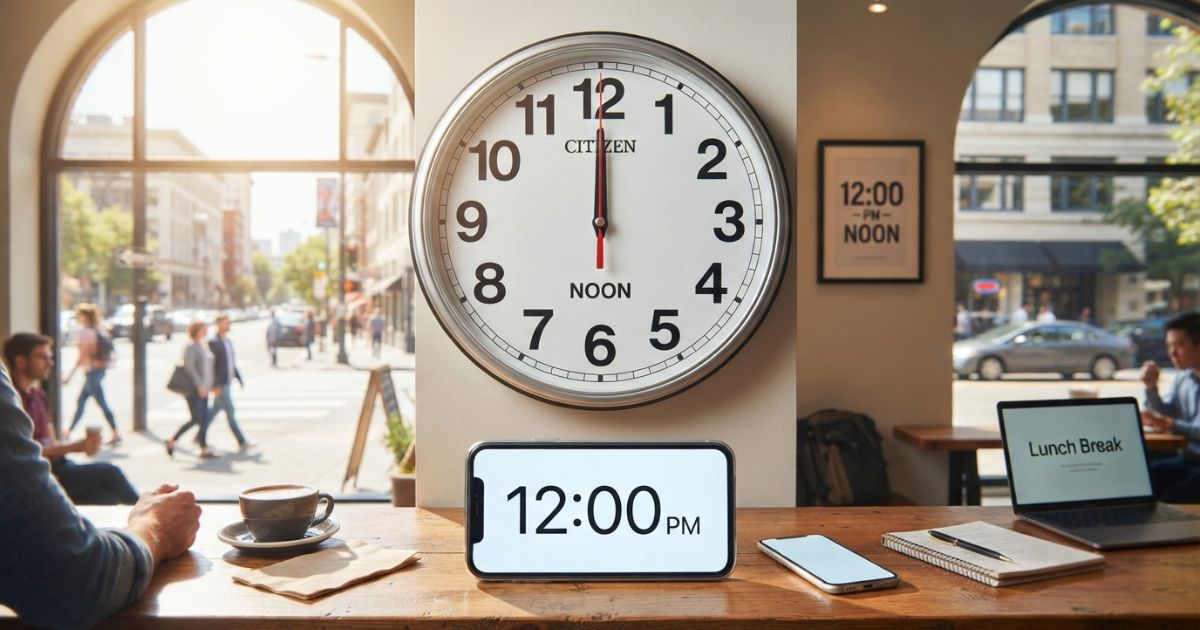

Most people don’t think twice about noon until they need to plan around it. A lunch meeting, a school bell, a flight check-in, a work deadline suddenly you’re staring at the clock trying to figure out exactly how much time is left before 12:00 PM hits.
The good news is that calculating the time remaining until noon is one of the simplest time calculations you can do. You don’t need a special app or a math degree just your current local time and a quick subtraction. This guide breaks down exactly how to do it, why the question comes up so often, and how to turn a simple countdown into a genuinely useful planning tool.
Understanding How Long Until 12:00 PM
12:00 PM is noon the exact midpoint of the day that separates morning from afternoon. In 24-hour time, it’s written simply as 12:00.
To find out how long remains until noon, compare it with your current local time. If it’s still morning, subtract your current time from 12:00 PM.
Here’s how that looks in practice:
| Current Time | Time Until Noon |
| 8:00 AM | 4 hours |
| 9:30 AM | 2 hours 30 minutes |
| 10:15 AM | 1 hour 45 minutes |
| 11:45 AM | 15 minutes |
| 12:00 PM | 0 minutes (it’s noon) |
If your clock already reads past 12:00 PM, today’s noon has come and gone the next one falls tomorrow.
Why People Search “How Long Until 12:00 PM”
Searching for a noon countdown isn’t just idle curiosity. It usually comes down to needing a fast, reliable way to gauge how much of the morning is left without doing mental math every few minutes.
Some of the most common reasons people look this up include:
- Waiting for a lunch break
- Preparing for a noon appointment or call
- Tracking a work or project deadline
- Planning a school class or activity
- Getting ready for an online event or webinar
- Scheduling a phone or video call
- Coordinating travel or transportation
- Organizing household chores before midday
For many, it’s also a way to break the remaining morning into smaller, more manageable chunks of time.
How Countdown Timers Help With Daily Planning
A countdown timer takes a fixed clock time noon and turns it into something visible and tangible: a shrinking block of minutes you can actually plan around.
Instead of glancing at the clock every five minutes, you see the exact time left and can structure your morning accordingly. For example, if there are two hours before noon, you might split that time like this:
- Spend 45 minutes on a high-priority task.
- Take a short 10-minute break.
- Spend another 45 minutes wrapping up remaining work.
- Use the last 20 minutes to review your afternoon schedule.
This kind of structure makes noon feel like a natural checkpoint rather than a distant deadline, and it helps cut down on the habit of constantly refreshing the clock.
Time Conversion: From AM and PM to 24-Hour Format
Confusion around noon often comes from mixing up the 12-hour and 24-hour clock systems. The 12-hour format uses AM and PM, while the 24-hour format counts continuously from midnight (00:00) through the end of the day (23:59).
| 12-Hour Format | 24-Hour Format | Meaning |
| 12:00 AM | 00:00 | Midnight |
| 9:00 AM | 09:00 | Morning |
| 11:00 AM | 11:00 | Late morning |
| 12:00 PM | 12:00 | Noon |
| 1:00 PM | 13:00 | Afternoon |
| 6:00 PM | 18:00 | Evening |
| 11:00 PM | 23:00 | Late evening |
Knowing this conversion makes it much easier to calculate time differences that span across noon or midnight, especially when working with schedules, calendars, or international teams that default to 24-hour time.
How Time Zones Affect the Noon Countdown
The answer to “how long until 12:00 PM?” always depends on your local time zone not a universal clock.
Picture two colleagues in different countries checking the same question at the same moment. One might have just an hour left until noon, while the other passed noon hours ago. Same question, completely different answers.
Time zones matter most in situations like:
- International meetings and conference calls
- Online classes with students in different regions
- Remote work across distributed teams
- International flight schedules
- Live broadcasts and streamed events
- Global business deadlines
Whenever a noon-based event involves people outside your own region, always confirm whether it refers to your local time or the host’s time zone.
Creative Ways to Use a Noon Countdown
A countdown to noon isn’t only useful for appointments it can double as a structuring tool for your entire morning.
Morning Productivity Challenge
Treat noon as a finish line and decide in advance what you want to accomplish before it arrives whether that’s finishing a work task, exercising, replying to messages, or prepping lunch.
Study Sessions
Students can use noon as a natural stopping point for focused study blocks, breaking the morning into clear sessions instead of studying without an endpoint in sight.
Work Planning
For office workers and freelancers, noon works well as a mid-shift checkpoint a moment to review what’s been completed before shifting focus to afternoon priorities.
Travel Preparation
If you have a flight, train, or pickup scheduled around midday, a countdown helps you calculate exactly when to leave, pack, or finish last-minute preparation.
How to Calculate How Long Until 12:00 PM Manually
Manual calculation is easy when the current time falls before noon. Take the current time and subtract it from 12:00 PM.
Example 1: Current time is 9:20 AM.
12:00 PM − 9:20 AM = 2 hours 40 minutes remaining.
Example 2: Current time is 11:35 AM.
12:00 PM − 11:35 AM = 25 minutes remaining.
The same logic applies even when seconds are involved a digital countdown is simply performing this subtraction continuously and refreshing the result in real time.
What Happens If It Is Already After 12:00 PM?
If your clock has already passed noon, today’s 12:00 PM is behind you, and the next occurrence falls tomorrow.
| Current Time | Next 12:00 PM |
| 8:00 AM | 4 hours later (today) |
| 10:30 AM | 1 hour 30 minutes later (today) |
| 11:50 AM | 10 minutes later (today) |
| 12:00 PM | Now |
| 1:00 PM | Tomorrow |
| 6:00 PM | Tomorrow |
This is exactly why an automated time calculator is handy it recognizes on its own whether noon is still ahead today or has already passed, and adjusts the countdown to tomorrow without you needing to do the date math.
Why Noon Is an Important Time Marker
Noon has long served as a natural dividing line for the day. Everything before it is generally considered morning; everything after is afternoon. That makes 12:00 PM a convenient anchor point for schedules, appointments, lunch breaks, and daily routines.
For a lot of people, noon also acts as a kind of psychological midpoint the moment morning tasks wind down and afternoon priorities begin to take over.
Understanding the Difference Between 12:00 AM and 12:00 PM
One of the most common time-related mix-ups involves confusing midnight with noon.
- 12:00 PM means noon.
- 12:00 AM means midnight.
In 24-hour format, the distinction is clear:
- 12:00 AM = 00:00
- 12:00 PM = 12:00
Using the words “noon” and “midnight” instead of “12:00 AM/PM” removes this ambiguity entirely and makes scheduling communication far clearer, especially in writing.
Related Post: What Time Was It 15 Hours Ago? Calculate the Exact Time Easily
Using a Live Countdown for Better Planning
A live countdown updates continuously, showing the exact hours, minutes, and seconds left until noon. This level of precision matters more in some situations than others.
For example, a live countdown might show:
- 2 hours 15 minutes remaining
- 47 minutes remaining
- 8 minutes remaining
- 30 seconds remaining
For a general daily schedule, second-level precision usually isn’t necessary. But for timed events, product launches, presentations, or scheduled broadcasts, watching the seconds tick down can genuinely help with timing.
How Online Time Calculators Work
Online time calculators follow a simple formula: they take your current date and time, compare it with the selected target time, and calculate the difference.
For a same-day countdown to noon, the formula looks like this:
12:00 PM − Current Time = Time Remaining
If noon has already passed for the day, the calculator automatically shifts the target to tomorrow’s noon instead, factoring in the date change so the countdown never shows a negative number.
Noon Countdown for Different Daily Activities
A countdown to 12:00 PM serves different purposes depending on the setting.
| Situation | How Noon Helps |
| Office work | Creates a natural morning deadline |
| School | Marks a class period or lunch break |
| Travel | Helps organize departure preparation |
| Healthcare | Tracks appointment timing |
| Fitness | Sets a workout target time |
| Cooking | Helps coordinate meal prep timing |
| Freelancing | Acts as a project checkpoint |
| Online events | Helps you prepare before a scheduled start time |
The real value of a countdown isn’t just knowing the number it’s using that time with intention.
Making the Most of the Time Before Noon
If you have several hours before 12:00 PM, the goal isn’t to watch the clock it’s to use the time productively. Here’s a simple five-step approach.
1. Identify Your Priority
Choose the single most important task that needs to be finished before noon. Trying to do everything at once usually means finishing nothing well.
2. Estimate the Required Time
Be realistic about whether the task needs 20 minutes, an hour, or the full morning. Underestimating is one of the most common planning mistakes.
3. Add a Small Buffer
Avoid scheduling every single minute. Leaving room for interruptions or unexpected delays keeps your morning from falling apart the moment something goes off-plan.
4. Check Your Progress
Glance at the remaining time periodically rather than watching the countdown constantly frequent checking usually slows you down more than it helps.
5. Prepare for the Afternoon
Once your priority task is done, spend a few minutes organizing what comes next so the transition into the afternoon feels smooth rather than rushed.
Conclusion
Figuring out how long until 12:00 PM is one of those small but genuinely useful daily calculations. Once you understand that noon simply means 12:00 in 24-hour time, the math becomes straightforward: subtract your current time from noon if it’s still morning, or calculate ahead to tomorrow’s noon if the moment has already passed. A live countdown does this work automatically, but knowing the manual method means you’re never stuck without an answer.
Whether you’re managing a work deadline, coordinating a global meeting, studying for an exam, or simply pacing out your morning, treating noon as a fixed checkpoint gives your day more structure. Just remember the one distinction that trips up almost everyone: 12:00 PM is noon, and 12:00 AM is midnight and if your schedule crosses time zones, always double-check whose “noon” you’re working with.
Frequently Asked Questions
How many hours are in 12 hours?
Twelve hours equals half of a 24-hour day, or 720 minutes, or 43,200 seconds.
Is 12:00 PM noon?
Yes. 12:00 PM refers to noon, while 12:00 AM refers to midnight.
What is 12:00 PM in military time?
12:00 PM is written as 1200 in standard military time.
What happens if 12:00 PM has already passed?
The countdown simply shifts to tomorrow’s 12:00 PM instead of today’s.
How can I calculate the time until noon manually?
Subtract your current time from 12:00 PM if it’s still morning, or calculate the hours remaining until tomorrow’s noon if it has already passed.
Why does my noon countdown differ from someone else’s?
Different time zones, device clock settings, or locations can cause two people to see different countdown results at the same moment.
Does a countdown update every second?
Yes, a live countdown typically refreshes continuously, showing changing hours, minutes, and seconds in real time.
Is 12:00 PM morning or afternoon?
12:00 PM marks the exact transition point between morning and afternoon.

Benjamin Reed is a passionate writer who shares insightful and engaging content on lifestyle, trends, and everyday topics.
