

Figuring out what time it was 12 hours ago is one of those small calculations that comes up more often than you’d expect. Whether you’re checking a work log, reviewing security footage, or just trying to remember when you last took your medication, this guide walks you through the math and the logic behind it no confusion, no guesswork.
What Time Was It 12 Hours Ago?
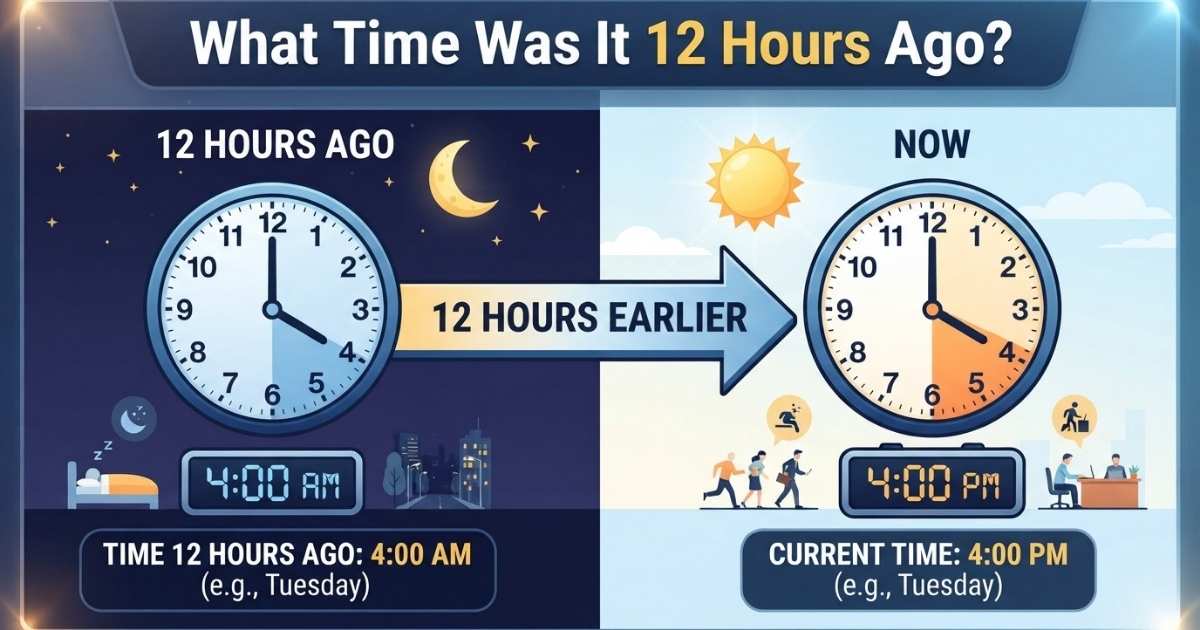
To find the time 12 hours ago, simply subtract 12 hours from your current time. Because 12 hours is exactly half of a 24-hour day, the clock number itself doesn’t change only the AM/PM label flips.
For example, if it’s currently 6:00 PM, then 12 hours ago it was 6:00 AM. If it’s currently 6:00 AM, then 12 hours ago it was 6:00 PM yesterday.
This “same number, opposite period” rule works every time, as long as you remember to check whether the date rolls back to the previous day.
Understanding the Mathematics Behind Time Calculation
The math here is simple subtraction, but it helps to think in total minutes rather than just hours.
- 12 hours = 720 minutes
- 12 hours = 43,200 seconds
So the formula is:
Past Time = Current Time − 12 Hours (or − 720 Minutes)
If you convert your current time into 24-hour format first, the subtraction becomes even cleaner. For instance, 3:00 PM is 15:00. Subtract 12, and you get 03:00, or 3:00 AM. No AM/PM flipping required the 24-hour clock handles it automatically.
What Happens When You Cross Midnight?
Things get slightly trickier when your current time is early in the morning, because subtracting 12 hours pushes you back into the previous calendar day.
For example:
- Current time: 5:00 AM
- Subtract 12 hours: 5:00 PM
- Since 5:00 AM comes before noon, that 5:00 PM result belongs to yesterday
The rule of thumb: if your current time falls between 12:00 AM and 11:59 AM, subtracting 12 hours will always land you on the previous day’s afternoon or evening.
Related Post: What Time Was It 5 Hours Ago? Calculate the Exact Time
Why AM and PM Switch Every Twelve Hours
The 12-hour clock is built around two repeating cycles AM (midnight to just before noon) and PM (noon to just before midnight). Since each cycle lasts exactly 12 hours, moving 12 hours in either direction always shifts you from one cycle into the other.
Think of it as a light switch: AM flips to PM, and PM flips to AM. The minutes and seconds stay locked in place only the label changes, along with the date when needed.
What Time Was It 12 Hours Ago: Practical Examples
Example One
Current time: 9:00 AM → 12 hours ago was 9:00 PM yesterday.
Example Two
Current time: 2:30 PM → 12 hours ago was 2:30 AM today.
Example Three
Current time: 11:15 PM → 12 hours ago was 11:15 AM today.
Example Four
Current time: 12:00 PM (noon) → 12 hours ago was 12:00 AM (midnight) today.
Example Five
Current time: 7:45 AM → 12 hours ago was 7:45 PM yesterday.
Why People Search “What Was 12 Hours Ago From Now”
This question pops up in everyday situations more than people realize. Someone might be trying to reconstruct a timeline after a missed call, calculate when a medication dose is due again, or check whether an online order was placed before or after a cutoff time. Others are comparing timestamps in emails, chat logs, or security systems where only the current time is visible and the past reference point needs to be worked out manually.
The Role of Time Zones
Subtracting 12 hours only works cleanly within a single time zone. If you’re comparing timestamps across regions, you need to account for the time zone offset separately from the 12-hour subtraction.
For example, if it’s 8:00 PM in New York, 12 hours ago was 8:00 AM in New York but that same moment might already be the next afternoon in Tokyo. Always calculate the 12-hour difference first in local time, then convert to the other zone if needed. Daylight Saving Time transitions can also shift the result by an extra hour, so it’s worth double-checking during those changeover periods.
Using Online Time Calculators
While manual subtraction works fine for quick checks, online time calculators are useful when precision matters especially when seconds, time zones, or dates spanning more than 24 hours are involved. These tools typically show the result in both 12-hour and 24-hour formats and automatically adjust the calendar date, removing the risk of manual error.
Human Perception of Time
Interestingly, 12 hours can feel wildly different depending on context. Twelve hours of sleep might pass in what feels like an instant, while 12 hours spent waiting for news can drag on endlessly. The clock, however, is indifferent to perception it always measures exactly 720 minutes, regardless of how fast or slow that time felt to you.
What Time Was It 12 Hours Ago in the 24-Hour Clock?
The 24-hour clock removes AM/PM ambiguity entirely. Just subtract 12 from the hour value:
| Current Time (24-hr) | 12 Hours Ago | Date Change |
| 00:00 | 12:00 | Previous day |
| 04:00 | 16:00 | Previous day |
| 09:30 | 21:30 | Previous day |
| 12:00 | 00:00 | Same day |
| 15:45 | 03:45 | Same day |
| 20:00 | 08:00 | Same day |
| 23:15 | 11:15 | Same day |
Common Mistakes People Make When Subtracting 12 Hours
Forgetting the Date Changes
Many people subtract the hours correctly but forget that early-morning times roll back to the previous calendar day.
Mixing Up Noon and Midnight
12:00 PM is noon and 12:00 AM is midnight confusing the two throws off the entire calculation.
Changing the Minutes
When subtracting exactly 12 hours, minutes and seconds never change. Only the hour and AM/PM shift.
Ignoring Time Zones
A result that’s accurate in one time zone can be completely wrong once compared against another region’s local time.
Real-Life Situations Where Knowing 12 Hours Ago Matters
Work Schedules
Shift workers often need to calculate handover times or verify when an overnight shift began.
Travel Planning
Travelers crossing time zones use 12-hour calculations as a starting point before converting to their destination’s local time.
Reviewing Security Footage
Investigators and property owners frequently need to pinpoint footage from exactly half a day earlier.
Medication Reminders
Many prescriptions require dosing every 12 hours, making this calculation part of a daily routine.
Online Gaming and Events
Players coordinating across regions often need to know what time an event started in their own local time zone.
A Simple Formula to Remember
12 Hours Ago = Current Time − 12 Hours
- Subtract 12 from the hour.
- If the result is negative, add 12 and switch AM/PM.
- Adjust the date backward if the calculation crosses midnight.
- Keep minutes and seconds exactly the same.
Examples Using Everyday Times
| Current Time | 12 Hours Ago |
| 1:20 AM | 1:20 PM (yesterday) |
| 6:00 AM | 6:00 PM (yesterday) |
| 10:10 AM | 10:10 PM (yesterday) |
| 1:00 PM | 1:00 AM (today) |
| 4:40 PM | 4:40 AM (today) |
| 8:55 PM | 8:55 AM (today) |
| 11:30 PM | 11:30 AM (today) |
What About Seconds and Milliseconds?
For most everyday purposes, hours and minutes are enough. But in technical fields like IT logging, forensics, or scientific data collection, precision down to the second or even millisecond can matter. In those cases, 12 hours still equals exactly 43,200 seconds, and the same subtraction principle applies; it’s just applied at a finer resolution using timestamp formats like ISO 8601.
Why Time Feels Different Than It Really Is
Human perception of duration is shaped by attention, activity, and emotion, not by an internal clock ticking at a fixed rate. A stressful 12-hour wait can feel endless, while 12 hours of focused work or deep sleep can vanish in what feels like minutes. This gap between perceived and actual time is exactly why precise calculations not gut feeling matter when accuracy is required.
Conclusion
Working out what time it was 12 hours ago comes down to one simple habit: subtract 12 from the current hour, flip AM to PM (or PM to AM), and check whether the date needs to move back a day. Because 12 hours is exactly half of the 24-hour cycle, the clock number and minutes always stay the same only the period and, sometimes, the calendar date shift.
Whether you’re double-checking a medication schedule, reviewing footage, or coordinating across time zones, this small calculation is easy to master once you understand the pattern. Use the tables and examples above as a quick reference, or rely on an online time calculator when you need instant, error-free results across time zones and dates.
Frequently Asked Questions
What time was it 12 hours ago?
Subtract 12 hours from your current time; the AM/PM period flips, and the date may move back one day.
How many minutes ago is 12 hours?
Twelve hours equals 720 minutes.
How many seconds ago is 12 hours?
Twelve hours equals 43,200 seconds.
Does 12 hours ago mean yesterday?
Only if your current time falls before noon otherwise, 12 hours ago is still today.
What was 12 hours ago from 8 AM?
Twelve hours before 8:00 AM was 8:00 PM the previous day.
What was 12 hours ago from 8 PM?
Twelve hours before 8:00 PM was 8:00 AM the same day.
What was 12 hours ago from midnight?
Twelve hours before 12:00 AM (midnight) was 12:00 PM (noon) the previous day.
What was 12 hours ago from noon?
Twelve hours before 12:00 PM (noon) was 12:00 AM (midnight) that same day.
Do the minutes change when subtracting 12 hours?
No, minutes and seconds always stay exactly the same only the hour and AM/PM label change.
Does the time zone affect the calculation?
The 12-hour duration itself doesn’t change, but the displayed local time will differ if you’re comparing across time zones.
Can I calculate 12 hours ago manually?
Yes subtract 12 from the hour, switch AM/PM, and move the date back a day if the calculation crosses midnight.

Benjamin Reed is a passionate writer who shares insightful and engaging content on lifestyle, trends, and everyday topics.
