


USB-C charger for phone shopping starts with one rule that prevents almost every bad purchase: the phone sets the ceiling.
A charger wattage is an offer, not a speed. Your phone negotiates what it accepts, and it never takes more.
That is why a 100W brick charges most phones no faster than a 30W one, and why it also cannot damage them.
What actually decides your speed is a short stack: your phone generation, one standard called PPS, and your cable.
This guide works that stack in order, using the phone makers own published requirements before any reviewer opinion.
One disclosure: EnglishHexa has no accessories shop or charger cluster. Its nearest ground is device coverage, linked where it genuinely helps.
The Ceiling Rule, Explained Once
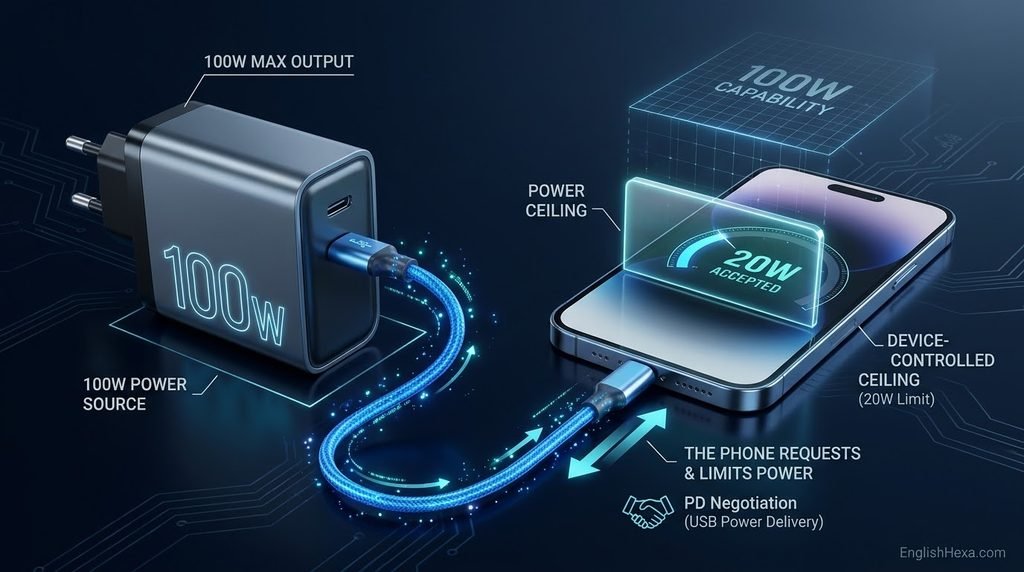
USB Power Delivery devices talk before they power. Charger and phone agree a voltage and current through a digital handshake.
Without agreement, output sits at 5 volts, the safe default. Nothing is forced into the phone at any point.
So a bigger charger is safe by design, not by luck. The phone draws its ceiling and declines the rest.
The ceiling also explains the sprint pattern. Phones charge fastest when empty and taper hard after about 80 percent.
Makers therefore quote 0 to 50 percent times. That sprint is the honest comparison window between chargers.
Full charge times mostly measure the phone taper, not the charger. Treat any full charge table cautiously without its test conditions.
What Your Phone Actually Accepts: The Maker Table
Skip the shelf labels and start from the makers. Apple, Samsung, and Google each publish what their phones ask for.
| Phone family | What the maker asks for | Maker stated result |
|---|---|---|
| iPhone 8 to 16 (wired) | USB PD adapter, 18W or more (20W class for iPhone 12 and later) | Up to 50 percent in around 30 minutes |
| iPhone 17, 17 Pro, 17 Pro Max | USB PD adapter, 40W or more | Up to 50 percent in around 20 minutes |
| iPhone 17e and iPhone Air | USB PD adapter, 20W or more | Up to 50 percent in around 30 minutes |
| iPhone 18 Pro and Pro Max | 60W capable USB PD adapter with AVS, 60W capable cable | Up to 50 percent in around 15 minutes |
| Galaxy Super Fast Charging | 25W adapter, USB PD with PPS | Super Fast Charging label and pace |
| Galaxy Super Fast Charging 2.0 | 45W adapter, USB PD 3.0 with PPS, 5A cable (see the S25 note) | Samsung fastest wired mode on supported models |
| Galaxy Super Fast Charging 3.0 | 60W USB PD 3.1 PPS charger (S26 Ultra class) | Up to 75 percent in around 30 minutes, model claim |
| Recent Google Pixel | USB-C PPS charger, 30W or 45W by model | 50 to 75 percent in about 30 minutes, by model |
The Brick fast charger requirements guide assembles these maker statements in one place. It is the requirements reference behind this table.
Apple side is the simplest: plain USB PD, no PPS, with the wattage stepping up by generation.
The Apple 20W USB-C power adapter page shows the floor product: its own 20W adapter, quoted at 50 percent in around 35 minutes there.
Note the small conflict: Apple support framing says around 30 minutes, its product page says around 35. Both are printed here.
Samsung side adds the gate this guide is named for. The Samsung charger types support page lists the tiers and their conditions officially.
The iPhone 18 Pro Step Changes the Top End
The newest Pro models raise the bar again: 60W capable with AVS, per Apple figures relayed in current guides.
AVS, Adjustable Voltage Supply, is a PD mode that adjusts voltage in 100mV steps inside the standard power range.
An adapter guide from a major accessory brand repeats the same figures, including the 15 minute sprint claim.
Practical effect: the universal charger advice now tops out higher than it did a year ago. Size for your newest phone.
PPS: The Gate Between Fast and Slow
PPS stands for Programmable Power Supply. It is a mode inside USB PD 3.0 and later revisions.
Instead of fixed voltage jumps, a PPS charger adjusts in 20 millivolt steps between 3.3 and 21 volts.
The phone requests exactly what it needs, moment by moment. Conversion heat moves into the adapter, not the phone.
Samsung builds its fast tiers on it. No PPS, no Super Fast Charging, whatever the wattage on the box says.
What Happens Without PPS
A Galaxy on a plain PD charger falls back to standard charging. Tester reporting puts that cap around 15 to 18 watts.
That is the single most common slow charging complaint in this category: a big laptop brick, no PPS, a flagship crawling.
The fix is never more watts. It is the letters PPS in the charger specification, at your phone tier wattage.
The PPS Range Trap
Not every PPS line reaches every tier. A PPS range stopping at 11 volts and 2.25 amps tops out near 25 watts.
Samsung 45W mode needs a PPS range reaching about 45 watts, like the 5 to 20 volt lines on proper adapters.
The HDML phone fast charging guide walks these profile tables in detail. Read the PPS row, not the headline, before buying for a Galaxy.
The Pixel Reading, With Its Conflict
Google quotes Pixel charging times with PPS chargers of 30W or 45W, depending on the model.
One current report adds that the largest Pixel needs a PPS range reaching 21 volts for its top rate.
Some explainers argue Pixels reach their cap on plain PD too. The two readings conflict, and this guide prints both.
The resolution is practical: a PPS charger satisfies both readings, so it is the safe Pixel buy either way.
The Cable Is Half the Purchase
Every fast charge claim in this guide has a silent partner: the cable, rated by the current it may carry.
Basic USB-C cables carry 3 amps. At 20 volts that caps delivery at 60 watts, whatever the charger offers.
Samsung 45W mode runs near 10 volts and 4.5 amps. A 3A cable cannot carry it, so the phone settles lower.
| Cable | Current rating | Practical ceiling | Where it binds |
|---|---|---|---|
| Basic USB-C to USB-C | 3A | 60W | Samsung 45W mode on pre S25 models |
| 5A rated (sold as 100W or 240W) | 5A with e-marker | 100W plus | The correct partner for 45W Galaxy charging |
| USB-A to USB-C | Legacy rates | No PD at all | Fast charging is impossible at any brick size |
Above 60 watts, cables carry an e-marker chip that declares their rating to the charger. No chip, no trust, no current.
Shopping shortcut: cables listed as 100W or 240W are 5A cables. That rating line is the one to search for.
The S25 Exception to the 5A Rule
Samsung notes that Galaxy S25 and later models can reach Super Fast Charging 2.0 with the 3A cable in the box.
Earlier 45W models still need the 5A cable. Check your generation before blaming a charger for a 25W result.
For the 60W tier, Samsung indicates the 3A cable suffices, because that mode runs at higher voltage, lower current.
Ports and Splits: Total Watts Are Shared Watts
A multi port charger headline number is the total across all ports, shared dynamically as devices attach.
A tested 67W three port charger splits 45, 12, and 10 watts with three devices connected, per a major roundup.
One device alone usually gets the top port full rating. The sharing begins with the second cable.
Samsung own multi port chargers carry a sharper version: Super Fast Charging 2.0 works only on port 1, only solo.
Before buying multi port, find the split table for your exact combination: phone plus laptop, or two phones.
A pairing that drops your phone below its fast threshold turns a premium brick into a slow one at the worst moment.
One Brick for Phone and Laptop
The 65W class is the travel sweet spot: full phone speed solo, and enough for most ultrabook laptops.
Split between the two, good models hold 45W for the laptop and about 20W for the phone, keeping both useful.
That consolidation is what the extra money buys. It is not phone speed, which the ceiling already capped.
GaN, Honestly
GaN is gallium nitride, the semiconductor inside most modern compact chargers. It switches faster and wastes less heat.
The result is smaller, cooler chargers at a given wattage, with foldable prongs and pocketable shells.
The benefit scales with power. At 20 to 30 watts the saving is modest; at 65 watts and up it transforms the product.
Two cautions. GaN does not make a charger faster for your phone, and it does not by itself make one safer.
Safety lives in the certification and protection circuits. GaN is a size and heat story, full stop.
Safety and Certification: The Spec That Protects

Two different marks answer two different questions, and a careful buyer checks both.
A UL or ETL listing means the electrical design passed safety testing, against standards such as IEC 62368-1.
USB-IF certification means the USB behavior passed interoperability testing. It is about working correctly, not about fire safety.
Then read the protections list: over voltage, over current, short circuit, and over temperature protection are the core set.
Those circuits are what stand between a fault and your phone. Wattage without them is a liability, not a feature.
Counterfeits Are the Real Hazard
Popular charger models are counterfeited heavily. Clones copy the shell and logos and omit fuses and isolation barriers.
Tells: a price far below the brand store, a suspiciously light unit, blurry printing, and missing safety marks.
Buy from the brand store or a major retailer. The savings on a clone are small; the downside is a fire risk.
The EnglishHexa blog follows the wider device beat; this safety checklist is the part to bookmark before any marketplace order.
Tested Picks by Job, With Dated Prices

Reviewers who measure output converge on a small set of models. Prices below are dated strands from those tests.
| Job | Tested pick (reviewer strand) | Why it earned the place | Price strand |
|---|---|---|---|
| Best overall | Anker Prime 67W GaN (Android Authority, 30 plus tested) | All key standards, three ports, printed split table | Premium tier, check dated listings |
| Best value | Anker Nano 3 30W (Android Authority) | 30W PD, 27W PPS, tiny shell | Budget tier |
| Best for phone | Belkin 45W BoostCharge Pro Dual (CNN Underscored) | Pixel 10 to 53 percent in 30 minutes in its test | Mid tier, often discounted |
| Best budget | UGREEN Nexode 35W (CNN Underscored); Nexode 30W (OveReview) | Near top phone scores under 30 dollars | Under 20 to 30 dollars |
| Most versatile | Google Pixel Flex Dual 67W (Android Authority) | Latest PD standards, two ports, PD 3.2 class | 59.99 dollars at test time |
| First party Samsung | Samsung 45W Travel Adapter (Android Authority) | Removes all PPS doubt for Galaxy owners | About 27 dollars at test time |
| Cheapest credible | Nimble Wally SubNano 20W (CNN Underscored) | Won its iPhone 30 minute heat outright | 17 dollars MSRP at test time |
The CNN Underscored best USB-C chargers test is phone first testing: its top pick won on measured percentages, not on specification sheets.
Two large roundups were checked for this guide, the CNN Underscored best USB-C chargers test among them; one blocks automated reading and is cited here in text.
Its findings match the strands above: a 67W Anker class overall pick, a 30W value pick, and per pick standards tables.
For home setups where phones meet bigger screens, the Smarter entertainment experiences guide covers the entertainment side of the same device shelf.
First Party vs Third Party, Family by Family
Samsung: the first party 45W adapter is competitively priced and removes every PPS doubt, as the Samsung charger types support page confirms. It is the right default.
Apple: the Apple 20W USB-C power adapter page is the simple floor. Tested 30W third party chargers match it for older phones and cover more.
Google: the own brand dual port 67W is genuinely versatile and priced like it. Buy it for two port Pixel households.
Third party wins when three conditions hold: tested output, visible certification, and a lower price for the same specification.
The One Charger Household
A mixed household needs exactly one specification: USB PD with PPS, 30 watts or more, plus headroom for the newest phone.
At 45 to 65 watts with PPS, the same brick covers a Galaxy at full speed, an iPhone at its ceiling, and a laptop.
Pair it with a 5A rated cable for the Samsung top mode, and keep the basic cable for the bedside.
That pairing is the whole strategy. Everything else in this category is a variation on ports, size, and price.
Test It in the Return Window
A new charger earns trust in one week of checks, all inside any return period. Run them in this order.
- The sprint test. From under 20 percent, charge 30 minutes and compare with your maker claim.
- The label test. A Galaxy should display the expected label: Super Fast Charging, or 2.0 on the 45W tier.
- The cable swap. If the sprint disappoints, swap in the 5A cable before blaming the charger.
- The split test. Attach your real second device and repeat the sprint; watch the phone lane hold its speed.
- The heat check. Warm is normal; too hot to hold, odors, or buzzing are return signals, not quirks.
Mistakes That Waste Money Here

Buying watts your phone cannot accept. A 240W brick charges a phone at the phone ceiling, like every other brick.
Skipping PPS for a Galaxy. The most expensive slow charger is a 100W non PPS brick on a Samsung flagship.
Trusting the included cable. Bundled and old cables are usually 3A; the 45W tier needed a 5A partner for years.
Reading the box, not the split table. Multi port totals are shared; your combination decides your actual speed.
Chasing GaN at 20 watts. At phone only wattages, GaN buys size, not speed or safety. Spend on certification instead.
Buying the clone. A counterfeit discount is the only genuinely dangerous saving in this category. Skip it entirely.
Battery Health, Settled Plainly
The damage question deserves a direct answer: heat is the battery enemy, not fast charging itself.
Phones defend themselves with the taper, with thermal throttling, and with overnight modes that stretch the final fill.
PPS helps from the charger side, delivering power with less conversion heat in the phone during the fast phase.
The habits that matter are environmental: do not charge under pillows, in hot cars, or in direct sun at full speed.
Use adaptive or overnight charging when speed is worthless, and sprint charging when it is not. Both are free.
A certified charger at the right tier does not meaningfully age a battery faster than a slow one in the same conditions.
Away From the Wall: Car, Desk, and Travel
In the car, the same rules ride along: a PD car charger with PPS runs a Galaxy at speed; a USB-A port cannot.
At a desk, a multi port brick earns its keep when the split table protects the phone lane beside the laptop.
In a hotel, one 65W GaN brick plus two cables covers phone, laptop, and earbuds from a single awkward outlet.
In the bag, foldable prongs and a flat profile matter more than another 10 watts you will never draw.
Carry the 5A cable as the main cable and a basic one as the spare; the spare is the one guests borrow.
Frequently Asked Questions
1. How many watts do I need in a USB-C charger for my phone?
Match the phone, not the shelf.
Apple asks USB PD at 18W or more for iPhone 8 to 16 and 40W or more for the iPhone 17 family.
Samsung Super Fast Charging needs 25W with PPS, or 45W with PPS and a 5A cable.
Recent Pixels are quoted with 30W or 45W PPS chargers.
A 30W PPS charger is the safe middle.
2. Can a charger with more watts damage my phone?
No, not a compliant one.
USB PD devices negotiate before power flows, agreeing voltage and current through a digital handshake; without agreement the output sits at 5V.
A 100W charger offers power the phone may decline.
The damage risk lives in uncertified and counterfeit chargers that skip the protection circuits, not in honest wattage.
3. What is PPS and do I need it?
PPS, Programmable Power Supply, is a mode inside USB PD 3.0 and later that adjusts voltage in 20mV steps between 3.3 and 21V instead of fixed jumps.
Samsung requires it for Super Fast Charging at 25W and 45W, and Google quotes Pixel times with PPS chargers.
Apple phones skip PPS entirely.
Galaxy or Pixel households should buy it.
4. Why does my Galaxy not show Super Fast Charging?
Work the three usual causes in order.
The charger lacks PPS, which caps a Galaxy around 15 to 18W in tester reporting.
The cable is a 3A cable, while 45W mode requires a 5A cable on pre S25 models.
Or the phone itself tops out at 25W, so the faster mode does not exist on it.
The label appears only when all conditions are met.
5. Does the cable really affect charging speed?
Yes, the cable is the most missed half of the purchase.
Cables are rated by current: a basic cable carries 3A, capping delivery at 60W, and 45W Samsung charging requires a 5A cable on earlier models.
Above 60W, cables need an e-marker chip to declare their rating.
A powerful charger on a weak cable charges at the cable speed.
6. Is a 65W charger faster than a 30W charger for a phone?
Almost never, because the phone sets the ceiling.
An iPhone accepting about 27 to 30W draws the same from both bricks, and testers record identical 0 to 50 sprint times.
The 65W brick earns its price charging a laptop as well, or splitting across two devices.
Buy the headroom for the second job, never for phone speed.
7. What does GaN mean and do I need it?
GaN is gallium nitride, the semiconductor inside newer chargers.
It switches faster and wastes less heat than silicon, so chargers get smaller and cooler at a given wattage.
The benefit grows with power: modest at 20 to 30W for a phone, decisive at 65W and above.
GaN alone does not mean a charger is safer or faster for your phone.
8. How do multi port chargers split their wattage?
The headline number is the total across all ports, shared dynamically.
A tested 67W three port charger splits 45, 12, and 10 watts with three devices attached.
One device alone usually gets the top port full rating.
Read the split table for your exact combination, because a phone plus laptop pairing can drop the phone below its fast charge threshold.
9. Can one charger fast charge an iPhone, a Galaxy, and a Pixel?
Yes, with the right specification.
A USB PD charger with PPS at 30W or more covers all three families at or near their ceilings, and 27W with PPS is a widely cited universal floor.
For the newest iPhones at full speed, step up to 40W or more, ideally PD 3.2 class, which also carries the AVS range current reporting describes.
10. How do I know a USB-C charger is safe?
Check two different marks.
A UL or ETL listing means the electrical design passed safety testing against standards such as IEC 62368-1.
USB-IF certification means the USB behavior passed interoperability testing.
Then read the protections list (over voltage, over current, short circuit, over temperature) and buy from the brand store, because counterfeits omit fuses and isolation.
11. Does fast charging damage the battery?
Heat is the battery enemy, not wattage itself.
Phones taper charging sharply after about 80 percent, manage temperature actively, and PPS delivers power with less conversion heat in the phone.
The evidence based habits are simple: avoid charging under pillows or in hot cars, and use adaptive or overnight modes when speed does not matter.
12. Why is there no charger in my phone box?
Apple, Samsung, and Google all sell adapters separately now, citing waste reduction, with the EU USB-C common charger rule as the policy backdrop.
The practical result: the adapter is a planned purchase, not an afterthought.
Budget for the charger and a rated cable together, because the fastest phone modes often need a better cable than the one in the drawer.
13. What is the difference between USB PD 3.0, 3.1, and 3.2 for phones?
For phones, less than the numbers suggest.
PD 3.0 brought PPS and covers everything to 100W.
PD 3.1 added the extended power range to 240W, which is laptop territory.
PD 3.2 refines the standard range, including the AVS behavior current reporting ties to the newest iPhones.
A phone buyer needs PD with PPS; the revision matters mainly at the extremes.
14. What is AVS and does my charger need it?
AVS, Adjustable Voltage Supply, adjusts voltage in 100mV steps between 9 and 20V in the standard power range.
Current reporting ties the newest iPhone top speeds to it (the iPhone 18 Pro class at 60W capable with AVS) and notes PD 3.2 PPS chargers between 27W and 100W carry it.
A 40W plus PD 3.2 PPS charger satisfies both Apple wordings.
15. How fast should my phone charge from 0 to 50 percent?
The sprint is what makers quote, because charging tapers afterward.
Apple quotes up to 50 percent in around 30 minutes for iPhone 8 to 16 on 18W plus, and around 20 minutes for the iPhone 17 family on 40W plus.
Testers recorded a Pixel 10 reaching 53 percent in 30 minutes on a good 45W dual port charger.
Far slower means check PPS, then the cable.
16. Is the Apple 20W adapter still a good buy?
For iPhone 16 and older, yes: it meets Apple fast charge requirement cheaply, quoted at about 50 percent in around 30 to 35 minutes depending on the Apple page.
For an iPhone 17 family phone it leaves speed behind, because those models ask 40W or more.
Tested third party 30W GaN chargers often cost the same and cover more devices.
17. What charger does the Samsung Galaxy S25 Ultra or S26 Ultra need?
A 45W USB PD charger with PPS and, on pre S25 models, a 5A cable, which unlocks Super Fast Charging 2.0.
Samsung lists a 60W tier (Super Fast Charging 3.0) for the S26 Ultra generation.
On a plain PD charger without PPS these phones still charge, but tester reporting puts the cap around 15 to 18W: standard speed wearing a fast label.
18. What charger does a Google Pixel need?
Google quotes recent Pixel charging times with USB-C PPS chargers of 30W (most models) or 45W (Pro XL class), and one current report adds that the big model needs a PPS range reaching 21V.
Some explainers argue plain PD reaches the cap too; the readings conflict.
A 30W or 45W PPS charger satisfies both, so it is the safe recommendation.
19. Should I buy the first party charger or a third party one?
By family.
Samsung first party 45W is competitively priced (about 27 dollars in one dated roundup) and removes all PPS doubt.
Apple first party is the simple floor, beaten on value by tested 30W third party chargers.
Google own dual port 67W is versatile at a premium.
Third party wins when it is tested, certified, and cheaper for the same spec.
20. Why does my charger get hot?
Some warmth is conversion loss, concentrated in smaller GaN shells.
Heat is a concern when the charger throttles output, smells, discolors, or is too hot to hold: those are failure and counterfeit signals.
Quality chargers carry over temperature protection that reduces or cuts power.
Give chargers air; a brick buried in bedding charges slower and ages faster.
21. Can I charge my laptop and phone from one charger?
Yes, and it is the strongest reason to buy the 65W class.
A 65 to 67W GaN charger fast charges a phone alone, runs most ultrabooks, or splits between them at reduced rates.
Read the split table: good models hold about 45W for the laptop and 20W for the phone.
Travelers gain most: one brick, one outlet, two devices covered.
22. What is an e-marker chip and when do I need one?
An e-marker is a chip inside higher rated USB-C cables declaring the cable current rating and capabilities.
Cables above 60W or 3A require one; without it the system defaults to 3A, capping at 60W regardless of the charger.
For phones the practical case is the 5A cable that Samsung 45W mode requires on pre S25 models, which is e-marked in practice.
23. How can I spot a counterfeit charger?
Classic tells: a price far below the brand store, a unit noticeably lighter than the genuine article, blurry or misspelled printing, missing UL or ETL marks, and marketplace seller names that shuffle brand letters.
Counterfeits matter because they omit the internal fuses and isolation barriers that make a charger safe.
When the gap is small, buy from the brand store.
24. Do I need a new charger for the iPhone 17?
For full speed, yes, if your current adapter is the old 20W class.
The iPhone 17, 17 Pro, and 17 Pro Max ask for 40W or more to reach up to 50 percent in around 20 minutes.
Your existing PD charger still works at the older pace.
The lighter 17e and Air models ask only 20W, so the answer depends on the exact model you own.
25. What is the best USB-C charger under 20 dollars?
The tested value class is strong: one major roundup names a 30W GaN charger as its best value pick, and another test let a 17 dollar 20W charger win its iPhone heat outright.
Prices move, so treat any under 20 pick as a dated strand and re-check.
The spec floor at this price: USB PD, PPS for Android households, and a visible safety listing.
26. Can I use a USB-A to USB-C cable for fast charging?
Not at full speed.
USB-A ports top out far below USB PD rates and cannot negotiate PD or PPS, so charging falls back to slow legacy speeds whatever the brick claims.
Fast charging needs USB-C at both ends: a PD charger and a USB-C to USB-C cable rated for the current your phone top mode requires, 5A for the Samsung 45W tier.
27. Why does charging slow down after 80 percent?
That taper is the phone protecting its battery.
Lithium cells accept high current when empty and must ease off as they fill, so every phone reduces power in steps toward full.
This is why makers quote 0 to 50 times, and why full charge tables mostly measure the phone.
No charger can override the taper, and one claiming to is misdescribing physics.
28. What protections should a good charger list?
The core set is over voltage protection (OVP), over current protection (OCP), short circuit protection (SCP), and over temperature protection (OTP), with under voltage lockout on better designs.
These circuits stand between a fault and your phone.
A product page listing wattage but no protections and no safety listing is telling you exactly where its budget went.
29. Is USB-C charging the same on every phone now?
The connector converged; the negotiation did not.
All three major families charge over USB-C with USB PD, but Samsung layers a PPS requirement, Google names PPS chargers in its specs, the newest iPhones step up in wattage and AVS reporting.
Other brands run proprietary systems outside the US mainstream.
One PPS charger covers the US big three, which is as universal as it honestly gets.
30. How long should a good USB-C charger last?
Years, if it is built and treated well.
Tester protocols running hundreds of plug cycles and 24 hour load stretches exist because cheap chargers fail early at the prongs, the cable joint, or thermally.
Foldable prongs, strain relief, and a real brand warranty are the durability signals.
A travel daily driver is a different product from a nightstand resident.
31. Should I buy a charger with a built in cable?
It trades flexibility for convenience.
One tested pick builds a 60W cable into a two port 67W brick, suiting chronic cable losers and travel kits.
The costs: when the cable frays the whole unit is done, and its rating is fixed.
Detached cables let you upgrade the 5A piece separately, which is the piece Samsung top speeds depend on.
32. What wattage is best for a bedside charger?
For overnight, speed is worthless and cool, quiet reliability is everything.
A basic 20W PD charger from a listed brand is plenty, and phone overnight or adaptive modes stretch the fill to your alarm anyway.
Keep the high watt PPS brick at the kitchen counter and in the travel bag, where its speed is actually used during the day.
33. Can a power bank replace a wall charger for fast charging?
For speed on the go, a PD power bank with PPS mirrors wall charger behavior, including the Samsung and Pixel conditions, because the negotiation is identical.
Check the bank per port output spec, not its capacity headline.
At home the wall charger wins on cost and heat.
Many buyers end with one of each: the brick for sprints, the bank for days out.
34. What does trickle charge mode do?
Small devices like earbuds and watches can be over served by aggressive chargers, so some models offer a low current trickle mode, often started by a button press, that feeds them gently.
It is a useful extra on multi device chargers.
Phones do not need it; they negotiate their own draw.
If an earbuds case charges oddly on a big brick, trickle mode is the feature to look for.
35. Are expensive chargers worth it over budget ones?
Sometimes, and testing shows the line is not price.
Large sample testers found some 15 dollar chargers outperforming 50 dollar models, while flagship multi port chargers earn premiums with split intelligence, build quality, and support.
Pay for measured output, certification, and the exact port layout you need.
Refuse to pay for wattage your phone cannot accept.
36. What should I check in the first week with a new charger?
Run the sprint test: from under 20 percent, time 30 minutes against your phone maker claim, with the screen showing the expected label, Super Fast Charging on a Galaxy for example.
Feel for excessive heat, listen for coil whine, and test every port combination you actually use.
All of it fits inside any return window, which is the real deadline for charger quality control.
37. Does charger efficiency matter?
At the margins.
Efficient GaN designs waste less power as heat, helping small chargers sustain output, and standby draw adds up across a household of idle bricks.
Testers grade efficiency because a charger that converts poorly often sustains poorly.
For one phone charger the yearly energy difference is small; the heat and consistency differences are the practical ones.
38. Can I fast charge two phones at once?
Yes, with a multi port charger whose split keeps each port at or above each phone fast threshold.
Two phones needing 25 to 30W each want a 60W plus total with a favorable split table; a 45W dual port typically gives one phone full speed and the other a slower lane.
Check the two device row of the split table, not the box headline.
39. What is the EU USB-C rule and does it affect my charger choice?
The EU common charger rules make USB-C the standard port across phones and many electronics sold there, which is why the connector converged globally.
The rule standardizes the plug, not the negotiation, so PD and PPS literacy still decides your speed.
For US buyers the effect is indirect: more USB-C devices, fewer proprietary ports, adapters sold separately everywhere.
40. Which charger should a mixed iPhone and Samsung household buy?
A 45W or 65W USB PD charger with PPS covers both at full speed: the Galaxy gets its PPS gate and wattage, the iPhone takes what it needs from the same brick, and the larger sizes add a laptop lane.
Pair it with a 5A rated cable for the Samsung top mode on older models.
One tested 67W class model splits 45/12/10 fully loaded, so read its split table.
41. How do reviewers actually test these chargers?
The credible protocol uses a USB power meter to log negotiated voltage and current, times the 0 to 50 sprint and the full charge separately, loads every port combination against the claimed split table.
And watches heat with a thermal camera under sustained load.
Roundups testing 30 to 45 models with that protocol outweigh spec sheet roundups.
42. Can I use the same charger for a phone and a Nintendo Switch or Steam Deck?
Yes.
Handheld consoles charge over USB PD in the same range as phones and small laptops, so a 45W to 65W PPS charger covers a phone and a console from one brick.
Check the split table if both charge together, and expect the console to take the larger lane.
It is one more reason the 65W class outsells its phone only value.
Conclusion
A USB-C charger for phone decision is four checks, in order: your phone ceiling, the PPS gate, the cable rating, and the split table.
Run them and the market simplifies fast. Most households land on one 45 to 65W PPS charger and a 5A cable.
Skip the wattage theater, refuse the clone, and test the sprint inside the return window while returning is free.
Your next reads on this shelf: the maker table updates with each phone generation, and the cable guide goes deeper on ratings.

Dilawar Mughal is an SEO expert with 8 years of hands-on experience helping websites grow their organic traffic, rankings, and revenue. He specializes in content-driven SEO, local SEO, and Pinterest SEO, and builds practical, results-focused strategies for businesses and publishers.
