
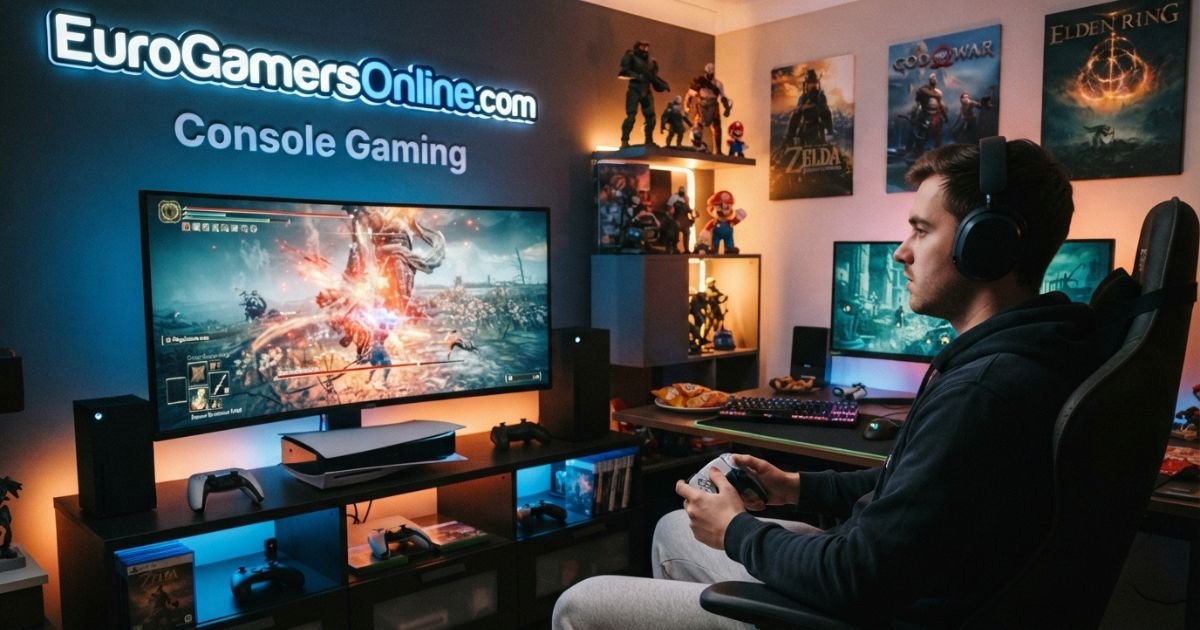

EuroGamersOnline.com Console Gaming looks simple from the outside. You plug in a box, pick up a controller and play. In practice, the choices pile up fast: which system, which games, which subscription, which accessories, and which settings actually matter.
This guide covers console gaming the way a sensible player approaches it. It puts games first, keeps spending tied to real needs, and treats comfort and online safety as part of the hobby, not an afterthought. It applies to PlayStation, Xbox and Nintendo systems alike, and to new and returning players.
Start With the Games, Not the Console
Most buying guides open with hardware specs. That is backwards for most people. A console is a delivery system for games, and the best one is the one that plays the games you will actually finish.
Try this simple exercise before you spend anything:
- Write down five games you want to play.
- Check which platforms they are available on.
- Note which ones are exclusive to a single system.
- Ask friends or family which system they own, especially if you want to play together.
If four of your five games are on one platform, the decision is already made.
Match the platform to your play style
Each major platform has a different personality:
- PlayStation: known for cinematic, story driven single player games.
- Xbox: strong on subscription value, since Game Pass lets you try many titles for a monthly fee.
- Nintendo Switch family: built around portable play, local multiplayer and family friendly design.
These are broad tendencies, not rules. Libraries change, so check current game lists and subscription catalogues before you buy.
Related Post: Inside the Aelftech com Team 2026: People Behind the Vision
Your First Console Doesn’t Need to Be Perfect
Many new players freeze at the buying stage because they fear picking the wrong system. Here is the honest truth: there is no wrong choice if you enjoy the games.
Modern consoles are more alike than different. All of them play a wide range of major releases, connect to the internet, and receive regular software updates. Backward compatibility on several systems also means older games often keep working, which protects your library.
Think in total cost, not sticker price
The console price is only the first payment. Add these to your budget so nothing surprises you:
- Games: new releases cost more than older or second hand titles.
- Online subscription: usually required for online multiplayer on most platforms.
- Storage: modern games are large, and internal space fills quickly.
- Accessories: a second controller or headset can add up.
Disc, digital or both?
Physical games can be resold or borrowed. Digital games are convenient and never need swapping. Digital versions also tend to hold their price longer, while physical copies can drop in price sooner. If you play many games, watching sales on both formats often saves more than the format itself.
New, refurbished or second hand?
Certified refurbished units can cut costs, but check the warranty, included accessories and return policy. With second hand consoles, confirm the account is fully removed and that the disc drive, ports and controller all work before you pay.
What Makes Console Gaming So Appealing?
Console gaming has lasted because it removes friction. Understanding why helps you make choices that keep it enjoyable.
- Simplicity: every player has the same hardware, so games are tested against one target.
- Plug and play: no driver hunting or hardware compatibility charts.
- Living room comfort: big screen, couch, and a controller designed for long sessions.
- Social play: local co-op and online lobbies make it easy to play with friends.
- Consistency: updates arrive automatically and features stay predictable.
- Wide variety: everything from short arcade sessions to hundred hour role playing games.
The trade off is less customisation than PC gaming. For most players, that is a fair price for convenience.
Choosing Games When Everything Looks Interesting
Store pages, trailers and sales can make everything look like a must play. Decision fatigue is real, and a backlog of unplayed games is a common problem. A little structure helps.
A simple three step filter
- Check the genre fit. Do you like fast action, slow exploration, puzzles or sports?
- Check the time commitment. A 60 hour adventure is a different promise than a 6 hour one.
- Check the difficulty options. Adjustable difficulty and accessibility settings make games friendlier.
Beginner friendly genres
If you are new to controllers, these genres are easy to start with:
- Racing games: teach steering, triggers and reaction timing.
- Platformers: clear goals and forgiving mechanics.
- Action adventures: guided progress at your own pace.
- Sports titles: familiar rules make learning faster.
- Co-op party games: short rounds and easy rules.
Use demos, trials and free games
Free to play multiplayer games are a risk free way to learn online play. Game demos, free trials and subscription libraries let you sample before you commit. Reading a few player reviews after launch also helps, since early impressions sometimes change after patches.
Manage the backlog
Try the “one in, one out” habit: finish or drop a game before buying another. It sounds strict, but it keeps spending down and satisfaction up.
Accessories: Buy What Solves a Problem
The accessory market is huge, and much of it is marketing. A useful rule is to name the problem first. If you cannot say what an item fixes, wait.
Worth considering early
| Accessory | Problem it solves |
| Second controller | Playing local co-op with a friend or family member |
| Headset | Hearing footsteps and voice chat without disturbing others |
| External or internal SSD | Running out of storage for games you actually play |
| Charging dock | Dead controllers and cable clutter |
| Quality HDMI cable | Matching the console’s video output to your display |
| Surge protector | Protecting the console from power spikes |
Usually safe to postpone
- Gaming chairs
- Decorative lighting
- Capture cards and studio microphones (unless you plan to stream)
- Trigger mods and custom shells (a matter of taste, not a necessity)
What to check before buying
- Compatibility: confirm the item works with your exact console model.
- Specs: for storage, look at the interface and speed the console requires.
- Warranty and returns: especially for third party gear.
- Reviews from real users: pay attention to complaints about durability.
Cheap accessories can be fine, but avoid unbranded chargers and power bricks, since poor quality electronics can fail or damage equipment.
The Part Nobody Puts on the Box: Comfort
Comfort rarely gets marketing space, but it shapes how long you can enjoy the hobby. Long sessions can bring eye strain, sore wrists, stiff necks and disrupted sleep.
Set up your space
- Screen distance: sit far enough back that you are not scanning the screen edge to edge.
- Brightness: match room lighting so the screen is not glaring.
- Seating: keep your back supported and feet flat.
- Hands and wrists: hold the controller loosely, and rest your forearms.
Build healthy habits
- Take a short break roughly every hour.
- Look at something distant for a few seconds to rest your eyes.
- Stretch your hands, shoulders and neck.
- Drink water, and avoid gaming right up to bedtime.
Reduce fatigue with settings
Many games let you adjust field of view, motion blur, camera shake and subtitle size. Turning off motion effects can reduce discomfort for some players. Explore the accessibility menu, because it often helps everyone, not only players with specific needs.
If you feel persistent pain or dizziness, stop playing and speak to a healthcare professional. This guide offers general tips and is not medical advice.
Online Gaming Is More Than Pressing “Play”
Going online adds the best part of console gaming, and a few new responsibilities.
Connection basics
- Use a wired connection when you can. Ethernet is usually more stable than Wi‑Fi.
- If you use Wi‑Fi, sit closer to the router or use a mesh system.
- Check latency, not just speed. Low ping matters more than raw download speed for online matches.
- Look at your NAT type. An open or moderate NAT usually makes matchmaking and voice chat smoother. A strict NAT can cause lobby problems.
Understand subscriptions
Most platforms tie online multiplayer to a paid membership, while free to play games often do not require one. Some memberships add monthly games, cloud saves and discounts. Read what your plan includes before renewing, and cancel if you stop using it.
Stay safe online
- Use a strong, unique password and turn on two step verification.
- Never share login codes, even with people who claim to be support.
- Be careful with links and offers from strangers in chat.
- Use block and report tools when players behave badly.
- Keep your real name and location private.
Family settings
Parents can use console parental controls to manage age ratings, spending limits, screen time and who a child can chat with. Talk with children about online behaviour too. Settings help, but conversation matters more.
When Something Goes Wrong, Don’t Panic
Most console issues are fixable in minutes. Work through them in order, from the simplest fix to the more involved.
If the console will not turn on
- Check the power cable and wall outlet.
- Try a different socket without an extension lead.
- Hold the power button for the full duration your console requires.
- Unplug it for a few minutes, then try again.
If there is no picture
- Confirm the TV input is correct.
- Reseat the HDMI cable at both ends.
- Try another HDMI port or cable.
- Boot in safe mode from your console’s official instructions if the screen stays blank.
If the controller will not connect
- Charge or replace the batteries.
- Connect it by cable to re-pair.
- Remove other paired devices that may interfere.
- Update the controller firmware if your console offers it.
If downloads or online play are slow
- Restart the console and router.
- Move to a wired connection.
- Pause other downloads and streaming on your network.
- Test your connection from the console’s network settings.
If the console is loud or overheating
- Keep vents clear and avoid enclosed cabinets.
- Do not stack items on top of the console.
- Clean dust from the outside with a dry cloth.
- If noise or heat continues, contact the manufacturer or an authorised repair service, not a random shop.
Protect your saves
Turn on cloud saves if your plan supports them, and back up important data before any repair or factory reset. A few seconds of setup can save hundreds of hours of progress.
What You Can Expect From EuroGamersOnline Console Gaming
EuroGamersOnline.com Console Gaming is built around practical, reader first content for players of all levels. Here is what that focus looks like in practice:
- Clear buying guidance: explanations that put your games and budget before marketing.
- Accessory advice: guides that explain what each item does and what to check before buying.
- Setup and troubleshooting help: step by step instructions written in plain language.
- Comparisons that stay honest: benefits and trade offs, not hype.
- Updates over time: gaming changes quickly, so prices, features and subscription details should always be verified against official sources before you buy.
The aim is simple. Help you spend less time researching and more time playing.
You Don’t Have to Keep Up With Everything
Gaming media moves at a relentless pace. New releases, leaks, upgrades and hardware rumours arrive daily. It is easy to feel behind, but you are not.
Here is a calmer way to approach it:
- Follow only a few trusted sources instead of every feed.
- Wait for reviews and patches before buying big launches.
- Play older games freely. Great games do not expire.
- Ignore upgrade pressure. If your console runs the games you love, it is doing its job.
- Set a monthly budget so sales do not make decisions for you.
Playing smarter often means playing more slowly and more deliberately.
Final Thoughts
Smart console gaming is not about owning the newest hardware or the longest accessory list. It is about making a handful of good decisions in the right order.
Recap:
- Choose games first, then the console that fits them.
- Count the full cost, including games, storage and subscriptions.
- Buy accessories only when they solve a real problem.
- Look after your comfort, eyes and sleep.
- Secure your account and set up your network properly.
- Troubleshoot calmly, step by step.
- Ignore the noise and play what you enjoy.
Whether this is your first console or your fifth, the best setup is the one that gets you playing comfortably and confidently. Start small, stay curious, and let the games lead.
Frequently Asked Questions
Which console is best for beginners?
The best console is the one that plays the games you want and fits your budget. Compare game libraries, subscriptions and friends’ platforms before deciding.
Do I need an online subscription to play console games?
Most platforms require one for online multiplayer in paid games. Free to play games and offline single player games usually do not.
Should I buy physical or digital games?
Physical games can be resold or shared, while digital games are more convenient. The better choice depends on how you buy, store and trade games.
What accessories should I buy first?
Start with items that fix a clear need, such as a second controller, a headset or extra storage. Delay cosmetic upgrades until you know what you use.
Is a wired or wireless connection better for online gaming?
A wired Ethernet connection is generally more stable and has lower latency. Wi‑Fi works well when the signal is strong and the network is not crowded.
How do I fix a console that will not connect to the internet?
Restart the console and router, check your network settings, and try a wired connection. If it still fails, check for service outages with your provider.
How long should I play before taking a break?
A short break about every hour helps reduce eye strain and stiffness. Adjust to how you feel, and stop if you notice pain or dizziness.
How can I keep my child safe while gaming online?
Use the console’s parental controls to set age ratings, spending limits and chat settings. Pair them with regular conversations about online behaviour.
Is it worth buying a refurbished console?
It can be, if it comes with a warranty and a clear return policy. Verify condition and included accessories before purchase.
Do I need the newest console to enjoy modern games?
No. Many great games run well on current and previous generation systems, so upgrade only when a game you want requires it.

